市场泡沫

Search documents
甲骨文一个月内已拿下650亿美元云订单,回应“收入泡沫”
Di Yi Cai Jing· 2025-10-17 04:05
Core Insights - Oracle has signed new cloud infrastructure contracts worth $65 billion with four companies within 30 days, excluding OpenAI [1][3] - The company expects its cloud infrastructure revenue to reach $166 billion by fiscal year 2030, accounting for approximately 75% of total sales of $225 billion [3] - Oracle's stock price rose over 3% following the announcement, nearing a market capitalization of $900 billion [1] Group 1 - Oracle's recent cloud agreements include seven contracts with four clients, with Meta being one of the notable customers [1][3] - The company emphasizes that it has a diverse client base beyond OpenAI, which is seen as a valuable customer but not the sole focus [3] - Oracle's adjusted gross margin for AI infrastructure is reported to be between 30% and 40%, after accounting for costs related to land, data centers, power, and computing equipment [3] Group 2 - Oracle's CFO Doug Kehring addressed market skepticism regarding the surge in orders, clarifying that the company seeks opportunities with clear market profit returns rather than pursuing revenue for its own sake [4] - The company is expanding its cloud infrastructure division to compete with major players like Amazon and Google, while also offering database services on other cloud platforms [3]



全球金融界大佬热议黄金,这可能是个不祥信号?
Jin Shi Shu Ju· 2025-10-17 03:44
Group 1 - The core discussion at the IMF and World Bank annual meeting focused on the rising gold prices, which have become a hot topic among central bank leaders and private sector bankers [1][2] - Gold prices surged to over $4,300 per ounce, continuing a record-breaking trend for the year, leading to debates among market experts about whether to buy or short gold [2] - Concerns were raised by macroeconomists that if the rise in gold prices indicates a bubble, its potential burst could have dangerous repercussions for the global economy [3] Group 2 - Central bank leaders view the movement in gold prices as a signal of political concerns, with former German central bank president Axel Weber stating that skepticism towards governments leads to a preference for gold [4] - James Bullard, former president of the St. Louis Fed, expressed worries about the implications of rising gold prices on inflation, suggesting it reflects a lack of confidence in the Federal Reserve's ability to manage inflation [4] - Tobias Adrian from the IMF noted that the increase in gold prices is a response to investor uncertainty, with central bank gold purchases on the rise but at a steady pace [4] Group 3 - U.S. Treasury Secretary Scott Bessent attributed the rise in gold prices to a greater number of buyers than sellers, dismissing claims that it signifies a shift in the dollar's status as the global reserve currency [4] - Economic factors, including supply constraints and a lack of sellers in the short term, are influencing gold prices, according to economist Brian Bethune [5] - Analysts from a left-leaning think tank suggested that the IMF should consider selling part of its substantial gold reserves to fund foreign aid [5]
黄金交易呈现更大主题;高盛顶级交易员保持“审慎_看涨”
Goldman Sachs· 2025-10-13 01:00
Investment Rating - The report maintains a "responsibly bullish" outlook on the market, particularly regarding gold [31]. Core Insights - The current equity bull market and the rise of leading technology companies have raised concerns about a potential bubble, driven by exuberance around transformative technologies [4][5]. - Key differences from historical bubbles include fundamental growth driving technology sector appreciation, strong balance sheets of leading companies, and a lack of intense competition in the AI space [7][10]. - The report highlights that while technology sector valuations are becoming stretched, they have not yet reached levels consistent with historical bubbles [9]. - The upcoming Q3 earnings season is expected to show a consensus growth expectation of +6% year-over-year, with the "Magnificent Seven" tech companies anticipated to grow by +14% year-over-year [19][20]. Summary by Sections 1. Market Themes - The report discusses the ongoing debate about whether the market is in a bubble, citing historical patterns of exuberance and rapid asset price increases [4][5]. - It notes that current investor behavior and market pricing show similarities to past bubbles, but also highlights key differences that suggest a more stable environment [7][10]. 2. Positioning - The report indicates that hedge fund positions are not extreme, with a 66th percentile measure in the PB book, while systematic trading groups are near record lengths in futures [11][14]. - It emphasizes the significant inflow of $134 billion into equity ETFs and mutual funds over the past month, indicating strong household activity [15]. 3. Earnings Expectations - The report sets a clear benchmark for Q3 earnings, with expectations for growth across the S&P 500 and particularly for major tech companies [16][19]. 4. Gold Market Insights - The price target for gold has been raised to $4,900 by December 2026, driven by demand factors [20][22]. - The report discusses the broader themes affecting gold trading, including currency debasement and central bank reallocations, indicating a decoupling from traditional real rate drivers [30][29].

IMF与英国央行齐发警告:AI热潮下的市场泡沫
Di Yi Cai Jing Zi Xun· 2025-10-08 23:57
Core Insights - The IMF and the Bank of England have issued warnings about the potential bubble in the AI-driven capital surge, highlighting the rapid increase in tech stock valuations and the accumulation of vulnerabilities and risks in the market [1][2] Group 1: Valuation Concerns - Global stock prices have surged due to optimistic sentiments regarding AI's potential to enhance productivity, with current valuations nearing levels seen during the internet boom 25 years ago [2] - The S&P 500's forward price-to-earnings ratio is approximately 22 to 23 times, significantly above the long-term average of about 17 times, indicating overvaluation [2] - The top five tech companies in the S&P 500—Apple, Microsoft, Alphabet, Amazon, and Nvidia—account for about 30% of the index's market capitalization, the highest concentration in 50 years, making the market particularly vulnerable to a downturn in AI expectations [2][3] Group 2: Systemic Risks - The widespread adoption of AI could lead to systemic risks as financial institutions may rely on similar AI trading or forecasting models, potentially amplifying market volatility during extreme conditions [3] - The IMF has noted that the application of AI in the financial system could accelerate market adjustments, with automated decision-making and high-frequency algorithms causing more severe price fluctuations in response to information changes [3] Group 3: Energy Costs and Infrastructure - The surge in AI computing demand is leading to increased electricity consumption in data centers, which could impact overall energy supply and demand, potentially undermining the productivity gains from AI if infrastructure bottlenecks are not addressed [4]
桥水达利欧呼应格里芬:黄金“无疑”是比美元更可靠的避险资产
智通财经网· 2025-10-08 10:52
Group 1 - Ray Dalio, founder of Bridgewater Associates, asserts that gold is a more reliable safe-haven asset than the US dollar, with current gold prices reaching historical highs similar to the 1970s during high inflation and economic turmoil [1][2] - Since the end of July, gold prices have surged over 20%, currently around $4000 per ounce, driven by expectations of a government shutdown and potential interest rate cuts by the Federal Reserve [1] - Dalio recommends allocating about 15% of investment portfolios to gold as a strategic asset allocation move [1][3] Group 2 - Dalio highlights the attractiveness of gold as a store of value amid rising government debt, geopolitical tensions, and declining confidence in currency stability [2] - He expresses concerns about the overheated stock market, particularly regarding the potential bubble in the AI sector, drawing parallels to historical speculative bubbles [3] - Despite valuation concerns, Dalio remains optimistic about investment opportunities in the AI sector, particularly in companies that enhance efficiency through AI and those providing platform support [3] Group 3 - Dalio maintains a positive outlook on the Chinese market while noting that investments in the US are currently larger, acknowledging the unique challenges and advantages of both markets [3]
Market euphoria can get more euphoric before something turns it around, says SoFi's Liz Thomas
Youtube· 2025-10-07 19:53
Market Sentiment - Current market sentiment reflects a sense of euphoria, with discussions around a potential bubble in the market, although this sentiment may continue to grow before any downturn occurs [2][3][4] - The market is compared to late 1999, suggesting that there may still be significant upside potential before a correction happens [3][4] Investment Strategy - The investment strategy should focus on maintaining positions in winning stocks while diversifying into sectors that have not yet led the rally, particularly healthcare [8][9][10] - Smaller cap names and sectors like healthcare are expected to contribute to the next leg of the market rally, as they have recently started to show positive momentum [6][7][10] Sector Analysis - Healthcare is highlighted as a promising sector for growth, with potential for significant returns as it has not participated in the rally to the same extent as other sectors [9][12] - The current market environment favors growth over value, indicating that investors are likely to seek opportunities in growth sectors like healthcare [12]


JPMorgan's David Kelly: Market rally is 'a little irrational' amid deteriorating fundamentals
Youtube· 2025-10-03 14:56
Economic Outlook - The economy is experiencing slower growth and rising inflation, leading to a cloudier outlook as government data is lacking [3][11] - There is a disconnect between market performance and underlying economic fundamentals, with concerns about market euphoria amidst deteriorating conditions [4][12] Market Dynamics - The majority of market investments are coming from upper-income individuals who are benefiting from the current economic conditions, creating a structural imbalance [5][6] - Investors are hesitant to withdraw funds due to significant embedded capital gains, which may lead to a delayed market reaction to economic shocks [6][7] Fiscal Stimulus and Consumer Behavior - Potential fiscal measures, such as taxpayer refund checks, could temporarily boost consumption but may also exacerbate inflation [14][15] - The anticipated tax refund season in early 2026 may provide a short-term economic boost, but it is characterized as a temporary "sugar rush" rather than sustainable growth [10][11] Investment Strategy - The equity market may appear attractive due to stable economic growth and easier monetary policy, but valuations are becoming increasingly stretched [18][19] - Investors are advised to diversify their portfolios as mega-cap US equities may not be the best investment option given the current pricing dynamics [19][20]

10个指标,帮你警惕市场过热!
Sou Hu Cai Jing· 2025-09-29 09:51
Group 1: Market Activity Indicators - Abnormal trading volume indicates a high level of market activity, with A-share market trading volume exceeding 2 trillion yuan for several consecutive days, suggesting a potentially overheated market [2] - Rapid price increases are observed with major market indices rising significantly, such as the Shanghai Composite Index increasing over 10% in a short period, indicating overly optimistic market sentiment [2] - High turnover rates, particularly exceeding 3%, suggest strong speculative behavior among investors [2] Group 2: Valuation Concerns - Elevated price-to-earnings (PE) ratios, particularly in technology stocks exceeding 50 times, compared to a historical average of around 30 times, indicate potential overvaluation [3] - Price-to-book (PB) ratios above 3 times in certain sectors, while historical averages hover around 2 times, further signal overvaluation risks [3] Group 3: Capital Inflows - Significant foreign capital inflows, especially with large net inflows over consecutive days, may indicate market overheating despite being a positive sign for market attractiveness [3] - Rapid increases in margin financing balances suggest excessive use of leverage by investors, potentially increasing market instability [3] Group 4: Market Sentiment - Extreme optimism among investors, with a widespread belief in continuous market gains, may lead to blind chasing of prices and neglect of risks [4] - Overly positive media coverage, with frequent headlines suggesting a bull market, can mislead investors and exacerbate market overheating [4] Group 5: Sector Disparities - Significant gains in a few sectors, such as technology and new energy, while others remain stagnant, indicate potential bubble risks due to concentrated capital [6] - Rapid shifts in market hotspots, with investors frequently chasing trends, may lead to increased market volatility [6] Group 6: Regulatory Signals - Warnings from regulatory bodies may indicate a need for caution among market participants regarding potential risks [6] - Expectations of policy tightening in response to market overheating could signal an impending adjustment phase [6] Group 7: Technical Indicators - Overbought conditions indicated by Relative Strength Index (RSI) exceeding 70 suggest potential market overheating [6] - Divergence in MACD indicators, where market indices rise but MACD fails to confirm, may indicate weakening upward momentum and adjustment risks [6] Group 8: Signs of Market Bubble - Discrepancies between asset prices and fundamental performance, such as poor company earnings coupled with rising stock prices, suggest bubble conditions [7] - Blind following of market trends by investors, without regard for fundamentals, may further inflate market bubbles [7] Group 9: Post-Market Activity - Increased trading activity outside regular market hours may reflect excessive investor enthusiasm and heightened market sentiment [7] - Rising discussions on social media regarding stock investments, particularly among non-professional investors, may indicate overly optimistic market conditions [7]

警报拉响,FOMO狂潮席卷,传统避险资产变成赌场,究竟谁能幸免?
Sou Hu Cai Jing· 2025-09-24 07:51
Group 1 - The global financial market is experiencing unprecedented euphoria driven by FOMO, with AI as the main catalyst, leading to soaring indices and even traditional safe-haven assets like gold becoming speculative tools [1][7] - AI has become the absolute protagonist of the current market rally, with significant investments from major companies like Nvidia, which announced plans to invest $100 billion in building a super data center for OpenAI, boosting market optimism [3][5] - The valuation of AI stocks has reached extreme levels, with many companies' stock prices reflecting overly optimistic future scenarios, leaving little room for error [5][6] Group 2 - The concentration of trading activity is alarming, with less than 100 shares accounting for 66% of total trading volume in the U.S. stock market in Q3, up from 31% in 2019, indicating a crowded trade environment [6] - Gold prices have surged to a historical high of $3,775.1 per ounce, defying traditional safe-haven behavior and moving in tandem with risk assets like the Nasdaq index and Bitcoin, signaling a breakdown of traditional hedging mechanisms [9][11] - The performance of gold mining stocks has been aggressive, with related ETFs (GDX) rising nearly 100% from their lows, indicating that speculative fervor has permeated even the most conservative sectors [11] Group 3 - The Federal Reserve's recent decision to lower the benchmark interest rate by 25 basis points to a target range of 4.00%-4.25% has led to market confusion, as the stock market did not respond positively and bond yields unexpectedly rose [16][18] - Internal divisions within the Federal Reserve have contributed to market uncertainty, with differing opinions among officials regarding the need for further rate cuts, complicating the clarity of policy signals [18][19] - The current market environment is being compared to 1999, where fundamental analysis has been overshadowed by liquidity and price momentum, with traders focusing solely on price increases [22]
罕见!黄金今年36次、美股28次,同创新高,什么信号?如何交易?
华尔街见闻· 2025-09-23 10:12
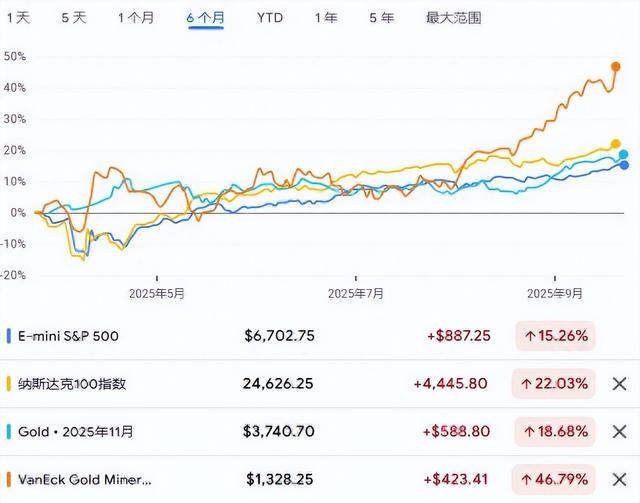
Core Viewpoint - The article discusses the current bullish market conditions driven by the Federal Reserve's interest rate cuts, significant investments in AI, and rising asset prices, particularly in gold, indicating a potential for further market growth despite concerns about bubbles and risks [2][3][6][8]. Group 1: Market Conditions - The S&P 500 index has reached a new high for the 28th time this year, while COMEX gold prices closed at $3,775.10, marking the 36th record high of the year, with a year-to-date increase of approximately 43% [3]. - Risk assets and safe-haven assets are both at historical highs, raising questions about whether the market has fully priced in all positive factors and if future growth is sustainable [6][9]. - Analysts believe the market is not yet in a "perfect pricing" state, suggesting that there is still room for further increases despite existing concerns about risks [9][11]. Group 2: Economic and Policy Factors - U.S. Bank strategist Michael Hartnett highlights that tax cuts, tariff reductions, and interest rate cuts create a "run-it-hot" policy environment, providing implicit guarantees for the economy and stock market [8]. - Deutsche Bank's report indicates that the market is filled with concerns about future risks, which could actually provide space for potential market growth [9][10]. Group 3: Investment Strategies - Hartnett proposes a five-point trading strategy to navigate the current market, including investing directly in bubble assets, creating a "barbell" portfolio with both bubble and undervalued stocks, shorting corporate bonds of bubble companies, shorting U.S. bonds, and trading volatility in bonds and stocks [18][19][20]. - Historical data shows that past market bubbles have had significant average increases, suggesting that the current market may still have upward potential [15][17]. Group 4: Gold Market Analysis - The article describes the current gold market as being driven by geopolitical uncertainty, inflation concerns, and expectations of interest rate cuts, creating a "perfect storm" for gold prices [23]. - Despite rising gold prices, analysts argue that the market has not yet entered a bubble phase, as key indicators do not show irrational exuberance [25][26]. - There are some signs that could indicate a potential bubble in gold, such as increased media presence and activity in gold ETFs, but overall, the market is viewed as being in a strong bull phase rather than a bubble [28].