政策利率

Search documents
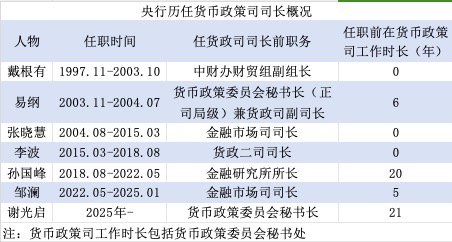
金融人·事|21年央行“老兵”谢光启的新使命
Xin Lang Cai Jing· 2026-01-07 09:49
Core Insights - The People's Bank of China (PBOC) has outlined seven key priorities for the year, with a focus on effective monetary policy implementation amid a constrained policy space due to low interest rates [1][3][19] Leadership Transition - Xie Guangqi has been appointed as the Director of the Monetary Policy Department, marking a significant leadership change within the PBOC [1] - Xie has extensive experience in the Monetary Policy Department, having worked there for 21 years and participated in key policy transformations [15] Monetary Policy Challenges - Current policy interest rates are only 140 basis points above the theoretical zero lower bound, indicating limited room for further rate cuts [3][17] - The PBOC faces the challenge of maintaining economic stability and addressing low inflation, as the Consumer Price Index (CPI) has shown prolonged low growth [19] Historical Context and Research Contributions - Xie has a strong academic background, having published significant research on the relationship between executive compensation and company performance, which has influenced monetary policy discussions [4][5][6] - His involvement in various research projects has contributed to the development of structural monetary policy tools in China [11] Structural Monetary Policy Tools - The PBOC has increasingly relied on structural monetary policy tools to support specific sectors, such as small and micro enterprises, amid a changing economic landscape [11][12] - As of early 2025, structural monetary policy tools accounted for 13% of the PBOC's balance sheet, a significant increase from previous years [11] Economic Indicators and Future Directions - The PBOC aims to align social financing and money supply growth with economic growth and price stability targets, reflecting a shift in focus for monetary policy [13] - The central bank is expected to continue implementing moderately loose monetary policies to stimulate economic growth and stabilize prices in the coming year [19]

现代中央银行系列(一):政策利率演变与货币政策工具盘点
Changjiang Securities· 2026-01-06 06:18
1. Report Industry Investment Rating No information provided in the content. 2. Core Viewpoints of the Report - The construction of the "modern central bank" system depends on the improvement of the "dual - pillar" of monetary policy and macro - prudential management policy. This report focuses on the formation and evolution of China's policy interest rate system and systematically reviews the development and application of various monetary policy tools, aiming to establish a theoretical and practical framework for subsequent analysis of the interest rate transmission mechanism [2][7][21]. - The current policy interest rate of the central bank has shifted to the short - end, with the 7 - day reverse repurchase rate becoming the main policy interest rate, and the Medium - term Lending Facility (MLF) rate fading out of the policy interest rate sequence [8][24][28]. - The central bank's monetary policy toolbox is diverse, and the innovation of monetary policy has obvious stage divisions. Since 2024, there have been changes in the central bank's thinking on quantity - price operations and expected management of monetary policy [9]. - Since the end of 2024, the monetary policy has changed from "prudent" to "moderately loose", and in 2026, it continues to be set as such, with more emphasis on "flexibility and efficiency" [10][135]. 3. Summary According to Relevant Catalogs Introduction - "Building a modern central bank system" is an important part of "establishing a modern fiscal and financial system". Since its proposal, the central bank has carried out reforms in multiple directions, including the short - end concentration of policy interest rates, the introduction of new open - market operation tools, and the launch of targeted structural monetary policy tools. The regulatory authorities have also given clear expectations for future reform directions [17][19]. - The report series is launched to comprehensively sort out and interpret policy reforms, and the first report focuses on the review and direction deduction of monetary policy tools and policy interest rates [19][21]. Interest Rate System Framework: Starting from Policy Interest Rates Policy Interest Rate Latest Changes: Focusing on the Short - End - China's current interest rate system is divided into three levels: the central bank's policy interest rate (currently the 7 - day reverse repurchase rate), market benchmark interest rates (including the deposit - type financial institution pledged repurchase rate, treasury bond yield, and loan prime rate), and diverse market interest rates in the money, bond, and deposit - loan markets [8][24]. - In 2024, during the process of deepening interest rate marketization reform, the central bank clearly defined the 7 - day reverse repurchase rate as the main policy interest rate. The MLF rate has faded out of the policy interest rate sequence, with adjustments in its operation time and bidding method [28][29]. Policy Interest Rate Review: Retrospect of the Development of 7 - Day Reverse Repurchase and MLF - Policy interest rates have evolved from multiple co - existing rates to the 7 - day reverse repurchase rate. Before 2015, there were many types of policy interest rates. Around 2020, the central bank established a framework with the open - market operation rate as the short - term policy interest rate and the MLF rate as the medium - term policy interest rate. From 2024 - 2025, the 7 - day reverse repurchase rate became the only policy interest rate [37][39][40]. - The 7 - day reverse repurchase has evolved from sporadic use to the most core policy interest rate. It originated in 1998, with low - frequency use from 1999 - 2007 and a suspension from 2008 - 2011. Since 2016, it has become a regular operation, and since 2020, the 7 - day term has been the main one, with its policy attribute continuously enhanced [42][46][47]. - The MLF was created in September 2014 to hedge the decline in foreign exchange reserves. Its term has been unified to 1 - year, and its scale has increased significantly. Around 2020, its operation rate independently assumed the function of the medium - term policy interest rate. Currently, it has withdrawn from the policy interest rate position and returned to its function of liquidity injection [59][63][68]. Monetary Policy Toolbox Inventory Deposit Reserves: A Long - Term Liquidity Adjustment Tool for the Banking System - The system framework of deposit reserves has been continuously improved, with the scope of the reserve base expanding and the deposit reserve ratio system undergoing multiple reforms, including the implementation of a differential deposit reserve ratio system, targeted reserve requirement cuts, and the establishment of a "three - tier and two - preference" framework, which is now simplified to a "three - tier" framework [79][80][85]. - The central bank has adjusted the deposit reserve ratio in multiple stages according to the macro - economic situation, and the reserve assessment method has changed from the point - in - time method to the average method. The central bank has also adjusted the reserve interest rate multiple times [90][94][95]. Buy - out Reverse Repurchase: Created in October 2024 to Provide Medium - and Short - Term Liquidity - The buy - out reverse repurchase is different from the traditional pledged reverse repurchase in terms of bond ownership and bidding method. Its operation has become more transparent, with a monthly rhythm of providing different - term liquidity support at different times. It has become an important channel for the central bank to inject liquidity [98][100][101]. Treasury Bond Trading: Launched in 2024 to Release Medium - and Long - Term Liquidity - Treasury bond trading was launched in August 2024, suspended in January 2025, and restarted in October 2025. It can supplement the medium - and long - term liquidity of the banking system, and the central bank's trading of treasury bonds has an impact on its balance sheet [107][110]. Other Monetary Policy Tools Overview - The central bank's monetary policy toolbox is rich, including open - market operation tools (such as central bank bills, central bank bill swaps, etc.), central bank lending tools (such as rediscount and re - loans), and innovative tools (such as standing lending facilities, pledged supplementary loans, etc.). Some tools have faded out after fulfilling their historical missions [115][117]. Current Monetary Policy Orientation: "Moderately Loose" and "Flexible and Efficient" - Since the end of 2024, the monetary policy has changed from "prudent" to "moderately loose", and in 2026, it continues to emphasize "flexibility and efficiency". The "moderately loose" policy is necessary for economic recovery and coordination with fiscal policy [10][135]. - "Flexible and efficient" implies precise implementation of policies, especially considering the limited space for reserve requirement cuts and interest rate cuts. The Federal Reserve's three interest rate cuts in 2025 have opened up policy space for domestic interest rate cuts. Although the domestic deposit reserve ratio has limited downward space, there is still room for reform, and the use of diversified liquidity injection tools can replace reserve requirement cuts to some extent [137][139][141].
2026年货币政策延续“适度宽松”:短中长期多层次流动性调节更趋精准 政策利率或有1-2次降息空间
Xin Hua Cai Jing· 2026-01-04 07:14
Core Viewpoint - In 2025, China's monetary policy returned to a stance of "moderate easing," focusing on guiding expectations and improving transmission channels, with a more precise and prudent approach to operations [1][6]. Group 1: Monetary Policy Overview - The liquidity management system in 2025 was characterized by a multi-layered approach, utilizing tools such as reverse repos, medium-term lending facilities (MLF), and government bond transactions [2]. - The People's Bank of China (PBOC) adjusted the MLF bidding model to a "fixed quantity, interest rate bidding, multiple price bidding" format, which further diminished the policy interest rate's anchoring role [2]. - The net MLF issuance in 2025 reached 1.161 trillion yuan, with a total net liquidity injection of 4.961 trillion yuan [2]. Group 2: Interest Rate Adjustments - The PBOC implemented a downward adjustment of 0.25 percentage points on structural monetary policy tool rates and a comprehensive reserve requirement ratio cut of 0.5 percentage points, effectively reducing the overall financing costs [3]. - The average interest rate for newly issued corporate loans was approximately 3.1% in November, down about 30 basis points year-on-year, while the rate for personal housing loans was also around 3.1%, down 3 basis points year-on-year [3]. - The frequency and magnitude of interest rate cuts in 2025 were lower than in 2024, with only one reduction of 10 basis points for the 7-day reverse repo rate [3]. Group 3: Structural Support and Focus Areas - The monetary policy continued to emphasize support for key sectors, including technology innovation and small enterprises, with increased quotas for re-lending aimed at these areas [3][8]. - The third quarter report indicated that loans for technology, green projects, and inclusive finance grew faster than the overall loan growth rate [3]. - The focus on structural monetary policy tools is expected to persist, with significant investments anticipated in technology and consumer sectors [8]. Group 4: Future Outlook for 2026 - The monetary policy for 2026 is expected to maintain a "moderate easing" stance, with an emphasis on precise support and collaboration with fiscal policies [5][6]. - Analysts predict that the social financing scale in 2026 may exceed that of 2025, driven by increased government debt financing [7]. - There is potential for 1-2 rate cuts in 2026, with a possible reduction of 10-20 basis points, while the focus will remain on maintaining a reasonable interest rate relationship [7][8].
美联储会议纪要:政策制定者在通胀和失业哪个构成更大风险问题上分歧显著
Sou Hu Cai Jing· 2025-12-30 23:44
与此同时,纪要称,"一些与会者指出,通胀上升有可能变得根深蒂固,在通胀读数仍然偏高的背景下 进一步下调政策利率可能被误解为政策制定者对2%通胀目标的承诺有所减弱。" 美联储主席鲍威尔在12月会议后对记者表示,美联储已经将利率下调到足以防范劳动力市场出现更严重 恶化的水平,但又能够继续对通胀形成压制。 美联储12月会议纪要显示,政策制定者在通胀和失业哪一个对美国经济构成更大风险的问题上,存在显 著分歧。 纪要指出:"多数与会者认为,朝着更为中性的政策立场迈进将有助于防止劳动力市场状况出现严重恶 化的可能性。" 会议纪要称:"一些支持或本可以支持将目标区间维持不变的与会者表示,接下来两次会议之间将公布 大量有关劳动力市场和通胀的数据,有助于他们判断是否有必要降息。" 由于政府停摆持续整个10月并延续至11月近一半时间,官员们在会议时缺乏通常可用的经济数据。但决 策者称,未来几周的新数据或可为他们提供指引。 ...
芝加哥联储预计美国12月失业率将保持在4.6%不变
Xin Lang Cai Jing· 2025-12-30 14:29
芝加哥联储周二估计,美国12月失业率料为4.6%,与11月官方公布的失业率持平,经济学家称11月官 方数据很可能因政府停摆造成的相关技术问题而被扭曲。 责任编辑:李桐 责任编辑:李桐 芝加哥联储周二估计,美国12月失业率料为4.6%,与11月官方公布的失业率持平,经济学家称11月官 方数据很可能因政府停摆造成的相关技术问题而被扭曲。 美国劳工统计局将于1月9日公布12月官方失业率。经济学家预计失业率将小幅回落至 4.5%。 美联储本月早些时候下调了政策利率,以应对大多数决策者认为的劳动力市场趋弱的情况,联储还暗示 在新的一年里可能会暂停进一步降息,同时等待更多的经济数据。这是一个有争议的决定,三位决策者 投了反对票。这次会议的记录将于周二晚些时候公布。 芝加哥联储从公共和 民间数据中估算失业率,每月发布两次,以便让决策者更及时地了解这一关键经 济指标。最新数据反映出招聘或解雇工人的速度变化不大,因此估算出的12月失业率与劳工部公布的11 月读数完全一致。 美国劳工统计局将于1月9日公布12月官方失业率。经济学家预计失业率将小幅回落至 4.5%。 美联储本月早些时候下调了政策利率,以应对大多数决策者认为的劳动力 ...
芝加哥联邦储备银行预计美国12月失业率将达4.6%
Xin Lang Cai Jing· 2025-12-30 14:15
芝加哥联邦储备银行于周二发布预估数据称,美国12月失业率为4.6%,与11月官方公布的失业率持 平。 经济学家表示,11月的官方失业率或因政府停摆相关技术性因素出现偏差。 美国劳工统计局将于1月9日发布12月官方失业率数据。 经济学家预计,该数值将小幅回落至4.5%。本月早些时候,美联储鉴于多数官员认为劳动力市场正走 弱,决定下调政策利率,同时释放信号称,明年或将暂停进一步降息,以等待更多经济数据出炉。 这一决策颇具争议,引发了三名官员的反对。本次议息会议的纪要将于周二晚些时候公布。 美国劳工统计局将于1月9日发布12月官方失业率数据。 经济学家预计,该数值将小幅回落至4.5%。本月早些时候,美联储鉴于多数官员认为劳动力市场正走 弱,决定下调政策利率,同时释放信号称,明年或将暂停进一步降息,以等待更多经济数据出炉。 这一决策颇具争议,引发了三名官员的反对。本次议息会议的纪要将于周二晚些时候公布。 责任编辑:陈钰嘉 责任编辑:陈钰嘉 芝加哥联邦储备银行于周二发布预估数据称,美国12月失业率为4.6%,与11月官方公布的失业率持 平。 经济学家表示,11月的官方失业率或因政府停摆相关技术性因素出现偏差。 ...
12月LPR报价继续“按兵不动”
Zhong Guo Jing Ying Bao· 2025-12-22 11:41
(编辑:郝成 审核:朱紫云 校对:颜京宁) 中经记者 谭志娟 北京报道 展望未来,业界专家预计,2026年LPR有望稳中有降。因为2025年12月美联储下调政策利率后,2026年 还将进一步降息,这也会减轻对国内货币政策灵活调整的掣肘。由此预计2026年我国央行有可能实施新 一轮降息降准,这将带动两个期限品种的LPR报价跟进下调,引导企业和居民贷款利率下行,激发内生 性融资需求。 12月22日,中国人民银行授权全国银行间同业拆借中心公布,当日贷款市场报价利率(LPR)为:1年 期LPR为3.0%,5年期以上LPR为3.5%。两个期限LPR均与上月持平,这也是自6月以来LPR报价一直按 兵不动。 业界专家认为,12月两个期限品种的LPR报价保持不变,主要源于近期政策利率(央行7天期逆回购利 率)保持稳定。这意味着12月LPR报价的定价基础没有发生变化,已在很大程度上预示当月LPR报价会 保持不动。同时,12月以来包括1年期银行同业存单到期收益率(AAA级)在内的主要中长端市场利率 稳中有升,商业银行在货币市场的融资成本略有上升,在商业银行净息差处于历史最低点的背景下,当 前报价行也缺乏主动下调LPR报价加点的动 ...

高市早苗内阁支持率维持在75%
日经中文网· 2025-12-22 03:23
Group 1 - The approval rating of Prime Minister Sanna Takashi's cabinet is 75%, remaining stable since November, and has been above 70% for three consecutive months since taking office in October [2] - The Bank of Japan raised the policy interest rate to 0.75%, the highest level in 30 years, with 55% of respondents approving the decision [4] - The highest priority policy issue for respondents is addressing inflation, with 55% indicating this as a concern [4] Group 2 - The support rate for the ruling Liberal Democratic Party (LDP) is 37%, a decrease of 4 percentage points from the last survey [4] - The support rates for opposition parties include 9% for the Democratic Party for the People (up from 6%), 7% for the Constitutional Democratic Party (up from 6%), and 5% for the Shinsei Party (down from 7%) [5] - The survey conducted by Nikkei Research received 916 responses with a response rate of 40.1% [5]

人民币现金收付新规2026年施行,央行明确不得拒收现金
Sou Hu Cai Jing· 2025-12-20 03:17
Group 1 - The Ministry of Commerce announced the continuation of anti-dumping duties on imported ethylene propylene diene monomer rubber from the US, South Korea, and the EU [1] - The People's Bank of China and other departments released new regulations on cash payments, stating that cash cannot be refused except in specific legal circumstances, effective from February 1, 2026 [1] - The National Health Commission announced new food safety standards requiring the labeling of saturated fats and sugars on pre-packaged food, effective from March 16, 2027 [2] Group 2 - The State Administration of Foreign Exchange reported that in November 2025, banks settled 1.484 trillion yuan and sold 1.3732 trillion yuan [2] - The Hainan Free Trade Port achieved significant breakthroughs on its first day of customs closure, with zero-tariff imports valued at 360 million yuan, mainly consisting of crude oil and aircraft materials [2] - The National Medical Insurance Administration is seeking public opinion on four foundational standards for medical imaging cloud services [2]

日本政策利率上调至0.75%,30年来最高
日经中文网· 2025-12-19 03:31
Core Viewpoint - Japan's central bank has decided to raise its policy interest rate to 0.75%, the highest level in 30 years since 1995, marking a significant shift from the long-standing deflationary environment that has plagued the country [2][4]. Group 1 - The Bank of Japan raised the uncollateralized overnight call rate target by 0.25 percentage points [2]. - This increase brings Japan's policy interest rate to its highest level since 1995, a period during which the rate had never exceeded 0.5% [4]. - The central bank plans to maintain a moderate rate hike approach moving forward [2].