
日元汇率

Search documents
美元兑日元短线走低,日本财务大臣称在对日元采取大胆行动方面拥有“自主权”
Hua Er Jie Jian Wen· 2025-12-22 13:16
美元兑日元短线走低约20点,现报157.22,日本财务大臣片山皋月称,在对日元采取大胆行动方面拥 有"自主权" 市场有风险,投资需谨慎。本文不构成个人投资建议,也未考虑到个别用户特殊的投资目标、财务状况或需要。用户应考虑本文中的任何 意见、观点或结论是否符合其特定状况。据此投资,责任自负。 风险提示及免责条款 ...
三井住友警告:若日元进一步走弱 日本加息路径将重陷不确定
Xin Hua Cai Jing· 2025-12-19 05:47
Core Viewpoint - The depreciation of the Japanese yen is primarily driven by market expectations that "real negative interest rates will temporarily persist," which supports the profitability outlook for export-oriented companies and continues to boost the Japanese stock market [1][2] Group 1: Currency and Monetary Policy - The Bank of Japan's Governor, Kazuo Ueda, may need to adopt a "rather tough tone" in an upcoming press conference to curb further yen depreciation [1] - If the yen continues to weaken, the pace of interest rate hikes may become uncertain again, highlighting the complex situation facing Japan's monetary policy [1] - The current inflation pressures and fiscal sustainability require the central bank to consider raising interest rates, while an excessively strong yen could harm the export-driven economy, and an excessively weak yen could exacerbate imported inflation and undermine foreign investor confidence in Japanese government bonds [1] Group 2: Exchange Rate Trends - As of December 19, 2025, the USD/JPY exchange rate is approaching a historical low of 157:1 [1] - The Bank of Japan signaled a hawkish stance on December 1, indicating it would "consider the pros and cons of raising policy rates" during monetary policy meetings, leading to widespread expectations of an end to the three-decade era of ultra-low interest rates in Japan [1]

日本央行要动手了?加息信号背后的通胀、日元与国运博弈
Sou Hu Cai Jing· 2025-12-13 12:18
Group 1 - The Bank of Japan is expected to raise interest rates for the first time since 1995, with a market betting on a 25 basis point increase at the upcoming policy meeting on December 19 [1][11] - Japan's core CPI reached 2.5%, aligning with the central bank's inflation target, providing a rationale for potential rate hikes [3][17] - The depreciation of the yen has led to increased import costs, contributing to domestic inflation and public dissatisfaction [5][16] Group 2 - The Bank of Japan's monetary policy has been characterized by a gradual approach, contrasting with the aggressive rate hikes seen in the U.S. Federal Reserve [8][10] - Market expectations for a rate hike have surged to 88%, the highest since 1995, but even with a potential increase, Japan's rates would remain the lowest among developed countries [11][13] - The current inflation is largely driven by rising energy and raw material prices, with concerns that a sustainable wage-price spiral has not yet formed [17][19] Group 3 - Japan's government debt exceeds 260% of GDP, the highest among developed nations, complicating the fiscal landscape for potential rate hikes [20] - The Bank of Japan holds over 50% of government bonds, and any significant rise in long-term yields could adversely affect its balance sheet and the financial market [22] - Global economic conditions, including potential interest rate cuts by the U.S. Federal Reserve, could impact Japan's monetary policy decisions and the yen's value [25][27] Group 4 - The Bank of Japan is likely to enter a prolonged period of low interest rates and gradual rate increases, as the legacy of three decades of monetary easing presents significant challenges [29]


日本政府提交补充预算草案 日债延续上周抛售态势
Xin Hua Cai Jing· 2025-12-08 13:12

新华财经北京12月8日电 市场对日本央行下周加息的预期似乎更加不安,日债市场整体承压,10年期日债收益率周一(8日)盘中交易中 升至1.965%,达到2007年6月以来的最高水平。 周一亚市交易时段,30年期超长日债收益率涨3.9BPs,站上3.4%整数关口,再次刷新上周创下的纪录。盘后,日债继续下跌,2年期日 债收益率涨1.8BP至1.068%,10年期日债收益率涨2.6BPs至1.975%,再次刷新纪录;20年期日债收益率涨4.4BPs至2.964%。 | 投资者继续抛售日债整体承压 | | 12月8日 | | --- | --- | --- | | SYMBOL # | YIELD + | CHANGE # | | JPN 3-MO | 0.63 | -0.022 V | | JPN 2-YR | 1.068 | +0.018 A | | JPN 3-YR | 1.192 | +0.016 A | | JPN 5-YR | 1.456 | +0.019 A | | JPN 10-YR | 1.975 | +0.026 | | JPN 15-YR | 2.931 | +0.021 A | | JPN 20 ...
日本政府追加预算规模料达1120亿美元!财政担忧加剧致债汇齐跌
智通财经网· 2025-11-20 08:24
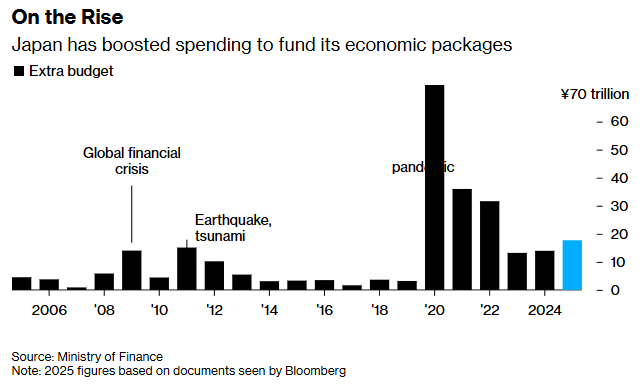
Core Viewpoint - Japan's Prime Minister, Sanae Takaichi, is set to introduce an economic stimulus plan funded by an additional budget, which is approximately 27% larger than the spending plan announced by former Prime Minister Shigeru Ishiba a year ago, highlighting her commitment to expansionary fiscal policy [1] Group 1: Economic Stimulus Plan - The proposed stimulus plan is expected to combine tax cuts and special account expenditures, resulting in general account expenditures reaching 17.7 trillion yen (approximately 112 billion USD) [1] - The additional budget size exceeds the 13.9 trillion yen proposed by Ishiba last year, indicating a significant increase in government spending [1] - The total value of the stimulus plan, including some already budgeted projects, is projected to reach 21.3 trillion yen [1] Group 2: Debt and Interest Rates - The increase in general account spending will necessitate a larger additional budget, which will involve more government bond issuance, further exacerbating Japan's already high debt burden [4] - Japan's total government debt is expected to reach 230% of its economic size this year, according to the International Monetary Fund [4] - As concerns over rising debt levels grow, Japanese government bond yields have increased, with the 20-year bond yield rising nearly 5 basis points to 2.856% [4] Group 3: Economic Context - The overall impact of the stimulus plan, including private sector spending, is expected to swell to approximately 42.8 trillion yen as Japan seeks to address multiple challenges, including persistent inflation [5] - Recent GDP data showed a 1.8% annualized decline in Japan's real GDP for the third quarter, marking the first negative growth in six quarters, which supports Takaichi's push for a large-scale stimulus plan [5]
日本七大车企受关税冲击集体利润下滑
日经中文网· 2025-11-15 00:33
Core Viewpoint - The impact of U.S. tariffs on Japanese automakers has significantly affected their financial performance, with a total estimated loss of approximately 1.5 trillion yen due to tariffs and a further 700 billion yen from currency exchange rates, leading to a net profit decline of about 30% year-on-year for the period from April to September [2][4]. Group 1: Financial Impact - The combined net profit of seven major Japanese automakers for the April to September period was close to 2.1 trillion yen, marking a year-on-year decrease of approximately 30%, continuing a trend of decline for two consecutive years [2][4]. - The estimated impact of tariffs on operating profit for the seven automakers is around 1.5 trillion yen, with projections indicating that the tariff impact could reach approximately 2.5 trillion yen by the fiscal year ending March 2026 [4]. - Mazda's sales in the U.S. account for about 30% of its global sales, and the tariffs resulted in a profit decline of 97.1 billion yen during the April to September period, leading to a return to net losses for the first time in four years [5]. Group 2: Company-Specific Performance - Subaru, which derives 80% of its sales from the U.S., faced significant challenges, with 154.4 billion yen in tariff impacts offsetting profits despite increased sales from new model launches [7]. - Toyota stands out among the seven automakers, experiencing a 5% year-on-year increase in global sales, achieving a record high, despite a tariff impact of 900 billion yen. Its final profit decline was limited to 7%, the least affected among the group [7]. - Honda has adjusted its annual net profit forecast downward due to semiconductor shortages, estimating a 150 billion yen impact on operating profit from the supply chain disruptions [8]. Group 3: Market Outlook - The expected exchange rate for the year is projected to be between 140 to 147 yen per U.S. dollar, while the current rate is around 154 yen, indicating a depreciation of the yen, which could benefit Japanese automakers [8]. - Analysts express uncertainty regarding the ongoing impact of tariffs, noting that companies differ in how they account for supplier tariff burdens, leading to unpredictable performance outcomes [8].

贝森特“指导”日本政府“少干预”,日本央行加息在望?
Hua Er Jie Jian Wen· 2025-10-29 01:04
Core Viewpoint - The recent statements by U.S. Treasury Secretary Bessent have stirred market expectations regarding Japan's monetary policy, emphasizing the need for the Japanese government to provide the Bank of Japan (BOJ) with sufficient policy space to stabilize inflation expectations and exchange rates [1][3][6]. Group 1: Market Reactions - Bessent's comments have been interpreted as external support for the BOJ to tighten monetary policy, increasing expectations for an interest rate hike [3][6]. - Following Bessent's post, the yen strengthened against the dollar, moving from 152.12 to approximately 151.54 [3]. - Despite expectations that the BOJ would maintain interest rates at the upcoming meeting, Bessent's remarks have added weight to the view that a rate hike may be imminent [6][9]. Group 2: Government and Central Bank Dynamics - Bessent's statements directly challenge the monetary policy stance of Japan's new Prime Minister, who advocates for low interest rates and has previously urged the BOJ to collaborate with the government to boost demand [7]. - The Japanese government is attempting to downplay the impact of Bessent's comments, with Finance Minister Katayama asserting that the meeting did not directly address BOJ's monetary policy [8]. - There appears to be a divergence within the Japanese government regarding the implications of a weak yen, with some officials viewing it as beneficial for the economy [8]. Group 3: Economic Indicators and Predictions - Japan's core inflation rate has remained above the BOJ's 2% target for over three years, raising concerns among policymakers about potential second-round price effects [9]. - Most economists predict that the BOJ will raise interest rates again in December or January [9][10]. - Analysts suggest that if Japan aims to correct the yen's weakness, it must consider monetary intervention or policy adjustments [10].

美国CPI点评(25.9)暨宏观周报(第25期):美国核心通胀回落,未来将走向何方?-20251025
Huafu Securities· 2025-10-25 09:46
Inflation Data - In September, the US CPI rose by 0.1 percentage points to 3.0%, marking the highest level since the beginning of the year[2] - Core CPI fell slightly by 0.1 percentage points to 3.0%, which was below market expectations[2][3] - The month-on-month increase in core CPI was 0.23%, a decrease of 0.12 percentage points from August[3] Economic Factors - The increase in durable goods prices was 0.32% month-on-month, indicating ongoing effects from tariffs imposed earlier this year[3] - Labor market cooling and a weak real estate market contributed to the decline in inflation, with core non-durable goods and core services rising by 0.08% and 0.24%, respectively[3][4] - Despite a 25 basis point rate cut by the Federal Reserve in September, long-term interest rates remained high, limiting the rebound in core CPI[3][4] Future Outlook - The potential for a rebound in core CPI exists in the first half of next year due to the recovery of key factors and base effects[4][16] - The upcoming fiscal expansion may boost manufacturing investment and create jobs, impacting inflation dynamics positively[4][16] - The US dollar index may gain momentum from economic cycles and monetary easing in developed economies[4][16]
美财长:日本央行若继续实施正确政策 日元汇率将企稳
智通财经网· 2025-10-16 04:12
Group 1 - The core viewpoint is that U.S. Treasury Secretary Yellen stated that if the Bank of Japan continues to implement appropriate monetary policies, the yen exchange rate will stabilize at a reasonable level [1] - The yen has depreciated significantly against the dollar, with a drop of more than twice that of other major currencies this month, reaching a low of 153.27 yen per dollar on October 10 [1] - Speculation about the Bank of Japan's interest rate hike has weakened, which is a key factor in the recent exchange rate fluctuations [1] Group 2 - The unexpected victory of Sanae Takaichi in the ruling Liberal Democratic Party leadership election may lead to her becoming the next Prime Minister, as she seeks support from opposition parties [2] - If the yen falls below 155 against the dollar, there is a high likelihood of an interest rate hike within two weeks, which the new government may accept to mitigate inflationary pressures from rising living costs [2] - Japan's consumer price index has remained above 2% for over three years, while real wages have continued to decline [2]
贵金属日报-20251010
Guo Tou Qi Huo· 2025-10-10 11:24
Investment Ratings - Gold: ★☆☆, indicating a bullish bias but limited operability in the market [1] - Silver: ★☆★, with a somewhat more complex rating, perhaps suggesting a mix of short - term and long - term considerations [1] Core Views - The medium - to long - term upward logic of precious metals remains unchanged. However, with the entry into force of the first - phase Gaza cease - fire agreement and gold and silver reaching their integer - level target prices, the short - term upward momentum of gold has slowed, and silver's volatility has increased. There is a need to be wary of adjustments due to profit - taking by funds, and caution should be exercised at historical highs [1] Other Summaries Central Bank and Policy - Related - Fed officials have different views on interest rate cuts. Williams supports further cuts, believing the labor market may slow further; Barr advocates caution in cutting rates; Kashkari generally agrees with Barr; Daly thinks policy remains moderately tight after the September cut, and the Fed is expected to implement more cuts as part of risk management [2] - High - ranking Japanese official Takaichi Sanae has no intention of causing excessive yen depreciation, and it's unclear when the next interest rate hike will occur, but she is likely to be cautious. Yen weakness has both positive and negative impacts on the economy [2] - The central bank of the Democratic Republic of the Congo plans to build up its gold reserves during the gold price surge to stabilize the national currency [2]