消费投资

Search documents
汪涵问我职业生涯最大的失败,原来竟然是……
Hu Xiu· 2025-08-21 11:04
Core Insights - The investment experience in the consumer industry is highlighted through brands like Three Dots Half Coffee and Dongmao Street Tea House [1] - A significant missed opportunity in the career is identified as not investing in Pop Mart [1] Company Insights - Three Dots Half Coffee and Dongmao Street Tea House are mentioned as notable brands in the investment portfolio [1] - Pop Mart is recognized as a brand that could have been a successful investment, indicating its strong market presence and potential [1] Industry Insights - The consumer industry is characterized by dynamic brands that can offer substantial investment opportunities [1] - The mention of specific brands reflects the competitive landscape and the importance of timely investment decisions in the consumer sector [1]

0融资的网红冰淇淋要IPO了?
36氪· 2025-08-11 09:48
Core Viewpoint - The article discusses the contrasting fortunes of the ice cream market in China, highlighting the rapid growth of the brand "野人先生" (Mr. Wildman) amidst a general decline in high-end ice cream investments and sales, exemplified by the struggles of established brands like Häagen-Dazs and the bankruptcy of钟薛高 (Chongxuegao) [3][15][19]. Market Trends - The consumer investment landscape has been sluggish for several years, with a significant drop in the number and amount of investments in the consumer sector, particularly in ice cream [4][16]. - Data from CVSource indicates that investment activity in the consumer sector has decreased, with many investment firms in East China, South China, and Northern regions reporting only single-digit project launches in 2025 [4]. Company Performance - "野人先生" has opened 500 new stores in just five months, surpassing Häagen-Dazs' 247 stores in China, and is in the process of initiating an IPO [7][19]. - The brand's pricing strategy positions its ice cream at around 28-38 yuan, which is considered high-end, yet it has managed to maintain a gross margin exceeding 60% and a payback period of 12 months for franchise stores [12][13]. Founder Background - The founder, 崔渐为 (Cui Jianwei), has a background in finance and a personal story of transitioning from a high-paying job to entrepreneurship, driven by insights gained from his experience in the Italian ice cream market [9][10]. Market Dynamics - The overall ice cream market in China is projected to grow from 180 billion yuan in 2024 to 220 billion yuan by 2025, indicating a robust demand despite the challenges faced by premium brands [19]. - The article notes that consumer preferences are shifting towards value-for-money products, which may explain the struggles of high-end brands and the success of "野人先生" [16]. Competitive Landscape - The article contrasts "野人先生" with other high-end brands that have faced difficulties, such as the decline of茅台冰淇淋 (Moutai Ice Cream) and the bankruptcy of钟薛高, suggesting a potential shift in consumer behavior towards more affordable options [15][18]. - The success of "野人先生" is attributed to its focus on fresh ingredients and strategic store locations, primarily in indoor shopping centers, which allows for year-round sales [20].

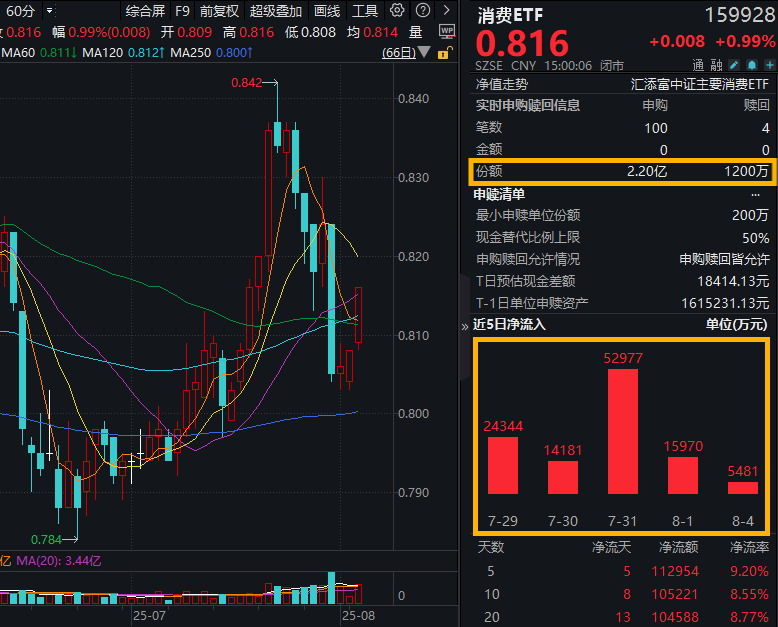
大盘再创年内收盘新高,消费持续补涨!规模领先的消费ETF(159928)收涨近1%,全天获大举净申购超2亿份!
Sou Hu Cai Jing· 2025-08-05 08:03
Market Overview - The A-share market closed positively on August 5, with a total trading volume exceeding 1.6 trillion yuan, and the Shanghai Composite Index rising nearly 1%, reaching a new closing high for the year [1] - The leading consumption ETF (159928) saw a nearly 1% increase, with a trading volume of 470 million yuan and a net subscription of 208 million units, marking the ninth consecutive day of capital inflow, totaling over 1.4 billion yuan [1] ETF Performance - The consumption ETF (159928) has a current scale exceeding 13.1 billion yuan, significantly leading its peers [1] - Key constituent stocks of the consumption ETF performed well, with Dongpeng Beverage rising over 3%, Luzhou Laojiao up over 2%, and Shanxi Fenjiu increasing over 1% [3] Policy and Economic Insights - Haitong International noted that six out of eight essential consumption sectors tracked in July maintained positive growth, while two sectors, including high-end and mid-range liquor, experienced negative growth due to new alcohol bans and adverse weather conditions [5] - The report highlighted that most liquor prices stabilized in July, with slight adjustments observed in various products [5] - The introduction of favorable policies, such as the implementation of a childcare subsidy system estimated at 100 billion yuan annually, is expected to stimulate essential consumption sectors [6] Industry Analysis - CITIC Securities indicated that the liquor industry has been under pressure this year, but signs of stabilization are emerging, with expectations of a gradual recovery in demand and performance in the third quarter [7] - The report emphasized that leading liquor companies are enhancing shareholder returns through increased dividends and buybacks, which may provide a safety margin for investments [7] - The analysis of Moutai's business model suggests a proactive approach to exploring new demand and adjusting its distribution network during the industry's cyclical downturn [8] Investment Strategy - The consumption ETF (159928) is characterized by its resilience across economic cycles, with over 68% of its top ten constituent stocks being essential consumer goods [8] - The report recommends focusing on sectors benefiting from policy support, particularly dairy products and liquor, while remaining cautious about the potential decline in soft drink margins [6]






全球私募股权巨头频出手 资本竞逐中国消费市场
Zhong Guo Zheng Quan Bao· 2025-07-20 20:17
Group 1 - The consumption investment sector is regaining attention, with significant interest from international giants in China's beverage market, including acquisitions in soda, coffee, and ice cream segments [1][2] - KKR has received approval to acquire 85% of Yuanjing International, which is linked to the beverage brand Dayao, indicating a strategic move into the Chinese beverage market [2][3] - The competitive landscape in the Chinese food and beverage sector is shifting, with local brands like Luckin Coffee and Mixue Ice Cream rapidly expanding, while foreign brands are experiencing declining sales and seeking to optimize or exit their operations [3][4] Group 2 - Starbucks China is currently in a bidding process for potential equity sales, attracting interest from several prominent private equity firms and large domestic companies, which could lead to one of the largest mergers in the Chinese consumption sector [3][4] - General Mills is reportedly seeking to sell its Haagen-Dazs stores in China, with multiple well-known institutions showing interest, although the negotiations are still in early stages [3][4] - Haagen-Dazs has faced challenges in the Chinese market, with a decline in store traffic and a reduction in the number of operational stores from over 400 to 370, highlighting the competitive pressures from local brands [4][5] Group 3 - Private equity firms like Primavera Capital and Carlyle Group have experience in the consumer retail sector, which positions them well to enhance operational efficiency and market penetration for the brands they acquire [5] - KKR's acquisition of Dayao and the interest in Starbucks China are seen as significant moves for global institutions looking to establish a foothold in the Chinese consumer market [5]
华映资本管理合伙人王维玮:消费投资“热”了,估值尚未明显变化
Jing Ji Guan Cha Wang· 2025-06-29 08:11
Core Insights - The article discusses the evolution of Pop Mart's business model and the broader changes in consumer investment trends, emphasizing the importance of long-term perspectives in investment decisions [2] Group 1: Business Model Evolution - Pop Mart's initial business model was a "store within a store" concept focused on creative products, which has evolved through multiple iterations to its current form [2] - The management partner of Huaying Capital, Wang Weiwei, highlights that investment should not only focus on the present but also consider long-term cycles [2] Group 2: Consumer Investment Trends - After a surge in consumer investment from 2021 to 2022, the sector is expected to face a downturn in 2024, with a potential recovery in 2025 as leading Hong Kong consumer stocks see significant valuation increases [2] - Huaying Capital has accelerated its investment pace this year, with total investments reaching three times that of the previous year, focusing on efficiency-driven companies and emotional consumption sectors [2] Group 3: Market Dynamics - The consumer industry faces inherent efficiency bottlenecks, with offline consumption limited by geographical constraints, creating opportunities for small and medium enterprises [3] - Wang Weiwei notes that the competitive landscape in the consumer sector is intense, requiring companies to excel in product, brand, channel, and capital operations [3] Group 4: Investment Strategy and Valuation - The valuation logic in consumer investment has shifted from price-to-sales (PS) to price-to-earnings (PE) methods, with a general cap of 10 times PE expected in 2024 [4] - Despite the changing landscape, the overall valuations of consumer projects have not shown significant changes this year [4] Group 5: Exit Strategies and M&A Opportunities - Huaying Capital is increasingly favoring Hong Kong listings for exits, as the market offers high certainty and low opportunity costs, especially with the recovery of consumer sector valuations [4] - The next five years are anticipated to witness a wave of industry consolidation, with five key M&A opportunities identified, including the scaling of small enterprises and the modernization of family business governance [5]

一双丑鞋,套现67亿
36氪· 2025-06-24 13:35
Core Viewpoint - The article discusses the recent sale of shares by L Catterton in the German sandal brand Birkenstock, highlighting the brand's growth, financial performance, and strategic moves in the consumer market [4][5][16]. Group 1: Financial Performance and Share Sale - L Catterton is selling approximately 18 million shares of Birkenstock at a price of $52.5 per share, raising about $940 million (approximately 6.7 billion RMB) [4]. - Following this sale, L Catterton's ownership in Birkenstock will decrease from 71.9% to about 62% [5]. - Birkenstock's valuation has exceeded $10 billion as of May this year, with a revenue growth of 19% and a net profit increase of 47% reported for the second quarter of the 2025 fiscal year [5][15]. Group 2: Brand History and Development - Birkenstock was founded in 1774 by Johann Adam Birkenstock and has evolved from a small workshop to an international brand known for its comfort and quality [8][10]. - The brand has expanded its product line beyond shoes to include socks, bags, belts, and even natural skincare products [9]. - In 2021, L Catterton acquired nearly 70% of Birkenstock for approximately $4.8 billion, marking a significant investment in the brand [10]. Group 3: Market Expansion and Strategy - Post-acquisition, L Catterton has focused on expanding Birkenstock's presence in markets like China, India, and Southeast Asia, while also enhancing its online business [12][13]. - Birkenstock has collaborated with high-fashion brands like Valentino and Rick Owens, integrating luxury elements into its product offerings [12]. - The brand's products are primarily manufactured in Germany, maintaining a strong emphasis on quality and local production [15]. Group 4: Future Outlook - L Catterton's recent share sale may indicate that Birkenstock's financial performance has met the investment firm's expectations, allowing for further investment opportunities [16]. - Despite the share sale, L Catterton retains about two-thirds of Birkenstock's shares, and the CEO remains optimistic about the company's growth prospects, projecting a revenue increase of 15% to 17% for the 2025 fiscal year [17].

为了“理解消费王岑”,我跟他聊了5个小时
投中网· 2025-06-19 03:34
Core Viewpoint - The article discusses the evolving landscape of consumer investment, highlighting the emergence of new consumer brands and the potential for a resurgence in the consumer sector, particularly in the context of recent market trends and the experiences of investor Wang Cen [2][3]. Group 1: Consumer Market Trends - By 2025, several prominent consumer brands such as 52 TOY, Gu Ming, and Ba Wang Tea Ji are preparing for IPOs, indicating a new wave of entrepreneurial success in the consumer sector [2]. - The Hong Kong stock market has seen a bullish trend driven by consumer stocks like Lao Pu Gold, Pop Mart, and Mixue Ice City, suggesting a renewed investor confidence in consumer brands [2][3]. - The current consumer enthusiasm differs from previous trends, raising questions about the sustainability and characteristics of this new consumer wave [3]. Group 2: Insights from Wang Cen - Wang Cen emphasizes the importance of understanding the "five organs" of a brand: product, channel, traffic, branding/marketing, and capital, which are crucial for successful consumer investment [6][7]. - The evolution of channels from traditional markets to modern e-commerce platforms has drastically changed the landscape, necessitating a deep understanding of online and offline integration [7][10]. - Wang Cen's experience as a content creator has provided him with insights into traffic dynamics, which he believes are essential for successful brand investment [8][10]. Group 3: Investment Strategies - The article introduces the CHEES model, which outlines key factors for evaluating consumer brands: Cheap (affordability), Health (wellness), Emotion (cultural significance), Entertainment (engagement), and Lifestyle (consumer habits) [44][45]. - The model suggests that brands capturing two of these elements are likely to succeed, while those capturing three are positioned for significant growth [44][45]. - Wang Cen notes that the current economic climate favors affordable brands, as seen with Mixue Ice City, which operates on a low-cost model appealing to price-sensitive consumers [33][34]. Group 4: Future Outlook - The article posits that the consumer sector is entering a new golden period, with potential for significant growth in brands that adapt to changing consumer preferences and economic conditions [25][34]. - Wang Cen expresses cautious optimism about the future of consumer investments, emphasizing the need for strategic thinking and understanding market dynamics [25][44]. - The discussion highlights the importance of adapting to macroeconomic trends and consumer behavior shifts, suggesting that successful brands will be those that can navigate these changes effectively [43][44].

一双丑鞋,套现67亿
投中网· 2025-06-17 06:27
Core Viewpoint - The article discusses the significant exit of L Catterton from its investment in Birkenstock, highlighting the brand's growth and market performance, as well as the implications for future investments in the consumer sector [4][5][10]. Group 1: Investment Details - L Catterton is selling approximately 18 million shares of Birkenstock at a price of $52.5 per share, totaling around $9.4 billion (approximately 67 billion RMB) [4]. - Following this sale, L Catterton's ownership in Birkenstock will decrease from 71.9% to about 62% [5]. - The funds raised from this stock sale are intended to prepare for future investment opportunities, as L Catterton recently announced a total capital commitment of approximately $11 billion [5][15]. Group 2: Company Performance - Birkenstock's revenue for the second quarter of the fiscal year ending March 31, 2025, increased by 19% year-over-year, with net profit surging by 47% [7][15]. - The brand's valuation has exceeded $10 billion as of May this year, reflecting strong market performance since its IPO on the New York Stock Exchange in October 2023 [3][14]. - Despite a dip in net profit in the 2023 fiscal year, the company attributes this to strategic measures for expanding production capacity [14][15]. Group 3: Brand History and Expansion - Founded in 1774, Birkenstock has evolved from a small workshop to an international brand, known for its comfort and quality [8][10]. - The brand has expanded its product line beyond shoes to include socks, bags, and skincare products, and has been actively pursuing growth in Asian markets [9][13][14]. - Collaborations with high-fashion brands have positioned Birkenstock as a luxury item, enhancing its market appeal [13]. Group 4: Market Outlook - The CEO of Birkenstock expressed optimism about the company's performance in the 2025 fiscal year, projecting revenue growth of 15% to 17% [16]. - The recent stock sale by L Catterton has caused some fluctuations in Birkenstock's stock price, indicating potential investor concerns [15][16].

一双丑鞋,套现67亿
虎嗅APP· 2025-06-16 13:27
Core Viewpoint - The article discusses the significant stock sale of Birkenstock by L Catterton, highlighting the brand's growth and market performance, as well as the strategic implications of this transaction for future investments [1][2]. Summary by Sections Company Overview - Birkenstock, founded in 1774, has evolved from a small village workshop to a global brand, known for its comfort and quality [6][8]. - The brand's valuation exceeded $10 billion as of May 2023, with a revenue growth of 19% and a net profit increase of 47% reported for the second quarter of the 2025 fiscal year [4][14]. Investment and Ownership Changes - L Catterton acquired a majority stake in Birkenstock for approximately $4.8 billion in 2021 and is now reducing its ownership from 71.9% to about 62% through the sale of 18 million shares at $52.5 each, totaling around $940 million [2][14]. - The recent stock sale is seen as a preparation for L Catterton's future investment strategies, especially after raising $11 billion in capital commitments for new acquisitions [2][14]. Market Expansion and Performance - Post-acquisition, L Catterton has focused on expanding Birkenstock's presence in Asia, particularly in China and Southeast Asia, while enhancing its online sales channels [11][13]. - Birkenstock's products are primarily manufactured in Germany, maintaining a strong brand identity and quality assurance [13]. Financial Performance - The company has shown robust financial performance since its IPO in October 2023, despite some fluctuations in stock price following L Catterton's sale announcement [14][15]. - The CEO remains optimistic about the company's growth trajectory, projecting a revenue increase of 15% to 17% for the 2025 fiscal year [15].

始祖鸟母公司,被资本悄悄抛弃了?
阿尔法工场研究院· 2025-06-03 16:19
Core Viewpoint - FountainVest's decision to sell half of its stake in Amer Sports for approximately $1.3 billion (around 935 million RMB) highlights the lucrative returns from investments in the consumer sector, particularly in high-end sports brands like Arc'teryx and Salomon, which have gained popularity among middle-class consumers [1][3]. Group 1: Investment and Financial Performance - FountainVest acquired a stake in Amer Sports in 2018 for about 77 billion RMB, and the recent sale allows them to recover their investment and achieve significant profits [3][10]. - Amer Sports reported a revenue of $5.183 billion in 2024, with Arc'teryx contributing over $2 billion, marking it as a key asset for the company [7][8]. - The company experienced a compound annual growth rate of 20.4% from 2020 to 2022, indicating strong recovery and growth post-pandemic [8]. Group 2: Company History and Transformation - Amer Sports, originally founded as a tobacco company in 1950, transitioned to the sports goods industry through a series of acquisitions, including brands like Wilson and Atomic [5][6]. - The major turning point for Amer Sports occurred in 2018 when it was acquired by a consortium led by Anta Sports for €4.6 billion (approximately 360 billion RMB), marking the largest outbound acquisition by Chinese capital that year [7][8]. Group 3: Market Trends and Future Prospects - The recent surge in outdoor and leisure sports has significantly boosted Amer Sports' market position, with the brand Arc'teryx becoming a sought-after item in the outdoor sports market [8][10]. - Following a successful IPO in 2024, Amer Sports' market capitalization reached $6.492 billion (approximately 46.6 billion RMB), and its stock price has seen substantial growth since its listing [8][9]. - The consumer investment landscape is becoming increasingly competitive, with private equity firms like FountainVest actively seeking new opportunities in the sector, supported by the capital raised from their recent stake sale [11][12].