
物价回升

Search documents
十大首席看2026中国经济
Xin Lang Cai Jing· 2025-12-22 03:08
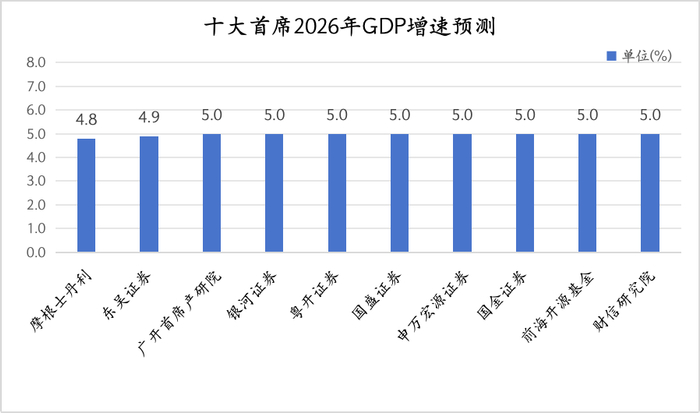
Economic Growth Outlook - In 2025, China's GDP is projected to grow by 5.2% year-on-year, laying a solid foundation for achieving the annual growth target of around 5% [1] - Economists predict that in 2026, China's GDP growth will continue to recover, with an expected growth rate of approximately 5.0% [2][4] Key Economic Drivers - The main drivers for economic growth in 2026 include stable export growth and a rebound in investment, particularly in infrastructure, supported by government policies [4][5] - The real estate market is expected to continue its bottoming process, with overall market risks considered manageable [4][8] Export and Trade Dynamics - Despite challenges from US-China trade tensions, China's exports are anticipated to maintain resilience, supported by new demands from emerging markets and global investments in AI [7] - Economists express cautious optimism regarding export stability, influenced by the global economic environment and potential easing of trade conflicts [7][6] Real Estate Market Trends - The real estate sector is projected to remain in a deep adjustment phase, with investment in real estate expected to decline by 15.9% year-on-year in 2025 [8] - Economists believe that while the real estate market will continue to face downward pressure, the rate of decline may gradually narrow due to previous policy measures [9][8] Price Level Expectations - Consumer Price Index (CPI) is expected to rise by 0.5% year-on-year in 2026, while Producer Price Index (PPI) is projected to decline by 0.9% [10] - The overall price levels are anticipated to remain low, with potential for gradual recovery influenced by supply and demand dynamics [12][10] Fiscal and Monetary Policy - The fiscal deficit rate for 2026 is expected to remain at 4%, consistent with 2025, with slight increases in special bonds and local government debt [14] - Economists forecast 1-2 interest rate cuts in 2026, with a reduction of 0.1-0.2 percentage points, and a potential decrease in the reserve requirement ratio [14][15] Policy Focus Areas - The policy focus for 2026 will include expanding domestic demand, strengthening industries, and promoting consumption through various subsidies and support measures [16] - Key areas of investment will include infrastructure, technology advancement, and stabilizing the real estate market through targeted policies [16][5]

11月消费增长1.3%,增速连续六个月放缓
Sou Hu Cai Jing· 2025-12-16 08:37
Group 1 - The growth rate of total retail sales of consumer goods in China has slowed down, primarily due to a high base from the same period last year [2][4] - In November, the total retail sales reached 43,898 billion yuan, with a year-on-year growth of 1.3%, marking six consecutive months of decline [2][3] - The decline in consumer confidence and spending is influenced by expectations regarding income and employment, leading to cautious consumer behavior [2][3] Group 2 - Urban retail sales in November amounted to 37,684 billion yuan, growing by 1.0%, while rural retail sales reached 6,214 billion yuan, with a growth of 2.8% [3] - The retail sales of goods were 37,841 billion yuan, with a growth of 1.0%, while dining revenue grew by 3.2% [3] - The automotive market has seen a decline in sales for two consecutive months, with November retail sales of passenger vehicles dropping by 8.1% year-on-year [3][5] Group 3 - From January to November, the total retail sales of consumer goods reached 456,067 billion yuan, with a year-on-year growth of 4.0% [5] - Online retail sales during the same period were 144,582 billion yuan, growing by 9.1%, with physical goods online retail accounting for 25.9% of total retail sales [5] - The sales of household appliances and communication equipment have seen significant growth, driven by policies encouraging the replacement of old products [5][6] Group 4 - Consumer prices have shown signs of recovery, with a year-on-year increase of 0.7% in November, marking a continuous rise for three months [6] - The core Consumer Price Index (CPI), excluding food and energy, has stabilized with a year-on-year increase of 1.2% [6] - Industrial profits have also shown growth, with revenues for large-scale industrial enterprises increasing by 1.8% year-on-year from January to October [6]

事件点评:中央经济工作会议学习
KAIYUAN SECURITIES· 2025-12-13 14:41
Report Summary 1. Report Industry Investment Rating No information provided regarding the report industry investment rating. 2. Core Viewpoints - The key policy goal in 2026 is likely price recovery, similar to the situation in 2016 when the importance of GDP growth rate decreased and price recovery was crucial [3][4]. - In 2026, there are two possibilities for the real - estate market. One is a market - based bottoming of housing prices after they fall back to near 2015 levels, and the other is a policy - oriented bottoming if prices fall below 2015 levels [6]. - In 2026, price recovery is highly likely. Depending on the housing price situation, there are three scenarios for the market, all involving rising long - term bond yields and stock market increases [7]. 3. Summary by Related Catalogs Policy Goals - Price recovery is likely an important policy goal in 2026, as indicated by multiple mentions of price - related content in the Central Economic Work Conference. The conference addressed issues such as supply - demand imbalance, expansion of domestic demand, fiscal and monetary policies, competition regulation, and environmental protection [3]. - The logic in 2026 may be similar to that in 2016, with a decline in the importance of GDP growth rate and price recovery being the key. In 2016, the actual GDP growth rate decreased by 0.2% compared to 2015, while the nominal GDP growth rate increased by over 1%, and price recovery improved corporate profits and the stock market [4]. Policy Measures - The policy focus has shifted from reversing the downward price trend (2022 - 2024.9) to maintaining price stability (2025.12). The policy emphasizes maintaining overall policy intensity and making decisions based on the situation to hedge against downward pressure [5]. - Specific measures include maintaining necessary fiscal deficits, debt, and spending; using new policy - based financial tools; and the option of flexible use of reserve requirement ratio cuts and interest rate cuts, which are not mandatory and depend on external shocks [5]. Real - Estate - The government's approach to real - estate risk has two stages: moral risk and systemic risk. Currently, the policy is at the moral risk stage, but may shift if housing prices continue to fall [6]. - In 2026, there are two possible scenarios for the real - estate market: a market - based bottoming of housing prices after falling back to near 2015 levels, or a policy - oriented bottoming if prices fall below 2015 levels [6]. Key Variables in 2026 - There is a high probability of price recovery in 2026, which will lead to three market scenarios: price recovery with falling housing prices, price recovery with market - based bottoming of housing prices, and price recovery with policy - based bottoming of housing prices, all resulting in rising long - term bond yields and stock market increases [7].
债券视角看中央经济工作会议:平稳开局,重在增效
Huachuang Securities· 2025-12-13 13:09
Report Industry Investment Rating No relevant content provided Core Viewpoints of the Report - In 2026, the macro - environment and policy layout for the bond market may remain basically stable, but the policy demand for "price recovery" has increased. The bond market may continue the range - bound trading, with a slight upward shift in the fluctuation center. Under the "stable growth" goal, the currency maintains a "moderately loose" tone, and the overall macro - policy emphasizes stability and quality rather than pursuing incremental growth. The policy's stronger demand for price recovery means that the impact of inflation on nominal interest rate pricing needs attention [7][10]. Summary According to the Table of Contents 1. Macro - tone: A Stable Start with Emphasis on Efficiency - **Macro - situation judgment**: The meeting acknowledges "old problems and new challenges" and the "external environment", and points out the "contradiction of strong supply and weak demand". It highlights long - term contradictions in the economic transformation stage and the short - term uncertainty of the external economic and trade environment. It also implies that "anti - involution" and supply - side optimization need to be strengthened [11]. - **Overall tone**: The policy orientation is "seeking progress while maintaining stability and improving quality and efficiency". It focuses on stability and continuity, with a reduced demand for growth and progress. It aims to optimize practices and improve efficiency on the basis of stable policy strength, and gives priority to the "quality" of the economy over the "quantity". It also re - emphasizes "counter - cyclical and cross - cyclical" regulation, with a long - term perspective [12]. - **Fiscal policy**: It continues the positive tone, with the overall strength remaining flat. After the high fiscal increment in 2025, the focus may be on giving full play to the fiscal multiplier effect. It is expected that the fiscal deficit rate will remain at 4% in 2026. The use of quasi - fiscal tools will continue to support the goal of "stopping the decline and stabilizing investment" [14]. 2. Monetary Policy: Balancing Cross - cyclical Considerations - **Policy goals**: It focuses on growth and prices, and downplays the goal of financial aggregates. It aims to achieve "stable growth" and "reasonable price recovery" by maintaining reasonable liquidity, reducing the real financing cost, and ensuring the smooth operation of the interest rate transmission mechanism [16]. - **Use of reserve requirement ratio and interest rate cuts**: It advocates "flexible and efficient" use of reserve requirement ratio and interest rate cuts, which is more concerned about policy effectiveness and consistent with the cross - cyclical regulation idea. In a neutral scenario, there may be one policy interest rate cut of 10bp in 2026, likely to occur from the end of the first quarter to the beginning of the second quarter [17]. 3. Key Tasks: Quality > Quantity, Focus on Amplifying Policy Multipliers (1) Domestic Demand Policy: Pursuing Effect and Quality, Weakening Incremental Expansion - **Consumption**: In 2026, consumption growth may still have potential. The meeting proposes a "residents' income increase plan", expands the supply of high - quality goods and services, and optimizes the implementation of "two new" policies. The stimulus for consumption demand may remain stable or decline, aiming to improve the multiplier effect [20]. - **Investment**: The meeting for the first time proposes to "stop the decline and stabilize investment", optimize the implementation of "two important" projects, and continue to use new policy - based financial tools. The policy may support investment more in 2026, and the growth rate is expected to turn positive [21]. (2) Deepening Reforms: Prioritizing "Anti - Involution" and Accelerating Debt Clearance - **Unified market construction**: It ranks higher, with the goal of price recovery being emphasized. It formulates a "regulation" and re - emphasizes "anti - involution", which may affect the bond market's interest rate center [24]. - **Debt clearance**: It is necessary to accelerate the clearance of arrears to enterprises. In 2026, the importance of local debt clearance may remain high, and its impact on investment needs attention [24]. - **Small and medium - sized financial institutions**: There is an increase in the "reduction and quality improvement" of small and medium - sized financial institutions, and the trend of mergers is expected to continue [24]. 4. Risk Resolution: Adding Content on Local Debt Resolution, Reducing Real Estate Policy Intensity (1) Local Debt: Actively and Orderly Resolve Local Government Debt Risks - The meeting adds specific statements on local government debt risks, emphasizes the territorial and main responsibilities of debt resolution, and maintains a high - pressure regulatory attitude towards new hidden debts. It also mentions the risk of local government financing platform operating debts and may optimize relevant debt restructuring and replacement measures [26]. - It requires accelerating the clearance of arrears to enterprises, emphasizing the "three guarantees" bottom line and "living a tight - fisted life" [26]. (2) Real Estate: Weakening the Goal of Stopping the Decline and Stabilizing, "De - stocking" by City - The meeting deletes the goal of "stopping the decline and stabilizing" the real estate market, and the policy intensity is reduced. It focuses on supply - side optimization and de - stocking through measures such as "controlling increments", "de - stocking", and "encouraging the acquisition of stock properties" [27].
前11月社融增量超33万亿元 信贷投放提质换挡
Zheng Quan Shi Bao Wang· 2025-12-12 12:28
Core Viewpoint - The People's Bank of China reported that the social financing scale increased by 33.39 trillion yuan in the first eleven months of 2025, reflecting a 3.99 trillion yuan increase compared to the same period last year, indicating a supportive monetary policy for high-quality economic development [1] Financial Statistics - As of the end of November, the year-on-year growth rate of social financing stock was 8.5%, unchanged from the previous month [1] - The growth rate of broad money (M2) was 8%, a decrease of 0.2 percentage points month-on-month [1] - The growth rate of narrow money (M1), which reflects the liquidity of funds, was 4.9%, down 1.3 percentage points month-on-month [1] Government Bonds and Direct Financing - Government bond net financing reached 13.15 trillion yuan in the first eleven months, accounting for nearly 40% of the increase in social financing [3] - The total new government debt for the year was set at 11.86 trillion yuan, an increase of 2.9 trillion yuan from last year, contributing to the growth of social financing [3] - Corporate bond financing was 2.24 trillion yuan, an increase of 3.125 billion yuan year-on-year, while non-financial corporate stock financing was 420.4 billion yuan, up 178.8 billion yuan year-on-year [3] Credit Quality Improvement - In the first eleven months, RMB loans increased by 15.36 trillion yuan, with a year-on-year growth rate of 6.4% as of the end of November [5] - Inclusive small and micro loans grew by 11.4%, and medium to long-term loans for manufacturing increased by 7.7%, both exceeding the overall loan growth rate [5] - The decline in loan growth is attributed to the replacement of loans by diversified financing methods and the impact of local government debt [5] Loan Pricing - The weighted average interest rate for newly issued loans in November was approximately 3.1%, down about 30 basis points year-on-year [6] - The weighted average interest rate for new personal housing loans was also around 3.1%, down about 3 basis points year-on-year [6] Price Trends and Economic Outlook - The Consumer Price Index (CPI) rose by 0.7% year-on-year in November, while the Producer Price Index (PPI) fell by 2.2% year-on-year but increased by 0.1% month-on-month [7] - Experts indicate that the long-term conditions for economic growth remain unchanged, and the monetary and financial conditions are relatively loose, supporting a return of prices to reasonable levels [7]
央行最新发布!前11月社融增量超33万亿,信贷投放提质换挡
Sou Hu Cai Jing· 2025-12-12 11:26
Core Viewpoint - The People's Bank of China reported that the social financing scale increased by 33.39 trillion yuan in the first eleven months of 2025, which is 3.99 trillion yuan more than the same period last year, indicating a supportive monetary policy environment for high-quality economic development [1] Financial Statistics - As of the end of November, the year-on-year growth rate of social financing stock was 8.5%, unchanged from the previous month; M2 growth rate was 8%, down 0.2 percentage points month-on-month; M1 growth rate was 4.9%, down 1.3 percentage points month-on-month [1] - The increase in social financing scale was supported by government bond net financing, corporate bonds, and equity financing [1][3] Government Bonds and Direct Financing - Government bond net financing reached 13.15 trillion yuan in the first eleven months, accounting for nearly 40% of the increase in social financing [3] - The total new government debt for the year was set at 11.86 trillion yuan, an increase of 2.9 trillion yuan from last year, which has positively impacted the social financing scale [3] Credit Quality Improvement - In the first eleven months, RMB loans increased by 15.36 trillion yuan, with a year-on-year growth rate of 6.4% as of the end of November [5] - The growth rates of inclusive small and micro loans and medium to long-term loans for the manufacturing sector were 11.4% and 7.7%, respectively, both higher than the overall loan growth rate [5] Loan Pricing and Economic Indicators - The average interest rate for newly issued corporate loans was approximately 3.1%, down about 30 basis points year-on-year, while the average interest rate for personal housing loans was also around 3.1%, down about 3 basis points year-on-year [6] - The consumer price index (CPI) rose by 0.7% year-on-year in November, while the producer price index (PPI) fell by 2.2% year-on-year but increased by 0.1% month-on-month [6]
央行最新发布!前11月社融增量超33万亿元!
Sou Hu Cai Jing· 2025-12-12 10:20
Group 1 - The core viewpoint of the article highlights that the social financing scale in China has shown significant growth, with a cumulative increase of 33.39 trillion yuan in the first eleven months of 2025, which is 3.99 trillion yuan more than the same period last year [1] - The year-on-year growth rate of social financing stock was 8.5% at the end of November, maintaining a high growth level, reflecting a moderately loose monetary policy environment conducive to high-quality economic development [1][4] - Government bond net financing and direct financing have been key drivers of social financing growth, with government bond net financing reaching 13.15 trillion yuan, accounting for nearly 40% of the social financing increment [4] Group 2 - The increase in loans has been significant, with a total of 15.36 trillion yuan in new RMB loans in the first eleven months, and the loan balance growth rate at 6.4% at the end of November [7] - The structure of loans shows that inclusive small and micro loans and medium to long-term loans for manufacturing have grown at rates higher than the overall loan growth, indicating increased support for key sectors [7] - The average interest rate for new loans remained at historical low levels, with corporate loans at approximately 3.1%, which is about 30 basis points lower than the same period last year [8] Group 3 - The article notes that the recent macroeconomic policies have effectively promoted a reasonable rebound in prices, with the Consumer Price Index (CPI) rising by 0.7% year-on-year in November [10] - The Producer Price Index (PPI) showed a year-on-year decline of 2.2% but a month-on-month increase of 0.1%, indicating a potential stabilization in price trends [10] - Experts suggest that the long-term conditions for economic growth remain strong, and the monetary and financial conditions are relatively loose, supporting a return of prices to reasonable levels [10]
央行最新发布!前11月社融增量超33万亿元!
证券时报· 2025-12-12 10:09
最新发布。 12月12日,中国人民银行发布的最新金融统计数据报告显示,经初步统计,2025年前11个月社会融资(社融)规模增量累计为33.39万亿元,比上年同期多增3.99万 亿元。11月末,社融存量的同比增速为8.5%,与上月持平;广义货币(M2)增速8%,环比下降0.2个百分点;反映资金活化程度的狭义货币(M1)增速为4.9%, 环比下降1.3个百分点。 从金融总量表现看,11月末社会融资规模存量、M2增速均保持不低于8%的较高增速水平。"这充分体现了适度宽松的货币政策状态,为经济高质量发展营造了适宜 的金融总量环境。"业内专家表示,今年以来,宏观政策加大逆周期调节力度,对提振内需、稳定经济发挥了积极作用,也为金融总量合理增长提供了支撑。 11月末,社融规模增量保持较快增长,政府债券净融资、企业债券、股权融资等继续发挥支撑作用;信贷投放"提质换挡",普惠小微贷款、制造业中长期贷款、科 技贷款继续较快增长,增速持续高于全部贷款增速。 只看贷款增长情况越来越难以完整反映金融支持实体经济的成效。前述业内专家表示,社会融资成本低位运行,说明实体经济融资需求被合理满足;重点领域信贷 投放占比提升,说明金融资源供给与 ...
茅台批价跌破1499元指导价!贵州茅台股价不降反升?
Mei Ri Jing Ji Xin Wen· 2025-12-12 02:35
Group 1 - The price of 2025 Feitian Moutai (original box) has decreased by 15 yuan, now priced at 1495 yuan per bottle, marking the first time it has fallen below the 1499 yuan guidance price [1] - On December 12, Guizhou Moutai's stock price increased to 1420 yuan per share, despite the recent drop in the price of Feitian Moutai [1] - After approximately five years of adjustment, Guizhou Moutai's stock price has stabilized, with institutional holdings at a near ten-year low, indicating a weakening correlation between stock price and wholesale price [1] Group 2 - Positive macroeconomic signals are contributing to the stabilization and rebound of leading liquor companies [2] - The food and beverage ETF (515170.SH) holds a 17.89% weight in Guizhou Moutai, covering other premium liquor brands, with a total weight of nearly 60% [2] - The food and beverage ETF (515170.SH) is an accessible investment tool for individual investors looking to position themselves in leading liquor companies at lower price levels [2]

贵州茅台企稳反弹,食品饮料板块拉升!华创张瑜:2026年物价重视程度进一步提高
Mei Ri Jing Ji Xin Wen· 2025-12-12 02:21
张瑜团队判断:2026年是物价重视程度进一步提高的一年,或在供需两端发力,促进物价合理回升。其 中供给端主要体现在优化竞争秩序、重点行业产能治理、规范地方招商引资行为等。 华创证券研究所副所长张瑜解读经济工作会议通稿时指出:经济工作会议中与物价相关的表述包 括,"国内供强需弱矛盾突出""持续扩大内需、优化供给";"把促进经济稳定增长、物价合理回升作为 货币政策的重要考量";"促进粮食等重要农产品价格保持在合理水平"。 12月12日早盘,食品饮料板块拉升,食品饮料ETF(515170.SH)涨超1%,成分股方面,贵州茅台在 1400元附近企稳反弹,最新报1420元,五粮液、泸州老窖涨超1%,酒鬼酒涨超5%,舍得酒业涨超3%。 ...