
稳投资

Search documents
股市:正迎来一股暖风
Xin Lang Cai Jing· 2025-12-24 01:21
炒股就看金麒麟分析师研报,权威,专业,及时,全面,助您挖掘潜力主题机会! 来源:小白读财经 12月22日,国家提到:谋划一批带动全局的重大工程、重大项目、重大载体。 种种迹象显示,股市的宏观环境正迎来一股暖风。包括几个方面: 2、中国多领域"反内卷"向纵深推进,多行业价格战走向"硬约束"时代。 中央经济工作会议明确提到:制定全国统一大市场建设条例,深入整治"内卷式"竞争。 我之前说过,股价上涨的层底逻辑包括两个,一是业绩回升,二是产品涨价。无论如何,"反内卷"客观 上对物价的低位回升有一定的帮助。对股价的推动也是非常正面的。 3、以人工智能为代表的科技革命继续前进,这轮革命中,相较于美国专注于算力的战略,中国将更多 资金投向人工智能应用领域,中国市场空间更大。大国之间的竞争,关键还是科技竞争,最终会体现在 股市上。 4、投资领域正在释放积极信号。国家已经明确了扩大内需是明年排在首位的重点任务。坚持内需主 导,全方位扩大国内需求,要推动投资止跌回稳。 有业内人士预计:2026第一季度固投同比增速为2.8%(2025年1—11月,固投同比下降2.6%),预计广 义基建和制造业投资同比增速均有望超过5.0%,带动投 ...
锚定2026年重点任务:银行业积极稳投资扩内需惠民生
Jin Rong Shi Bao· 2025-12-23 03:21
内需是拉动经济增长主动力与稳定锚。今年以来,针对经济运行中面临的风险挑战,各地区、各部 门按照党中央决策部署,加紧实施更加积极有为的宏观政策,及时出台和有效落实一系列扩大国内需 求、促进产业升级、畅通经济循环的政策措施,对于支持经济平稳运行发挥了重要作用。 近期召开的中央经济工作会议提出,我国经济发展中老问题、新挑战仍然不少,外部环境变化影响 加深,国内供强需弱矛盾突出,重点领域风险隐患较多。 在部署2026年经济工作时,会议将"坚持内需主导,建设强大国内市场"放在了首位。"大国经济的 重要特征是回旋余地大,内部可循环,能够独立自主、自立自强。"中央财办分管日常工作的副主任、 中央农办主任韩文秀表示,要进一步开拓视野、创新思路,努力在扩大消费和投资、发展科技和产业、 促进城乡融合和区域协调发展等方面,培育形成更多新的增长点,开辟发展新空间。 投资是扩大内需的重要抓手。根据中央经济工作会议部署,2026年要推动投资止跌回稳,适当增加 中央预算内投资规模,优化实施"两重"项目,优化地方政府专项债券用途管理,继续发挥新型政策性金 融工具作用,有效激发民间投资活力。高质量推进城市更新。 在国家政策和金融管理部门的指引 ...

21社论丨着力拓展投资增长空间,确保稳增长
Xin Lang Cai Jing· 2025-12-19 22:31
Core Viewpoint - The National Development and Reform Commission emphasizes the importance of effective investment during the 14th Five-Year Plan period, focusing on expanding domestic demand and enhancing government investment to stimulate private investment and reform investment mechanisms [1][2]. Group 1: Investment Strategy - The central economic work conference identifies stabilizing investment as a key task for economic growth, especially in light of external environmental changes and domestic economic challenges [1]. - Fixed asset investment growth has declined, with a year-on-year decrease of 2.6% from January to November, influenced by local government debt and real estate adjustments [1]. Group 2: Long-term Investment Potential - There remains significant potential for effective investment in China, as per capita capital stock is still lower than that of developed economies, and there are gaps in water conservancy, energy, municipal infrastructure, and new infrastructure [2]. - The need for investment in both physical and human capital is highlighted, with calls for increased funding in infrastructure and public services [2]. Group 3: Funding Sources and Policy Measures - The central economic work conference proposes a more proactive fiscal policy, including increasing central budget investment and optimizing local government special bond usage to enhance funding sources [2]. - New policy financial tools are emphasized as crucial for stabilizing investment, with expectations for these tools to be implemented early [2]. Group 4: Project Implementation - The 15th Five-Year Plan aims to advance major national strategies and projects, focusing on infrastructure and public service improvements, aligning with demographic changes [3]. - The central economic work conference prioritizes "two major projects" and "urban renewal" for investment in the coming year [3]. Group 5: Private Investment Activation - The State Council has issued measures to promote private investment, including 13 targeted initiatives to enhance market access and support for private enterprises [4]. - The central economic work conference calls for improving regulations to boost private sector confidence and investment willingness [4].
国联证券:11月经济:投资消费谁先回稳?
Xuan Gu Bao· 2025-12-15 10:47
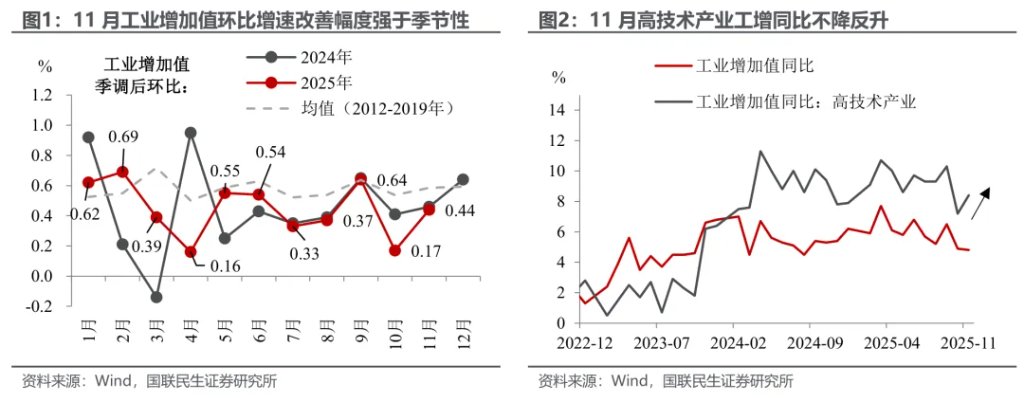
11月经济呈现出 "工业稳、投资与消费缓" 的格局。鉴于政策效果将在明年一季度更为充分显现,当前消费与投资仍面临阶段性逆风,"谁先企 稳"对明年经济"开门红"具有关键的信号意义。对此,我们认为可以从如下角度考虑: 投资端:"乌云中的银线"。虽然房地产下行压力仍在释放,但基建与制造业已不时释放积极信号:11月制造业投资增速止跌回升,初步显现"拐 点";建筑业PMI表现偏强,叠加新增专项债加速发力项目建设,表明"稳投资"的政策储备与执行已在跟进。 消费端:增速放缓背后的复杂局面。除高基数效应外,前期"国补"政策的火热、"双十一"促销前置,均在一定程度上透支了部分消费力,对短期 消费增速形成压制。长远来看,消费复苏仍需依赖消费场景实质性拓展以及居民收入预期改善。 尤其在中央经济工作会议"推动投资止跌回稳"的指引下,"稳投资"政策意图明确。投资有望先于消费实现企稳,成为支撑明年一季度"开门红"的 主要亮点。后续关键仍在于政策"愿望清单"能否如期兑现、向实物工作量有效转化。 工业:同环比背离释放了哪些信号?与改善幅度明显强于季节性的环比增速不同,11月工业增加值同比增速却小幅放缓至4.8%(前值4.9%),两 者的背离 ...

国家发改委部署明年重点任务:更大力度发展民营经济
Zhong Guo Xin Wen Wang· 2025-12-13 15:47
在改革工作方面,会议表示,研究制定全国统一大市场建设条例,协同推进"准入、场景、要素"一体化 改革;持续抓好招商引资、招标投标等方面重点问题整治,坚决破除各类壁垒障碍;更大力度发展民营 经济,大力推动民营经济促进法配套制度建设。 围绕前述重点工作,会议还提出,完善重点行业产能治理和重大基础设施调控;优化实施消费品以旧换 新政策,积极扩大服务消费;稳步实施碳排放总量和强度双控制度,完善配套制度,强化评价考核,严 控新增"两高"项目等。(完) (文章来源:中国新闻网) 中新社北京12月13日电 (记者王恩博)据中国国家发改委13日消息,全国发展和改革工作会议12日至13日 在北京召开。会议部署2026年发展改革重点任务,其中提及,更大力度发展民营经济。 会议明确了九项明年发展改革重点工作,分别是:编制实施好"十五五"规划;多措并举促进投资止跌回 稳;提振消费要出实招出新招;综合整治"内卷式"竞争和培育发展新动能;进一步全面深化改革;深入 扩大高水平对外开放;以双碳为引领加快推进全面绿色转型;更大力度保障就业和改善民生;适应人口 形势变化优化公共资源配置。 其中,针对稳投资,会议提出,充分发挥"两重"建设(国家重大 ...
2025年中央经济工作会议学习体会:“扩内需”的战略地位进一步提升
Bank of China Securities· 2025-12-12 00:42
Economic Strategy - The strategic position of "expanding domestic demand" has been further elevated, emphasizing its role in addressing "old problems and new challenges" in the economy[1] - The meeting highlighted the need for a more proactive macroeconomic policy, with a focus on enhancing policy foresight, targeting, and coordination[1] - "Expanding domestic demand" is seen as a crucial measure to counter external demand uncertainties and stimulate domestic supply, leading to improved corporate profits and household income[1] Fiscal and Monetary Policy - The fiscal deficit target for 2025 is set at 4.0%, an increase of 1.0 percentage point from 2024, with an estimated actual deficit rate of 5.3% when including special government bonds[4] - The meeting called for continued implementation of a proactive fiscal policy, maintaining necessary fiscal deficits and total debt levels[4] - Monetary policy will remain moderately accommodative, with a focus on using various tools like reserve requirement ratio cuts and interest rate reductions to support economic stability and reasonable price recovery[4] Investment and Consumption - The meeting proposed the formulation of a plan to increase urban and rural residents' income, which is fundamental to boosting consumer spending[4] - Investment strategies will focus on stabilizing and revitalizing investment through both project and local fiscal funding[4] - The emphasis on "doing better with incremental policies and revitalizing existing resources" aims to align new policies with the existing economic foundation[12]
四季度以来一批重大项目建设顺利推进
Zheng Quan Ri Bao· 2025-12-02 16:17
Group 1 - The core viewpoint of the articles highlights the acceleration of major project construction across various regions in China, aiming to boost effective investment and stabilize economic growth by the end of 2025 [1][2]. - In Fujian Province, a total of 130 projects with an investment of 701.26 billion yuan were included in a concentrated commencement and completion event, with 65 projects starting construction and 65 being completed [1]. - Chongqing launched 177 major projects with a total investment exceeding 180 billion yuan, covering multiple sectors such as modern industry, infrastructure, social welfare, and ecological protection [1]. Group 2 - Investment in major projects is seen as a "ballast stone" for stabilizing economic growth, creating a closed loop of "investment-production-revenue" that activates the industrial chain's collaborative effects [2]. - Guangdong Province has planned 1,500 key construction projects with an annual investment target of 1 trillion yuan, achieving 96% of its investment goal by October 2025 [2]. - The construction of infrastructure projects is expected to improve public services and enhance the overall living experience, laying a foundation for future industrial development and economic upgrades [2]. Group 3 - To ensure the sustained acceleration of major project construction, local policies should focus on five core areas: resource assurance, efficiency in approvals, financial empowerment, environmental optimization, and mechanism protection [3]. - Streamlining approval processes through "parallel approvals and acceptance of incomplete applications" is recommended to simplify project initiation and land use [3]. - Encouraging local enterprises to participate in project subcontracting and material supply can help reduce construction costs and enhance the precision of industrial chain support [3].
2025年10月经济数据点评:10月经济放缓:稳投资还是稳消费?
Minsheng Securities· 2025-11-14 09:16
Economic Performance Overview - In October, the industrial added value increased by 4.9% year-on-year and 0.17% month-on-month[1] - The total retail sales of consumer goods reached 46,291 billion yuan, growing by 2.9% year-on-year and 0.16% month-on-month[1] - From January to October, fixed asset investment (excluding rural households) totaled 408,914 billion yuan, showing a year-on-year decline of 1.7%[1] Investment and Consumption Trends - Historical data suggests that investment growth typically rebounds first during economic stabilization periods, as seen in 2008-09 and 2020-21[2] - Manufacturing investment saw a significant decline, with a year-on-year drop from -1.9% in September to -6.7% in October[3] - Infrastructure investment growth decreased from -4.6% in September to -8.9% in October, indicating a low level of infrastructure activity[3] Consumer Behavior Insights - The retail sales growth rate slightly declined to 2.9% in October, influenced by a high base from the previous year and the waning effects of the "old-for-new" policy[4] - The early "Double Eleven" shopping festival helped mitigate the decline in retail sales growth, which did not significantly worsen despite multiple pressures[4] Real Estate Market Dynamics - From January to October, real estate investment cumulative growth fell to -14.7%, down from -13.9% previously, reflecting weak demand and high base effects from last year[5] - The need for further policy support in the real estate sector is emphasized to balance supply and demand and promote high-quality development[5] Risk Factors - Potential risks include policies falling short of expectations, unexpected changes in the domestic economic situation, and fluctuations in exports[6]
深夜食堂基金版:“稳”是穿越周期的力量
Zhong Guo Zheng Quan Bao· 2025-11-10 08:53
Core Viewpoint - The current market environment, characterized by volatility and rapid shifts in investment hotspots, necessitates a focus on long-term stability rather than chasing fleeting trends [1] Group 1: Investment Philosophy - The essence of investing in public funds is to achieve asset preservation and appreciation in the equity market, with a focus on smooth and steady returns [2] - A good investment experience is defined by minimizing significant and prolonged losses while allowing investors to hold their positions without the stress of timing the market [2] Group 2: Strategic Approach - The investment strategy is based on macroeconomic analysis, identifying undervalued opportunities from cyclical turning points rather than engaging in short-term trading [3] - The manager emphasizes the importance of asset turnover and trading volume to assess market sentiment and identify potential investment opportunities [3] Group 3: Dynamic Adjustment - The investment approach involves flexible adjustments to the portfolio in response to market style changes, reducing exposure to overvalued assets while increasing weight in undervalued ones [4] - The manager's patience in waiting for the right market conditions, as seen in the strategic positioning in brokerage stocks, highlights the importance of maintaining a balanced portfolio [5] Group 4: Market Context - The recent fluctuations in the Shanghai Composite Index, which briefly surpassed 4000 points before retreating, illustrate the structural characteristics of the current market [6] - The focus on stability is crucial in a volatile market, with the aim of achieving lower overall drawdowns compared to the market average [6]
“稳”是穿越牛熊的力量
Xin Lang Ji Jin· 2025-11-07 05:40
Core Viewpoint - The current market environment emphasizes the need for stability in investment strategies, particularly as the Shanghai Composite Index approaches the 4000-point mark and experiences volatility [1][9]. Investor Experience - The essence of purchasing mutual funds is to achieve asset preservation and appreciation in the equity market, with a focus on smooth and steady returns while avoiding significant losses [3][9]. - A good investment experience is defined by two standards: minimizing large and prolonged losses, and alleviating the stress of market timing for investors [3][9]. Investment Strategy - The investment philosophy is based on macroeconomic research, focusing on identifying undervalued opportunities from cyclical turning points rather than chasing short-term trends [5][9]. - The manager has increased allocations in public utilities and transportation sectors in anticipation of counter-cyclical policies, while also monitoring "white horse stocks" that are closely tied to China's economic performance and interest rates [5][9]. Dynamic Adjustment - The investment approach involves flexible adjustments to the portfolio in response to market style changes, reducing exposure to high-volatility assets while increasing weight in undervalued assets with reversal potential [7][9]. - The manager's patience in waiting for market opportunities, such as in the brokerage sector, reflects a strategy of maintaining a balanced portfolio to withstand short-term pressures [7][9]. Long-term Perspective - Emphasizing the importance of time in investment management, the strategy focuses on managing risk from a volatility perspective rather than fixating on individual stock performance [8][9]. - The overall goal is to stabilize the portfolio's foundation to navigate through market fluctuations, allowing for a more secure investment journey for clients [9].