美国债务危机

Search documents
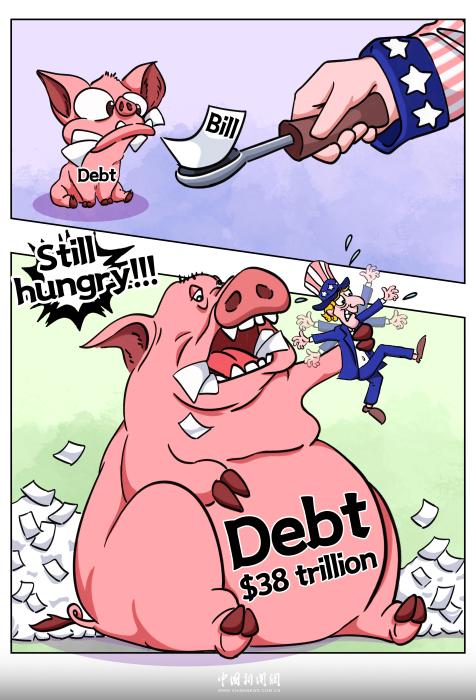
喂养债务“怪兽”,难免自掘坟墓 | 新漫评
Zhong Guo Xin Wen Wang· 2025-10-29 11:16
Core Viewpoint - The ongoing U.S. government shutdown has led to a significant increase in national debt, reaching $38 trillion, highlighting lawmakers' failure to fulfill basic fiscal responsibilities [2] Group 1: Economic Impact - The shutdown has resulted in salary interruptions for hundreds of thousands of federal employees, severely disrupting economic operations [2] - The national debt is described as a "monstrous" entity that has been allowed to grow unchecked, with the government likened to a poor caretaker feeding this debt beast [2] Group 2: Debt Concerns - The increase in debt during the shutdown is seen as a troubling sign of the government's inability to manage fiscal responsibilities, raising concerns about future economic stability [2] - The metaphor of the debt being a "pig" that is being fed suggests that the larger the debt grows, the more catastrophic the potential consequences will be when it eventually collapses [2]

不是36万亿而是230万亿?美国或已歇业,美元真成假钞了吗
Sou Hu Cai Jing· 2025-10-24 19:37
Core Insights - Investors are facing an unprecedented financial storm, particularly concerning the unsustainable level of U.S. national debt, which has reached $37.5 trillion by September 2025 [2] Debt Situation - The U.S. national debt has ballooned to $37 trillion, with a staggering increase of $1 trillion in just nine months [5] - By 2025, $9.2 trillion of debt is due, representing 25.4% of total outstanding debt, which will need refinancing in a high-interest environment of 4.25%, leading to an additional $184 billion in annual interest expenses [4] - The Congressional Budget Office predicts that by 2052, the debt-to-GDP ratio will rise to 185%, with the debt potentially exceeding $50 trillion by 2030 [4] Interest Payments - Interest payments on U.S. debt are projected to exceed $1.3 trillion in 2025, surpassing the combined total of defense spending ($800 billion) and healthcare expenditures [4] - Interest payments have become the second-largest federal expenditure, following Social Security [4] Economic Implications - The high-interest rate environment is exacerbating the debt crisis, creating a vicious cycle of increased borrowing leading to higher interest rates and heavier interest burdens [4] - The fiscal deficit for the first half of 2025 reached $1.3 trillion, with an annual estimate of over $1.9 trillion, while the "Tax Cuts and Jobs Act" is expected to reduce revenue by $4.5 trillion over the next decade [4] Global Financial Impact - The U.S. dollar's share in global foreign exchange reserves has dropped from 71% in 1999 to 57.4% in 2024, with projections indicating it may fall below 50% [6] - The rise of alternative payment systems, such as the Russian SPFS and China's CIPS, is gaining traction as countries seek alternatives to the U.S. dollar [7] Public Debt Burden - Each American citizen is estimated to carry a debt burden of $108,000, with total household debt reaching $18.4 trillion in 2025 [8] - The percentage of overdue debts has increased from 2.8% to 3% in the second quarter of 2025 [8] Investment Strategies - Investors are advised to consider tangible assets as a hedge against the declining value of the dollar, with gold prices rising by 15% and silver by 70% in 2025 [8] - Bitcoin has also seen a resurgence, reaching $83,000, being referred to as "trust currency" by some analysts [8]
美国债务已经达到38万亿美元,当美国债务达到40万亿美元的时候就会出现重大问题,40万亿美元是个临界点
Sou Hu Cai Jing· 2025-10-24 15:21
Core Viewpoint - The U.S. federal debt has surpassed $38 trillion and is projected to reach $40 trillion soon, raising concerns about fiscal sustainability and market confidence [1][3][11] Debt Growth and Ownership - Over the past decade, U.S. debt has doubled from approximately $17 trillion in 2013 to $38 trillion, with over $6 trillion added during Biden's administration [3][5] - The proportion of U.S. debt held by foreign investors has fallen below 30%, with Japan, the UK, and China reducing their holdings [3][5] Interest Payments and Budget Concerns - In 2024, the U.S. is expected to spend $1.2 trillion solely on interest payments, which is comparable to military and social security expenditures combined [5][6] - The U.S. debt has increased significantly compared to GDP growth, with debt rising over 70 times since the 1970s while GDP has only increased by about 20 times [6] Future Projections and Risks - By 2030, social security and healthcare spending may consume over 60% of the federal budget, necessitating tax increases that could provoke backlash from businesses and the middle class [8][10] - The Congressional Budget Office has warned that if current trends continue, the debt-to-GDP ratio could exceed 120% by 2033, a level not seen since World War II [8][10] Market Confidence and Systemic Risks - The psychological threshold of $40 trillion could undermine investor confidence, leading to a situation where no one is willing to purchase U.S. debt, regardless of interest rates [11] - The current fiscal strategy resembles a cycle of borrowing to pay off existing debt, raising concerns about long-term sustainability [8][10] Misallocation of Funds - The increase in debt has not been directed towards infrastructure, education, or inflation control, but rather has been consumed by fiscal deficits and financial assets [13]
从关税到政府停摆:特朗普的“十月危机”持续发酵!
Sou Hu Cai Jing· 2025-10-13 05:58
近日,特朗普政府宣布,自11月1日起,对中国进口商品额外加征100%关税,并对关键软件实施出口管制。 关税大棒乱舞 此举引发轩然大波,有分析认为,这是继中方发布了关于稀土等相关物项的出口管制措施之后,特朗普政府做出的"应激反应"。 在懂王发布上述消息后,美国股市迅速作出反应,当地时间10月10日,三大指数集体下挫,上万亿美元市值蒸发,其中,纳斯达克指数大跌3.56%,创下今 年4月"解放日"以来最糟糕的表现。 不少专家唱衰,美国经济学家玛丽·拉弗莉在接受采访时表示,特朗普加征关税的威胁完全无用。 有观点指出,在美国政府"停摆"期间和人工智能估值辩论之际宣布新的关税,再也没有比这"更糟糕的时机了"。 CNBC的文章则表示,尽管中美贸易谈判进展较为缓慢,但市场普遍认为,两国最终会达成一些协议,且整体关系正在改善。如果特朗普的威胁真的实施, 投资者担心美国经济可能难以承受沉重的负担。 美国管理与预算办公室表示,随着停摆的持续,很快将有超过4000名联邦雇员被解雇。当地时间10月12日,美国副总统万斯亦表示,美国政府停摆持续的时 间越长,联邦政府的裁员幅度就会越大。 这无疑给那些已经在无薪休假状态下的数十万工作人员带 ...

美国,重大警告!
Zheng Quan Shi Bao Wang· 2025-10-11 23:40
Core Viewpoint - Ray Dalio, founder of Bridgewater Associates, warns that the rapid growth of U.S. government debt, combined with escalating internal and external conflicts, is creating an atmosphere reminiscent of the pre-World War II era, posing a serious challenge to the existing order [1][2][3] Debt Growth and Economic Impact - As of October 2025, U.S. national debt is projected to exceed $37.86 trillion, with the Congressional Budget Office estimating that public debt will reach 99% of GDP in 2024 and 116% by 2034, the highest in U.S. history [2][7] - Dalio emphasizes that rising debt relative to income is squeezing available spending space, threatening the vitality of the U.S. economy [2][3] - The ongoing accumulation of debt is intertwined with increasing social division and geopolitical risks, creating a concerning environment [2][3] Political and Fiscal Challenges - Dalio attributes the debt crisis to political polarization in the U.S., advocating for a combination of increased tax revenue and spending cuts to address the "debt bomb" [2][3] - The Federal Budget Committee criticizes the current government shutdown as wasteful and meaningless, highlighting a projected federal deficit of $1.8 trillion for the fiscal year 2025 [7][8] - The CBO reports that rising costs in healthcare, social programs, and defense, coupled with tax policies that limit revenue growth, present ongoing fiscal challenges for the U.S. government [7][8] Recommendations and Future Outlook - Dalio suggests that the debt-induced crisis could manifest within two to three years under the current administration, potentially undermining the international status of the U.S. dollar and causing ripple effects in global markets [6][7] - The CRFB calls for urgent reforms to address long-term welfare program funding issues, particularly Medicare and Social Security, which are projected to face insolvency within seven years if not reformed [8]
达利欧:美国债务增长过快,正在酝酿一种“非常类似”二战前的氛围
Hua Er Jie Jian Wen· 2025-10-10 08:08
Group 1 - Dalio warns that the rapid growth of U.S. government debt, combined with escalating internal and external conflicts, is creating an atmosphere similar to the pre-World War II period, posing a serious challenge to the existing order [1] - The U.S. public debt held by the public reached 99% of GDP last year, and it is projected to rise to 116% by 2034, surpassing any historical levels in the U.S. [2][3] - Dalio attributes the debt crisis to bipartisan political failures, referring to it as a "deficit/debt bomb," and advocates for a combination of tax increases and spending cuts to address the issue [3] Group 2 - Dalio emphasizes that the debt crisis is intertwined with increasing social division and geopolitical risks, creating an environment of significant concern [3] - He highlights the potential for a "form of civil war" in the U.S. due to "irreconcilable differences," warning that these conflicts will ultimately test the power of various factions [3] - Bridgewater Associates is expected to achieve its largest gain since 2010 this year, following a period of restructuring and personnel changes under CEO Nir Bar Dea [4] Group 3 - As of December 31 last year, Bridgewater Associates managed assets totaling $92 billion, a decrease from nearly $140 billion at the beginning of 2023 [5]
达利欧再度警示美国债务危机:局势堪比二战前!
Jin Shi Shu Ju· 2025-10-10 05:33
Group 1 - Ray Dalio, founder of Bridgewater Associates, warns about the rapid growth of U.S. government debt, comparing the current situation to the years leading up to World War II [1] - Dalio attributes the rising debt to bipartisan political failures and advocates for a combination of tax increases and spending cuts to address the "deficit/debt bomb" [1] - According to the Congressional Budget Office (CBO), U.S. public debt reached 99% of GDP last year, projected to rise to 116% by 2034, surpassing any historical levels [1] Group 2 - Dalio emphasizes that the surge in debt is part of a larger issue, including escalating global conflicts and widening wealth gaps, creating a "worrisome environment" [1] - He suggests that the U.S. and other regions are experiencing a form of internal conflict with "irreconcilable differences" [1] - Bridgewater Associates, founded in 1975, is known for its "radical transparency" culture and is expected to achieve its largest annual gains since 2010 this year [2] Group 3 - As of December 31, the assets managed by Bridgewater Associates amounted to $92 billion, a decrease from nearly $140 billion at the beginning of 2023 [3]
坏消息接二连三?特朗普紧急发文,美财长暗示:希望中美达成协议
Sou Hu Cai Jing· 2025-10-08 08:10
当中国人民享受假期的欢愉时,特朗普却面临着越来越多的麻烦。过去几天内,特朗普政府接连迎来了 三大坏消息,这让他不得不紧急发布声明来稳定局势,而美国财长也公开暗示中国:不要不给美国面 子。 在分析这些坏消息之前,我们先来看看美国国内的局势。目前,美国的"内战"局势愈发严峻,芝加哥等 地爆发了大规模的暴力冲突。特朗普已经派遣了国民警卫队来进行镇压,但上百人的抗议队伍与移民 局、海关执法人员发生了剧烈冲突,甚至爆发了枪击事件。先是加利福尼亚州,接着是俄勒冈州和伊利 诺伊州,似乎所有由民主党主导的州都成为了特朗普政策的打击目标。 能导致美国债务危机提前爆发,进而引发经济风暴。如果美债问题失控,整个美国经济将遭遇巨大的冲 击。 而在外部,美国和欧洲的关系也在恶化。随着俄乌战争的持续,普京显然没有停止推动俄罗斯与欧洲的 矛盾。特朗普虽然口头上支持乌克兰,但依然坚持要求欧洲购买武器再向乌克兰提供援助,这无疑让美 国在经济上受益,而欧洲却为此付出了代价。长期下去,欧洲的内部矛盾会加剧,美欧之间的隔阂也会 越来越大,而这正是普京所期待的局面。 与此同时,欧洲国家对美国的信任逐渐动摇。意大利和瑞士近期分别邀请中国外长王毅访问,显 ...
黄金重估的算盘
Sou Hu Cai Jing· 2025-10-02 09:16
Core Insights - The article discusses the potential for the U.S. Treasury to revalue its gold reserves as a strategy to alleviate its debt crisis, which could significantly impact global gold markets [1][3] - The current market price of gold has risen 45% this year, influenced by geopolitical conflicts, expectations of Federal Reserve interest rate cuts, and increased gold purchases by central banks [1][3] Group 1: U.S. Treasury and Gold Reserves - The U.S. Treasury's gold reserves, valued at $110 billion based on the 1973 price of $42.22 per ounce, could exceed $1 trillion at current prices, representing a 90-fold increase [1][3] - This potential revaluation could cover significant debt interest payments and combined with tariff revenues of $300 billion, nearly balance the budget [1][3] Group 2: Global Gold Market Dynamics - The shift of Switzerland's gold refining operations to the U.S. aims to enhance American gold processing autonomy and create jobs, reflecting a strategic move in the global gold market [1][3] - The article highlights a "gold rush" among nations, emphasizing that those who hold more gold will have a strategic advantage in future geopolitical negotiations [1][3]

鲍威尔为何给美股牛市预期泼冷水
21世纪经济报道· 2025-09-27 02:21
Group 1 - The article discusses the impact of the Federal Reserve's interest rate decisions on the U.S. equity market, highlighting that abundant liquidity is becoming a decisive factor in market pricing, with expectations of a bull market in U.S. stocks [1][2] - Following comments from Fed Chair Powell regarding high stock indices, major U.S. stock indices experienced a decline, with the S&P 500, Nasdaq, and Dow Jones Industrial Average dropping an average of 79 basis points over three trading days [1] - The article suggests that Powell's remarks may be aimed at guiding market expectations regarding future rate cuts, as a stronger expectation of rate cuts could lead to a decline in the dollar index and reduced capital inflow into the U.S. [2][4] Group 2 - The article notes that the U.S. debt-to-GDP ratio has exceeded 123%, significantly above the IMF's warning threshold of 90%, which may explain the ongoing decline in the dollar index and increased sensitivity of overseas bond markets to U.S. economic data [3][4] - It emphasizes the challenge for the Federal Reserve to balance economic growth and inflation control, particularly in light of the government's tariff policies, which complicate the task of maintaining a stable economic environment [4] - The article concludes that a decrease in the federal funds rate is likely, but the Fed faces the challenge of preventing the market from forming a one-sided consensus on future rate expectations [4]