自主可控

Search documents
英大证券晨会纪要-20260302
British Securities· 2026-03-02 02:22
Core Views - The A-share market is currently characterized by "volatile differentiation and hot spot rotation," with rapid changes in market focus requiring investors to time their entries carefully to avoid blind chasing of trends [2][13][14] - The report suggests a strategy of "buying on dips" in sectors benefiting from price increases and geopolitical catalysts, such as oil and gas, as well as technology sectors with long-term growth potential like AI computing and semiconductors [2][14] Market Overview - Last Friday, the three major indices of the A-share market opened lower and experienced weak fluctuations, with the ChiNext index dropping over 1%. However, the Shanghai Composite and Shenzhen Composite indices staged a V-shaped recovery in the afternoon [4][5] - The market saw strong performance in small metal and energy metal sectors, while technology-related sectors like optical modules, PCBs, and semiconductors experienced corrections, highlighting the evident rotation effect [4][6] Weekly Market Review - The Shanghai Composite index rose by 1.98% over the week, while the Shenzhen Composite and ChiNext indices increased by 2.80% and 1.05%, respectively. The market's initial positive momentum was attributed to returning capital and rising policy expectations post-holiday [6][7] - The cyclical sectors, including oil, coal, and non-ferrous metals, have been leading the market, driven by external catalysts such as the escalating US-Iran situation and internal price increase logic [6][7] Sector Analysis - **Cyclical Sectors**: The report emphasizes the potential for cyclical sectors like oil, coal, and non-ferrous metals to benefit from improving economic conditions and price recovery, suggesting early positioning before data validation [7][8] - **Rare Earth and Small Metals**: The rare earth sector is highlighted for its investment value due to concentrated supply and increasing demand in key industries such as electric vehicles and aerospace. The report recommends focusing on leading companies with resource advantages [8] - **Precious Metals**: The report notes significant price increases in precious metals driven by factors such as the onset of a Fed rate cut cycle and geopolitical tensions, advising caution against chasing high prices [9] - **Power Sector**: The power sector is expected to benefit from new energy policies and the growing demand for AI computing infrastructure, indicating a positive outlook for related stocks [10] - **Real Estate Sector**: The report discusses the potential for recovery in the real estate sector due to supportive government policies, suggesting that investors focus on companies with strong land reserves [10] - **Communication Sector**: The communication sector is recommended for attention due to the ongoing demand for AI and infrastructure upgrades, although caution is advised regarding high valuations in some sub-sectors [11] - **Semiconductor Sector**: The semiconductor sector is viewed positively due to the ongoing digital transformation and domestic policy support, with a focus on companies with strong performance indicators [12] Future Market Outlook - The upcoming Two Sessions are expected to influence short-term market trends, with anticipated policy clarity likely to support a continued upward trajectory in the A-share market [3][14] - Investors are advised to remain vigilant regarding external geopolitical developments, particularly the US-Iran situation, which could impact market sentiment [3][14]
国泰海通·策略前瞻丨稳定是如今中国股市的底色
国泰海通证券研究· 2026-03-01 14:30
Core Viewpoint - Stability is the fundamental characteristic of the current Chinese economy and stock market, with limited impact from the Middle East situation on indices, suggesting a positive contrarian investment approach [2] Group 1: Market Analysis - The Shanghai Composite Index has recently stabilized and rebounded, with the company maintaining a positive outlook on the Chinese market performance. Contrary to market consensus, the company believes that "value also has its spring," which has become a significant theme in the recent market rise [4] - The ongoing geopolitical tensions in the Middle East are challenging investor expectations for China, but the company asserts that the current stability of the Chinese economy and stock market is supported by factors such as rising national strength, military capability, and governance levels [4][9] - The Hong Kong Financial Secretary indicated that there are sufficient plans to address market risks arising from the Middle East conflict, suggesting that the mechanisms for market stability are in preparation [4] Group 2: Economic Outlook - With the upcoming National People's Congress, there is an expectation of increased fiscal efforts, which may lead to an upward revision of economic forecasts for China. The focus on domestic demand and investment stabilization is emphasized as a key task [5][12] - The issuance of special bonds has significantly increased, with a cumulative issuance of 0.83 trillion yuan in January-February, representing a year-on-year growth of 39.6%, which is expected to drive economic activity [5][12] Group 3: Industry Comparison - Emerging technology is highlighted as a main investment theme, with a focus on self-sufficiency and AI applications. The company recommends sectors such as machinery, electronics, defense, and power equipment, as well as AI-related industries [6][13] - The financial sector is seen as a stabilizing force in the market, with recommendations for banks and non-banking financial institutions due to their significant weight in the market [6][13] - The company also identifies cyclical sectors such as construction materials, chemicals, and real estate as benefiting from the domestic investment recovery [6][14] Group 4: Investment Themes - Token Outbound: The increase in global demand for Chinese AI models is expected to boost investments in power equipment and domestic computing power [25] - Strategic Resources: The ongoing Middle East conflict poses risks to the supply of strategic resources, creating investment opportunities in energy and key minerals [26][27] - Urban Renewal: The government is planning significant projects in urban renewal, which will enhance demand for construction materials and infrastructure [28][29] - Commercial Aerospace: The acceleration of financing and development in the commercial space sector presents investment opportunities in rocket manufacturing and related services [30][31]


电子行业研究:英伟达FY27Q1指引强劲,继续关注英伟达GTC新技术方向
SINOLINK SECURITIES· 2026-03-01 12:24
Investment Rating - The report maintains a positive outlook on the AI-PCB and core computing hardware sectors, as well as the Apple supply chain and self-controlled beneficiary sectors [4][26]. Core Insights - NVIDIA's FY27Q1 revenue guidance is strong at $78 billion (±2%), indicating sustained demand for AI [1][26]. - The demand for AI-related products, particularly the new LPU chip, is expected to drive significant growth in the PCB industry, with potential increases in material requirements and production capacity [1][26]. - The report anticipates explosive growth in the ASIC numbers from major tech companies like Google, Amazon, Meta, OpenAI, and Microsoft between 2026 and 2027 [4][26]. Summary by Sections 1. Consumer Electronics - The report highlights the ongoing expansion of AI applications in consumer electronics, particularly within the Apple supply chain and smart glasses, driven by advancements in multi-modal interaction and AI model optimization [5]. - AI mobile applications are expected to see significant growth, with Apple focusing on innovations in chips, systems, and hardware [5]. 2. PCB - The PCB industry is experiencing high demand, particularly for copper-clad laminates, driven by the automotive and industrial sectors, as well as AI applications [6][26]. - The report notes that many AI-PCB companies are currently operating at full capacity and are expanding production to meet demand [4][26]. 3. Semiconductor and Components - The semiconductor sector is projected to benefit from increased demand for storage solutions, particularly DRAM, as cloud service providers expand their data center capacities [20][22]. - The report emphasizes the importance of domestic semiconductor equipment and materials in light of global supply chain challenges and export controls [23][25]. 4. Market Trends - The report indicates a robust upward trend in the semiconductor equipment sector, with significant growth expected in 2025 driven by advanced logic processes and increased demand for HBM applications [24]. - The overall electronic industry has shown a positive performance, with specific segments like PCB and passive components leading in growth [35][38]. 5. Company Highlights - Companies like NVIDIA, Micron Technology, and various PCB manufacturers are highlighted as key players benefiting from the current market dynamics [1][26][27]. - The report suggests that firms such as North Huachuang and Zhongwei Company are well-positioned to capitalize on the growing demand for semiconductor equipment and materials [28][29].

英伟达FY27Q1指引强劲,继续关注英伟达GTC新技术方向
SINOLINK SECURITIES· 2026-03-01 10:55
Investment Rating - The report maintains a positive outlook on the AI-PCB and core computing hardware sectors, as well as the Apple supply chain and self-controlled beneficiary sectors [4][26]. Core Insights - NVIDIA's FY27Q1 revenue guidance is strong at $78 billion (±2%), indicating sustained demand for AI [1][26]. - The demand for AI-driven products is expected to lead to significant growth in the PCB industry, with many AI-PCB companies experiencing strong orders and production [4][26]. - The report anticipates explosive growth in the number of ASICs from major tech companies like Google, Amazon, Meta, OpenAI, and Microsoft between 2026 and 2027 [4][26]. Summary by Sections 1. Industry Overview - The AI demand is driving a significant increase in PCB value, with expectations for material upgrades and increased production layers [1][26]. - The report highlights the strong performance of the AI sector, with NVIDIA's new LPU chip expected to create new demands in the PCB market [1][26]. 2. Semiconductor and PCB Sector - The PCB industry is maintaining high demand due to the growth in automotive and industrial control sectors, alongside AI expansion [6][26]. - The report notes that the price of copper-clad laminates is expected to rise, indicating a tightening supply situation [6][26]. 3. Consumer Electronics - The report emphasizes the ongoing expansion of consumer electronics applications, particularly in the Apple supply chain and smart glasses [5][26]. - AI applications are expected to continue their rapid growth, with significant advancements in mobile and wearable technologies [5][26]. 4. Storage and Memory - The storage sector is projected to enter an upward cycle, driven by increased demand from cloud service providers and consumer electronics [20][22]. - The report suggests that the DRAM market will see price increases due to supply constraints and rising demand [20][22]. 5. Semiconductor Equipment - The semiconductor equipment sector is expected to benefit from the ongoing trend of domestic production and self-sufficiency in the face of global supply chain challenges [23][25]. - The report highlights the strong demand for advanced packaging and the need for domestic semiconductor equipment [23][25]. 6. Key Companies - Companies such as North Huachuang, Zhongwei Company, and Sanhua Group are highlighted for their strong positions in the semiconductor and PCB markets [27][28][33]. - The report notes that these companies are well-positioned to benefit from the ongoing trends in AI and semiconductor demand [27][28][33].
化工行业周报20260301:国际油价上涨,TDI、黄磷价格上涨-20260301
Bank of China Securities· 2026-03-01 08:46
Investment Rating - The report rates the chemical industry as "Outperform" [2] Core Insights - The report highlights the impact of geopolitical events on oil and certain petrochemical product prices, the focus on undervalued leading companies in the industry, and the price increase trends in certain sub-industries under the backdrop of "anti-involution" [2][4] - It emphasizes the strong downstream demand and the increasing importance of self-sufficiency in electronic materials and certain new energy materials companies [4] Summary by Sections Industry Dynamics - As of February 27, the TTM price-to-earnings ratio for the SW basic chemicals sector is 30.87, at the 87.20% historical percentile, while the price-to-book ratio is 2.78, at the 81.65% historical percentile [4] - The SW oil and petrochemical sector has a TTM price-to-earnings ratio of 15.58, at the 47.72% historical percentile, and a price-to-book ratio of 1.51, at the 52.34% historical percentile [4] Investment Recommendations - The report suggests focusing on the following in March: the impact of geopolitical events on oil and petrochemical prices, undervalued leading companies, price increases in certain sub-industries due to "anti-involution," and companies in electronic materials and new energy materials benefiting from strong downstream demand [4][11] - Long-term investment recommendations include traditional chemical leaders with resilient operations, sub-industries with improving supply-demand dynamics, and companies in the new materials sector [4][11] Price Trends - The report notes that 43 out of 100 tracked chemical products saw price increases, with 58% of products experiencing month-over-month price rises [11][35] - Specific price increases include TDI, which rose to 15,081 CNY/ton, a 3.47% increase from the previous week and a 20.65% increase year-on-year [38] - Yellow phosphorus prices increased to 24,370 CNY/ton, up 4.90% from the previous week and 6.28% year-on-year [39]


战略数据研究|专题报告:2026年保险配置展望:资源、AI、消费出海还是金融
Changjiang Securities· 2026-02-28 14:45
Group 1: Insurance Fund Management Overview - As of the end of 2025, the total balance of insurance funds was 38.48 trillion yuan, with life insurance companies holding 34.66 trillion yuan, and stock investments amounting to 3.51 trillion yuan, representing 10.12% of the total[2][15]. - In 2025, the insurance fund management balance increased by approximately 5.2 trillion yuan, with equity holdings growing by about 1.3 trillion yuan, accounting for approximately 25% of the total increase[5][16]. Group 2: Asset Allocation Trends - The survey indicates that over 60% of insurance institutions plan to increase their stock positions in 2026, with 27% of asset management firms and 31% of insurance companies maintaining their equity positions[7][44]. - The predicted increase in stock investments for 2026 is expected to exceed 1.2 trillion yuan, driven by the initiative to allocate 30% of new premiums to A-shares[6][28]. Group 3: Investment Preferences and Focus Areas - Insurance institutions are focusing on sectors such as electronics, non-ferrous metals, power equipment, and AI computing, aligning with the "14th Five-Year Plan" for technological innovation and industrial upgrading[8][47]. - The preference for high-dividend stocks remains strong, with approximately 30% of institutions still focusing on high-dividend strategies, despite a shift towards growth sectors like AI and semiconductors[8][54]. Group 4: Overseas Investment Outlook - Hong Kong stocks are the most favored overseas investment option for 2026, with half of the asset management institutions planning to slightly increase their allocations[9][61]. - Gold investments are also gaining attention, alongside U.S. stocks, indicating a diversified approach to overseas asset allocation[9][61].
吉利磷酸铁锂布局落下关键一子
高工锂电· 2026-02-27 12:29
Core Viewpoint - Geely is moving beyond the competition of complete vehicle products and entering the competition at the industrial chain level [3] Group 1: Geely's New Energy Strategy - Jiangxi Yiyuan New Energy Technology Co., Ltd. has officially completed the production of its lithium iron phosphate cathode material project, with a total investment of 2.5 billion yuan and an annual recycling capacity of 40,000 tons of lithium iron phosphate batteries [4] - The successful production of Yiyuan New Energy marks a key breakthrough for Geely in the core material segment of power batteries, facilitating cost control and supporting technological self-iteration [5] - The establishment of the lithium iron phosphate factory signifies Geely's transition from vehicle competition to industrial chain competition [5] Group 2: Competitive Landscape - Geely is not the first automaker to invest in upstream cathode materials, with BYD being the most advanced competitor, having established a closed-loop system from lithium resources to complete vehicles [6] - BYD has invested in various upstream lithium resources and has built multiple battery production bases, creating a controllable system from raw materials to complete vehicles [7] - In 2025, Geely's annual sales are projected to reach 3.02 million vehicles, a significant increase of 39% year-on-year, while BYD's retail sales are expected to decline by 6.3%, narrowing the sales gap between the two companies [8] Group 3: Sales Performance and Product Strategy - In January 2026, Geely surpassed BYD in total sales, reclaiming the title of sales champion [9] - Among Geely's projected sales of 3.02 million vehicles in 2025, 1.687 million will be new energy vehicles, with the Galaxy series accounting for 73.5% of new energy sales [10] - The Galaxy series, particularly the Xingyuan model, is a key player in the market, with sales of 460,000 units, making it the best-selling passenger car in China for 2025 [10] Group 4: Supply Chain and Material Strategy - The launch of the Yiyuan New Energy lithium iron phosphate project is a strategic move by Geely to enhance its supply chain and address its shortcomings in cathode materials [11] - The project aims to achieve comprehensive utilization of 40,000 tons of waste lithium iron phosphate batteries annually, ensuring local supply of raw materials and improving supply chain stability [13] - Geely's battery business is structured into three core segments, with significant production capacity planned across various bases [14] Group 5: Resource Acquisition and Future Outlook - Geely has systematically laid out its lithium resource strategy through equity cooperation and strategic investments, securing key raw materials for lithium iron phosphate production [15] - The completion of the Yiyuan project allows Geely to continue upgrading its material strategies, particularly in lithium iron phosphate and manganese lithium phosphate [16] - Geely's vertical integration strategy from vehicle manufacturing to battery production and material sourcing aims to create a robust competitive advantage in the face of rising raw material costs [16]


日联科技(688531.SH)业绩快报:2025年归母净利润1.75亿元,同比增加21.81%
Ge Long Hui A P P· 2026-02-27 09:48
Core Viewpoint - The company reported significant growth in revenue and net profit for the fiscal year 2025, indicating strong operational performance and financial health. Financial Performance - The company achieved operating revenue of 1.071 billion yuan, a year-on-year increase of 44.88% [1] - The net profit attributable to shareholders reached 175 million yuan, up 21.81% year-on-year [1] - The net profit attributable to shareholders after deducting non-recurring gains and losses was 145 million yuan, reflecting a 50.85% increase year-on-year [1] - Total assets at the end of the reporting period were 4.108 billion yuan, an increase of 12.88% from the beginning of the period [1] - Shareholders' equity attributable to the parent company was 3.369 billion yuan, up 4.28% from the beginning of the period [1] - The net cash flow from operating activities was 191 million yuan, showing a remarkable growth of 509.37% year-on-year [1] Business Strategy and Development - The company focused on its core business and increased R&D investment to strengthen its position in core technologies and products [2] - The industrial X-ray source achieved full-spectrum coverage, and the micro-focus X-ray source saw large-scale shipments [2] - The company successfully industrialized nano-level open-tube X-ray sources and high-power X-ray sources, along with breakthroughs in AI intelligent detection software and 3D/CT detection technology [2] - New orders saw significant growth, reflecting enhanced market competitiveness [2] - The company is committed to a multi-application field layout strategy, covering integrated circuits, electronic manufacturing, new energy batteries, and materials testing [2] - The company is actively pursuing global expansion, enhancing domestic and international R&D production capabilities and marketing networks [2] - Core competencies in product strength, channel strength, and brand strength have been continuously improved, leading to an overall enhancement in competitive capabilities [2]

锂矿第二大进口来源国断供,A股2000亿龙头大涨近8%
2 1 Shi Ji Jing Ji Bao Dao· 2026-02-27 00:38
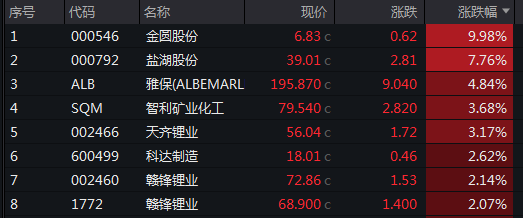
Core Viewpoint - Zimbabwe's recent lithium export ban adds significant pressure to an already tight lithium market, raising concerns about potential price increases for lithium products [2][3][11]. Group 1: Market Impact - Zimbabwe's Ministry of Mines announced a ban on lithium ore exports, including in-transit shipments, with no clear timeline for resumption [2]. - In 2025, China is projected to import approximately 7.751 million tons of lithium concentrate, with 1.204 million tons (15.5%) sourced from Zimbabwe, making it the second-largest supplier after Australia [3][11]. - The ban has intensified market expectations for rising lithium prices, as evidenced by significant price increases in lithium carbonate futures [3][13]. Group 2: Domestic Companies' Performance - Domestic companies with lithium resources, particularly those with low-cost salt lake operations, are favored in the market due to their immunity from overseas export policy changes [3]. - As of February 26, companies like Jinyuan Co. and Salt Lake Co., which have domestic salt lake resources, saw significant stock price increases, outperforming international competitors [3][17]. - The stock performance of domestic lithium companies reflects a preference for those with "self-controllable" resources, indicating a shift in investor sentiment towards local production capabilities [17]. Group 3: Policy and Strategic Shifts - Zimbabwe's "value retention" strategy aims to compel mining companies to refine minerals locally, thereby increasing economic benefits from its resources [5]. - The new regulations restrict export licenses to companies with valid mining rights and approved processing facilities, marking a shift towards more aggressive resource nationalism [8]. - The global lithium supply chain is facing sudden disruptions due to these policy changes, which could have far-reaching implications for the industry [8][9].




新材料2026年度策略:关注国产替代&自主可控领域,重视新质生产力发展(附报告)
材料汇· 2026-02-26 14:06
Core Viewpoint - The chemical materials industry is entering a new transformation cycle driven by energy transition, AI integration, and green low-carbon initiatives, with a focus on domestic substitution and self-control opportunities in the context of geopolitical tensions [2][3][55]. Group 1: Market Overview - Domestic and international demand is experiencing a mild recovery, supported by favorable policies in real estate and consumption, while overseas demand is bolstered by fiscal and monetary easing in the US and Europe [2][28]. - The chemical industry has seen a decline in fixed asset investment, with a cumulative year-on-year decrease of 8.2% by November 2025, indicating the end of the expansion phase that began in 2021 [2][47]. Group 2: Investment Recommendations - The chemical materials industry is expected to undergo significant changes, focusing on three main areas: accelerated energy transition, the penetration of AI and synthetic biology, and the establishment of core competitiveness through green low-carbon initiatives [3][55]. - Investment opportunities are highlighted in domestic substitution and self-control sectors, particularly in semiconductor materials, new energy materials, and coatings [4][57]. Group 3: Semiconductor Materials - The global semiconductor materials market is projected to reach $75.98 billion by 2025, with an 8.4% year-on-year growth, driven by the expansion of global wafer fabs and the recovery of demand for mature process products [5][64]. - The domestic localization rate for key materials such as CMP polishing materials and photoresists is below 30%, indicating significant potential for import substitution [6][64]. Group 4: New Energy Materials - The wind power sector is expected to maintain a high growth trajectory, with China's cumulative installed capacity projected to reach 1.3 billion kilowatts by 2030, supported by favorable policies and market dynamics [7][69]. - The energy storage industry is experiencing explosive demand driven by policy support, AI applications, and export growth, with key materials like lithium hexafluorophosphate seeing significant price increases [7][72]. Group 5: Coatings - The coatings industry is shifting towards value competition, with high-end industrial coatings and military special coatings emerging as new growth engines despite overall market contraction [8][79]. - The global shipbuilding coatings market is expected to reach $6.28 billion by 2025, with domestic manufacturers gaining ground against foreign competitors [10][89].