要素市场化配置

Search documents
深化动力协同,壮大江苏科技领军企业
Xin Hua Ri Bao· 2025-12-22 22:03
Core Viewpoint - The article emphasizes the importance of leading technology enterprises as a crucial component of national competitiveness, highlighting their role in driving innovation, industry upgrades, and development momentum in the face of global competition [1]. Group 1: Current Development Status - China's leading technology enterprises are characterized by diverse business areas and varied technological paths, achieving breakthroughs in fields such as artificial intelligence, integrated circuits, quantum technology, and biomanufacturing [1]. - Compared to global counterparts, there are still gaps in key dimensions such as independent control of core technologies, global market influence, and industrial chain integration capabilities [1]. - Jiangsu Province's leading technology enterprises rank among the top in the country in terms of scale, innovation efficiency, and high-end talent aggregation [1]. Group 2: Innovation Iteration Mechanism - The intrinsic motivation of technology enterprises stems from continuous technological breakthroughs and product innovations, with an iterative innovation mechanism that transforms discrete innovation activities into a replicable and responsive dynamic process [2]. - Innovation iteration involves three layers of logic: stepwise accumulation of technological reserves, precise transformation of market demands, and controllable handling of failure costs [2]. Group 3: Implementation of Innovation Iteration - Effective implementation of the innovation iteration mechanism relies on sustained and precise R&D investment, with enterprises needing to increase R&D intensity and optimize the allocation of R&D resources [3]. - Government support is crucial, focusing on public attributes of basic research and increasing fiscal investment to strengthen the foundation for innovation iteration [3]. - Flexible organizational structures and deep external collaborative networks are essential for enhancing innovation efficiency and providing institutional guarantees for innovation exploration [3]. Group 4: Policy Openness - A high-level policy openness mechanism guides technology enterprises in their technological paths, market layouts, and innovation directions through systematic institutional arrangements [4]. - The mechanism serves to align enterprise innovation activities with national industrial chain security needs, leveraging fiscal subsidies and tax incentives to reduce R&D costs [4]. - Effective policy openness creates a closed-loop coupling of policy supply, enterprise response, and ecological support, enhancing the synergy between policy transformation capabilities and institutional environments [4]. Group 5: Market Mechanism - The market mechanism's resource allocation capability is a core driver for the growth of technology enterprises, influencing decision-making through pricing signals, talent market efficiency, and competitive product market rules [5]. - The market mechanism establishes standards for evaluating technology enterprises, enabling a replacement and transcendence of administrative interventions through collaborative market factors [5]. Group 6: Synergistic Growth Drivers - The combined forces of innovation iteration, high-level policy openness, and market-driven resource allocation will collectively promote the growth of technology enterprises [6]. - Continuous R&D and technological breakthroughs build core barriers, while government policies and market mechanisms activate growth vitality, forming a synergistic closed loop that helps technology enterprises overcome development bottlenecks and occupy industry leadership positions [6].
市场监管总局:平台强推“全网最低价”或构成垄断|营商环境周报
2 1 Shi Ji Jing Ji Bao Dao· 2025-12-22 06:45
Group 1: National Power Market Evaluation System - The National Development and Reform Commission and the National Energy Administration have issued a notification to establish a nationwide unified power market evaluation system focusing on four key areas: market operation effectiveness, market role performance, sustainable development of operating entities, and market competition adequacy [2][3] - The evaluation aims to create a scientific, systematic, and dynamic power market evaluation framework that balances multiple objectives such as security of supply, green transition, and economic efficiency [2][3] - The evaluation work will be organized by the National Development and Reform Commission and the National Energy Administration, with participation from market operators, universities, and research institutions [3] Group 2: High-Quality Development of Service Outsourcing - The Ministry of Commerce and six other departments have released an action plan to promote high-quality development in the service outsourcing sector, aiming to cultivate a number of internationally competitive leading enterprises by 2030 [4][5] - The action plan includes six specific measures focusing on enhancing platform capabilities, fostering innovation, nurturing key players, expanding market access, developing industry standards, and training talent [4][5] - The plan emphasizes the integration of digital economy with the real economy, promoting the development of international data service businesses and establishing a data service industry chain [5] Group 3: Antitrust Compliance Guidance - The State Administration for Market Regulation has introduced compliance guidelines addressing eight new types of monopoly risks for platform enterprises, including algorithm collusion and unfair pricing practices [6][8] - The guidelines aim to help platform operators identify, assess, and prevent antitrust compliance risks, promoting a shift from reactive enforcement to proactive compliance management [7][8] - The guidelines encourage platforms to develop internal management systems for antitrust compliance, ensuring sustainable development and healthy market competition [8] Group 4: Element Market Reform in Henan Province - The Henan Provincial Government has released a comprehensive reform pilot plan for market-oriented allocation of factors, proposing 70 specific measures to enhance the flow and efficient allocation of resources [10][11] - The plan includes initiatives to promote technological innovation, improve land allocation efficiency, facilitate human resource mobility, and establish data circulation rules [10][11][12] - The plan aims to support the development of high-end equipment, new materials, and biomedicine sectors through the establishment of verification centers and pilot bases [10][11] Group 5: Support for Biomedicine and Medical Devices in Sichuan Province - The Sichuan Provincial Government has issued policies to support the high-quality development of the biomedicine and medical device industries, including financial incentives for innovative drugs and devices [13][14] - The policies focus on enhancing research capabilities, improving clinical trial quality, and optimizing approval processes for innovative products [13][14] - The initiative aims to create a favorable ecosystem for industry development, including support for intellectual property protection and financial leasing for medical equipment [14] Group 6: Innovative "Rent-Equity Linkage" Mechanism in Zhejiang - The Taizhou Bay New Area in Zhejiang has introduced a "rent-equity linkage" mechanism to alleviate financial pressures on startups while enhancing the park's service capabilities [16][17] - This model allows selected high-potential tech companies to defer rent payments, enabling them to focus on research and market expansion [16][17] - The mechanism aims to foster a long-term partnership between the park and enterprises, facilitating investment and shared growth opportunities [17]
锚定“十五五” 都市圈产业协同与机制创新如何竞速?
Mei Ri Jing Ji Xin Wen· 2025-12-20 09:56
Core Insights - The article emphasizes the importance of urban agglomerations as key components of China's new urbanization strategy, highlighting the need for integrated development and collaboration among cities to enhance regional economic ties [1] Group 1: Urban Agglomeration Development - The "14th Five-Year Plan" suggests accelerating the integration of urban clusters and urban agglomerations, providing a clear path for future urban agglomeration construction [1] - The core of urban agglomeration integration is to break down administrative barriers, facilitate the flow of factors, and deepen cross-regional collaborative development [1] Group 2: Industrial Collaboration - Urban agglomeration construction is likened to a "big brother leading the siblings," where the core city must be strong enough to benefit surrounding cities and drive overall development [2] - Various urban agglomerations are focusing on specific industrial strengths, such as Qingdao's emphasis on marine economy and high-end services, Zhengzhou's advanced manufacturing clusters, and Xi'an's collaboration with key enterprises in the automotive sector [2][3] Group 3: Mechanism Innovation - The core of regional collaborative development is the efficiency of factor allocation, which has shifted from traditional factors to include innovative elements like capital, technology, and data [4] - The State Council has approved pilot programs for market-oriented allocation of factors in ten regions, including the Hefei urban agglomeration, providing practical platforms for reform [4] Group 4: Collaborative Governance - Urban agglomerations are exploring innovative governance mechanisms, such as Qingdao's blue asset market and Xi'an's technology innovation agreements among 14 cities [5] - Chengdu's initiatives, including the "Silver-Certificate" platform and cross-city property registration processes, have effectively addressed institutional barriers to factor flow [5] Group 5: Strategic Recommendations - Experts suggest that the "14th Five-Year Plan" period should focus on improving the institutional mechanisms for urban agglomeration integration, drawing on Chengdu's experiences to establish provincial coordination and cooperation groups [6]
创新立市 产业强市 生态兴市
Xin Hua Ri Bao· 2025-12-18 07:47
三是坚持融合联动,"一体化"建设合作平台。中央"十五五"规划建议提出,更好发挥跨区域联结型地区 支撑带动作用。当前,我们正在谋划建设合宁双圈科创联动区,以滁州中心城区创新核为引领,以顶山 汊河、浦口南谯两个省级开发区等东联南京,以合滁(定远、全椒)合作园等西链合肥,建设宁滁合产 业廊道,推动联动机制高效运转、创新要素双向流动、产业分工协同协作,打造具有全国影响力的科技 创新共同体和智能制造集聚区。恳请兄弟城市给予支持,将其纳入南京都市圈"十五五"发展规划。 四是坚持共建共享,"全域化"增进民生福祉。都市圈同城发展的根本目的就是为了提高老百姓的幸福 感、获得感。要持续深化医疗、教育、养老、文旅等领域合作,扩大优质公共服务资源覆盖范围,加强 生态共保联治,共建一体化综合交通体系,高效推进政务服务"跨省通办",推动都市圈发展成果更多更 公平惠及人民群众。 五是坚持携手共进,"协同化"落实重大事项。协同推进《长三角一体化发展"十五五"实施方案》中涉都 市圈重大事项落地落实,共同推动沿沪宁产业创新带扩围提质,深度嵌入创新带产业体系;合力推进沪 渝蓉高铁、宁滁蚌城铁、淮扬高速等跨界重点项目建设,提升宁滁等城际铁路一体化管 ...
省政府大力支持 提出七十条措施 高质量高标准推进郑州市要素市场化配置综合改革试点
Zheng Zhou Ri Bao· 2025-12-17 02:17
Core Points - The State Council approved a pilot program for market-oriented allocation of factors in Zhengzhou and nine other regions, aiming for high-quality and high-standard reforms [1] - The Henan provincial government released a comprehensive work plan with 70 specific measures to eliminate barriers to the free flow and efficient allocation of factors [1] Group 1: Technological Innovation - The plan emphasizes the importance of technological factors in driving innovation and proposes reforms for the management of scientific achievements in universities and research institutions [2] - It aims to establish a resource pool for scientific achievements and promote the transformation of these achievements to benefit small and medium-sized enterprises [2][3] - The plan includes the construction of over 30 concept verification centers and pilot bases in key sectors such as high-end equipment and biomedicine [2] Group 2: Land Resource Allocation - The plan seeks to improve the efficiency of land use for industrial development by implementing standardized land transfer and ensuring immediate project initiation upon land acquisition [4] - It proposes measures to revitalize existing land resources and establish a unified market for construction land, allowing rural collective land to enter the market [4] Group 3: Talent Attraction and Management - The plan aims to relax household registration conditions to facilitate the settlement of agricultural migrants and other residents in Zhengzhou [5] - It includes initiatives to enhance the mobility of labor and talent, improve evaluation systems for technical skills, and establish a digital platform for skill talent [5][6] Group 4: Data and Computing Infrastructure - The plan outlines the establishment of a comprehensive data registration and trading system, promoting the use of artificial intelligence and other new technologies [7] - It aims to build advanced computing infrastructure, including a national supercomputing center in Zhengzhou, to support various sectors [7] Group 5: Financial Services for Innovation - The plan proposes measures to enhance financial services for the real economy, including the introduction of "technology talent loans" and the establishment of a scoring system for technology talent [8][9] - It aims to stimulate capital market activity and support the development of various financial products to facilitate direct financing for enterprises [8] Group 6: Resource Market Mechanisms - The plan emphasizes the need to improve market mechanisms for resource allocation, particularly in the electricity and water sectors, to support economic and environmental sustainability [10] - It includes initiatives to participate in national carbon trading and promote market-based water rights trading [10] Group 7: Advanced Production Factors - The plan focuses on the innovative allocation of production factors in emerging sectors such as artificial intelligence and low-altitude economy, aiming to enhance service sector reforms [11] - It proposes the establishment of a comprehensive analysis system for various production factors to facilitate better decision-making and resource allocation [11]
高质量高标准推进郑州市 要素市场化配置综合改革试点
Zheng Zhou Ri Bao· 2025-12-15 00:40
Core Viewpoint - The State Council has approved a comprehensive reform pilot for market-oriented allocation of factors in Zhengzhou and nine other regions, aiming to enhance the quality and efficiency of resource allocation through 70 specific measures outlined in the reform plan [1] Group 1: Technological Innovation and Market Development - The reform plan emphasizes the importance of technological factors in driving innovation and proposes reforms in the management of scientific achievements in universities and research institutions [2] - It aims to establish a resource library for scientific achievements and promote the transformation of these achievements to support small and medium-sized enterprises [2] - The plan includes the construction of 30 concept verification centers and pilot bases in high-end equipment, new materials, and biomedicine [2] Group 2: Land Resource Optimization - The plan seeks to improve the efficiency of industrial land use by implementing standardized land transfer and ensuring immediate project commencement upon land acquisition [4] - It proposes measures to revitalize existing land resources and establish a unified urban-rural construction land market [4] - The plan includes policies to support the transformation of old industrial areas into cultural industries [4] Group 3: Talent Attraction and Management - The reform plan aims to relax household registration conditions to facilitate the settlement of agricultural migrants and other residents in Zhengzhou [5] - It proposes the establishment of a digital ecosystem for skilled talent and the development of a talent evaluation system linked to public services [6] - The plan includes initiatives to attract high-end talent and support innovation and entrepreneurship through various programs [6] Group 4: Data and Computing Infrastructure - The plan outlines the establishment of a comprehensive data registration and trading system, along with a national supercomputing center in Zhengzhou [7] - It aims to create benchmark data application scenarios in key sectors such as transportation, healthcare, and education [7] - The plan emphasizes the importance of data asset evaluation and the development of a data-driven economy [7] Group 5: Financial Services for Innovation - The reform plan introduces "Technology Talent Loans" to provide comprehensive financial services for technology-driven enterprises [8][9] - It aims to enhance the capital market's vitality and support the development of various financial products for small and medium-sized enterprises [8] - The plan includes measures to increase the proportion of RMB settlements in foreign trade [9] Group 6: Resource Market Mechanisms - The plan proposes improvements to the market mechanisms for resource allocation, particularly in the electricity and water sectors [10] - It emphasizes the need for a green trading mechanism and participation in national carbon trading [10] - The plan aims to facilitate market-oriented water rights trading to support industrial development [10] Group 7: Advanced Production Factors - The reform plan focuses on the innovative allocation of production factors in emerging industries such as healthcare, artificial intelligence, and low-altitude economy [11] - It aims to establish a comprehensive analysis system for various production factors to enhance decision-making and resource allocation [11] - The plan includes measures to ensure fair distribution of benefits from land use changes to various stakeholders [11]
河南省人民政府正式印发《郑州市要素市场化配置综合改革试点工作方案》 给土地“松绑” 为人才铺路
He Nan Ri Bao· 2025-12-14 23:41
Core Viewpoint - The Zhengzhou government has officially issued a comprehensive reform pilot plan for market-oriented allocation of factors, aiming to enhance the efficiency of resource allocation and promote high-quality development in the region [2][4]. Group 1: Reform Initiatives - The plan includes 70 reform measures focusing on key factors such as technology, land, human resources, data, capital, and environmental resources [2]. - Zhengzhou will establish 30 concept verification centers and pilot bases, along with over 100 provincial-level technology innovation platforms to facilitate the commercialization of research outcomes [2][3]. Group 2: Land and Human Resource Policies - The plan promotes long-term leasing of industrial land, a "standard land" transfer system, and a "land acquisition upon commencement" policy to reduce costs for enterprises [4]. - It aims to attract talent by relaxing household registration conditions for agricultural migrants and improving public service access for all residents [4][5]. Group 3: Data and Technology Development - The plan emphasizes the establishment of a data asset evaluation system and aims to cultivate over 50 benchmark data application scenarios in sectors like transportation, healthcare, and education [6]. - Zhengzhou will build a national supercomputing center and a core hub for supercomputing internet [6]. Group 4: Talent Development - The plan includes reforms in the salary system for public institutions and the establishment of a talent-sharing mechanism to meet the demands of emerging industries [5]. - It aims to attract top talent by adding 20 leading talents and over 200 technology leaders [5].
温州、徐州、大连冲刺万亿GDP城市,谁将晋级?
2 1 Shi Ji Jing Ji Bao Dao· 2025-12-12 12:16
Core Viewpoint - The expansion of the "trillion GDP club" is a significant highlight of regional economic development this year, with cities like Wenzhou, Xuzhou, and Dalian expected to join the ranks of cities with a GDP exceeding one trillion yuan [1][2]. Group 1: Economic Progress of Cities - Wenzhou is projected to surpass a GDP of one trillion yuan this year, with a GDP growth rate of 6.3% expected in 2024, reaching 9,719 billion yuan [5]. - Xuzhou's GDP is anticipated to exceed 1 trillion yuan by 2025, with a current GDP of 7,298.12 billion yuan and a growth rate of 6.0% [13]. - Dalian aims to achieve a GDP of 9,516.9 billion yuan in 2024, with a growth rate of 6.0% in the first three quarters of this year [10]. Group 2: Characteristics of the Expansion - The expansion of the trillion GDP cities includes ordinary prefecture-level cities, with Wenzhou and Xuzhou being notable examples [3]. - Cities with GDPs between 700 billion and 800 billion yuan, such as Shaoxing, Yangzhou, Yancheng, and Jiaxing, are expected to be the main contributors to future expansions [15]. - The trend indicates a shift from provincial capitals and municipalities to ordinary prefecture-level cities, impacting the economic landscape of China [3][15]. Group 3: Industrial Development and Economic Structure - Wenzhou's economy is supported by a robust manufacturing base and a strong private sector, with 83% of its GDP generated by the private economy [5][6]. - Dalian is focusing on developing high-tech manufacturing and has set a target for its new strategic emerging industries, although it faces challenges in establishing core competitiveness [12]. - Xuzhou, as a traditional industrial base, is also undergoing a transformation to enhance its economic structure and achieve balanced regional development [14]. Group 4: Future Outlook and Trends - The future expansion of the trillion GDP club is expected to include more ordinary prefecture-level cities, reflecting a broader trend of economic growth and regional coordination [17]. - The focus will shift from mere GDP growth to the quality of GDP, emphasizing structural optimization and the well-being of residents [18]. - The development strategies of cities like Shaoxing, Jiaxing, and Yangzhou highlight the importance of regional collaboration and integration with nearby major cities [16].


四川“十五五”规划建议:积极融入全国统一大市场
Zheng Quan Shi Bao Wang· 2025-12-10 00:40
人民财讯12月10日电,中共四川省委关于制定四川省国民经济和社会发展第十五个五年规划的建议发 布,其中提到,积极融入全国统一大市场。着力打通制约经济循环的卡点堵点,完善要素市场化配置机 制,创新产业(300832)用地供应方式和自然资源资产收储运营模式,盘活利用闲置低效资产资源,深 化水、能源、交通等领域价格改革,建设统一规范的人力资源市场体系,促进各类要素资源在更大范围 内畅通流动。支持成都开展要素市场化配置综合改革试点。全面落实市场基础制度规则,依法平等长久 保护各种所有制经济产权,加强公平竞争审查刚性约束,严格执行市场准入"全国一张清单",持续规范 招商引资行为。推进川渝区域市场一体化,打造融入全国统一大市场样板。 ...
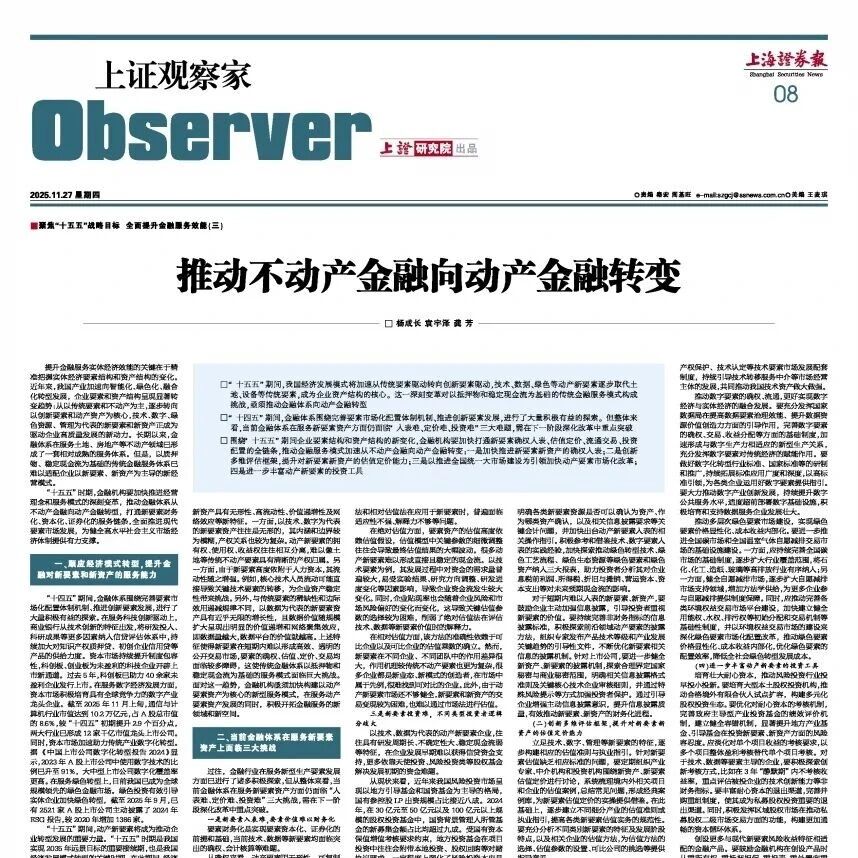
洞见 | 申万宏源杨成长:推动不动产金融向动产金融转变
申万宏源证券上海北京西路营业部· 2025-12-02 02:21
Core Viewpoint - The article emphasizes the need for China's financial system to transition from real estate finance to movable asset finance, driven by the shift in economic development from traditional factor-driven models to innovation-driven models during the "14th Five-Year Plan" and "15th Five-Year Plan" periods [2][3]. Group 1: Economic Transition and Financial System Challenges - During the "14th Five-Year Plan," the financial system explored ways to improve the market-oriented allocation of factors and promote the development of innovative factors, but it still faces challenges in serving new asset types [2][4]. - The transition to an innovation-driven economy will require financial institutions to adapt their service models to support new asset structures, focusing on technology, data, and green resources [5][6]. Group 2: New Asset Characteristics and Financial Service Requirements - New factors and assets are characterized by intangibility, high liquidity, and value increment, which pose challenges for traditional financial service models based on collateral and stable cash flows [7][8]. - The financial system must develop new service models that cater to movable asset characteristics, addressing the difficulties in rights confirmation, valuation, pricing, and investment [8][9]. Group 3: Current Challenges in Financial Services for New Factors - The financial system faces three main challenges: difficulty in incorporating new factors into financial statements, challenges in valuation due to lack of stable cash flows, and investment difficulties stemming from differing investor logic [8][9][10]. - New factors struggle with rights confirmation and accounting, as existing frameworks do not adequately address the unique characteristics of technology and data assets [9][10]. Group 4: Strategies for Financial Service Improvement - Financial institutions should enhance their capabilities in confirming rights and integrating new assets into financial statements, developing modern accounting systems that reflect the changes brought by technological and green transformations [16][17]. - A multi-dimensional evaluation framework should be established to improve the valuation and pricing capabilities for new factors and assets, involving industry experts and investment institutions [18][19]. - The construction of a unified national market for movable assets should be prioritized to facilitate the trading and circulation of new factors, enhancing market efficiency [20][21]. Group 5: Investment Tools and Financial Product Innovation - There is a need to diversify investment tools for movable assets, encouraging the development of patient capital and innovative financial products that align with the risk-return characteristics of new factors [23][24]. - Financial institutions should innovate their service models to better support the development of new factors, focusing on long-term investment strategies and enhancing risk management capabilities [25].