
货币宽松预期

Search documents
10月PMI点评:基本面对债市的定价权再次确认
Changjiang Securities· 2025-11-02 23:30
1. Report Industry Investment Rating No information provided in the given content. 2. Core Viewpoints of the Report - In October 2025, the decline of manufacturing PMI, weaker than the seasonal level and with weakening supply and demand, may indicate certain downward pressure on the Q4 economy [2][7]. - Both domestic and external demands declined, and price indicators did not continue the improvement trend of last month. The differentiated structure of "strong raw material prices and weak finished - product prices" may restrict the repair of corporate profits [2][7]. - The business climate of large enterprises fell below the boom - bust line, and the business climates of high - tech manufacturing and equipment manufacturing industries significantly declined [2][7]. - The business climate of the non - manufacturing industry is mainly driven by holiday service consumption, and the overall expansion strength is still weak [2][7]. - The trading logic of the bond market in Q4 focuses on the weakening economic fundamentals and the expectation of monetary easing, and a repair market may be welcomed. It is expected that the yield of the active 10 - year treasury bond (tax - exempt) may decline to 1.65% - 1.7%, and the yield of the taxable bond may decline to 1.7% - 1.75% [2][7]. 3. Summary by Relevant Catalogs 3.1 Event Description - In October 2025, the manufacturing PMI was 49.0%, a decrease of 0.8 pct from the previous month, lower than the Wind consensus forecast of 50.0%. The non - manufacturing business activity index slightly increased by 0.1 pct to 50.1%, slightly higher than the boom - bust line and lower than the Wind consensus forecast of 50.3%. Among them, the service industry business activity index was 50.2%, an increase of 0.1 pct, and the construction industry business activity index was 49.1%, a decrease of 0.2 pct [5]. 3.2 Event Comment - **Manufacturing PMI and economic pressure**: The manufacturing PMI in October 2025 fell back to a nearly two - year low. The production index and new order index decreased by 2.2 pct and 0.9 pct respectively to 49.7% and 48.8%. The procurement volume index decreased significantly by 2.6 pct to 49.0%, and the difference between the "finished - product inventory - on - hand orders" index widened by 0.6 pct to 3.6 pct. The weak pattern of production and demand was partly due to the pre - release of some demand before the National Day holiday and partly reflected the lack of endogenous momentum, indicating certain downward pressure on the Q4 economy [7]. - **Demand and price situation**: In October, external demand did not continue its resilience, and the new export order index significantly declined by 1.9 pct to 45.9%. The new order index for domestic demand also turned from rising to falling. The main raw material purchase price index and the ex - factory price index both decreased by 0.7 pct, recording 52.5% and 47.5% respectively. The difference between them remained at 5.0 pct, and the main raw material purchase price index was still in the expansion range. The "strong raw material prices and weak finished - product prices" structure may restrict the repair of corporate profits [7]. - **Enterprise and industry changes**: Among enterprises, the PMIs of large and small enterprises both fell by 1.1 pct to 49.9% and 47.1% respectively, and the PMI of medium - sized enterprises slightly fell by 0.1 pct to 48.7%. In terms of industries, the PMIs of high - tech manufacturing and equipment manufacturing industries were 50.5% and 50.2% respectively, a decline of 1.1 pct and 1.7 pct from the previous month. The consumer goods industry remained in the expansion range, slightly falling by 0.5 pct to 50.1%, while the PMI of the basic raw material industry further dropped to 47.3%. The overall market expectation was optimistic, with the production and business activity expectation index at 52.8%, and the expectation indexes of industries such as non - ferrous metals and transportation equipment rising to the high - level boom range above 60% [7]. - **Non - manufacturing industry situation**: In October, the non - manufacturing PMI slightly increased by 0.1 pct to 50.1%, and the service industry PMI rose to 50.2%. The on - hand order index fell by 0.8 pct while the new order index remained flat, indicating that the holiday effect was the main driver. The business activity indexes of industries such as transportation, accommodation, and culture and entertainment were all in the high - level boom range above 60%, but industries such as real estate continued to be sluggish. The construction industry business activity index turned from rising to falling, decreasing by 0.2 pct to 49.1%, possibly dragged down by the slowdown of holiday construction and the decline of post - holiday real estate sales [7]. - **Bond market outlook**: Currently, the endogenous momentum for the repair of production and demand may be limited. On the day when the PMI data was released, the yield of the 10 - year treasury bond active bond decreased by 0.95 BP. The economic fundamentals still face a pattern of weak supply and demand, the pressure on enterprises for passive inventory replenishment continues, and the ex - factory - raw material price gap still restricts the repair of corporate profits. Although 500 billion yuan of new policy - based financial instruments have been put in place and local governments have an additional 200 billion yuan of special bond quotas, the sustainability of the recovery of real estate sales and the transmission effect of policy funds on infrastructure investment still need to be observed. The trading logic of the bond market in Q4 focuses on the weakening economic fundamentals and the expectation of monetary easing, and a repair market may be welcomed. It is expected that the yield of the active 10 - year treasury bond (tax - exempt) may decline to 1.65% - 1.7%, and the yield of the taxable bond may decline to 1.7% - 1.75% [7].
金晟富:10.28黄金独家目标3950符合预期!后市黄金分析参考
Sou Hu Cai Jing· 2025-10-27 16:49
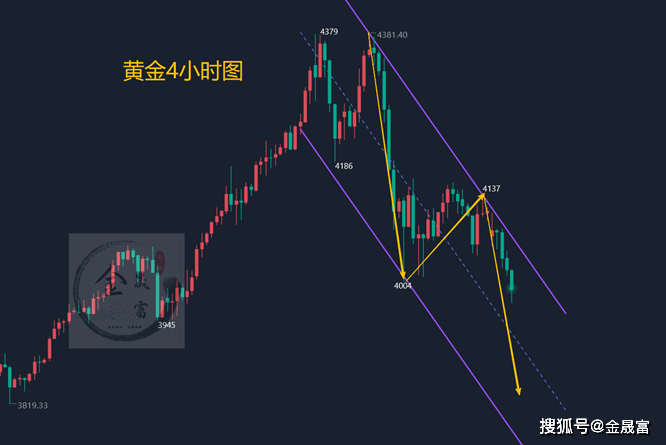
Core Viewpoint - The recent decline in gold prices is attributed to improved US-China trade relations, which has reduced demand for gold as a safe-haven asset, while market focus shifts to the upcoming Federal Reserve interest rate decision [1][2]. Group 1: Market Trends - On October 27, gold prices fell by 3.24%, trading at $3,971.08 per ounce, following a nine-week rally that saw prices peak above $4,300 due to geopolitical risks and monetary easing expectations [1]. - The recent drop in gold prices is linked to a preliminary agreement reached between US and Chinese officials during the ASEAN meetings, indicating a potential extension of the trade truce and reduced risks of renewed trade tensions [1][2]. Group 2: Economic Indicators - The upcoming week is significant for the gold market, with multiple central banks, including the Federal Reserve, expected to announce interest rate decisions, alongside the release of key economic data such as the September core PCE price index and Q3 US GDP figures [2]. - Market expectations for a 25 basis point rate cut by the Federal Reserve are supported by weaker-than-expected US consumer price index (CPI) data, which may limit further declines in gold prices [2]. Group 3: Technical Analysis - Technical analysis indicates that gold has broken below the $4,000 support level, with further downward movement expected, targeting levels around $3,945 [2][4]. - The current trading strategy suggests a focus on short positions, with recommendations to sell on rebounds near the $4,004-$4,010 range, while potential long positions could be considered near $3,945-$3,950 [4].

金价高位震荡,或进入月度调整行情,黄金ETF基金(159937)连续13日“吸金”合计超70亿元,高盛:黄金将冲上4900美元!
Sou Hu Cai Jing· 2025-10-23 02:42
Group 1 - The core viewpoint of the articles indicates a short-term decline in gold prices driven by profit-taking and reduced safe-haven demand, while long-term bullish sentiment remains strong due to ongoing geopolitical uncertainties and monetary policy conditions [4][5][6] - As of October 22, 2025, the gold ETF fund has seen a recent decline of 1.88%, but it has accumulated an increase of 8.82% over the past two weeks [3] - Goldman Sachs maintains a long-term price target of $4,900 per ounce for gold by the end of 2026, highlighting the growing market interest in gold's long-term allocation value [4] Group 2 - The recent short-term sell-off in gold is attributed to multiple factors, including easing trade tensions, a rebound in the US dollar index, and profit-taking by investors [4] - The World Gold Council emphasizes that the gold investment market is not saturated and remains in a relatively low allocation state compared to global stock market valuations, indicating ample growth potential [4][5] - The gold ETF fund has seen significant inflows, with a total of 73.47 billion yuan in net inflows over the past 13 days, averaging 5.65 billion yuan per day [7]

金价要涨到5000?各国央行持续增持!美国市场遭遇巨大冲击
Sou Hu Cai Jing· 2025-10-22 11:53
Core Viewpoint - The recent surge in gold prices is driven by a combination of geopolitical tensions, economic uncertainties, and a shift in central bank strategies towards gold as a core reserve asset [1][3][9]. Group 1: Market Dynamics - Gold prices experienced a dramatic increase, reaching a historical high of $4,398 per ounce, before closing around $4,380 [1]. - The volatility in gold prices was influenced by news regarding U.S.-China trade negotiations and the easing of banking crisis fears, which initially reduced demand for gold as a safe haven [1][3]. - The ongoing U.S. government shutdown has created a "data vacuum," complicating the Federal Reserve's ability to make informed decisions, leading to a high probability of interest rate cuts [3][4]. Group 2: Central Bank Behavior - Central banks globally are increasing their gold reserves, with a reported addition of 19 tons in August alone, reflecting a structural change in reserve management [6][9]. - The shift in perception of gold from a cyclical asset to a core high-liquidity asset is driven by concerns over U.S. fiscal stability and the desire to reduce reliance on the dollar [9][10]. - The trend of "de-dollarization" is evident, as countries like Russia seek to hold assets that are less susceptible to sanctions, while emerging markets explore alternatives to the dollar [9][11]. Group 3: Future Projections - HSBC has set a bold target of $5,000 per ounce for gold by 2026, supported by factors such as central bank purchases, U.S. fiscal deficits, and expectations of continued monetary easing [6][7]. - Analysts predict that as long as political and economic uncertainties persist, gold prices could continue to rise, with some suggesting that breaking the $5,000 mark is plausible [7][13]. - The current gold bull market is seen as a response to a crisis of confidence in fiat currency systems, indicating a significant shift in the global monetary landscape [9][13].
金矿股连跌一周,金矿股比金价跌得还猛!|市场观察
Di Yi Cai Jing· 2025-10-22 05:02
Core Viewpoint - The article discusses the significant decline in gold mining stocks, which have fallen more sharply than gold prices, driven by market expectations of an end to the Russia-Ukraine conflict and subsequent drops in international gold prices [1] Group 1: Market Performance - On October 22, the Shanghai gold (au7777) fell by 4.75%, closing at 943.3 yuan per gram, while London spot gold hit a low of 4002 USD per ounce [1] - Gold mining stocks, including Shandong Gold (600547.SH), Zhongjin Gold (600489.SH), and Chifeng Gold (600988.SH), experienced collective declines, with closing drops nearing or exceeding 4% [1] - The recent market trend saw gold and gold mining stocks rise for nearly two months due to factors such as U.S. government shutdowns, escalating trade tensions, and significant central bank purchases, peaking on October 14 before a correction began [1] Group 2: Future Outlook - Industry experts believe that despite the short-term sharp decline in gold prices, the expectations of monetary easing remain a medium-term positive for precious metals [1] - For gold mining stocks, the larger previous gains have led to earlier and more significant corrections, with additional fundamental factors to consider, as some companies reported third-quarter results that fell short of expectations [1]
金矿股连跌一周,跌幅比金价更猛
第一财经· 2025-10-22 04:37
Core Viewpoint - The article discusses the recent decline in gold prices and gold mining stocks due to market expectations of a potential end to the Russia-Ukraine conflict, despite previous upward trends driven by various economic factors [3][4]. Group 1: Market Trends - On October 22, gold prices fell significantly, with Shanghai gold (au7777) down 4.75% to 943.3 yuan per gram, and London spot gold hitting a low of 4002 USD per ounce [3]. - Gold mining stocks also experienced sharp declines, with companies like Shandong Gold and Zhongjin Gold seeing closing drops of nearly or over 4% [3]. - The recent rally in gold prices lasted nearly two months, driven by factors such as U.S. government shutdowns, trade tensions, and central bank purchases, but peaked on October 14, leading to a correction of over a week [3]. Group 2: Analyst Insights - Analysts believe that despite the short-term drop in gold prices, the medium-term outlook remains positive due to expectations of monetary easing, which is favorable for precious metals [4]. - The correlation between gold mining stocks and gold prices is strong but not absolute, as stock prices are also influenced by overall market performance and specific company news [4]. - There is a tendency for gold mining stocks to be overhyped, with their price increases outpacing gold prices prior to mid-October, leading to a necessary correction [4]. Group 3: Future Outlook - The recent drop in gold prices is viewed as temporary, with potential for future increases driven by rising global tensions, growing distrust in currencies, and increased demand for safe-haven assets [4]. - As gold mining companies release their third-quarter earnings, some results have not met market expectations, causing investor uncertainty regarding the profitability of these stocks [4]. - The upcoming U.S.-China talks are being monitored closely, as any positive developments could dampen demand for gold and silver as safe-haven assets [5].




金矿股连跌一周,跌幅比金价更猛!|市场观察
Di Yi Cai Jing Zi Xun· 2025-10-22 04:29
Group 1 - The market anticipates a potential end to the Russia-Ukraine conflict, leading to a significant drop in international gold prices [1] - On October 22, the Shanghai gold price (au7777) fell by 4.75%, closing at 943.3 yuan per gram, while London spot gold hit a low of 4002 USD per ounce [1] - Gold mining stocks also experienced sharp declines, with companies like Shandong Gold, Zhongjin Gold, and Chifeng Gold seeing closing drops nearing or exceeding 4% [1] Group 2 - The recent surge in gold prices was driven by factors such as U.S. government shutdowns, escalating trade tensions, and significant central bank purchases, leading to a peak on October 14 [1] - Following a joint statement from European leaders on October 21 supporting negotiations for a ceasefire, gold prices plummeted [1] - Analysts believe that despite the short-term drop, the expectation of monetary easing remains a medium-term positive for precious metals [1] Group 3 - According to Everbright Securities strategist Wu Lixian, the recent pullback in gold prices is a normal and healthy phenomenon after a rapid rise to nearly 4400 USD per ounce [2] - Gold mining stocks are highly correlated with gold prices, but this correlation is not absolute, as stock prices are also influenced by overall market performance and specific company news [2] - Red Ant Capital's investment director Li Zeming noted that gold mining stocks often experience excessive speculation, and the recent decline is primarily due to significant adjustments in gold and other precious metal prices [2] Group 4 - Fund manager Wang Xiang from Bosera Fund mentioned that traders are currently focused on the upcoming China-U.S. talks, which could suppress demand for safe-haven assets like gold and silver if tangible progress is made [3]
沪金银跌超5%,现货黄金跌回4002美元,贵金属是否进入“打折季”?
Di Yi Cai Jing· 2025-10-22 01:56
Group 1 - International gold and silver prices have experienced a significant drop, with Shanghai gold and silver futures opening down over 5%, and London spot gold hitting a low of $4002 per ounce [1] - The recent decline in precious metal prices follows a period of rapid increases, with gold reaching a peak of $4086 per ounce and silver dropping below $50 per ounce, indicating a correction after a sustained overbought condition [1] - Despite the short-term drop, analysts believe that the expectations of monetary easing remain intact, suggesting that this is not a trend reversal for precious metals [1] Group 2 - HSBC remains optimistic about gold, projecting that its upward momentum could last until 2026, driven by strong central bank purchases, ongoing fiscal concerns in the U.S., and expectations of further monetary easing, with a target price of $5000 [2] - Huaxin Fund has noted that short-term trading in gold is overheated, with volatility indicators reaching high levels, suggesting potential risks in the market [2] - Analysts indicate that while central bank purchases and growing investment demand will support long-term price increases for precious metals, investors should remain cautious of short-term adjustments due to trading and event-driven shocks [2]
大宗商品周报:关税仍存在不确定性扰动商品短期或震荡运行-20251020
Guo Tou Qi Huo· 2025-10-20 11:03
Report Industry Investment Rating No relevant content provided. Report's Core View - The commodity market may fluctuate in the short - term due to uncertainties such as Trump's trade policy, Sino - US trade negotiations, the US government shutdown, and geopolitical situations. The precious metals sector has strong potential, while other sectors have different trends [2]. Summary by Related Catalogs 1. Market Performance Review - The commodity market declined by 1.14% last week. Only the precious metals sector rose by 10.76%, while the non - ferrous, agricultural products, black, and energy - chemical sectors fell by 1.07%, 1.52%, 1.66%, and 3.43% respectively. The 20 - day average volatility of the commodity market increased with a narrowing margin, and the precious metals and energy - chemical sectors had significant volatility increases. The overall market scale increased, with only the non - ferrous sector having net capital outflows, mainly concentrated in Shanghai copper [2][6]. - Among specific varieties, gold, silver, and soybean No.1 had the highest gains of 10.9%, 10.53%, and 2.03% respectively, while glass, crude oil, and fuel oil had the largest declines of 9.28%, 6.34%, and 5.54% respectively [6]. 2. Outlook for Different Sectors Precious Metals - The uncertainty of Sino - US economic and trade relations strengthens the sector's hedging properties. Powell's statement that balance - sheet reduction may end in the next few months strengthens the expectation of monetary easing, leading to a significant rise in the sector. The actual overall position of gold is at a low level, with potential for further growth. Short - term fluctuations may intensify [2]. Non - Ferrous Metals - The Fed's October Beige Book shows weakening consumer spending and a labor shortage. Domestically, the economy continues to improve. The raw material supply is tight, and inventory increases, with overall supply and demand remaining relatively loose. The sector may fluctuate in the short - term, waiting for a clear macro - environment [3]. Black Metals - The apparent demand for rebar has recovered significantly after the holiday but is still weak year - on - year. Production continues to decline, and inventory has decreased. The high - level hot metal has slightly declined, and downstream carrying capacity is insufficient. With the contraction of steel mill profits, the pressure for steel mills to cut production increases, and the negative feedback expectation of the industrial chain strengthens. The price of coking coal may be prone to rise and difficult to fall. The sector may fluctuate in the short - term, with coking coal and coke relatively stronger [3]. Energy - Oil prices continued to decline last week. The US refinery utilization rate dropped sharply, causing crude oil inventory to increase by 352,400 barrels more than expected. The three major institutions' October reports raised the supply - demand surplus for this year and next year by 210,000 barrels per day and 460,000 barrels per day respectively. The easing of the Russia - Ukraine situation and Sino - US trade games have increased market risk - aversion. Oil prices may continue to be weak in the short - term [3]. Chemicals - For polyester products, the industrial chain may continue to be weak due to weak oil prices and weakening demand expectations. For building materials, PVC domestic demand is stable, but exports face policy pressure, and cost support is not obvious. Glass has high intermediate inventory pressure and continues to be under pressure [4]. Agricultural Products - The sales progress of new - season US soybeans is slow, and China has not purchased US new - season soybeans, putting pressure on US soybean prices. Domestic soybean supply in the fourth quarter is generally stable, and soybean meal inventory is high. If Sino - US trade relations do not improve, soybean meal may fluctuate downward. The pattern of strong oil and weak meal may continue [4]. 3. Commodity Fund Overview - Gold ETFs had significant gains, with most having a weekly return rate of around 11%. The total scale of gold ETFs was 21.8244 billion yuan, with a growth of 10.76%. The trading volume increased by 204.56%. Other commodity funds such as energy - chemical, agricultural product, and non - ferrous metal ETFs had different performance trends [38].
贵金属日报:美国政府继续停摆,贵金属维持强势-20251016
Hua Tai Qi Huo· 2025-10-16 03:22
贵金属日报 | 2025-10-16 美国政府继续停摆 贵金属维持强势 市场分析 IMF发布最新一期《财政监测报告》指出,到2029年,全球公共债务规模预计将首次突破GDP的100%;IMF警告 称如果当前财政支出与债务增长趋势得不到遏制,全球金融稳定性可能面临严重威胁。美国政府方面,美国参议 院以51票对44票的投票结果,再次未能推进共和党的临时拨款法案;据悉,需要60票才能推进这项将为政府提供 资金直至11月底的法案。美联储方面,美联储理事斯蒂芬·米兰最新表示,近期的贸易紧张局势加大了经济增长前 景的不确定性,因此决策者更有必要尽快降息。 2025-10-15,沪金主力合约开于937.50元/克,收于960.34元/克,较前一交易日收盘变动2.27%。当日成交量为41087 手,持仓量为129725手。昨日夜盘沪金主力合约开于958.00元/克,收于962.08元/克,较昨日午后收盘上涨0.18%。 2025-10-15,沪银主力合约开于11430.00元/千克,收于11966.00元/千克,较前一交易日收盘变动3.75%。当日成交 量为2033514手,持仓量为477807手。昨日夜盘沪银主力合约开于1 ...