黄金税收政策

Search documents
金价大跌3500元,印度狂买黄金,中美谈成后,中国开始打压黄金?
Sou Hu Cai Jing· 2025-11-04 07:10
Group 1 - Gold prices have dramatically fallen by nearly $500 within a week, leading to a corresponding drop of over 10% in domestic gold bar prices in China [1] - In contrast, India's gold imports surged to a record $10.06 billion in a single month, accounting for one-sixth of the country's total imports, driven by a significant reduction in import duties from 15% to 6% [10] - The Indian government's move aims to curb rampant gold smuggling and is closely linked to its ambitious infrastructure plans, which require substantial financing [10][12] Group 2 - The recent fluctuations in gold prices are attributed to multiple negative factors, including profit-taking by investors after a significant price increase and a slight easing of international trade tensions [5] - Geopolitical developments, such as calls for negotiations in the Ukraine conflict, have diminished gold's appeal as a safe-haven asset [7] - The technical analysis indicates that prior to the recent drop, gold prices had accumulated a gain of over 65% this year, leading to a rapid sell-off as investors sought to lock in profits [8] Group 3 - The new Chinese gold tax policy, effective until the end of 2027, differentiates between investment and non-investment uses of gold, aiming to enhance the international competitiveness of China's gold market [3][4] - This policy is expected to reshape investment channels, as trading through exchanges will offer tax advantages, making it more attractive for long-term investors [13] - The impact of the new tax policy on gold jewelry consumers is limited, as retail prices already include VAT and consumption tax [13] Group 4 - Central banks globally continue to purchase gold, with China's central bank being a significant buyer, providing strong fundamental support for the gold market [14] - The rise of stablecoins and virtual currencies poses potential pressure on traditional gold demand, as some investors view them as alternatives to gold [14] - India's Reserve Bank has been actively increasing its gold reserves, with a strategy focused on diversifying its foreign exchange reserves amid rising U.S. Treasury yields [15][16]


大行积存金业务暂停又恢复,已有银行金条价格含税上调
第一财经· 2025-11-04 07:04
Core Viewpoint - The recent changes in gold tax policies have led to multiple banks, including Industrial and Commercial Bank of China (ICBC), China Construction Bank, and Agricultural Bank of China, temporarily suspending their gold accumulation and physical exchange services, with some banks adjusting their product offerings and pricing in response to the new regulations [3][5][12]. Group 1: Impact of New Tax Policies - The new gold tax policy has prompted banks to pause gold accumulation services and adjust their product offerings, with ICBC and China Construction Bank announcing suspensions on November 3, 2025 [5][6]. - ICBC quickly resumed its gold accumulation services on the evening of the same day, indicating a rapid response to the regulatory changes [7][8]. - The adjustments made by banks are primarily due to system upgrades and the need to comply with the new tax regulations, rather than a significant impact on their gold business [12][14]. Group 2: Changes in Product Offerings - Banks like China Merchants Bank have shifted some of their self-operated gold products to a consignment model, reducing the range of physical gold products available for exchange [8][15]. - The new tax policy has led to an increase in the prices of physical gold products, with banks adjusting their pricing structures accordingly [12][15]. - The changes in tax regulations mean that banks will now face different invoicing rules, which could affect their cost structures and pricing strategies for gold products [13][14]. Group 3: Market Reactions and Future Outlook - The market for gold products has seen a tightening of inventory, with certain gold bars becoming unavailable for purchase [9][12]. - Industry experts suggest that while the immediate impact on banks' gold businesses may be limited, the overall product and operational structures will undergo adjustments in response to the new tax policies [14].



大行积存金业务暂停又恢复,有银行金条价格已含税上调
Di Yi Cai Jing· 2025-11-04 06:40
Core Viewpoint - The recent changes in gold tax policies have led to several major banks temporarily suspending their gold accumulation and physical exchange services, while some banks have adjusted their product offerings in response to the new regulations [1] Group 1: Bank Responses - Major banks such as Industrial and Commercial Bank of China, China Construction Bank, and Agricultural Bank of China have paused gold accumulation and physical exchange services due to the new tax policies [1] - China Merchants Bank has shifted some of its self-operated physical gold products to a consignment model and temporarily removed certain self-operated products from the market [1] - Industrial and Commercial Bank of China quickly announced the resumption of related services on the same day the suspensions were reported [1] Group 2: Impact of New Tax Policies - The new tax policies have had a significant impact on the pricing of investment gold bars, with some banks adjusting their prices to reflect the new tax-inclusive rates [1] - Industry insiders suggest that while the new tax policies will affect the cost structure of banks' gold business, the overall impact is expected to be limited [1] - Future collaborations between banks and third-party institutions, such as gold companies, may change as a result of these new regulations [1]
贵金属数据日报-20251104
Guo Mao Qi Huo· 2025-11-04 06:11
1. Report Industry Investment Rating - Not provided 2. Core Viewpoints - In the short - term, precious metal prices are expected to maintain a range - bound oscillation and are likely to further stabilize. It is recommended to focus on long - term allocation opportunities of buying on dips after stabilization [5] - In the long - term, the Fed is still in an interest - rate cut cycle. Global geopolitical uncertainties persist, and the unsustainable US debt and intensifying great - power competition will increase the credit risk of the US dollar in the long run. With central banks' gold purchases continuing, the long - term center of gold prices is likely to move up. Long - term investors are advised to allocate on dips [5] 3. Summary by Relevant Catalogs 3.1 Price and Spread Data - **15 - point price tracking of internal and external gold and silver on November 3, 2025**: London gold spot was at $4017.06 per ounce, London silver spot at $48.86 per ounce, COMEX gold at $4028.00 per ounce, COMEX silver at $48.58 per ounce, AU2512 at 922.58 yuan per gram, AG2512 at 11455 yuan per kilogram, AU (T + D) at 919.58 yuan per gram, and AG (T + D) at 11424 yuan per kilogram. Compared with October 31, 2025, the price changes were 0.2%, - 0.5%, 0.1%, - 0.1%, 0.1%, 0.1%, 0.1%, and 0.3% respectively [4] - **15 - point price tracking of spreads and ratios on November 3, 2025**: Gold TD - SHFE active spread was - 3 yuan per gram, silver TD - SHFE active spread was - 31 yuan per kilogram, gold internal - external (TD - London) spread was 4.32 yuan per gram, silver internal - external (TD - London) spread was - 1022 yuan per kilogram, SHFE gold - silver ratio was 80.54, COMEX gold - silver ratio was 82.91, AU2602 - 2512 was 2.82 yuan per gram, and AG2602 - 2512 was 24 yuan per kilogram. Compared with October 31, 2025, the changes were - 5.4%, - 38.0%, - 10.8%, - 7.8%, - 0.1%, 0.2%, - 7.8%, and - 4.0% respectively [4] 3.2 Position Data - **As of October 31, 2025**: Gold ETF - SPDR was 1039.2 tons, silver ETF - SLV was 15189.81735 tons. COMEX gold non - commercial long positions were 332808 contracts, non - commercial short positions were 66059 contracts, and non - commercial net long positions were 266749 contracts. COMEX silver non - commercial long positions were 72318 contracts, non - commercial short positions were 20042 contracts, and non - commercial net long positions were 52276 contracts. Compared with October 30, 2025, the changes were - 0.11%, 0.00%, 1.85%, 9.43%, 0.13%, 0.97%, - 0.21%, and 1.43% respectively [4] 3.3 Inventory Data - **As of November 3, 2025**: SHFE gold inventory was 87816.00 kilograms, SHFE silver inventory was 658851.00 kilograms. As of October 31, 2025, COMEX gold inventory was 38168047 troy ounces, and COMEX silver inventory was 482438705 troy ounces. Compared with the previous period, the changes were 0.00%, - 1.01%, - 0.20%, and - 0.14% respectively [4] 3.4 Interest Rate, Exchange Rate, and Stock Market Data - **As of November 3, 2025**: The US dollar/Chinese yuan central parity rate was 7.09. As of October 31, 2025, the US dollar index was 99.73, the 2 - year US Treasury yield was 3.60%, the 10 - year US Treasury yield was 4.11%, VIX was 17.44, the S&P 500 was 6840.20, and NYMEX crude oil was $60.88 per barrel. Compared with the previous period, the changes were - 0.02%, 0.19%, - 0.28%, 0.00%, 3.13%, 0.26%, and 0.98% respectively [4] 3.5 Market Analysis - **Market review**: On November 3, the main contract of Shanghai gold futures closed up 0.47% to 922.58 yuan per gram, and the main contract of Shanghai silver futures closed up 0.39% to 11455 yuan per kilogram [4] - **Analysis and short - term outlook**: The new gold tax policy mainly aims to standardize the gold market, strengthen tax supervision, and has limited impact on prices. With factors such as decreased market risk appetite and the ongoing US government shutdown, precious metal prices are in a range - bound oscillation. However, the divergence within the Fed on a December rate cut and the strong US dollar index will suppress the short - term upside of precious metal prices. Short - term precious metal prices are expected to maintain a range - bound oscillation and may further stabilize [5] - **Medium - and long - term outlook**: In the long run, the Fed is in an interest - rate cut cycle, and factors such as global geopolitical uncertainties, US debt issues, and central bank gold purchases will push up the long - term center of gold prices [5]
金价闪崩真相曝光!财政部一夜取消20年税惠,中小商家已悄然离场
Sou Hu Cai Jing· 2025-11-04 06:08
Core Viewpoint - The recent tax policy change in China has led to a significant drop in gold prices, with spot gold falling to $3963 per ounce, a decrease of nearly $40 in a single day, breaching the psychological threshold of $4000 [1] Tax Policy Changes - The new tax policy, effective from November 1, 2023, eliminates the long-standing VAT deduction for gold, categorizing gold transactions into investment and non-investment uses, which will be managed differently [1][3] - Investment gold transactions will face immediate VAT collection without the ability to deduct input tax upon resale, while non-investment gold buyers can deduct 6% of the invoice amount as input tax [3][4] Market Reactions - Following the announcement, market sentiment soured, with Hong Kong gold stocks dropping over 8% and some small retailers removing investment gold products from sale [3] - The shift in consumer cost structure means that buyers of investment gold may incur an additional 3% to 5% in costs due to the removal of tax benefits [4] Price Disparities and Market Dynamics - A new phenomenon of widening price gaps between on-exchange and off-exchange gold has emerged, as off-exchange gold is subject to a full 13% VAT, leading to lower buyback prices and higher sales prices [6] - Smaller retailers, lacking the channel advantages of larger entities, face increased pressure on profit margins, prompting a shift towards high-value products or personalized services [6] Industry Consolidation - The policy has initiated a trend of consolidation within the industry, with stronger players seeking partnerships with exchange members to share tax benefits, while traditional gold shops may exit the investment gold market [6] Global Context - The policy adjustment aligns with global trends, as central banks have increased gold holdings significantly, and the U.S. monetary policy fluctuations have added uncertainty to gold prices [7] - Compared to the U.S. market, where investment gold is taxed at a higher rate, China's new policy still maintains a lower overall tax burden for on-exchange transactions, enhancing their attractiveness [9] Investor Behavior - Ordinary investors face challenges in choosing channels for gold purchases, as costs rise in non-exchange avenues, while gold ETFs and paper gold products emerge as alternative investment options [9] - The recent fluctuations in gold ETF holdings indicate a shift of funds from physical gold to these financial products, although they carry liquidity risks in extreme market conditions [9] Long-term Outlook - Despite the policy changes, the fundamental attributes of gold as a safe-haven asset remain intact, with analysts predicting potential price increases in the coming year [11] - The tax reform is viewed as a measure to cool speculative activities in the gold market, while also potentially laying the groundwork for a strategic reserve of gold [11]
黄金ETF持仓量报告解读(2025-11-4)中黄金税收影响金价走势
Sou Hu Cai Jing· 2025-11-04 04:06
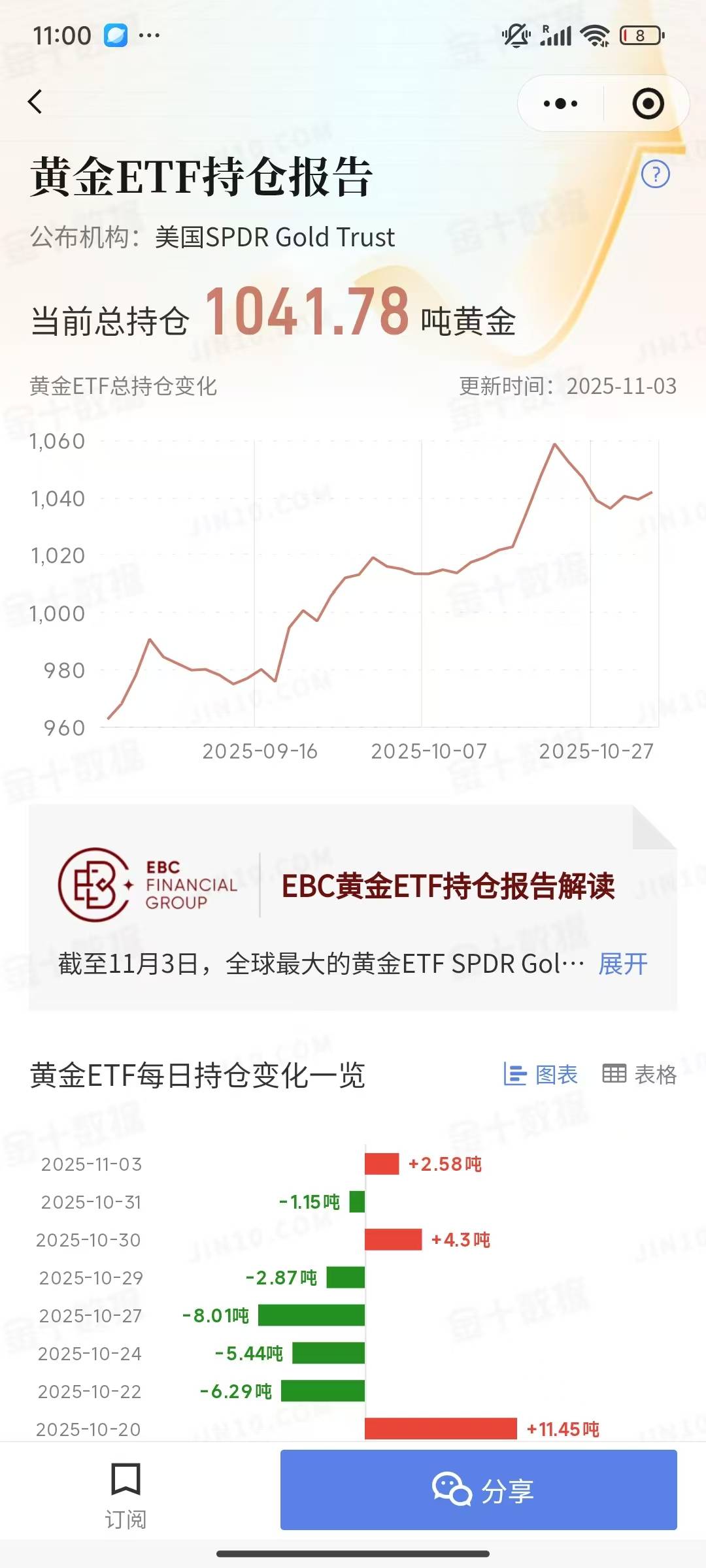
Core Viewpoint - As of November 3, 2025, the SPDR Gold Trust, the world's largest gold ETF, reported a total holding of 1,041.78 tons of gold, reflecting an increase of 2.58 tons from the previous trading day, amidst fluctuating gold prices around the $4,000 per ounce mark [5]. Group 1: Gold ETF Holdings - The current total holding of SPDR Gold Trust is 1,041.78 tons of gold [5]. - The holdings increased by 2.58 tons compared to the previous trading day [5]. Group 2: Gold Price Movements - On November 3, spot gold prices fluctuated, reaching a high of $4,029.39 per ounce and a low of $3,962.97 per ounce, with a trading range exceeding $60 [5]. - The closing price was $4,001.16 per ounce, down by $1.78 or 0.04% [5]. Group 3: Market Influences - The strengthening of the US dollar is pressuring gold prices, with the Federal Reserve's policy stance being a key driver for the dollar's strength [5]. - Recent adjustments in China's gold tax policy, reducing the VAT exemption from 13% to 6%, may also impact gold prices negatively [6]. - The ongoing US government shutdown, now in its 33rd day, raises concerns about economic data releases and broader economic impacts, which could support gold prices in the long term [6]. Group 4: Technical Analysis - Technical indicators show a lack of clear directional momentum for gold, with the RSI at 51 indicating a balance between bullish and bearish forces [7]. - Key resistance levels are identified between $4,030 and $4,045, while support is seen around $3,900 [7]. - A break below the 38.2% Fibonacci retracement level at $3,973 could lead to testing the 50% retracement level at $3,850 [7].
黄金大消息!连发公告:调整
Sou Hu Cai Jing· 2025-11-04 02:10
Core Viewpoint - The recent announcements from major banks regarding the suspension and resumption of gold accumulation services are primarily influenced by new macroeconomic policies and tax regulations affecting the gold market [3][5][7]. Group 1: Bank Announcements - Industrial and Commercial Bank of China (ICBC) announced the resumption of the "Ruyi Gold Accumulation" service after previously suspending it due to macroeconomic policy impacts [1]. - On the same day, China Construction Bank (CCB) also suspended its "Easy Gold" service, affecting real-time purchases and physical gold exchanges, while existing plans remain unaffected [5]. Group 2: Tax Policy Changes - The Ministry of Finance and the State Administration of Taxation released new tax policies for gold, effective from November 1, 2025, which include exemptions from value-added tax (VAT) for certain transactions involving standard gold [7]. - The new tax regulations are expected to increase costs for gold procurement and production, prompting companies like Chow Tai Fook to adjust their product prices accordingly [8]. Group 3: Market Reactions - Following the announcements, shares of gold jewelry companies in the A-share market experienced significant declines, with companies like Chao Hong Ji hitting the daily limit down [8][9]. - In the Hong Kong stock market, major gold jewelry stocks such as Chow Tai Fook and Luk Fook also saw substantial drops in their share prices, indicating a negative market sentiment towards the gold sector [10]. Group 4: Industry Impact Analysis - According to CITIC Securities, the new tax regulations will have three main impacts: increased costs for non-investment gold jewelry companies due to reduced input tax deductions, advantages for companies selling investment gold, and expected price increases for consumers purchasing gold jewelry [10].

黄金税收新政正式施行!投资哪个渠道能“免税”?
Sou Hu Cai Jing· 2025-11-04 01:15
Core Viewpoint - The new "gold tax" policy effective from November 1 aims to regulate gold investment, combat tax evasion, and better protect non-investment consumption needs in the industry [1][2]. Summary by Relevant Sections New Policy Details - The new policy includes three main aspects: 1. Member units declaring investment purposes cannot issue VAT invoices to downstream enterprises 2. For non-investment purposes, the input tax deduction rate will be reduced to 6% 3. Non-member units will have a uniform input tax deduction rate of 6% regardless of purpose [3]. Adjustments Compared to Previous Regulations - The policy moves away from a "one-size-fits-all" approach to a more refined management system [5]. - Non-investment gold (e.g., jewelry, craft gold bars) will continue to follow existing policies with VAT at 13% and consumption tax at 5%, resulting in minimal impact on end prices [6]. - The new regulations aim to curb excessive speculation by closing loopholes in previous rules, particularly regarding the sale of standard gold outside exchanges [7]. Impact on Different Gold Investment Types - **Gold Jewelry**: Costs for gold jewelry from formal channels will increase by 7%, while informal channels may see increases of up to 12%. The new policy limits VAT deductions to 6%, raising costs significantly [9]. - **Physical Gold Bars**: The cost of purchasing physical gold bars will rise, reducing their attractiveness as an investment. Only members of the two major exchanges can enjoy immediate VAT refunds for investment purposes, while ordinary customers face a 7% increase in procurement costs [10][11]. - **Gold ETFs**: The new policy does not affect ETF trading, potentially increasing demand for these financial instruments. The policy encourages investment in virtual gold and gold ETFs, which are not subject to physical delivery tax [12][13]. Overall Market Impact - The new tax policy is not expected to significantly impact gold price trends, as gold is globally priced. The long-term outlook remains strong due to factors like the restructuring of the global monetary credit system and ongoing central bank purchases [14].

工行:恢复受理如意金积存业务申请!
新华网财经· 2025-11-04 01:09
Group 1 - The core viewpoint of the article is that major banks in China, including Industrial and Commercial Bank of China (ICBC) and China Construction Bank (CCB), are adjusting their gold investment services in response to new macroeconomic policies and tax regulations [1][3][4]. Group 2 - ICBC announced the resumption of its "Ruyi Gold Accumulation" business after previously suspending it due to macro policy impacts, effective from November 3, 2025 [1][3]. - CCB has also suspended its "Easy Gold" business, including real-time purchases and physical gold exchanges, starting from November 3, 2025, while existing plans for current customers remain unaffected [4]. - The new tax policy regarding gold transactions, effective from November 1, 2025, exempts value-added tax (VAT) for certain transactions involving standard gold, which may influence the gold investment landscape [4].

兴业研究:2025Q3全球黄金供需状况及黄金税收新政影响分析
Ge Long Hui· 2025-11-04 01:04
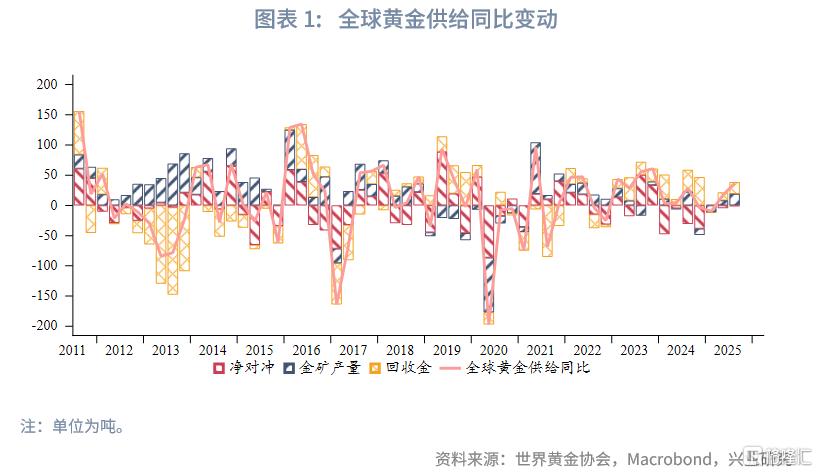
Global Gold Supply - In Q3 2025, the total global gold supply increased by 37.1 tons, a year-on-year rise of 2.90%, with balanced growth in mine production and recycled gold [3][9] - Mine production grew by 19.0 tons year-on-year, while producer net hedging decreased by 1.5 tons, continuing a downward trend after a brief increase in Q1 [3][9] - Global recycled gold volume increased by 19.6 tons, marking two consecutive quarters of positive growth [3] Global Gold Demand - In Q3 2025, global gold demand (excluding OTC and others) rose by 64.1 tons year-on-year, although the growth rate decreased compared to the previous quarter [9][10] - Demand for gold ETFs and gold bar investments continued to show positive growth, while jewelry demand saw an expanded decline [9][10] - Central bank gold purchases increased both year-on-year and quarter-on-quarter, with notable purchases from countries like Kazakhstan, Turkey, China, Czech Republic, and Ghana [13] Tax Policy Impact - A new tax policy regarding gold, effective from November 1, 2025, distinguishes between investment and non-investment uses, implementing differentiated tax policies for members and non-members [2][10] - Non-investment gold purchases will see increased tax costs, while the impact on investment gold through member channels is relatively limited [10][12] - The new policy is expected to drive gold investment towards exchanges, enhancing the influence of benchmark gold prices and benefiting banks and exchange members' gold investment products [12]