
K型分化

Search documents
37%美国成年人拿不出400美金应急费?美政府首次回应“斩杀线”
Mei Ri Jing Ji Xin Wen· 2026-01-21 01:26
据玉渊谭天,当地时间1月20日,美国财政部长贝森特在世界经济论坛年会现场举办公开活动。谭主在现场问了贝森特对"斩杀线"的看法,美国财 长称"斩杀线是上届政府的锅"。 玉渊谭天:37%的美国成年人拿不出400美金的应急费,有人称这种现象为"斩杀线",你怎么看这种说法? 贝森特表示,拜登政府执政期间,他们(低收入家庭)最关心的食品、杂货、房租等都上涨了35%到37%,我们每天都在想办法把它降下来,如 果你回看特朗普总统的第一任期,会发现时薪工人比管理层生活得更好,我相信你所描述的家庭,将会收到一笔可观的退税。 贝森特提到的退税是指美国《大而美法案》规定在2026年增加给美国民众的退税,但事实上美国税务专家指出,退税主要利好中高收入人群,低 收入家庭很难拿到这笔钱,无法直接解决"斩杀线"困境。 "斩杀线"本是指游戏中玩家角色血条的血量低于某条线时,就随时可能被击杀。现在被用来指代美国社会中的一种残酷现实:普通人一旦收入和 储蓄跌破某个水平,一个小小的意外都可能让他立即陷入死局。 这个词形象勾勒出当下部分美国人脆弱的生活现状:一场突发疾病、一笔逾期房租,便可击穿他们的经济基础,继而引发连锁反应,令他们陷入 难以逆转的 ...


增长幻象下的民生之困
Xin Lang Cai Jing· 2026-01-18 17:24
(来源:衢州日报) 转自:衢州日报 "斩杀线"是电子游戏用语,常指角色血量跌至可被一击出局的临界值。当下,这一概念成为描摹美国民 众财务脆弱性的隐喻:一场疾病或一笔意外账单,极易成为财务崩塌的致命一击,使其坠入债务违约、 甚至流离失所的深渊。 "斩杀线"的形成绝非偶然,是美国经济基本面失衡与贫富极化加剧、普通家庭财务脆弱、政府资源错配 和社会治理失效等因素交织的结果。经济数据的"增长幻象"与日常生活中的民生实困剧烈撞击,映射出 美国经济社会体系的深层病灶。 双重绞杀: 基本面失衡与贫富极化加剧 在美国,处于"斩杀线"边缘的民众不在少数。根据美国匹兹堡国民商业银行公司发布的2025年财务健康 报告,约67%的美国人属于"月光族";与此同时,美国银率网公司一项调查显示,59%的受访者说他们 无力支付高额意外开支。 尽管美国近来公布的经济增长数据超出市场预期,但"斩杀线"的隐忧将经济基本面的积弊暴露无遗:对 大多数美国普通民众而言,家庭生活成本上升,工资增长跑不赢通胀,实际购买力下降,中低收入群体 逐渐失去财务缓冲的空间。 美国劳工部1月13日发布数据显示,2025年12月美国消费者价格指数(CPI)同比上涨2.7 ...
“欧洲衰落论”翻车?数据显示西欧生产率超美国,差距在科技巨头
Sou Hu Cai Jing· 2026-01-18 13:38
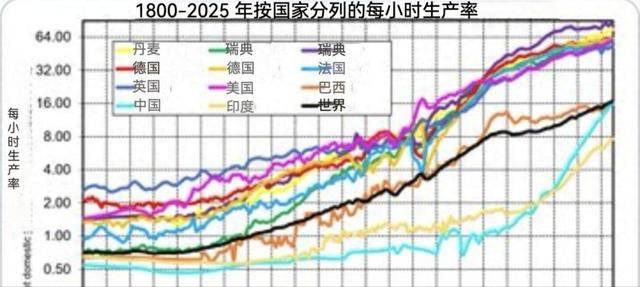
Core Viewpoint - The narrative of "European decline" is challenged by data suggesting that Western European workers may have higher productivity per hour compared to their American counterparts, raising questions about the validity of the decline argument [1][3]. Group 1: Labor Productivity Comparison - Labor productivity, measured as GDP produced per hour worked, shows conflicting data: the International Labour Organization reports Western Europe's productivity at approximately $83 per hour, slightly higher than the U.S. at $81.8 [3]. - Other authoritative sources, such as the OECD, indicate that the U.S. still leads in labor productivity, albeit with a smaller margin than commonly perceived [3]. Group 2: Statistical Methodology and Labor Participation - Differences in how "labor input" is measured may account for discrepancies in productivity statistics, as varying work hours and participation rates can skew average calculations [7]. - A simplistic average comparison does not definitively establish which region is superior, and productivity gaps cannot be equated to a narrative of decline [7]. Group 3: Societal Choices and Work-Life Balance - Even with data showing U.S. productivity advantages, labeling Europe as "declining" oversimplifies the situation; productivity differences have stabilized over the past fifteen years, rather than showing a continuous downward trend for Europe [8]. - The U.S. benefits from longer average work hours and higher labor participation rates, while Europe emphasizes work-life balance, resulting in shorter work weeks and more vacation time [8][10]. Group 4: Economic Structure and Technology - The productivity gap between the U.S. and Europe is largely driven by a small number of high-performing technology companies in the U.S., which significantly boost overall economic performance through substantial R&D investments and innovation [14]. - Europe lacks comparable global tech giants, leading to a more uniform but less dynamic economic model, which reflects in different policy responses during the pandemic [16]. Group 5: Conclusion on European Economic Narrative - The "European decline" narrative may oversimplify complex realities; data indicates that Western Europe's foundational productivity is not low and may even be superior under certain metrics [19]. - The challenge for Europe lies not in emulating the U.S. but in nurturing new engines of growth while maintaining its social consensus [19].
2026,中国旅游业最大黑天鹅是美元?
虎嗅APP· 2026-01-18 13:33
Core Viewpoint - The article discusses the impact of the strengthening Chinese yuan on the tourism and hospitality industry, highlighting the challenges faced by domestic hotels and the shift in consumer behavior towards outbound travel due to favorable exchange rates [4][10][18]. Group 1: Current Industry Situation - Domestic tourist traffic has decreased by 30% compared to 2024, but inbound tourism is recovering, particularly with high-net-worth visitors from South Korea [4][5]. - The appreciation of the yuan has made it more expensive for foreign tourists to visit China, leading to a decline in hotel bookings and a cautious approach from foreign clients [9][12]. - The recent increase in the yuan's value to 6.85 against the dollar means that foreign tourists can buy fewer services in China, while Chinese tourists find their money goes further abroad [10][12][18]. Group 2: Market Dynamics - The demand for outbound travel has surged, with a reported 80.2% increase in flight bookings to popular destinations during the 2026 Spring Festival [14]. - The competition for the Chinese tourism industry is shifting from domestic regions to international destinations with favorable exchange rates [17][18]. - The hospitality sector is experiencing a dual pressure: a decline in inbound tourists and a loss of high-net-worth domestic travelers who prefer cheaper options abroad [30][32]. Group 3: Future Outlook - The article predicts a K-shaped market differentiation in 2026, where businesses engaged in cross-border travel and high-end customized tours will thrive, while mid-tier hotels and travel agencies may face significant challenges [34][35][39]. - The lower segment of the market, focusing on extreme cost-effectiveness in domestic tourism, will remain resilient as budget-conscious travelers seek affordable options [38]. - The middle tier, characterized by overpriced services without unique offerings, is at risk of being severely impacted as consumers shift their preferences [39][44]. Group 4: Strategic Recommendations - To survive the changing landscape, companies must pivot from relying on price advantages to enhancing unique experiences and service quality [45][49]. - The focus should be on creating emotional connections and providing distinctive cultural experiences that cannot be easily replicated abroad [50][51]. - The industry must adapt to a new reality where value is defined by experience rather than cost, necessitating a shift in operational strategies [52][53].

国际观察丨增长幻象下的民生之困——解析美国“斩杀线”的成因链
Xin Lang Cai Jing· 2026-01-18 08:11
Core Insights - The concept of "death line" metaphorically represents the financial vulnerability of American households, where a single unexpected expense can lead to financial collapse [1] - The underlying causes of this phenomenon include economic imbalance, increasing wealth disparity, and ineffective social governance [1] Economic Imbalance and Wealth Disparity - Approximately 67% of Americans are classified as "living paycheck to paycheck," and 59% report being unable to cover unexpected expenses [2] - Despite recent economic growth data exceeding expectations, the reality for most Americans is rising living costs and stagnant wage growth, with real purchasing power declining [2] - The Consumer Price Index (CPI) rose by 2.7% year-on-year as of December 2025, while wage growth for middle-income families was only 2.3% and for low-income families just 1.4% [2] - The K-shaped economic recovery indicates that while some groups are improving, others, particularly low-income households, are facing worsening conditions [3] - About 87% of households earning over $100,000 hold financial assets, while approximately 42.3 million Americans carry a total of $1.8 trillion in student loan debt [3] Financial Fragility: Insufficient Savings and High Debt - Many American households lack emergency savings, making them vulnerable to financial shocks from minor expenses [4] - Only 63% of American adults could cover a $400 unexpected expense in cash or equivalents from 2022 to 2024, with a personal savings rate of just 4.0% as of September 2025 [5] - Total household debt reached a record high of $18.59 trillion by the third quarter of 2025, with credit card debt exceeding $1.23 trillion [5] - The average credit card debt per person was $6,523, with high-interest rates exacerbating the financial strain on households [6] Insufficient Social Safety Nets and Governance Failures - The U.S. welfare system has a "welfare cliff" effect, where slight income increases can lead to significant reductions in benefits, worsening financial conditions for low-income families [7] - Government spending is heavily skewed towards military expenditures, with a defense budget of approximately $895 billion for fiscal year 2025, while social welfare budgets are being cut [7] - Tariffs imposed by the government have increased import prices, contributing to inflation that disproportionately affects ordinary consumers [7] - The decline in social mobility makes it increasingly difficult for lower-income groups to improve their financial situations, leading to a persistent "death line" [7]
美国2025年经济回顾及2026年经济展望报告
Sou Hu Cai Jing· 2026-01-18 02:51
Economic Overview - The U.S. economy in 2025 exhibited a "front low, back high" characteristic, with annual growth estimated between 1.8% and 2.0% [1] - In the first half of 2025, net exports negatively impacted economic growth due to preemptive imports driven by tariff expectations, leading to a brief negative growth period [1] - Inflation pressures eased slightly due to tariff expectations, while adjustments in immigration policy kept unemployment rates at a rare low [1] - The second half of 2025 saw inflation gradually rising as tariff policies were implemented, alongside increased downward pressure on the job market [1] 2026 Economic Outlook - The U.S. economy is expected to enter a new phase characterized by "resilience and imbalance," with GDP growth projected around 2.3% [2] - Private consumption is anticipated to show a "K-shaped" trend, where high-income groups maintain strong consumption while low-income groups may see a decline [2][4] - Structural challenges in the job market, including wage growth disparities and inflation pressures, will constrain balanced economic development [2][4] Investment Trends - The initiation of a Federal Reserve rate-cutting cycle and continued fiscal policies are expected to alleviate investment constraints for businesses and individuals [2] - Inventory investment is likely to shift from depletion to gradual replenishment, while real estate investment may improve due to declining long-term interest rate expectations [2][28] - Corporate equipment investment may also improve due to lower financing costs and tax incentives, although AI-related investments are expected to moderate after previous rapid growth [2][21] Employment Market Challenges - The job market in 2026 will face complex signals and structural challenges, with labor participation rates not returning to pre-pandemic levels [3] - Wage growth momentum is weakening, and the expansion of temporary positions is limited, indicating an uneven recovery in the job market [3] - The commercialization of AI technology may further pressure demand for mid- to low-skill jobs, complicating the employment landscape [3] Inflation and Monetary Policy - Tariff policies implemented in late 2025 are expected to push core commodity prices up in early 2026, contributing to overall inflation [3] - The Federal Reserve will face a "quadrilateral dilemma" in balancing inflation control, economic growth pressures, market liquidity risks, and external policy pressures [3] - Market expectations suggest the Fed may continue its rate-cutting path in 2026, but the pace will depend heavily on inflation trends and job market performance [3][4]

全球亿万富翁人数和财富再创纪录,普通人却艰难度日,K型分化撕裂全球
3 6 Ke· 2026-01-16 13:16
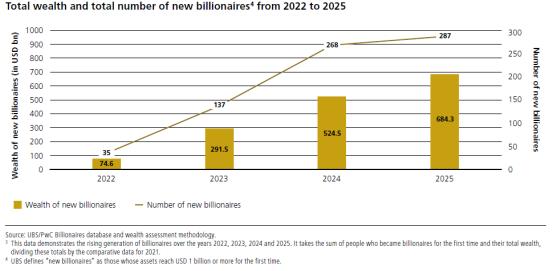
Core Insights - The UBS report indicates that by 2025, the number of billionaires globally will reach a historic peak of 2,900, with an increase of 287 billionaires in one year, marking a growth rate second only to 2021 [1][4] - The total wealth controlled by billionaires is projected to reach $15.8 trillion, a 13% increase from $14 trillion in 2024, highlighting a trend of accelerated wealth concentration [1][4] Group 1: Wealth Growth Drivers - The primary drivers for the increase in the number and wealth of billionaires are the rising valuations of global tech stocks and overall stock market strength, which provide robust support for the wealth appreciation of the ultra-rich [2] - Judy Spalthoff from UBS predicts continued growth in the billionaire population and wealth in the coming year [2] Group 2: Wealth Distribution and Inequality - The report highlights a stark contrast between the soaring wealth of billionaires and the structural inequalities in global wealth distribution, with a K-shaped divergence becoming increasingly evident [3] - The global Gini coefficient is nearing the warning threshold of 0.7, significantly exceeding the risk threshold of 0.6, indicating extreme wealth distribution imbalance [3][25] Group 3: Billionaire Demographics - Among the 2,919 billionaires, 2,059 are self-made, while 860 inherited their wealth, showcasing a dual path to billionaire status [5][6] - In 2025, 91 individuals became billionaires through inheritance, with a total inherited wealth of $298 billion, predominantly in the U.S. [6] Group 4: Regional Distribution - The Asia-Pacific region is identified as the core engine for billionaire growth, with the number of billionaires increasing from 981 to 1,036, led by mainland China with 470 billionaires [9] - The U.S. remains home to nearly one-third of the world's billionaires, with their total wealth rising by 18% to $17.5 trillion [9] Group 5: Investment Preferences - Billionaires are showing a strong preference for equities, particularly in the U.S., with 43% planning to increase their public equity holdings in the next 12 months [11] - Confidence in the U.S. as an investment destination has declined, with the percentage of billionaires seeing opportunities dropping from 80% to 63% [13] Group 6: Mobility Trends - Over one-third (36%) of billionaires have relocated, with many seeking better quality of life and favorable tax conditions, indicating a trend towards wealth concentration in policy-friendly regions [16] - The UAE, Hong Kong, and Singapore are emerging as key hubs for wealthy individuals, while cities like London are experiencing outflows due to declining living conditions [16] Group 7: Socioeconomic Implications - The report underscores the growing divide between the wealthy and the general population, with ordinary citizens facing rising inflation and stagnant wages, leading to a K-shaped economic recovery [17][18] - The wealth concentration among the top 1% is becoming increasingly unsustainable, posing risks to social stability and economic growth [25][29]

CXO、消费医疗大崩盘:这三年医疗行业发生了什么?
Sou Hu Cai Jing· 2026-01-13 03:48
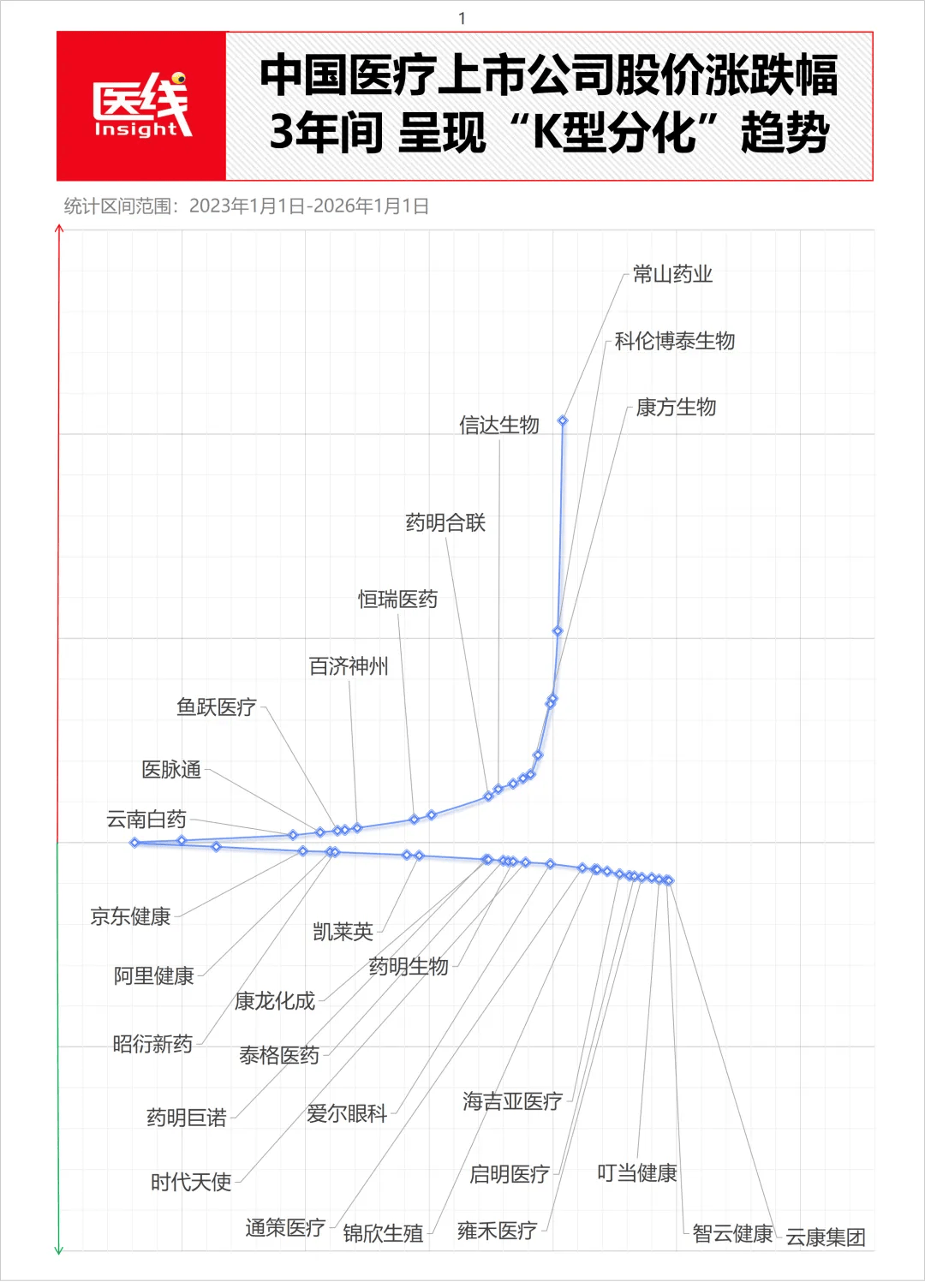
Core Insights - The Chinese healthcare industry has undergone a significant transformation from 2020 to 2025, transitioning from a "golden era" of investment to a "bubble-clearing period" characterized by a K-shaped divergence in market performance [1][2][4]. Group 1: K-shaped Downward Trends - The collapse of previously successful business models, particularly in CXO, consumer healthcare, and internet healthcare, has led to substantial market value losses, with some companies experiencing declines of over 90% [4][7]. - The downturn is attributed to macroeconomic factors such as U.S. interest rate hikes and geopolitical tensions, as well as microeconomic issues like supply-demand imbalances and the disappearance of growth dividends [8][10]. - The CXO sector, once seen as a perpetual growth engine, has faced a 46.68% decline for WuXi Biologics and 44.47% for Tigermed, revealing the fragility of its business model reliant on continuous global financing [12][10]. - Consumer healthcare has suffered a "Davis double whammy," with companies like Yonghe Medical and Aier Eye Hospital seeing declines of 86.19% and 52.69%, respectively, as consumer spending shifts away from discretionary healthcare services [14][15]. - Internet healthcare companies, including Zhiyun Health and Dingdang Health, have also faced severe declines, with drops of 92.44% and 90.67%, as the market realizes that their revenue largely comes from online drug sales rather than innovative healthcare solutions [19][21]. Group 2: K-shaped Upward Trends - In contrast, companies with strong global rights and hard-core technology have thrived, with Keren Biotechnology and Kangfang Biopharma seeing increases of 518.33% and 166.72%, respectively, marking a shift towards biopharma and global market engagement [29][31]. - The rise of these companies signifies a new era where capital is attracted to firms that can demonstrate robust clinical data and global market potential, moving away from mere concepts [30][31]. - Even within struggling sectors, some companies like WuXi AppTec and Yuyue Medical have shown resilience, with increases of 113.36% and 28.75%, respectively, by focusing on high-tech, high-barrier services [34][35]. Group 3: Challenges Ahead - Despite the emergence of new leaders, significant challenges remain, including the risks associated with licensing agreements that may compromise long-term profitability [36][37]. - The ADC sector is experiencing a rush similar to the past PD-1 craze, raising concerns about market saturation and price competition, which could undermine future profitability [39][40]. - The ongoing "ice age" in the primary market poses a threat to innovation, as funding for early-stage companies has become increasingly scarce, potentially leading to a decline in new drug approvals in the coming years [42][43].
中产「大逃杀」,正在席卷全球
3 6 Ke· 2026-01-11 02:28
Core Insights - The article highlights the precarious situation of the American middle class, illustrating how a single event such as job loss, illness, or mortgage default can lead to homelessness, emphasizing the fragility of their financial stability [1][18][45]. Group 1: Economic Vulnerability - Approximately 770,000 people in the U.S. are expected to be homeless in 2024, many of whom were once middle-class workers [1]. - About 80% of Americans could face financial crises due to a single medical emergency, as only 21% of households have over $5,000 in savings [4][5]. - Medical expenses, even for minor issues, can lead to significant debt, with emergency consultations costing hundreds of dollars and surgeries potentially leading to thousands in out-of-pocket costs [7][9]. Group 2: Housing and Living Costs - The median price for single-family homes in the U.S. is projected to be around $460,000 by 2025, with prices in high-cost areas exceeding $700,000 [12]. - A typical American family needs an annual income of about $120,000 to afford median housing costs, which can consume 30-40% of their income [15][20]. - Living in middle-class neighborhoods incurs higher costs, with rents and property taxes significantly elevated compared to ordinary areas [13][18]. Group 3: Employment and Income Stability - As of October 2025, nearly 1.17 million layoffs have been announced, a 54% increase from the previous year, particularly affecting government and tech sectors [21]. - Unemployment leads to an inability to pay mortgages, resulting in credit collapse and further job loss, creating a vicious cycle [22][25]. - Even unemployment benefits are insufficient to cover the basic annual needs of a family, which can reach $140,000 [23]. Group 4: Debt and Financial Management - Many middle-class Americans struggle with student loan debt, which can take decades to repay, hindering their ability to save [26][29]. - The average monthly salary is around $5,183, but many face high monthly student loan payments that complicate financial stability [26]. - A significant portion of Americans cannot access emergency funds, with about 37% unable to cover an unexpected expense of $400 [32]. Group 5: Global Context - The concept of the "killing line" reflects a broader trend of middle-class decline globally, with similar financial pressures observed in countries like South Korea and China [49][48]. - The article suggests that the middle class worldwide is experiencing stagnation, rising living costs, and increasing debt burdens, leading to a potential retreat from the middle class [49][50].

2025中国潮玩出海行业报告:引领全球风潮
Sou Hu Cai Jing· 2026-01-10 02:30
Core Insights - The report highlights the rise of Chinese潮玩 (trendy toys) brands in the global market, driven by emotional consumption trends and innovative cultural export models [1][17] - Chinese潮玩 companies are successfully penetrating mature markets in Europe and North America, as well as emerging markets in Southeast Asia, leveraging unique IP operations and efficient supply chains [1][3] Group 1: U.S. Market Dynamics - The U.S. economy is experiencing a "K-shaped" recovery, where high-income consumers show resilience while low-income groups face pressure from inflation and employment fluctuations [2][21] - The "healing economy" trend is gaining traction, with潮玩 products like blind boxes and plush toys providing emotional value and social engagement, leading to increased demand [2][21] - Chinese潮玩 brands, such as Pop Mart, differentiate themselves by offering original IPs and innovative product formats, achieving a price range of $20 to $40, appealing to various income levels [2][21] Group 2: Southeast Asia Market Opportunities - Southeast Asia is viewed as a blue ocean market for潮玩, characterized by a young population, high internet penetration, and strong consumer upgrade intentions [3][4] - The success of Pop Mart's LABUBU toy in Thailand, following a social media endorsement by local celebrity Lisa, exemplifies the alignment of潮玩 with local youth culture [3][4] - Despite challenges such as fluctuating external tariffs and internal political complexities, Chinese brands are advancing into this market with localized designs and a multi-channel approach [3][4] Group 3: Company Strategies and Differentiation - Pop Mart focuses on building a comprehensive IP ecosystem, from creation to sales, aiming to transform short-term trends into long-lasting IPs through various media [4][5] - Miniso leverages its global retail network and supply chain efficiency to act as a high-efficiency IP monetization platform, enhancing store performance through strategic IP collaborations [4][5] - TOP TOY, as a rising player, benefits from synergies with Miniso, focusing on product development while utilizing Miniso's sales channels for rapid market expansion [5][6] Group 4: Cultural and Economic Shift - The success of Chinese潮玩 brands signifies a shift from "Made in China" to "Emotional Brands from China," emphasizing universal emotional connections rather than relying solely on traditional cultural narratives [6][17] - Chinese companies are combining mature supply chains with innovative business models and original designs, transitioning from traditional manufacturing roles to becoming key players in the global潮玩 industry [6][17]

