产业升级

Search documents
五年间 甘肃经济增速连续16季度跑赢全国 综合实力实现快速跃升
Zhong Guo Fa Zhan Wang· 2026-01-28 13:19
Core Insights - Gansu Province has shown significant economic growth over the past five years, with a GDP reaching 1.36975 trillion yuan, representing a 33.6% increase compared to the end of the 13th Five-Year Plan [1] Economic Performance - Gansu's economic growth rate has exceeded the national average for 16 consecutive quarters since 2022 [1] - The added value of industrial enterprises above designated size has ranked in the top ten nationally for 30 consecutive months, with the number of such enterprises increasing from 1,832 to 3,382 [1] Industrial Development - Industrial investment has maintained double-digit growth for 54 months, contributing 36.1% to the province's economic growth [1] - The new energy sector has experienced rapid development, with total installed capacity reaching 80.416 million kilowatts, a 2.4-fold increase, and the establishment of a complete manufacturing industry chain for photovoltaic, wind, and thermal power [1] Infrastructure and Technology - The "Green Electricity from Gansu" initiative is expanding, with the operation of the "Gansu Electricity to Shandong" project and the commencement of the "Gansu Electricity to Zhejiang" project [1] - The data center cluster in Qingyang has rapidly developed, achieving a computing power scale of 114,000 P, contributing to the emergence of a "green computing power new city" in the Loess Plateau [1] Strategic Direction - Gansu is actively transforming from an old industrial base to a new one, focusing on quality and strength in its economic development [1]
东北首座万亿之城 下一步怎么干
Xin Lang Cai Jing· 2026-01-28 12:35
(来源:千龙网) 1月23日,大连高新技术产业园区海创科技交流中心内座无虚席。中国科学院能源化工技术与企业需求 对接会暨英歌石科学城科技成果对接会在此举办,一场精准对接前沿技术与产业需求、架起实验室到生 产线桥梁的"双向奔赴"正式上演。16家中国科学院能源化工领域院所专家携核心技术而来,来自130余 家重点企业、金融机构的二百余名代表怀揣需求赴约,以期让创新成果化作实实在在的发展硕果与经济 收益。 此次高效对接,正是大连推动产学研用深度融合,科技成果转化效能不断释放的鲜活缩影。近日,大 连"官宣"2025年地区生产总值突破万亿元大关,成为东北首个跻身"万亿俱乐部"的城市。这份沉甸甸的 成绩单,不仅是大连自身发展的量级跨越,更为正处于转型攻坚期的东北老工业基地注入了强劲信心, 是东北振兴进程中具有标志性意义的里程碑。 面对传统产业占比超80%的现实,如何以科技赋能打破"路径依赖",实现从"规模扩张"到"质效提升"的 跨越,成为大连破局的关键。 在长兴岛渤海湾畔,恒力重工创下的"恒力速度"令人惊叹——一期"海洋工厂"150天建成投用,沉睡十 余年的存量资产涅槃重生;二期"未来工厂"五个月建成投用,助推恒力重工成为 ...
热卷日报:震荡偏弱-20260128
Guan Tong Qi Huo· 2026-01-28 12:23
1. Report Industry Investment Rating - The report maintains a bullish view on hot-rolled coils [5] 2. Core View of the Report - Currently, the supply of hot-rolled coils is contracting while demand is resilient, resulting in an overall tight balance between supply and demand. Pre-holiday winter stocking is an important support for current demand. The social inventory of total inventory has decreased month-on-month, and the pressure on mill inventory is controllable, with the overall inventory risk improving marginally but still relatively high year-on-year. Attention should be paid to the impact of the post-holiday resumption of work and production on supply and demand. In summary, the tight balance between supply and demand and inventory reduction support prices, and subsequent attention should be paid to raw material costs and the strength of post-holiday demand recovery. Currently, the market sentiment is cautious with low volatility due to the tug-of-war between macro loose expectations and pre-holiday weak demand [5] 3. Summary by Relevant Catalogs Market行情回顾 - **Futures Price**: On Wednesday, the open interest of the main hot-rolled coil futures contract increased by 9,222 lots, with a trading volume of 283,776 lots, which was lower than the previous trading day. The intraday low was 3,275 yuan, and the high was 3,290 yuan. It showed a weak intraday oscillation, breaking below the 5-day moving average in the short term and closing at 3,280 yuan/ton near the 30-day moving average, a decrease of 13 yuan or 0.39% [1] - **Spot Price**: The price of hot-rolled coils in Shanghai, a major region, was reported at 3,280 yuan/ton, a decrease of 10 yuan from the previous trading day [2] - **Basis**: The basis between futures and spot was 0 yuan, basically at par [3] Fundamental Data - **Supply**: As of January 22nd, the weekly output of hot-rolled coils decreased by 29,500 tons month-on-month to 3.0541 million tons, and decreased by 172,300 tons year-on-year. The output decline may be affected by factors such as maintenance arrangements and profit fluctuations, which supports prices [3] - **Demand**: As of January 22nd, the weekly apparent consumption decreased by 42,000 tons month-on-month to 3.0996 million tons, and increased by 73,900 tons year-on-year. Although demand declined slightly month-on-month, it maintained year-on-year growth. Pre-holiday stocking supported demand, indicating strong overall demand resilience [3] - **Inventory**: As of January 22nd, the total inventory decreased by 45,500 tons week-on-week to 3.5778 million tons (social inventory decreased by 46,600 tons week-on-week, and mill inventory increased by 1,100 tons). Year-on-year, the total inventory increased by 212,700 tons (social inventory increased by 241,800 tons year-on-year, and mill inventory decreased by 29,100 tons year-on-year). The month-on-month decrease in total inventory alleviated inventory pressure marginally, while the year-on-year increase indicated that the inventory accumulation rate this year was slightly faster than last year, but the overall risk was controllable [3] - **Policy**: The new regulations on the management of steel export licenses will cause short-term export fluctuations, increase supply, and put downward pressure on prices. In the long term, they will promote industrial upgrading, structural optimization, and competitiveness improvement. The Central Economic Work Conference in December proposed a positive fiscal policy and a moderately loose monetary policy in the macro aspect, and listed in - depth rectification of involution - type competition as a key task for 2026, which is beneficial to prices and industry profitability. Efforts are also being made to stabilize the real estate market and expand domestic demand [4] Market Driving Factor Analysis - **Bullish Factors**: Decrease in supply output, expectation of winter storage demand start, export rush, policy support ("15th Five-Year Plan", infrastructure investment), and strong iron ore as a furnace charge [5] - **Bearish Factors**: Unexpected resumption of production by steel mills in January, seasonal weakening of demand, insufficient manufacturing orders, and inventory accumulation suppressing prices [5]
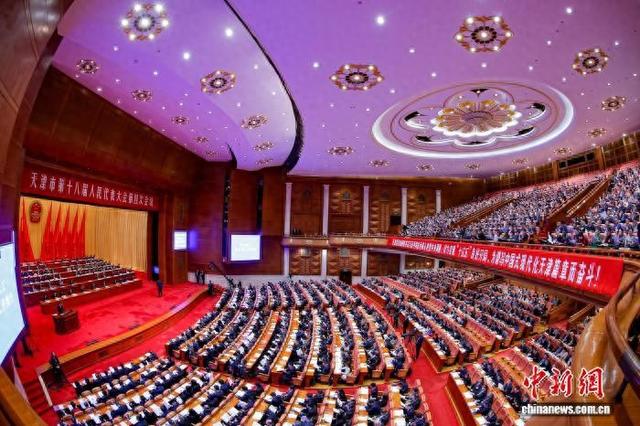
天津两会观察:津城产业图新,重在“链”“群”并举
Zhong Guo Xin Wen Wang· 2026-01-28 12:15
Group 1 - The core focus of Tianjin's industrial upgrade is to build a modern industrial ecosystem with both vertical depth and horizontal density, emphasizing intelligent, green, and integrated development [1][2] - The report outlines a strategic approach to enhance the resilience of industrial chains and the vitality of industrial clusters, moving from "physical splicing" to "chemical integration" [2] - Key industries highlighted include green petrochemicals, automotive, equipment manufacturing, aerospace, and information technology, with a focus on upstream and downstream connectivity and cluster cultivation [2][5] Group 2 - Traditional industries will be upgraded through specific initiatives, such as developing a chain from basic chemicals to new materials in green petrochemicals and enhancing capabilities in aerospace through collaboration with major companies [5] - Strategic emerging industries like information technology and biomedicine are emphasized, with support for local leading enterprises and the creation of AI+ information technology application scenarios [5] - The dual support of "solid foundation" and "nurturing new" is proposed to enhance both existing and new industrial capacities, focusing on smart transformation and the integration of traditional industries into key chains [6]

河南省人大代表邓世杰:金融财税政策协同发力,支持出口企业融入“双循环”新格局|两会财经访谈
Sou Hu Cai Jing· 2026-01-28 12:07
Core Viewpoint - The article discusses the challenges faced by export enterprises in China due to the cancellation of certain export tax rebates starting April 1, 2026, and emphasizes the need for policy collaboration to facilitate a smooth transition and proactive transformation for these companies [1]. Group 1: Policy Recommendations - A proposal to establish a "Support Fund for Industrial Transformation and Market Adjustment" to provide targeted support and promote green initiatives is suggested [4]. - It is recommended that a special fund for export enterprise transformation be set up within provincial budgets, funded by fiscal allocations and energy-saving funds [4]. - Companies affected by reduced tax rebates could receive temporary subsidies based on last year's rebate reductions, specifically for energy-saving upgrades and technological innovations [4]. Group 2: Financial and Tax Support - The article suggests prioritizing VAT refund processing for affected companies and exploring tax reductions on land and property for actively transforming enterprises [4]. - Financial institutions are encouraged to offer loans with lower interest rates based on the Loan Prime Rate (LPR) to help companies adjust to the new tax policies, along with government-backed financing guarantees [4]. - Supply chain financial services should be enhanced, including interest subsidies for supply chain bill discounts and accounts receivable financing [4]. Group 3: Market Expansion Strategies - Companies are urged to diversify their market presence and product offerings to enhance sustainable development within the "dual circulation" framework [5]. - Increased support for companies to explore new markets such as RCEP member countries and Belt and Road Initiative nations is recommended, including higher subsidies for certification, exhibitions, and overseas marketing expenses [6]. - A proposal for a "High Value-Added Product Export Increment Reward" aims to incentivize exports of high-tech and proprietary brand products [6]. Group 4: E-commerce and Domestic Sales - To facilitate the transition from export to domestic sales, subsidies for participation in exhibitions, e-commerce platform access, and supermarket entry costs are suggested [6]. - Support for cross-border e-commerce includes subsidies for overseas warehouse construction, platform usage fees, and international logistics costs, along with prioritized export credit insurance [6]. - The overall strategy emphasizes a coordinated policy approach to drive companies towards greener, higher-end, and value-added transformations, enhancing their internal motivation and market resilience [6].

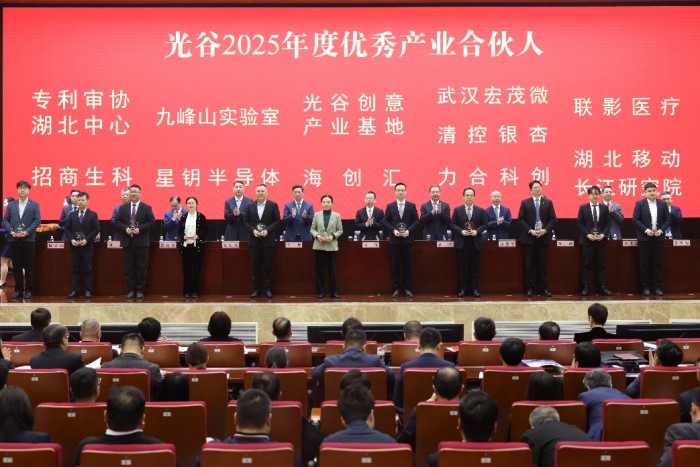
海创汇荣获“光谷2025年度优秀产业合伙人”,双向赋能助力“世界光谷”建设
Sou Hu Wang· 2026-01-28 08:55
Group 1 - The East Lake High-tech Zone held an economic work conference and a mobilization meeting for the "World Optics Valley" construction, recognizing individuals, enterprises, and institutions for their significant contributions to regional development [1] - Wuhan Haichuanghui Technology Co., Ltd. was awarded the title of "Outstanding Industrial Partner" for its exceptional contributions in promoting innovation and building an industrial ecosystem for large, medium, and small enterprises [1][7] Group 2 - Haichuanghui, as a global entrepreneurial acceleration platform created by Haier Group, established the Central China Ecological R&D Center in Optics Valley in January 2024, focusing on Haier's industrial chain needs and collaborating with universities, research institutions, and various enterprises [3] - The center has released over 150 technical cooperation demands and facilitated more than 60 connections between large, medium, and small enterprises, resulting in over 10 direct collaborations and orders with Haier's industrial chain [3] - In January 2026, Haichuanghui will lead the establishment of the "Haier-Optics Valley Scenario-Driven Center," leveraging Haier's rich scenario resources in smart home, health, industrial internet, and automotive sectors to foster innovation and collaboration with local institutions [5] - The recognition as an outstanding industrial partner reflects Haichuanghui's role in promoting regional industrial upgrades and building an open innovation ecosystem, with plans to deepen cooperation in smart home, optoelectronics, and life health sectors [7]
我国去年出钢产量多达9.61亿吨,占全球粗钢总产量的一半以上
Sou Hu Cai Jing· 2026-01-28 06:14
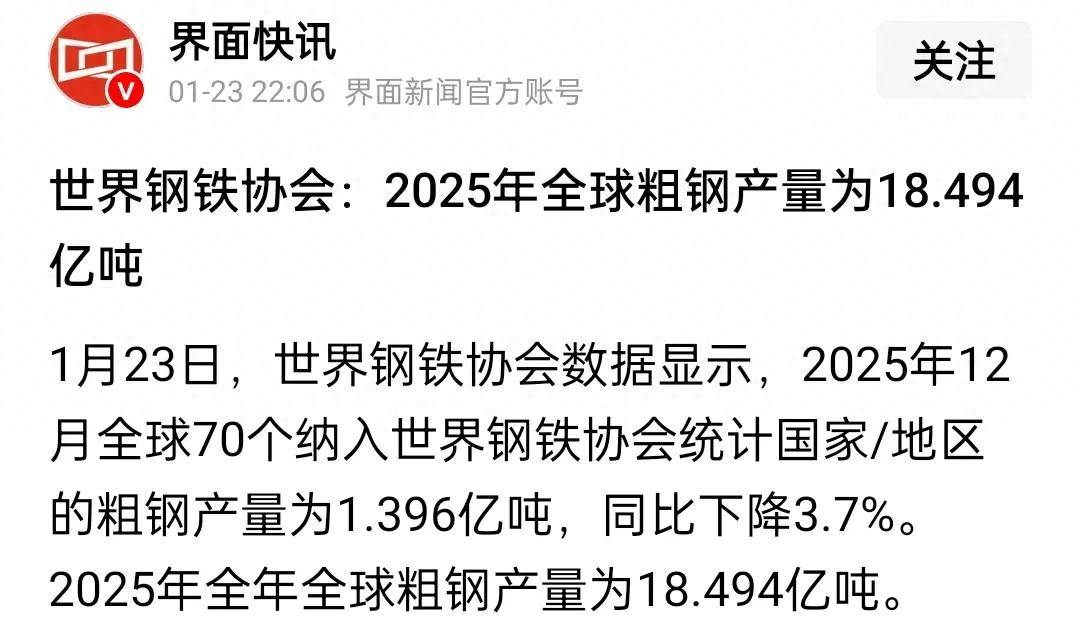
Core Viewpoint - The steel industry is experiencing a significant decline in production, with China's crude steel output projected to drop to 96.1 million tons in 2025, a decrease of 4.4% year-on-year, reflecting a shift towards quality and sustainability rather than sheer volume [1][5][7]. Group 1: Production Data - The World Steel Association forecasts global crude steel production to reach 1.8494 billion tons by 2025, while China's output is expected to be 961 million tons [1]. - China's crude steel production for 2024 is estimated at 1.005 billion tons, indicating a sharp decline of 44 million tons in just one year, which is more than the annual production of Germany [5][7]. - Despite the reduction, China maintains a 52% share of global steel production, significantly outpacing other countries like India and the United States [7][13]. Group 2: Policy and Market Dynamics - The decline in production is attributed to proactive industry adjustments driven by policy changes, particularly under the "dual carbon" goals, which emphasize capacity and output control [9]. - The Ministry of Industry and Information Technology has set clear guidelines to prohibit new capacity and promote the exit of outdated production facilities, particularly in regions like Hebei and Shanxi [9]. - The construction sector, a major consumer of steel, is facing a downturn, with a reported 18.14% drop in building steel sales from January to July 2025, leading to a noticeable demand gap [11]. Group 3: Industry Transformation - The shift from quantity to quality is evident, with high-end steel products now accounting for a larger share of production, and companies like Shagang and CITIC Pacific Special Steel meeting both domestic and export demands [13]. - The adoption of electric arc furnaces is becoming a trend, significantly reducing energy consumption and carbon emissions, with regions like Sichuan achieving a 40% share of electric furnace steel production [15]. - Industry consolidation through mergers and acquisitions is enhancing operational efficiency and cost savings, allowing for increased focus on research and development [15]. Group 4: Future Outlook - The reduction in crude steel output is viewed as a starting point for a transformation towards technological innovation and green low-carbon practices [17]. - Challenges such as limited scrap steel resources and high electricity costs for electric furnaces remain, but opportunities exist through government initiatives to boost infrastructure and manufacturing demand [17]. - The industry's evaluation criteria are shifting from production volume to technological advancement, environmental sustainability, and value chain collaboration, marking a new era for China's steel sector [19][21].
特朗普震怒:美国压箱底牌失效,对中国已不起作用!新一轮威胁发出
Sou Hu Cai Jing· 2026-01-28 06:14
Group 1 - The core focus of the articles is the evolving international trade dynamics under the Trump administration, particularly highlighting the recent cooperation between China and Canada in the electric vehicle sector, which has raised concerns in the U.S. [1][3] - The signing of the "China-Canada Economic Cooperation Roadmap" marks a significant high-level agreement, allowing up to 49,000 Chinese electric vehicles to enter the Canadian market at a 6.1% most-favored-nation tax rate, breaking previous trade barriers [1] - This cooperation is seen as a reflection of China's adaptability in the North American market, showcasing its advanced technology in the electric vehicle sector [1] Group 2 - The partnership between China and Canada is perceived as a mutually beneficial economic choice, yet it has triggered strategic anxieties in the U.S., with Trump suggesting that such cooperation could undermine American influence in North America [3] - Canada has responded to U.S. pressures by not only pursuing its partnership with China but also achieving breakthroughs in agricultural trade, such as reducing the comprehensive tax rate on canola seed imports to approximately 15% [3] - The article notes that more Western countries, like Finland, are also showing a willingness to deepen cooperation with China, with bilateral trade exceeding $8 billion and investment stock surpassing $23 billion [5] Group 3 - The U.S. is facing a strategic dilemma as its traditional allies begin to reassess their relationships, with some seeking more independent foreign policies, as exemplified by California's governor expressing interest in participating in World Health Organization matters [7] - China's proactive approach in international relations, particularly in the electric vehicle and high-end manufacturing sectors, is highlighted as a response to U.S. trade pressures, indicating a shift towards multilateral cooperation [7] - The articles suggest that the short-term benefits of Trump's tariff policies are fading, leading to increased risks for the U.S., including potential threats to financial security if European countries decide to sell off U.S. debt [7]

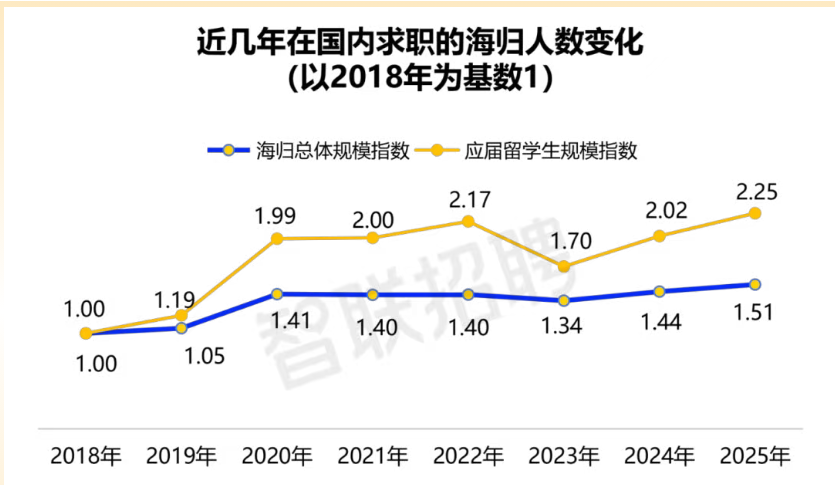
数据显示2025年回国求职应届留学生规模同比增长12%,总量为2018年2.25倍
Jin Rong Jie· 2026-01-28 05:46
智联招聘最新数据显示,2025年回国求职的应届留学生规模同比增长12%,总量达到2018年的2.25倍,创下近八年来新 高。这不仅标志着留学人员回国发展的信心显著增强,也反映出国内市场对国际化人才的吸引力持续提升。 图片来源:智联招聘 这股"回流潮"的背后,是宏观环境与个人选择的双重驱动。近年来,从中央到地方相继推出一揽子支持政策,覆盖就 业创业、安居落户、科研资助等多个层面,为海外学子铺就了顺畅的归国发展之路。与此同时,国内经济迈向高质量 发展,特别是在以新质生产力为代表的新兴领域,催生了大量高层次、国际化的就业岗位,为海外人才提供了施展才 华的广阔舞台。 观察留学人员的来源地,传统留学大国如英国、澳大利亚、美国依然输送了大量回国人才,但增长动能正悄然转向亚 洲。2025年,来自马来西亚、新加坡的留学生回国求职人数同比增速分别高达65.0%和50.1%,增势极为迅猛。澳大利 亚、俄罗斯等地也呈现出快速增长态势。这一变化显示,留学生的选择日趋多元化与理性,亚洲地区凭借其高性价比 的教育资源,正成为重要的国际化人才培育地,也为中国带来了背景更为丰富的海归群体。 责任编辑:栎树 这批新生代海归呈现出显著的高学历、 ...
江苏第6座万亿之城要来了
21世纪经济报道· 2026-01-28 04:33
Core Viewpoint - The article emphasizes that the competition for "trillion-yuan cities" is not solely about reaching the GDP milestone, but rather about sustainable and quality development, as highlighted by Xu Zhou's government officials [1][2][5]. Group 1: Economic Growth and GDP Projections - Xu Zhou's GDP is projected to reach approximately 9,537.12 billion yuan in 2024, making it a strong candidate for becoming a "trillion-yuan city" by 2025, with an expected growth rate of around 5.8% [1][5]. - In the first half of 2025, Xu Zhou's GDP reached 4,509.3 billion yuan, showing a year-on-year growth of 6.2%, and by the third quarter, it increased to 7,298.12 billion yuan, maintaining a growth rate of 6.0% [5]. Group 2: Industrial Transformation and Innovation - Xu Zhou is focusing on transforming its industrial base, moving from a coal-dependent economy to a diversified one, with an emphasis on advanced manufacturing, energy, and regional hub functions [5][7]. - The "343" innovation industrial cluster, which includes engineering machinery, green low-carbon energy, and new materials, is expected to reach a scale of 7,800 billion yuan by 2024, significantly contributing to the industrial economy [6]. - The engineering machinery cluster, recognized as Xu Zhou's primary industry, has achieved significant milestones, including being the first in domestic sales for 17 types of main products and maintaining over 90% self-sufficiency in the entire industry chain [6]. Group 3: Future Development and Strategic Positioning - Xu Zhou is in a phase of deepening the transition from old to new growth drivers, with traditional industries undergoing smart upgrades and new industrial clusters beginning to take shape [7][9]. - The city aims to leverage its regional central city status to enhance its development potential, integrating into the Yangtze River Delta's development strategy and collaborating with neighboring provinces for high-quality growth [9][10]. - Future development will depend on Xu Zhou's ability to achieve inter-provincial collaboration and fully utilize its geographical advantages to become a key hub for the Yangtze River Delta and beyond [10].