
太空算力

Search documents
长江电新:太空光伏四问四答
2025-12-30 14:41
Summary of Key Points from the Conference Call on Space Photovoltaics Industry Overview - The conference focuses on the **space photovoltaic industry**, highlighting its strategic importance in global competition among major space-faring nations [13][22]. Core Insights and Arguments 1. **Importance of Developing Space Photovoltaics**: - Space photovoltaics are crucial for powering spacecraft, with energy systems accounting for approximately **22% of costs** and **20-30% of mass** on satellite platforms [15][18]. - The demand for photovoltaic cells is expected to grow rapidly due to the construction of large low-Earth orbit (LEO) satellite constellations driven by military, communication, and commercial applications [15][22]. 2. **Technological Routes for Space Photovoltaics**: - Space photovoltaic technologies can be categorized into three main types: - **Wafer-based cells** (crystalline silicon and III-V semiconductors) - **Commercial thin-film cells** (amorphous silicon, cadmium telluride, and copper indium gallium selenide) - **Emerging thin-film technologies** (perovskite, organic, and quantum dot solar cells) [48][50]. - The **multi-junction gallium arsenide cells** are currently the leading technology, achieving efficiencies over **30%** in orbit [50]. 3. **Market Potential**: - The global gallium arsenide battery market is projected to reach nearly **$3 billion** in 2023, growing from **$214 million** in 2018, with a compound annual growth rate (CAGR) of **13.8%** [75]. - The deployment of large LEO constellations is expected to significantly benefit the space photovoltaic market, with over **100,000 satellites** planned globally [81][90]. - By **2030**, the market for space photovoltaics related to low-Earth satellites is estimated to be around **29.5 billion yuan**, approximately **10 times** the current market size [90]. Additional Important Insights - The **European Space Agency** has initiated the **SOLARIS program**, investing **€60 million** over three years to develop core technologies for solar energy systems in space [30]. - The **Chinese "Zhu Ri Project"** aims to establish a megawatt-level experimental solar power station in geostationary orbit by **2030** and a gigawatt-level commercial station by **2050** [30]. - The **cost of silicon solar cells** has decreased significantly, with prices dropping by **25.7%** for every doubling of production volume, making them competitive again in the space market [60]. Conclusion - The space photovoltaic industry is poised for significant growth driven by technological advancements and increasing demand from satellite constellations. The strategic importance of space energy systems in national security and commercial applications underscores the need for continued investment and innovation in this sector [13][22][90].


思特奇:在卫星互联网IT支撑建设方面有成熟的产品研发储备,并参与到相关项目建设
Ge Long Hui· 2025-12-30 13:02
格隆汇12月30日丨思特奇(300608.SZ)在互动平台表示,思特奇一直以来走自主、自研、安全、可控的 路线,IAAS/PAAS产品均已适配华为鲲鹏、昇腾系列芯片以及全面支持欧拉等国产操作系统,积极参 与航天相关系统的规划和合作。 公司在卫星互联网IT支撑建设方面有成熟的产品研发储备,并参与到 相关项目建设。在太空算力方面,也在积极参与相关客户的规划和预研合作。 ...

东吴证券:太空算力战略价值日益凸显 建议关注产业核心技术突破与工程化推进
智通财经网· 2025-12-30 08:29
Group 1 - The core viewpoint is that the space computing industry is rapidly evolving and is seen as a key path to solving global computing resource bottlenecks, with its strategic value becoming increasingly prominent [1][2] - Space computing is defined as the next generation of distributed computing paradigm built in Earth's orbit, transforming satellites from traditional data relay to autonomous decision-making "in-orbit intelligent agents" [2] - The fundamental driving force behind the industry's development is the need to overcome physical and resource limits of terrestrial computing, with the explosive growth in AI computing demand creating rigid constraints on ground data centers [2][3] Group 2 - Space computing is becoming a new focal point in the power competition between major countries, with China focusing on systematic construction and self-control through national laboratories and state-owned aerospace enterprises, while the U.S. is led by tech giants and startups exploring diverse business models [2][3] - Key technological bottlenecks include high-reliability radiation-resistant chips, ultra-fast inter-satellite laser communication, and large energy dissipation systems, which are major challenges for large-scale deployment and commercialization [3] - The industry chain is long with a concentrated value distribution, showing a pattern of stability at the top, rapid growth in the middle, and active development at the bottom, with upstream hardware being the most valuable segment [3] Group 3 - Relevant companies to focus on include Shunhao Co., Ltd. (002565.SZ), Shanghai Port Bay (605598.SH), Qianzhao Optoelectronics (300102.SZ), Changying Tong (688143.SH), Shanghai Huguang (603131.SH), Fenghuo Communication (600498.SH), Aerospace Electronics (600879.SH), China Satellite (600118.SH), and Yuke De-W (688158.SH) [3]

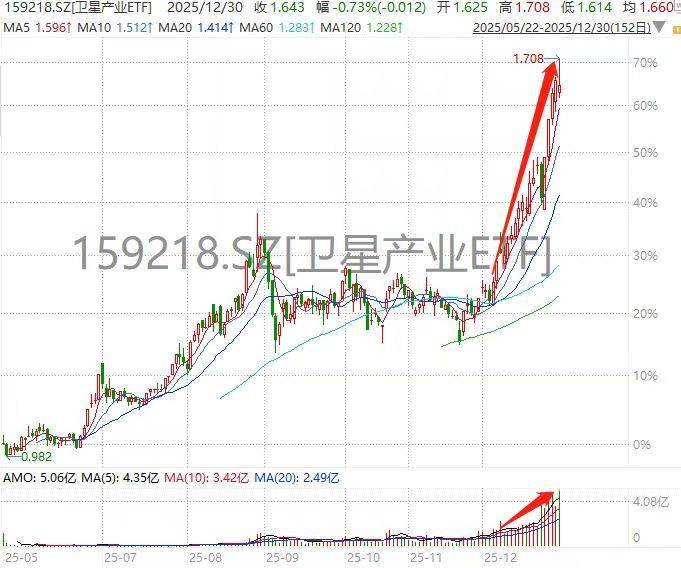
卫星板块资金分歧加大!卫星产业ETF(159218)盘中成交破5亿刷新历史天量!中国卫星转跌
Sou Hu Cai Jing· 2025-12-30 07:12
Group 1 - The satellite sector experienced fluctuations in the afternoon of December 30, with the satellite industry ETF (159218) declining by 0.73% and China Satellite dropping by 1.91%, while trading volume reached approximately 5.1 billion, setting a historical high [1][3] - Zhongyou Securities indicated that the commercial aerospace sector is entering a phase of development opportunities, with attention on upstream and downstream enterprises in the industry chain, including satellite manufacturing, ground equipment, and data processing [3] - Technological advancements and policy support are driving continuous growth in the industry, with space computing as an emerging field showing long-term development potential [3] Group 2 - The acceleration of the commercialization of aerospace technology is expected to enable related companies to achieve breakthroughs in satellite internet and remote sensing applications, leading to a more complete industrial ecosystem [3] - The market scale of the satellite industry is anticipated to continue expanding, with the satellite industry ETF (159218) becoming an efficient tool for capital allocation in commercial aerospace, covering core segments of the industry chain [3] - In the context of sustained high industry prosperity, the sector is likely to continue attracting medium to long-term investment attention [3]


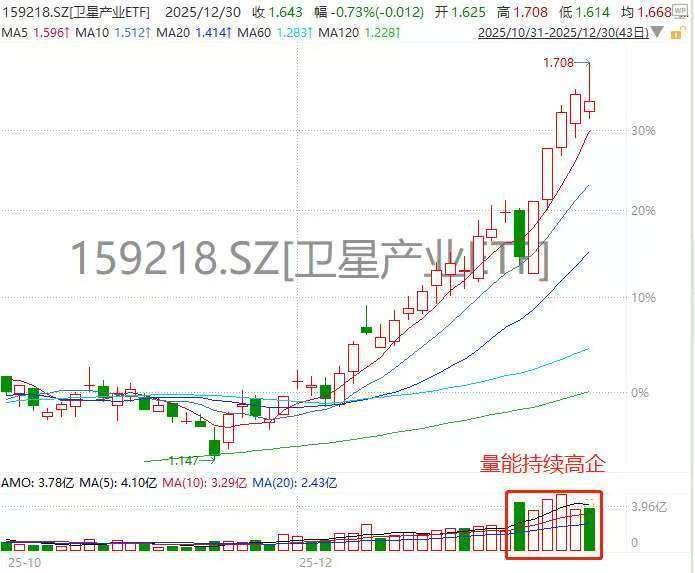
连续6日成交破3亿!卫星产业ETF(159218)持续堆量!商业航天链高烧不退
Sou Hu Cai Jing· 2025-12-30 06:34
Group 1 - The satellite sector is experiencing heightened activity, with the satellite industry ETF (159218) achieving a trading volume of approximately 370 million as of 13:52 on December 30, and an average daily trading volume of 420 million over the past five days, marking six consecutive days of trading exceeding 300 million [1][3] - The commercial aerospace sector is poised for growth opportunities, with attention on upstream and downstream enterprises in the industry chain, including satellite manufacturing, ground equipment, and data processing, driven by technological advancements and policy support [3] - The emerging field of space computing is expected to have long-term development potential, with the acceleration of the commercialization of aerospace technology likely leading to breakthroughs in satellite internet and remote sensing applications, contributing to a more complete industry ecosystem and expanding market size [3] Group 2 - The satellite industry ETF (159218) has become an efficient tool for capital allocation in commercial aerospace, covering core segments of the industry chain [3] - In the context of sustained high industry prosperity, the sector is expected to continue attracting medium to long-term investment attention [3]
计算机行业深度报告:太空算力:苍穹之上的下一代计算范式
Soochow Securities· 2025-12-30 06:33
证券研究报告·行业深度报告·计算机 计算机行业深度报告 太空算力:苍穹之上的下一代计算范式 2025 年 12 月 30 日 增持(维持) [Table_Tag] [Table_Summary] 投资要点 执业证书:S0600521080005 021-60199781 wangzj@dwzq.com.cn 证券分析师 王世杰 执业证书:S0600523080004 wangshijie@dwzq.com.cn 行业走势 -14% -10% -6% -2% 2% 6% 10% 14% 18% 22% 26% 2024/12/30 2025/4/30 2025/8/29 2025/12/28 计算机 沪深300 相关研究 《梳理 SpaceX 的 A 股供应商》 2025-12-29 《商业航天 还有哪 些事件 值得期 待?》 2025-12-21 东吴证券研究所 1 / 15 请务必阅读正文之后的免责声明部分 证券分析师 王紫敬 ◼ 太空算力是构建于地球轨道上的下一代分布式计算范式。将数据中心的 核心硬件部署于太空,形成轨道级 AI 基础设施,实现数据在采集源头 完成处理与分析,从而将卫星从传统的"数据下行中 ...
东北证券:四大因素将助推太空算力高景气 建议关注能源材料等三个方向
智通财经网· 2025-12-30 02:46
Core Viewpoint - The essence of space computing power is near-Earth orbit distributed space data centers, with four key factors driving its high prosperity: policy support, economic benefits, application scenarios, and advancements in reusable rockets and new materials [1][3]. Group 1: Driving Factors - **Policy Support**: The National Space Administration's action plan (2025-2027) promotes commercial aerospace development through relaxed access and substantial funding [3]. - **Economic Benefits**: North American data centers face a power shortage in the next three years, while space computing centers can overcome ground power consumption bottlenecks, achieving both economic and energy efficiency improvements [3]. - **Application Scenarios**: National security and mission requirements provide foundational support, while commercial cloud services will expand as costs and technology mature [3]. - **Advancements in Reusable Rockets and New Materials**: SpaceX's Falcon 9 has reduced launch costs to below $3,000 through recovery technology, and domestic companies are conducting high-altitude recovery experiments [3]. Group 2: Key Technological Innovations - **Energy Supply**: Space solar radiation is approximately 30% stronger than on Earth, making photovoltaics the optimal energy source. Key components include battery cells, substrates, and deployment structures, with various materials like silicon, gallium arsenide, and perovskite being recommended [4]. - **Cooling Solutions**: In space, cooling relies on thermal radiation and conduction due to the absence of air for convection. High-power computing satellites utilize a hybrid cooling solution of liquid cooling and large heat radiators [4]. - **Radiation Resistance**: The development of radiation-resistant chips is advancing rapidly in China, with materials like GaN and SiC becoming core solutions for high-power satellite chips [4].

格林大华期货早盘提示-20251230
Ge Lin Qi Huo· 2025-12-29 23:30
早盘提示 Morning session notice 更多精彩内容请关注格林大华期货官方微信 格林大华期货研究院 证监许可【2011】1288 号 2025 年 12 月 30 日 星期二 研究员: 于军礼 从业资格: F0247894 交易咨询资格:Z0000112 联系方式:yujunli@greendh.com | 板块 | 品种 | 多(空) | | | --- | --- | --- | --- | | | | | 【重要资讯】 | | | | | 1、野村预计,美联储新主席将在 6 月主导一次降息,但 FOM 内部可能强烈反对进 | | | | | 一步降息,可能引发美联储与特朗普政府之间的紧张关系。这种不确定性预计将在 | | | | 明年 | 7 月至 11 月集中爆发,届时市场可能出现"逃离美国资产"的趋势。 | | | | | 2、以色列总理将在美国佛州分别与美国国务卿和美国总统会面,可能与美方讨论 | | | | | 再次打击伊朗导弹项目的问题。伊朗总统表示,伊朗正面临与美国、以色列和欧洲 | | | | | 的"全面战争"。伊朗将对任何新的美以"侵略行为"做出更加果断的回应。 | | ...
商业航天重点投资方向梳理
2025-12-29 15:51
Summary of Key Points from the Conference Call Industry Overview - The commercial aerospace sector in the U.S. has seen significant stock price increases due to policy and order catalysts, with companies like Seadoo Space and Rocket Lab experiencing substantial gains in December [1][3] - The Trump administration's space executive order and NASA's lunar plans have created opportunities for commercial aerospace firms, with a $3.5 billion contract from the U.S. Missile Defense Agency directly boosting Rocket Lab's stock [1][4] - Domestic advancements in commercial aerospace, such as Blue Arrow Aerospace and the Long March 12A rocket validating reusable technology, are expected to enhance market sentiment and lead to IPOs in the coming year [1][4] Core Insights and Arguments - SpaceX's valuation has reached $1.5 trillion, shifting its business model from rocket launches to global internet services via Starlink, with projected revenues of $27 billion by 2027 [1][6] - The establishment of a Commercial Aerospace Bureau by the National Space Administration indicates a promising outlook for the sector, potentially driving market activity throughout the year [1][9] - The communication hardware supply chain is a critical investment focus within commercial aerospace, with over 60% of SpaceX's revenue derived from communication services [1][12] Market Dynamics and Future Outlook - The recent surge in the Shanghai aerospace sector is attributed to a series of catalysts, including significant stock price increases for companies involved in U.S. defense contracts [3][4] - The successful entry of private rocket companies into orbit has reduced launch costs, facilitating satellite mass production and aligning with the U.S. model [1][16] - The anticipated IPOs of companies like Blue Arrow Aerospace in 2026 are expected to provide substantial funding and orders for the industry [1][5][17] Investment Opportunities - The commercial aerospace sector is compared to the computer industry, highlighting the potential for investment driven by policy and technological advancements [1][7] - Key investment targets include companies involved in satellite operations, communication hardware, and those developing advanced materials for solar cells, particularly perovskite solar cells [1][15][18] - Notable companies in the rocket sector include state-owned enterprises and leading private firms like Blue Arrow and Tianbing, with specific attention to their technological capabilities and market strategies [1][19] Additional Insights - The demand for photovoltaic materials in commercial aerospace is expected to rise, with perovskite solar cells being identified as ideal for space applications due to their lightweight and flexible properties [1][15] - The establishment of the fifth set of standards by the Shenzhen Stock Exchange for the Sci-Tech Innovation Board outlines specific listing requirements for commercial aerospace companies, indicating a structured approach to industry growth [1][17] - The future prospects for leading companies like China Satellite and HGT Communications are promising, with significant market potential in remote sensing and military communication sectors [1][20][22]
商业火箭资本化加速-航天产业化变革启新
2025-12-29 15:51
Summary of Key Points from Conference Call Records Industry Overview: Commercial Aerospace - The domestic commercial aerospace industry is experiencing rapid capitalization, with several companies initiating IPO preparations, potentially accelerating listings to Q2 and Q3 of 2026 [1][5] - Reusable rocket technology is deemed crucial for the development of domestic commercial aerospace, with companies like Interstellar Glory and CAS Space planning their maiden flights and attempting first-stage recovery [1][6] - The domestic market is integrating market-oriented approaches with national systems to catch up with international standards, aiming to achieve global leadership in reusable technology [1][8] Key Developments and Predictions - The Shanghai Stock Exchange has introduced favorable listing standards for high-quality commercial aerospace companies, particularly those utilizing reusable rocket technology, requiring a minimum market value of 4 billion [2] - SpaceX's internal valuation is reported at $800 billion, with Ark Invest predicting a post-IPO market cap of $2.5 trillion, driven by expectations from Starlink and Starship [1][7] - Major satellite constellation projects, GW and Qianfan, are advancing rapidly, with Qianfan aiming to deploy 15,000 satellites by 2030 and GW planning at least 1,300 launches by 2030 [1][9] Technological Impact and Challenges - The success of reusable rocket technology is expected to significantly lower launch costs, thereby increasing market demand and frequency of commercial space missions [12] - The complexity and risks associated with technological innovation necessitate a degree of tolerance for potential failures during initial attempts at recovery [6] - Security challenges are emerging with the increasing intelligence of satellite payloads, necessitating enhanced management and protection measures [17] Infrastructure and Market Dynamics - The domestic capacity for satellite manufacturing has exceeded 3,000 units, supported by multiple state-owned and private enterprises [16] - Infrastructure developments include the establishment of commercial launch sites and demand-side investments in specialized networks, enhancing the overall commercial aerospace ecosystem [18] Investment Opportunities - Companies such as Aerospace Electronics, Fudan Microelectronics, China Satellite, and China Satcom are recommended for investment due to their strong market positions and liquidity [26] - The domestic market for large aircraft and engine manufacturing is identified as a significant investment theme for 2026, with companies like AVIC Xi'an Aircraft and Aero Engine Corporation of China presenting good opportunities [4][22] - The focus on military-to-civilian transitions and military trade is expected to drive growth, with specific recommendations for quartz fiber leaders and key players in the aerospace sector [28][29] Conclusion - The commercial aerospace sector is poised for significant growth driven by technological advancements in reusable rockets and satellite constellations, with various investment opportunities emerging as companies prepare for IPOs and expand their operational capabilities [1][26][29]

