
就业市场

Search documents
机构:过去三个月的就业人数平均只增加了3.5万人 劳动参与率正在下降
news flash· 2025-08-01 12:45
Group 1 - The average increase in employment over the past three months is only 35,000, marking the weakest hiring pace since the outbreak of the pandemic in 2020 [1] - The labor force participation rate is declining, with the labor force shrinking for the second consecutive month, which is a concerning sign [1] - Despite many individuals exiting the job market, the unemployment rate rose in July, indicating further economic concerns [1] Group 2 - Average hourly earnings increased by 0.3%, slightly up from 0.2% in June, with a year-over-year income growth of 3.9%, outpacing inflation and suggesting an increase in workers' purchasing power [1] - Employment indicators from household surveys showed a contraction in July, further highlighting the challenges in the labor market [1]
非农降温预警又来了,黄金急需喘息机会!
Jin Shi Shu Ju· 2025-08-01 06:35
鲍威尔称,在观察劳动力市场时,失业率是关键指标。6月美国失业率意外下降,但劳动力规模和参与 率也同步下降。在很大程度上,由于特朗普移民政策的重大变化,失业率的参考价值正在下降,反而变 成了一个"数学问题"。 今年上半年,美国就业市场似乎一直表现良好。然而,就业增长势头减弱的风险正在上升。 将于北京时间周五晚上8点30分发布的7月就业报告预计将显示新增11万个就业岗位,较6月的14.7万个 显著下滑;失业率预计将从4.1%微升至4.2%;平均时薪月率预计将上升0.3%,高于6月份的0.2%。如果 预测准确,这将强化就业市场放缓的观点,尽管未必需要美联储做出回应。 美国劳工统计局数据显示,截至6月,美国每月新增就业岗位在10.2万至15.8万之间。这些稳健增长,被 普遍认为达到了"盈亏平衡点",即新增岗位与劳动力增长同步,从而维持失业率稳定。 美联储的巴尔 金表示,6月底就业市场的"盈亏平衡点"现在回到了每月8-10万左右。 除去2020年疫情衰退期,当前每月13万个岗位的增速,是2010年以来(1-6月)的最低均值——当时美 国经济正从大衰退中恢复。 美联储主席鲍威尔周四在政策会议后的新闻发布会上表示,"你确实 ...
PCE Comes in Warmer Than Expected
ZACKS· 2025-07-31 16:11
Pre-market futures are in the green this morning and holding steady — all but the small-cap Russell 2000, which is currently trading down half of one percent. The Dow is up +115 points, the S&P 500 is +60 and the Nasdaq is up a strong +320 points at this hour. Bond yields are also ticking up somewhat. These numbers appear to be in reaction to this morning's economic posts. PCE Most Warmer than Expected in June Almost as a node to Fed Chair Jerome Powell's comments yesterday about the state of the economy, t ...



美国6月PCE略超预期,美联储降息时间表再添变数!
Jin Shi Shu Ju· 2025-07-31 12:59
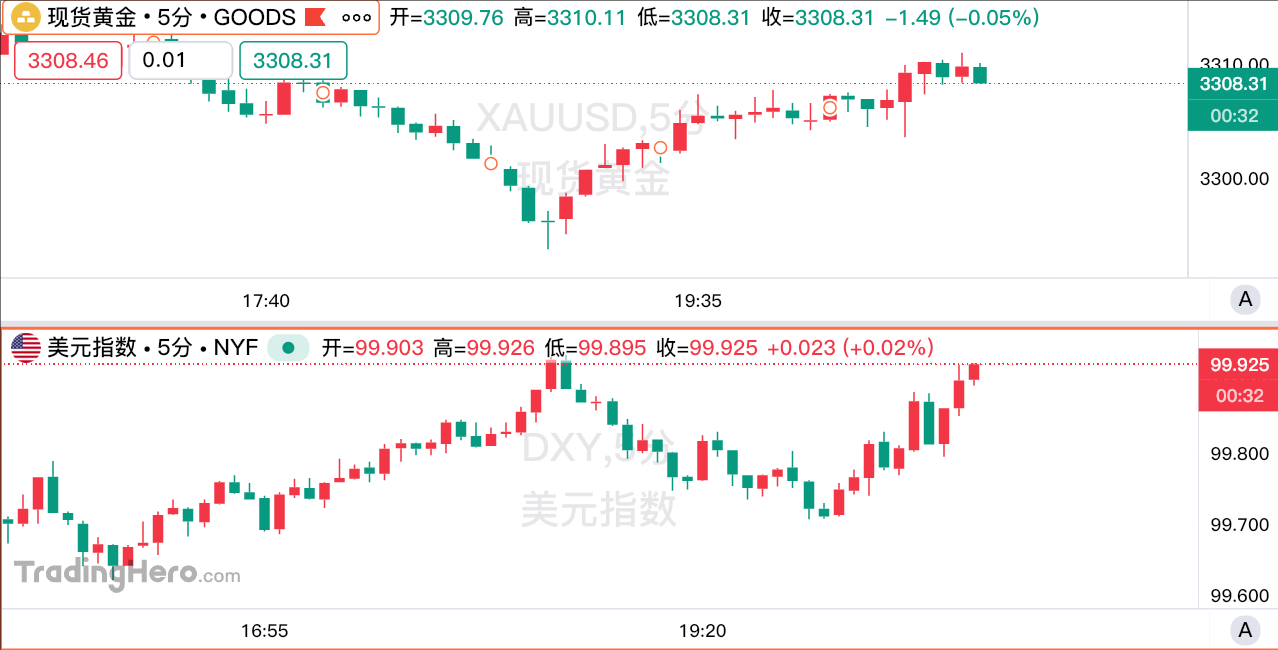
北京时间周四20:30,美国公布PCE数据,6月核心PCE物价指数年率录得2.8%,高于预期的2.70%,前值由2.70%修正为2.8%。6月核心PCE物价指数月率录 得0.3%,符合预期,高于前值的0.20%。 包含食品能源的整体PCE指数环比上升0.3%,同比上涨2.6%,分别高于市场预期的0.23%和2.5%。 数据还显示,个人消费支出价格指数环比上涨0.3%,将年率提升至2.6%,为2月份以来的最高水平。支出疲软的背后是劳动力市场降温。实际可支配收入在 5月份下降后持平,而工资和薪金几乎没有上涨。预计将于周五公布的7月就业报告将显示招聘持续放缓,失业率略有回升。储蓄率保持在4.5%。 美国系列数据公布后,现货黄金短线波动暂不大,美元指数短线小幅走高。 "美联储传声筒"Nick Timiraos表示,(6月)核心PCE通胀看起来开始恶化,并不比美联储去年开始降息时更好,从某些指标来看甚至更糟。6月份核心PCE 物价指数3个月年化率为2.6%(去年同期为2.3%)。按6个月年化计算,这一数字为3.2%(去年同期为3.3%)。 美国6月通胀数据略超预期,为美联储降息时间表再添变数。政策制定者此前强调,需要看 ...
美联储7月不降息,鲍威尔“鹰派”言论导致9月降息预期骤降|国际
清华金融评论· 2025-07-31 12:11
Core Viewpoint - The Federal Reserve decided to maintain the federal funds rate in the range of 4.25% to 4.5%, with a significant reduction in the market's expectation for a rate cut in September from 65% to below 50% [1][2][8]. Group 1: Federal Reserve Meeting Outcomes - The Federal Reserve's decision was supported by a 9-2 vote, with two members advocating for a 25 basis point rate cut, marking the first time since 1993 that two members opposed the chair's decision [4]. - The meeting statement included new language indicating "economic activity has slowed in the first half of the year," reflecting concerns about growth momentum [4]. - There is a shift in focus from solely inflation to also considering employment market risks, suggesting that if employment deteriorates, the Fed may prioritize action [4][8]. Group 2: Future Policy Outlook - The potential for a rate cut in September will depend on upcoming economic data, particularly regarding inflation and employment [7]. - If inflation data shows an increase due to tariffs or rising import prices, it could delay any rate cuts [7]. - The current unemployment rate is stable, but weak corporate investment and reduced immigration could lead to job market deterioration, with a threshold of 4.5% unemployment potentially triggering a rate cut [7]. Group 3: Market Impact - Following the Fed's meeting, market expectations for a September rate cut decreased significantly, with the annual expected rate cuts revised from 2.2 to 1.8 times [8]. - The risk of "moderate stagflation" in the U.S. economy is rising, with second-quarter real private consumption growth at only 1.2% and weak corporate capital expenditures [8]. - Short-term market volatility increased, with declines in U.S. stocks, rising bond yields, and a stronger dollar, reflecting the market's absorption of the Fed's hawkish signals [10]. Group 4: External Variables - Political pressure from former President Trump on Fed Chair Powell regarding rate cuts poses a challenge to the Fed's independence [10]. - Ongoing trade negotiations, particularly with China, Canada, and Mexico, could impact inflation risks if tariffs are escalated [10].

鲍威尔保持鹰派立场
Zhao Yin Guo Ji· 2025-07-31 11:28
Economic Outlook - The Federal Reserve maintained its policy interest rate at 5.25%-5.5%, marking a shift in economic description from "moderate expansion" to "slowing" [2] - The meeting saw two dissenting votes for the first time since 1993, indicating increased division among policymakers [2] - Market expectations for rate cuts in 2023 decreased from 46 basis points to 36 basis points following Powell's comments [1] Inflation and Employment - Powell highlighted that tariffs have been overlooked in their impact on inflation, suggesting that the costs will gradually be passed to consumers [1] - The labor market remains robust, with unemployment rates at historical lows, but a gradual weakening is expected in Q4 [1] - CPI growth is anticipated to rebound slightly in Q3 due to tariff impacts, but may decline again in Q4 as demand slows [1] Future Rate Cuts - The Fed is expected to keep rates unchanged in Q3, with potential cuts in October and December, bringing the year-end policy rate to approximately 3.83% [1] - The anticipated cuts are driven by rising unemployment and the economic impact of tariffs [2] Market Implications - Long-term U.S. Treasury yields are expected to rise initially before declining, with year-end projections at around 4.2% [2] - The U.S. dollar index may rise in Q3 due to inflation rebounds, but could decline in Q4 as inflation falls and rate cuts are implemented [2]
-美联储那些事儿:美联储7月议息会议:等待看到更多价格传导
Ping An Securities· 2025-07-31 09:28
Report Industry Investment Rating - Not provided in the given content Core Viewpoints - The Fed decided to keep the policy rate unchanged at 4.25 - 4.5% in the July 2025 meeting, with some members opposing and supporting a 25BP rate cut [8]. - Powell's stance is hawkish, and he has no pre - set expectations for the September policy decision, which dampens market rate - cut expectations [8]. - The certainty of a September rate cut by the Fed is low. If the unemployment rate remains stable or slightly rises in the next two months, the Fed may keep the rate unchanged to wait for tariff transmission results [9]. - If inflation does not rise significantly in the next two months, the bond market opportunities will increase in the fourth quarter; if inflation rises significantly, the US Treasury yields may rise further. It is recommended to maintain a relatively short duration in the short term [9]. - The US dollar index has rebounded to around 100 points. Short - term dollar short - covering may bring some upward space, and the view that the US dollar index will operate in the 95 - 105 range is maintained [6][9]. Summary by Related Catalogs Fed Meeting Decision - In the July 2025 meeting, the Fed kept the policy rate at 4.25 - 4.5% unchanged. Members Bowman and Waller voted against and supported a 25BP rate cut this month [8]. Powell's Stance - Powell adheres to data - dependence and has no policy expectations for September, which hits market rate - cut expectations [8]. - In terms of inflation, Powell aims to prevent one - time price increases from turning into continuous inflation, hopes to maintain a moderately restrictive monetary policy, and believes that tariff transmission to prices may be slower than expected [8][10]. - Regarding employment, Powell thinks the job market is relatively stable despite some downward risks [5][10]. - On economic growth, Powell admits that the overall economic growth has slowed down, and large fluctuations in net exports may affect consumer spending, making some signals difficult to interpret. He also believes that although consumer growth has slowed down, consumers' credit conditions are good [5][10]. Market Reaction - After the Fed's press conference, the market lowered the expectation of a September rate cut. Short - term interest rates rose significantly, the US dollar continued to rise, and the US stock market was under pressure. As of 4:30 Beijing time, the 2Y and 10Y US Treasury yields rose by 6.8BP and 2.8BP respectively compared with before the meeting, the US dollar index rose 0.6% to around 100 points, and the S&P 500 fell 0.4% at the close [9]. Outlook for September Fed Meeting - The certainty of a September rate cut by the Fed is not high. If the unemployment rate remains stable or slightly rises in the next two months, the Fed may keep the rate unchanged to wait for longer - term tariff transmission results [9]. Outlook for US Treasury Yields - If inflation does not rise significantly in the next two months, the bond market opportunities will increase in the fourth quarter; if inflation rises significantly, the US Treasury yields may rise further. It is recommended to maintain a relatively short duration in the short term, and the downward revision of the rate - cut expectation provides some allocation opportunities [9]. Outlook for US Dollar Index - After the US - EU trade agreement, the US dollar index has generally risen and has now rebounded to around 100 points. Short - term dollar short - covering may bring some upward space. Without a substantial weakening signal in the US labor market and continuous rate cuts by the Fed, the view that the US dollar index will operate in the 95 - 105 range is maintained [6][9].
7月FOMC点评:不急于行动,但出现分歧
HTSC· 2025-07-31 09:24
Report Summary Core Viewpoints - The Fed maintained the target range of the federal funds rate at 4.25 - 4.5% in the July FOMC meeting, in line with market expectations. There were internal disagreements, with two governors voting against and favoring an immediate rate cut, but Powell's hawkish remarks at the press conference reduced the rate - cut expectation. The Fed may wait for employment data to weaken before cutting rates [2]. - Before the FOMC meeting, US economic data was robust, driving up US Treasury yields and strengthening the US dollar. After the meeting, financial conditions tightened, and the US stock market turned down, showing some "mild stagflation" pressure [6]. - The probability of the first rate cut within the year occurring in the fourth quarter has increased, subject to inflation, employment data, and the Fed's decision - making mechanism. The Fed is likely to wait and see based on inflation and employment data [2][9]. FOMC Statement - The Fed kept the federal funds rate unchanged. Two governors, Bowman and Waller, voted against, increasing the easing expectation to some extent, but Powell's hawkish speech later reduced the rate - cut expectation [2]. - The Fed noted that economic activity slowed in the first half of the year, with high uncertainty, a low unemployment rate, and a robust jobs market [2]. Powell's Press Conference - Powell considered the current interest rate to be at a moderately restrictive level. Inflation is slightly above 2%, the labor market is robust, and the Fed has not decided on a September rate cut, waiting for more data [3]. - Powell emphasized the Fed's independence from political influence, stating that it makes decisions based on data [3]. Market Performance - Before the FOMC meeting, multiple economic data showed a robust US economy, with the 7 - month ADP employment increasing by 104,000 (higher than the expected 75,000), and the Q2 real GDP annualized year - on - year growth at 3% (higher than the expected 2.4% and the previous value of - 0.5%). However, consumer spending cooled, and there was "mild stagflation" pressure [6]. - After the meeting, the 2 - year US Treasury yield rose 7.79bp to 3.95%, the 10 - year yield rose 4.77bp to 4.37%, the US dollar index strengthened, and US stocks turned down [7]. Outlook for Policy Path - By the September FOMC meeting, economic data may not support a rate cut. The probability of the first rate cut within the year occurring in the fourth quarter has increased [9]. - From the inflation perspective, the Fed needs to see the peak of the inflation pulse caused by tariffs pass. The inflation effect of tariffs is slower than expected, and inflation is expected to rise rapidly in the third quarter [9]. - In terms of employment, the Fed is unlikely to cut rates before the unemployment rate approaches 4.5%. Currently, the labor market supply - demand balance is maintained, and the probability of the unemployment rate rising to 4.4% or higher before September is low [9]. - The Fed's decision - making mechanism shows that although two governors supported a rate cut in July, Powell led the majority to maintain a relatively tight stance and a data - driven model, and the Fed's independence is well - defended [10]. Asset Allocation Views - US Treasuries: Due to tariff impacts and Fed policy expectations, short - term risks of US Treasuries may rise slightly in the third quarter, while long - term bonds may be relatively stable. It is recommended to buy 10 - year US Treasuries at a yield of around 4.5% [11]. - US Stocks: After hitting record highs, the US stock market may face short - term volatility due to inflation, Fed's tight - stance, and tariff impacts on corporate earnings. It is advisable to hedge short - term risks by increasing volatility [11]. - US Dollar: With trade partners' concessions on tariffs, the "de - dollarization" concern has eased. The US dollar may stage a rebound in the third quarter, and attention should be paid to its impact on the foreign exchange market and domestic monetary policies [12].
宏观动态点评:7月FOMC,鲍威尔鹰派发言打压降息预期
HTSC· 2025-07-31 09:23
Monetary Policy Insights - The Federal Reserve maintained the benchmark interest rate at 4.25%-4.5% during the July FOMC meeting[1] - Two Fed governors voted against the decision to keep rates unchanged, marking the first such occurrence since 1993[1] - The Fed's assessment of economic growth was downgraded from "expand at a solid pace" to "moderated," indicating concerns over economic slowdown[1] Interest Rate Expectations - Following the meeting, the probability of a rate cut in September dropped to 45%, down from previous expectations[1] - Cumulative rate cut expectations for the year decreased by 7 basis points to 37 basis points[1] - The yields on 2-year and 10-year U.S. Treasury bonds rose by 6 basis points and 2 basis points, reaching 3.94% and 4.37% respectively[1] Economic Indicators - Powell emphasized the robustness of the job market but acknowledged existing downside risks[3] - The second quarter GDP growth exceeded expectations, but the overall growth rate for the first half of the year was slower compared to the same period last year[3] - Powell noted that tariffs are contributing to inflation, with companies likely to pass on costs to consumers in the future[3] Future Outlook - The decision on a potential rate cut in September will depend on economic data from July and August, particularly employment figures[4] - There is a possibility of two rate cuts between September and December if economic conditions weaken[4] - Risks include unexpected inflation from tariffs and a faster-than-expected slowdown in the U.S. job market[4]