
牛市

Search documents
A股强势反弹背后 估值驱动还是基本面回暖?
Jing Ji Guan Cha Wang· 2025-09-25 02:06
Market Overview - The recent strong rebound in A-shares is driven by policy support and a return of market confidence, rather than substantial improvements in the fundamentals [1][3] - On September 24, A-shares saw significant gains, with the ChiNext Index rising by 2.28%, reaching a three-and-a-half-year high, and the STAR 50 Index increasing by 3.49% [1][2] - The total trading volume on September 24 reached 2.33 trillion yuan, indicating heightened market activity and investor sentiment [1][2] Investment Trends - UBS noted a trend of residents reallocating funds from stable assets like bonds and money market funds to the stock market, indicating a shift in wealth distribution [1][4] - The increase in margin trading balances and new margin accounts suggests that leveraged funds are playing a crucial role in the current market rally [2][4][5] Policy Expectations - There is anticipation for new growth policies, with potential adjustments in monetary policy, including interest rate cuts and reserve requirement ratio reductions [6][7] - Specific policy directions may include early use of local government debt quotas for infrastructure spending, establishment of new policy financial tools, and expansion of consumer subsidies [7] Market Risks - Despite the positive market indicators, there are structural concerns as the current rally is primarily driven by valuation expansion rather than widespread corporate profit improvements [3][4] - The sustainability of the bull market is questioned, as long-term growth requires fundamental economic improvements and not just confidence and liquidity [3][6]
洪灏:我相信,牛市真的来了
Feng Huang Wang Cai Jing· 2025-09-25 00:59
凤凰网财经讯 9月23-24日,由凤凰卫视、凤凰网主办的"凤凰湾区财经论坛2025"在广州举行,本届论坛以"新格局·新路径"为主题,汇聚全球政商学界精 英,共同洞察变局脉络、探寻发展新机。 莲华资产管理有限公司管理合伙人洪灏出席论坛,并在"做多中国:十年大牛市?"环节发表主旨演讲。他表示,"我相信,牛市真的来了。" "其实,今年7月初,在这波上涨之前,我们就判断牛市来了。虽然,当时我们的看法并没有任何基本面的支持,但并不妨碍中国市场走强。因为,做投资久 了的人都知道,市场领先于实体经济。"洪灏继续说道。 不过洪灏也提醒,市场也有错的时候。"俗话讲,在未来3次经济危机里,股票市场预测了5次。所以,它有时候是对的,有时候是错的。但是从交易的角度 来看,我们并不在乎预测是对还是错,只在乎在未来一段时间窗口里,是否能看到一个牛市,以及在牛市中是否能赚钱。" 莲华资产管理有限公司管理合伙人洪灏 ...


924一周年:最牛和最菜的10只基金名单一览
Sou Hu Cai Jing· 2025-09-24 16:51
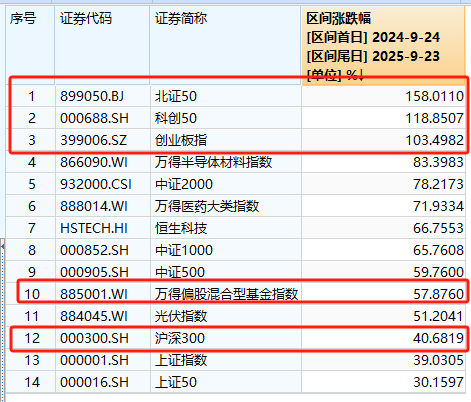
Market Overview - The bull market has lasted for a year, with major indices showing significant gains: the North Exchange 50 Index increased by 158%, the Sci-Tech 50 Index rose by 118%, and the ChiNext Index gained 103.49% [1] - Over 1,400 stocks in the A-share market have doubled in price, representing more than 26% of the 5,324 stocks listed, with notable sectors including electronics, machinery, power equipment, computers, and automobiles [1] Fund Performance - A total of 1,276 fund products have doubled in value, with the top 10 performing funds all being actively managed, indicating the strength of fund managers [2] - The best-performing fund, Debon Xinxing Value, achieved a return of 279.93%, with themes including CPO (4 funds), North Exchange (3 funds), and robotics (3 funds) [2][3] Underperforming Funds - Among over 20,000 funds, only 216 reported negative returns, with the worst performer being Dongcai Value Qihang C, which declined by 10.78% [4] - Notably, seven of the worst-performing funds belong to GF Fund, all managed by the same manager, Wang Mingxu [5] Investment Insights - The analysis suggests that during a bull market, holding onto key investments without frequent trading is a wise strategy, as significant profits are made through holding rather than trading [8] - Investors are encouraged to focus on market conditions rather than personal returns when making decisions [8] - Common investment pitfalls include selling too early or buying into losing positions, emphasizing the need for a well-defined strategy [8] - Maintaining a consistent presence in the market allows investors to better navigate fluctuations and refine their trading systems [8]
牛市的成因是什么?牛市还能否延续?
Yuekai Securities· 2025-09-24 13:11
Group 1: Causes of the Bull Market - The current A-share bull market is driven by profound global capital reallocation and breakthroughs in Chinese technology innovation, termed as the "technology revaluation bull" [2] - Changes in macroeconomic policy since the September 26 meeting last year and significant advancements in artificial intelligence have boosted investor risk appetite and market expectations [4] - Continuous improvement in capital market systems and the influx of quality companies have enhanced market attractiveness [6] Group 2: Market Outlook - The bull market is expected to continue, with short-term corrections providing buying opportunities [3] - The foundation for the bull market remains solid, supported by China's transition from "catching up" to "leading" in various tech sectors [8] - Domestic long-term capital continues to flow into the market, with overseas capital seeking to allocate assets in China amid global changes [9]
董少鹏:本轮牛市是新质牛 是新质生产力转化为市场投资价值的牛市
Di Yi Cai Jing· 2025-09-24 09:51
炒股就看金麒麟分析师研报,权威,专业,及时,全面,助您挖掘潜力主题机会! 责任编辑:何俊熹 MACD金叉信号形成,这些股涨势不错! ...
牛市中场!存款市值比最新 1.56
雪球· 2025-09-24 07:58
Core Viewpoint - The article discusses the optimistic sentiment in the market driven by favorable news in the semiconductor sector and expectations from a meeting scheduled at 3 PM on Monday, highlighting the performance of bank stocks and the overall market dynamics [3][4]. Market Performance - Bank stocks showed early signs of upward movement but faced downward pressure shortly after the market opened. The Shanghai Composite Index fluctuated, eventually closing up 0.22% after a brief decline [4]. - Small-cap stocks, such as those in the CSI 1000 index, experienced significant gains, reaching new highs in the last hour of trading [6]. Sector Performance - The semiconductor and communication sectors performed well, with notable contributions from robotics and battery industries. However, the photovoltaic industry showed weakness [8]. - Specific sector performance data includes: - Sci-tech chips: 62.77% year-to-date increase - Consumer electronics: 52.99% year-to-date increase - Sci-tech AI: 63.77% year-to-date increase - CSI All Index Semiconductor: 45.71% year-to-date increase [9]. Economic Indicators - The latest data from the central bank indicates that household deposits amount to 161.02 trillion yuan, with a market value ratio of 1.56 compared to the total market capitalization of 103.29 billion yuan at the end of August [14]. - The rolling 12-month increase in household deposits has stabilized around 14 trillion yuan, significantly lower than the nearly 24 trillion yuan at the beginning of 2023 [16]. Market Cycle Insights - Analyst Zhang Xia suggests that the Chinese economy and stock market follow a five-year cycle, predicting a "main rising wave" phase in the next 2-3 years post-2024 [17]. - The current market is considered to be in the second phase of a bull market, characterized by self-reinforcing incremental capital [21][22]. - Zhang emphasizes that the transition to a low-valuation, pro-cyclical market is likely to occur in the following year, driven by economic improvements and inflation [23].

X @外汇交易员
外汇交易员· 2025-09-24 06:00
摩根士丹利美股投资组合经理Andrew Slimmon认为,尽管标普500指数估值很高,但今年剩余时间内美国股市的牛市可能只会暂停一段时间。科技、金融和工业板块这些更具周期性的股票略显“超买”,但需要“拿住”,今年仍可能继续表现良好,部分原因是美联储上周刚刚重启降息周期,且经济衰退的迹象尚未显现。现在临近第四季度,股市仓位调整并非大势所趋,因为年初至今的赢家往往会在最后3个月继续发力。“市场大幅轮动”通常不会发生在第四季度。企业2025年和2026年的盈利最终可能会强于华尔街的预测,因为迄今为止,关税尚未造成许多人担心的拖累。部分企业已经削减成本以抵消关税的影响并保持利润率,这可能是近期美国招聘放缓的原因之一,企业可能“非常谨慎”地将关税成本转嫁给消费者。Slimmon表示,自己经常接到理财顾问的电话,询问美国股市何时可能回调,因为客户手头有现金可以投资。随着美联储重启降息,将现金投入货币市场基金的吸引力似乎有所减弱,因此投资者正在寻找更好的投资对象。尽管自己认为市场已经过度波动,但美国股市的上涨可能只会经历“暂停”,而非回调,部分原因是许多人“袖手旁观”,希望回调成为投资机会。 ...
罕见,黄金今年36次、美股28次,同创新高,什么信号?如何交易?
3 6 Ke· 2025-09-23 11:52
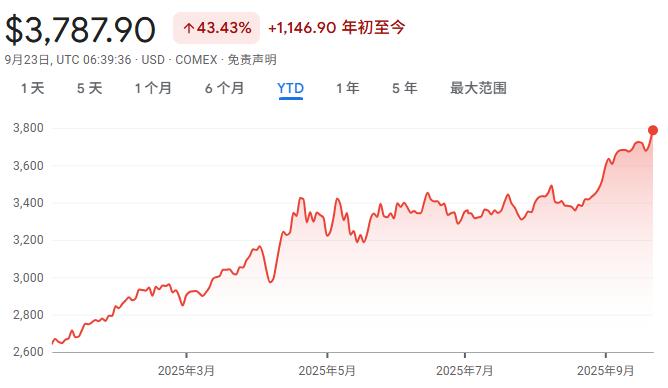
Core Viewpoint - The Federal Reserve is initiating interest rate cuts, leading to a surge in global asset prices, particularly in the U.S. stock market, with the S&P 500 index hitting new highs multiple times this year [1][2]. Group 1: Market Dynamics - Risk and safe-haven assets are both reaching historical highs, raising questions about whether the market has perfectly priced in all favorable conditions [2]. - Analysts from Bank of America and Deutsche Bank suggest that the market is not yet in a "perfect pricing" state, indicating potential for further gains despite existing bubble signs [2][5]. - The current economic environment, characterized by tax cuts, tariff reductions, and interest rate cuts, is providing implicit guarantees for the economy and stock market [2]. Group 2: Asset Performance - Gold prices have reached historical highs, with a year-to-date increase of approximately 43%, reflecting investor concerns over inflation and geopolitical uncertainties [1][9]. - The market sentiment is shifting towards risk assets as investors feel that holding cash is less favorable compared to consumption or investment [3]. Group 3: Historical Context and Future Outlook - Historical data shows that past stock market bubbles have seen average gains of 244% from low to peak, suggesting that the current market may still have room to grow [3][5]. - The "Magnificent Seven" tech stocks have risen by 223% since March 2023, with a dynamic P/E ratio of 39, indicating significant market interest in these assets [4][5]. Group 4: Investment Strategies - A five-point trading strategy is proposed to navigate the current market, including investing in bubble assets, creating a "barbell" portfolio, shorting bubble company bonds, and focusing on volatility [6][7]. - The strategy emphasizes the importance of recognizing the potential for further asset price inflation and the historical tendency for rising interest rates to follow asset bubbles [6][7]. Group 5: Gold Market Analysis - The current environment for gold is described as a "perfect storm," driven by geopolitical uncertainty, inflation fears, and expectations of interest rate cuts [9][10]. - Despite concerns about a potential bubble, key market indicators do not yet show signs of irrational exuberance, suggesting that gold is in a sustained bull market rather than a bubble [10][11].

0922国新办发布会点评:后续降准降息仍有可能,牛市持续可期
Shanghai Securities· 2025-09-23 10:42
Monetary Policy Insights - The press conference did not involve short-term monetary policy adjustments, but there remains a possibility of future interest rate cuts or reserve requirement ratio reductions[3] - The central bank's current stance is supportive, implementing moderately loose monetary policy based on macroeconomic data assessments[3] Financial Sector Achievements - During the 14th Five-Year Plan period, China's financial sector has made significant progress in reforming the financial system and enhancing service quality to the real economy[4] - The total assets of the banking sector, along with the scale of the stock and bond markets, rank among the highest globally, indicating progress towards becoming a financial powerhouse[4] Capital Market Developments - The new securities law and related regulations have strengthened the legal framework of China's capital markets, contributing to a fair and just market environment[8] - The total market capitalization of A-shares has surpassed 100 trillion yuan, reflecting a solid foundation for a long-term bull market[8] Technology Sector Impact - The market capitalization of the technology sector now exceeds 25% of the total A-share market, indicating its growing importance compared to traditional sectors like banking and real estate[9] - Enhanced awareness among listed companies regarding shareholder returns has led to significant increases in dividends and share buybacks, contributing to wealth effects in the market[9] Investor Engagement and Risk Management - Reforms in public fund management have improved investor experience and increased the participation of long-term funds in A-shares, with a 30% increase in holdings compared to the end of the 13th Five-Year Plan[10] - The regulatory focus on risk prevention and investor protection is expected to reduce market volatility and enhance investor confidence[11]