科技成长

Search documents
A股分析师前瞻:新一轮上行动能或在蓄势,“红十月”可期
Xuan Gu Bao· 2025-10-08 13:55
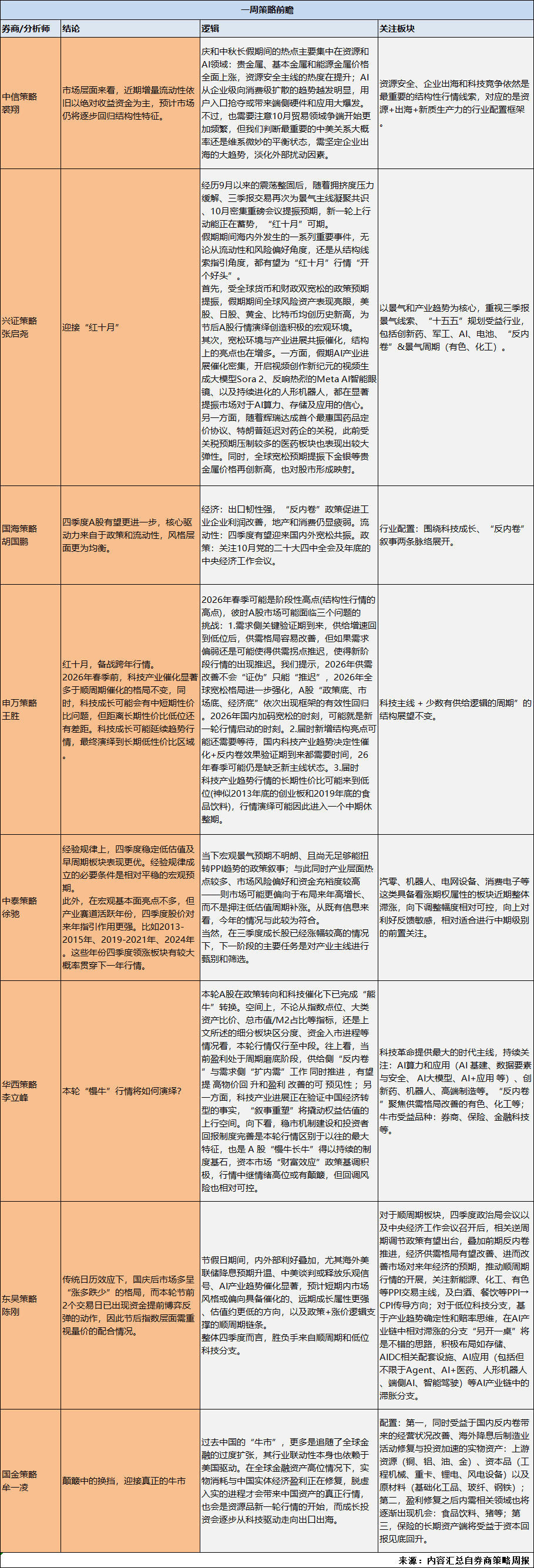
Group 1 - The market is expected to enter a new upward momentum in October, referred to as "Red October," following a period of consolidation since September, with easing crowding pressure and a focus on third-quarter reports [1][2] - Key drivers for the fourth quarter A-shares include policy support and liquidity, with a more balanced market style expected to revolve around technology growth and "anti-involution" narratives [1][2] - The technology sector is anticipated to have significant catalytic effects leading up to spring 2026, although there may be short-term price-performance issues [1][3] Group 2 - Recent global monetary and fiscal easing policies have created a positive macro environment for the A-share market, with global risk assets performing well during the holiday period [1][2] - The AI industry has seen significant advancements, boosting market confidence in AI computing power, storage, and applications, which are expected to drive investment opportunities [1][2] - The fourth quarter is likely to witness a strong performance in sectors benefiting from domestic demand recovery and overseas investment, particularly in resource-related and technology-driven industries [4]

北京时间9:30,中国股市逼空准时开始?
凤凰网财经· 2025-10-08 12:57
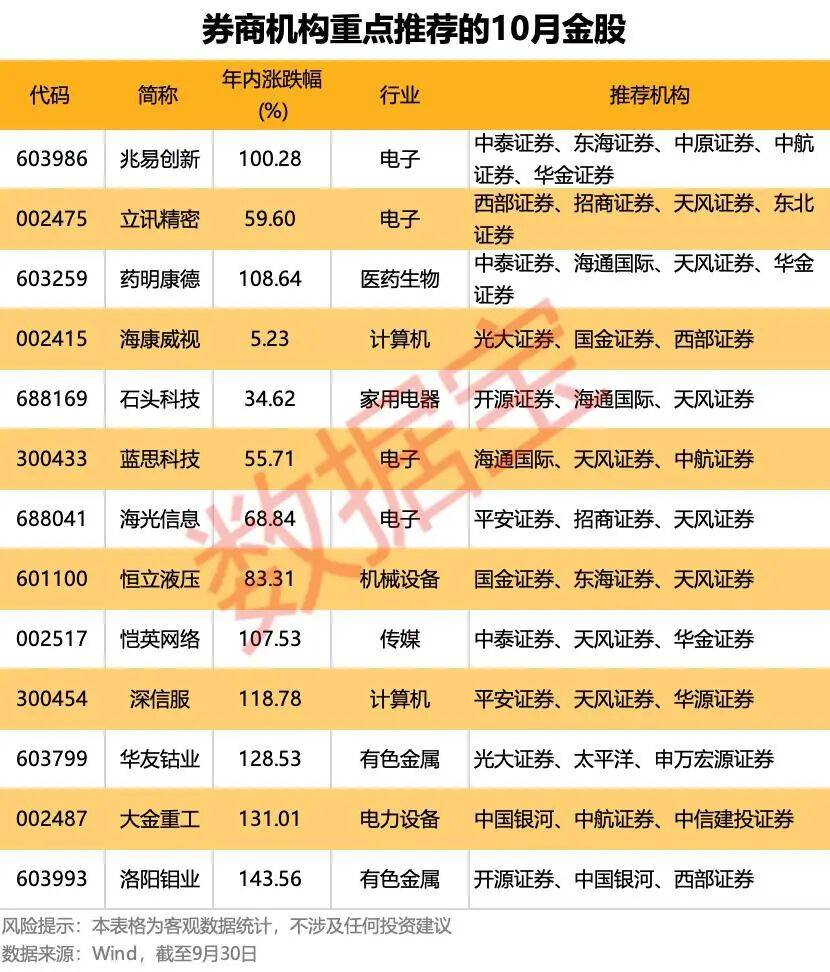
Group 1 - The article highlights significant global market movements during the National Day holiday, including a government shutdown in the US, a surge in Japan's stock market, and gold prices reaching historical highs [1] - Japan's Nikkei 225 index broke the 48,000-point mark for the first time on October 6, becoming the best-performing major index globally, influenced by the election of a new president in the ruling Liberal Democratic Party [2] - The US stock market saw slight gains, with the Nasdaq up 0.57%, Dow Jones up 0.44%, and S&P 500 up 0.39%, driven by strong performance in the semiconductor sector due to a significant agreement between AMD and OpenAI [6] Group 2 - Gold prices surged, with spot gold breaking the $4,000 mark for the first time, reflecting a nearly $1,400/ounce increase this year, a rise of over 52% [8] - The People's Bank of China announced a 1.1 trillion yuan reverse repurchase operation to enhance liquidity, marking a significant policy move to support the market [10] - A new government procurement policy will provide a 20% price evaluation advantage for domestically produced products starting January 1, 2026, aimed at fostering a competitive procurement market [11] Group 3 - The electric vehicle and energy storage sectors saw increased activity, with record charging volumes and strong demand for energy storage cells, although BYD's September sales declined to 396,300 units [12] - Meta's AI glasses have sold out in retail stores, indicating strong market demand, with plans for increased sales points to meet supply [14] - Longfeng Pharmaceutical's stock surged over 230% on its debut, attracting investor attention despite a general market downturn [15] Group 4 - Private equity firms maintain an optimistic outlook for the A-share market post-holiday, focusing on technology growth as a core investment theme [16] - October's "golden stocks" list from brokers features nearly 200 stocks, with Zhaoyi Innovation receiving multiple recommendations, indicating a focus on technology and consumer recovery sectors [17]

重磅利好!明天A股,猛攻4000点?
Sou Hu Cai Jing· 2025-10-08 09:19
Group 1 - The A-share market showed positive performance before the National Day holiday, with the Shanghai Composite Index, Shenzhen Component Index, and ChiNext Index rising by 1.43%, 2.40%, and 2.75% respectively, indicating a good profit effect for investors [1] - Analysts suggest that the fourth quarter will present more opportunities in the technology growth sector, recommending investors to focus on stocks with previously lagging earnings revisions [1][2] - A significant majority of private equity institutions (70%) are optimistic about the post-holiday A-share market, with a focus on technology sectors such as AI, semiconductors, humanoid robots, smart driving, and innovative pharmaceuticals [2] Group 2 - The October "golden stocks" list has been released, with nearly 200 stocks recommended by brokerages, highlighting the strong interest in the electronics sector, which has the highest number of recommended stocks [4] - Among the recommended stocks, Zhaoyi Innovation received the most attention from five institutions, reflecting confidence in its growth potential in the storage chip market [4][7] - Historical data shows that the Shanghai Composite Index has a 64% probability of rising in October, with an average increase of 0.48%, suggesting a generally optimistic outlook for the month [8][9] Group 3 - The upcoming quarterly reports of A-share listed companies are expected to provide opportunities for sectors with strong performance, as companies with good earnings are likely to attract investor interest [3] - The market is anticipated to experience a "slow bull" trend, with a focus on technology and high-end manufacturing, as well as resource cycle products benefiting from improved supply-demand dynamics [9] - The recent surge in global semiconductor prices, particularly in the storage chip sector, is expected to create a "super cycle" driven by the AI boom, positively impacting related stocks [11]

A股开市倒计时 五大私募火线解盘
Zhong Guo Zheng Quan Bao· 2025-10-08 02:19
Core Viewpoint - The A-share market is expected to perform positively after the National Day and Mid-Autumn Festival holidays, supported by favorable external markets and domestic consumption recovery [1] Market Outlook: External Factors Boost Confidence - The overall positive performance of external markets during the holiday period creates a favorable environment for the A-share market [2] - The Hong Kong stock market, particularly the semiconductor sector, has shown strong performance, providing emotional support for A-shares [2] - Improved trading sentiment is anticipated as global asset classes have generally risen, reducing uncertainties affecting Chinese assets [2] - Domestic macroeconomic stability and high service consumption during the holiday are expected to attract risk-averse funds back to the A-share market [2] - Collaborations in the tech sector, such as OpenAI and AMD, may catalyze related A-share sectors like computing power and AI applications [2] Strategic Response: Balanced and Selective Investment - Multiple private equity firms emphasize the importance of balanced allocation and selective stock picking in the upcoming trading period [3] - A proactive investment strategy is recommended, with an increase in positions and optimization of portfolios, as historical data suggests a recovery in A-share sentiment post-holiday [3] - The trend of household savings flowing into equity markets is expected to continue, indicating significant long-term upside potential for A-shares [3] - A combination of high-position operations and balanced holdings is advised, focusing on technology growth and high-end manufacturing while also including low P/B and high dividend assets for risk mitigation [3] Investment Themes: Consensus on Tech Growth - The technology growth sector is unanimously favored by five private equity firms, alongside opportunities in consumer recovery and undervalued sectors [5] - Continued optimism for technology stocks is noted, particularly in computing power, storage, and AI infrastructure-related sectors [5] - The upcoming third-quarter earnings reports are expected to present opportunities for well-performing sectors [5] - Specific areas of interest include internet giants, domestic semiconductor supply chains, and innovative pharmaceuticals [5] - Focus areas post-holiday include AI, humanoid robotics, high-end manufacturing, and potential recovery in financial and cyclical sectors [5] - Market style is expected to become more balanced, with investment opportunities across various asset classes, including technology, consumer, and cyclical sectors [5] Key Sectors of Interest - Emphasis on graphics processors and humanoid robotics, along with identifying oversold weight sectors for investment [6]
【财经早报】黄金,历史新高!
Zhong Guo Zheng Quan Bao· 2025-10-08 00:17
Group 1 - The domestic ETF market has rapidly developed during the 14th Five-Year Plan period, with over 1,300 ETF products and a scale exceeding 5.6 trillion yuan, making China the largest ETF market in Asia, surpassing Japan [2] - The transportation department forecasts a cross-regional population flow of 30.849 million people on October 7, marking a 3.5% increase from the previous period and an 18.3% increase year-on-year [2] - The total box office for the National Day holiday period (October 1-8) has surpassed 1.6 billion yuan, with films like "The Volunteer Army: Blood and Peace," "731," and "Assassination Novel 2" leading the charts [2] Group 2 - Nearly 200 stocks have been included in the brokerage firms' "Golden Stocks" list for October, with Zhaoyi Innovation being the most recommended by five institutions, indicating a focus on technology growth sectors for investment opportunities [3] - Private equity firms are optimistic about the A-share market performance post-holiday, citing external market improvements and domestic consumption recovery as supportive factors, with a focus on structural opportunities in technology growth [3] - A research team from the Chinese Academy of Sciences has made breakthroughs in solid-state battery technology, addressing key challenges such as interface impedance and ion transmission efficiency, with results published in the journal "Advanced Materials" [3][4] Group 3 - Tesla updated the ordering information for the standard versions of Model Y and Model 3, with prices set at $39,990 and $36,990 respectively, while the company’s stock fell by 4.45%, resulting in a market cap loss of approximately $65 billion [6]

喜娜AI速递:昨夜今晨财经热点要闻|2025年10月8日
Sou Hu Cai Jing· 2025-10-07 22:17
Group 1 - Bitcoin experienced a sudden drop of over 0.8%, falling below $124,000, with more than 160,000 liquidations in the past 24 hours [2] - A-shares are expected to perform well post-holiday, with private equity firms optimistic about technology growth and consumer recovery [2] - Concerns about a bubble in the tech sector are rising, particularly after AMD's stock surged due to its partnership with OpenAI [2] Group 2 - The U.S. government’s direct investments in companies have led to significant stock price increases, but this speculation carries risks [3] - The central bank has increased its gold reserves for 11 consecutive months, with gold prices recently surging due to geopolitical tensions and Fed rate cut expectations [3] - The S&P 500 index ended its seven-day winning streak, influenced by the government shutdown and delayed economic data releases [3] Group 3 - Goldman Sachs reports that copper prices have entered a new range, with a new bottom line set at $10,000 per ton due to strategic demand and supply constraints [4] - The Hong Kong stock market has shown weakness despite gains in the Nikkei index, influenced by various economic indicators and forecasts [5] - Tesla is reportedly planning to launch a lower-spec version of the Model Y to address global sales pressures, with a potential price reduction of about 10% [5] Group 4 - Current A-share market conditions are likened to the second phase of a bull market, with expectations of a broadening recovery across sectors [5]
A股开市倒计时,五大私募火线解盘
Zhong Guo Zheng Quan Bao· 2025-10-07 14:24
Core Viewpoint - The private equity industry holds an optimistic outlook for the A-share market post-holiday, driven by favorable external markets and domestic consumption recovery, with a focus on structural opportunities in technology growth sectors [1][2]. Market Outlook - The overall positive performance of external markets during the holiday period creates a favorable environment for the A-share market's reopening [2]. - The Hong Kong stock market, particularly the semiconductor sector, has shown strong performance, providing emotional support for the A-share market [2]. - There is an expectation of improved trading sentiment in the A-share market, as global asset classes have generally risen, reducing uncertainties for Chinese assets [2]. - Domestic macroeconomic stability and a surge in service consumption during the holiday are likely to attract risk-averse funds back to the A-share market [2]. - Collaborations in the tech sector, such as between OpenAI and AMD, may catalyze related sectors in the A-share market [2]. Strategic Response - Private equity firms emphasize the importance of balanced allocation and selective stock picking in their investment strategies [3]. - A proactive investment strategy is recommended, with an increase in positions and optimization of portfolios, as historical data suggests a recovery in A-share sentiment post-holiday [3]. - There is a long-term trend of household savings flowing into equity markets, indicating significant upside potential for the A-share market [3]. - The investment strategy post-holiday includes maintaining a strategic optimism with a combination of high positions and balanced holdings, focusing on technology growth and high-end manufacturing assets [3][6]. Investment Themes - The technology growth sector is widely recognized as a key area of opportunity, with a consensus among private equity firms [5]. - There is a continued positive outlook for technology stocks, particularly in areas related to computing power and artificial intelligence infrastructure [5][6]. - The upcoming third-quarter earnings reports are expected to present opportunities for sectors with strong performance [5]. - Specific sectors of interest include internet giants, domestic semiconductor supply chains, innovative pharmaceuticals, and solid-state battery development [6]. - The market is anticipated to become more balanced, with investment opportunities across various asset classes, including consumer and cyclical sectors [6].
10月“金股”来了!业内:四季度机会更多在科技成长领域
Zhong Guo Zheng Quan Bao· 2025-10-07 10:37
Core Viewpoint - The October "Golden Stocks" list from brokerages highlights nearly 200 stocks, with Zhaoyi Innovation being the most favored, recommended by five brokerages, indicating a strong interest in technology growth sectors for the upcoming quarter [1][2]. Group 1: Stock Recommendations - Zhaoyi Innovation has been recommended by five brokerages, including Zhongtai Securities and Donghai Securities, and saw its stock price rise over 8% before the National Day holiday, reaching a new high [2]. - Other notable stocks include WuXi AppTec and Luxshare Precision, each recommended by four brokerages, while several others received recommendations from multiple brokerages, indicating a broad interest across various sectors [2]. Group 2: Industry Distribution - The electronics industry has the highest representation in the October "Golden Stocks," with 27 stocks recommended, followed by the power equipment industry with 25 stocks [3]. Group 3: Performance of Previous Recommendations - Over half of the September "Golden Stocks" achieved positive returns, with 165 out of 301 stocks showing gains. Notably, Xiechuang Data saw an 81.7% increase, leading the performance [4]. - The Huashan Securities Golden Stock Index recorded a 15.12% increase in September, with several recommended stocks experiencing significant gains [4]. Group 4: Market Outlook - The market outlook for October and the fourth quarter suggests a focus on four main investment themes: technology growth and high-end manufacturing, resource cyclical products, structural recovery in consumption, and "anti-involution" themes [5]. - The technology sector is expected to remain a key focus, with a potential shift from hardware to application-oriented investments as companies report their third-quarter earnings [6].
年内涌现53只“翻倍基”!2025年前三季度基金业绩放榜
Sou Hu Cai Jing· 2025-10-02 07:20
Core Insights - The public fund industry has experienced a fruitful year in the structural bull market, with active equity funds making a significant comeback, particularly supported by the AI computing and innovative pharmaceutical sectors [1][2]. Group 1: Fund Performance - A total of 53 funds have achieved over 100% returns year-to-date as of September 30, with 42 of these being active equity funds, showcasing the fund managers' effective strategies in high-growth sectors [2][4]. - The top-performing fund, managed by Ren Jie, achieved a return of 194.49%, heavily investing in the overseas computing industry chain, with significant contributions from stocks like Shenghong Technology, which surged 581% this year [2][3]. - Other notable funds include Zhang Wei's fund with a 155.09% return, focusing on Hong Kong's innovative pharmaceuticals, and Feng Ludan's fund with a 140.86% return, both capitalizing on the AI industry chain [3]. Group 2: Commodity Performance - Gold ETFs have emerged as the standout performers in the commodity fund sector, with all 14 gold ETFs showing gains exceeding 40% year-to-date, driven by rising international gold prices [5][6]. - The highest-performing gold ETFs, managed by Zhao Xu and Rong Ying, reported returns of 41.48% and 41.47%, respectively, reflecting strong long-term investment value [5][6]. Group 3: Market Outlook - Looking ahead to Q4, several fund companies suggest maintaining a focus on growth sectors while also considering cyclical and consumer stocks, as the market has already seen significant gains [7][8]. - The ongoing AI technology innovation is expected to provide a premium valuation for related assets, despite potential short-term volatility [8][9]. - The overall market sentiment remains bullish, with continued optimism for emerging technologies and cyclical financial sectors, particularly in the context of the "anti-involution" policies that may enhance competition in the renewable energy sector [9].



机构:四季度AI、创新药、机器人将继续冲锋
2 1 Shi Ji Jing Ji Bao Dao· 2025-10-02 00:47
Group 1 - The core view is that the A-share market is expected to continue rising in Q4 2025, driven by "policy + liquidity," but volatility is anticipated [4][5] - Most institutions believe that the technology growth style will remain dominant, but investment strategies may shift from a focus on high-performing sectors to a more balanced allocation, targeting underperforming "anti-involution" sectors and low-position technology branches [2][5][12] - Historical data indicates that the A-share market typically experiences a strong profit effect in Q4, with a median increase of 1.96% in the first half of the quarter and a 100% win rate [5][8] Group 2 - The dual engines of "policy expectations + liquidity improvement" are seen as the main drivers for the market's upward movement, despite the likelihood of high-level fluctuations [5][6] - Analysts suggest that after the National Day holiday, the A-share market is likely to rise due to the return of risk-averse funds and improved liquidity in October [5][6] - The technology sector is viewed as the clearest investment theme for Q4, with a focus on AI, innovative pharmaceuticals, and robotics, although concerns about potential overheating in tech stocks are noted [8][9][10] Group 3 - The strategy of "high-cut low" (switching from high to low positions) is emphasized by multiple institutions as a key approach for Q4 [12][13] - Investment strategies include identifying undervalued segments within technology and focusing on "anti-involution" sectors that are experiencing excess supply and low price levels [15][16] - The market is expected to exhibit a more balanced style in Q4, with a potential shift towards value stocks alongside growth stocks, driven by anticipated policy support for economic stability [17]