
供给侧结构性改革

Search documents
多维度投石问路 券商标新立异破内卷
Zheng Quan Ri Bao· 2025-06-08 16:55
Core Insights - The Chinese securities industry is transitioning from quantity growth to quality transformation, with 150 brokerages and total assets of 12.93 trillion yuan, a 9.3% increase from 2023 [1] - The industry faces challenges from homogeneous competition, leading to price wars and a decline in service quality, which hinders high-quality development [1][4] - There is a pressing need for brokerages to enhance their comprehensive financial services, global asset allocation capabilities, and in-depth industry research [1] Industry Challenges - The phenomenon of "involution" in the industry is characterized by low-level, inefficient competition, which has drawn significant attention from the central government [2] - The excessive number of brokerages and the lack of differentiation in services have led to fierce competition, resulting in a decline in commission rates to around 0.02% [3][4] - Many brokerages are focusing solely on meeting KPI targets, neglecting customer service and satisfaction, which contributes to high customer turnover [3] Business Transformation - Brokerages are urged to expand their business boundaries and seek new growth opportunities beyond traditional services like brokerage and investment banking [5] - Emphasis is placed on differentiating services and products, particularly for niche markets such as technology and small enterprises, to avoid homogeneous competition [5][8] - Financial technology is highlighted as a crucial tool for enhancing service quality and operational efficiency [5] International Expansion - Many brokerages are actively exploring international markets and strengthening partnerships with global financial institutions to enhance their competitiveness [7] - Leading brokerages like Huatai Securities and CITIC Securities have reported over 40% year-on-year revenue growth in their international subsidiaries [7] Structural Reforms - The industry is undergoing supply-side structural reforms, with regulatory support for mergers and acquisitions to optimize resource allocation and enhance competitiveness [9][10] - Successful cases of mergers, such as Guotai Junan and Haitong Securities, demonstrate the potential for improved market share and operational efficiency [10] - The reforms aim to elevate industry concentration, allowing larger brokerages to better serve the economy while enabling smaller firms to focus on specialized services [10][11]
习近平主持召开中央全面深化改革委员会第十四次会议强调依靠改革应对变局开拓新局 扭住关键鼓励探索突出实效 李克强王沪宁出席
Ren Min Ri Bao· 2025-06-06 03:16
Group 1 - The meeting emphasized the importance of completing the "13th Five-Year Plan" and achieving the goal of building a moderately prosperous society, while initiating the new journey of building a modern socialist country through effective reforms [1][6] - The meeting highlighted the critical role of state-owned enterprises (SOEs) as a foundation for socialism and their significant contributions during the COVID-19 pandemic, particularly in emergency supply, medical support, and stabilizing supply chains [2] - The meeting discussed the need for a three-year action plan for SOE reform, focusing on enhancing competitiveness, innovation, and risk resistance while maintaining the leadership of the Communist Party [2] Group 2 - The meeting called for accelerating the integration of new-generation information technology with manufacturing, emphasizing the need for structural reforms and the adoption of smart manufacturing practices [3] - It was noted that rural land system reforms should ensure the protection of collective ownership while exploring ways to enhance farmers' rights and interests [3] - The meeting stressed the importance of media integration and the development of a comprehensive media system to enhance public communication and cultural transmission [3] Group 3 - The meeting addressed the need for educational reform, focusing on improving evaluation systems to align with socialist educational goals and reduce the emphasis on standardized testing [4] - It was highlighted that state-owned cultural institutions play a vital role in promoting socialist culture and should focus on producing high-quality artistic works that meet public demand [5] - The meeting reviewed the progress of healthcare reforms since the 18th National Congress, emphasizing the need for a robust healthcare system and the importance of preventive health measures [5][6]
习近平主持召开中央深改委第十五次会议并发表重要讲话
Xin Hua She· 2025-06-06 03:16
Group 1 - The core viewpoint emphasizes the need to accelerate the formation of a new development pattern that prioritizes domestic circulation while promoting mutual reinforcement between domestic and international circulation, as a strategic decision based on changes in China's development stage and conditions [1][2] - The meeting highlighted the importance of utilizing significant reform achievements since the 18th National Congress to focus on practical implementation and effectiveness in driving the new development pattern [1][2] - The meeting approved several implementation opinions aimed at promoting innovative development in foreign trade, revitalizing higher education in the central and western regions, and regulating private compulsory education [2][3][4] Group 2 - The meeting addressed the challenges posed by rising unilateralism and protectionism in the context of global economic globalization, stressing the need to expand openness and enhance domestic and international economic linkages [3][4] - The revitalization of higher education in the central and western regions is aimed at aligning with major regional development strategies and enhancing the internal motivation and vitality of education in these areas [3][4] - The meeting underscored the necessity of regulating private compulsory education to ensure the public nature of compulsory education and promote the overall development and health of students [4][5] Group 3 - The meeting discussed the importance of agricultural and rural reforms, emphasizing the need to maintain land ownership and protect farmers' interests while enhancing the efficiency of resource allocation in rural areas [6][7] - It was noted that significant progress has been made in agricultural reforms since the 18th National Congress, with a focus on ensuring food security and transitioning agricultural development towards quality improvement [6][7] - The meeting called for a systematic approach to reform, integrating various policies and ensuring they work together effectively to benefit the public [6][7]
习近平主持召开中央全面深化改革委员会第十六次会议
Ren Min Ri Bao· 2025-06-06 03:16
Core Points - The article emphasizes the significant breakthroughs achieved in comprehensive deepening reform since the 13th Five-Year Plan and highlights the new stage of development that China will enter during the 14th Five-Year Plan, indicating that reform is at a new juncture [1][6] - It stresses the importance of aligning reform with development needs, addressing new challenges posed by changing social contradictions and complex international environments, and enhancing the strategic, forward-looking, and targeted nature of reforms [1][6] Group 1: Reform Strategies - The meeting approved several key documents aimed at optimizing the layout and structure of state-owned enterprises, establishing a high-standard market system, and enhancing the management and supervision of state assets [2][3] - It was noted that optimizing the layout and structure of state-owned enterprises is crucial for better serving national strategic goals and adapting to high-quality development [2][3] Group 2: Market System and Asset Management - The construction of a high-standard market system is to be guided by new development concepts, focusing on expanding domestic demand and improving market environment and quality [3][5] - Emphasis was placed on the importance of managing state assets effectively, ensuring they serve as a material foundation for the development of the Party and the state, and safeguarding the interests of the people [3][5] Group 3: Social Services and Cultural Responsibility - The meeting highlighted the significance of promoting healthy development in elderly care and childcare services, addressing the "one old and one young" issue to improve people's livelihoods and promote balanced population development [4][5] - Cultural enterprises are urged to uphold social responsibilities, reflect core socialist values, and produce quality cultural products that align with the aesthetic pursuits of the Chinese people [4][5] Group 4: Education Reform - The meeting acknowledged the progress made in educational reform since the 18th Central Committee, emphasizing the need to continue deepening reforms in the education sector to align with national strategic needs and public expectations [5][6] - It called for optimizing the education structure and promoting a balanced public education service system to reduce regional and urban-rural disparities [5][6]
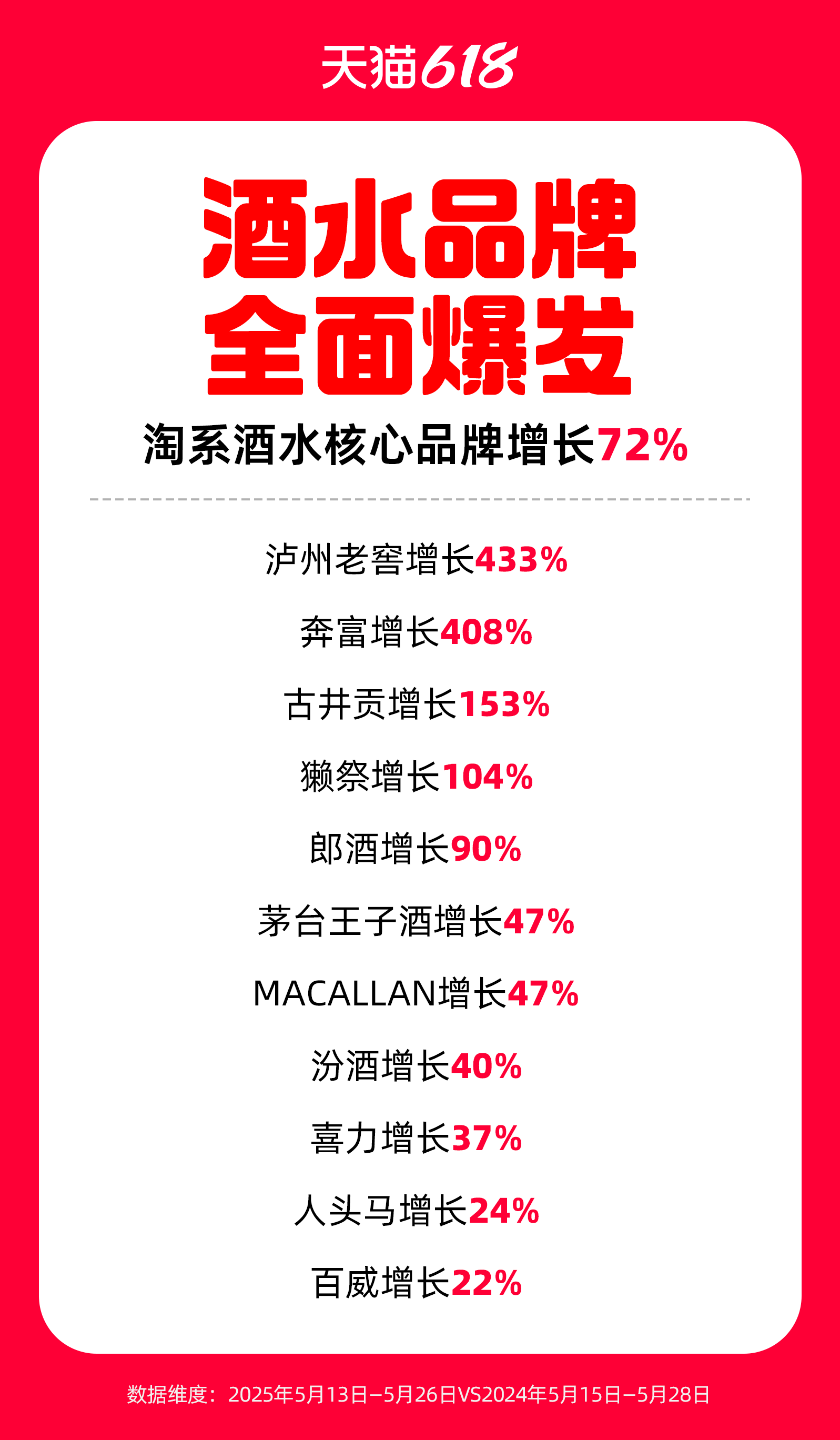
酒水消费凸显“品牌价值”,天猫618核心酒水品牌增长72%
Zhong Guo Jing Ji Wang· 2025-06-05 06:30
Group 1 - The core viewpoint of the articles highlights a significant surge in alcohol consumption during the Tmall 618 shopping festival, with various categories such as Chinese liquor, wine, yellow wine, and foreign liquor experiencing rapid growth [1][5][7] - From May 13 to May 26, the first phase of Tmall 618 saw a 72% year-on-year increase in core alcohol brands within the Taobao ecosystem, with domestic liquor, wine, and yellow wine achieving double-digit growth [1][5] - The trend of "self-consumption" is emerging, particularly among younger consumers, as evidenced by the substantial growth in sales of domestic liquor brands during Tmall 618 [5][6] Group 2 - Specific brands such as Jian Nan Chun, Luzhou Laojiao, and Langjiu reported remarkable year-on-year growth rates of 284%, 433%, and 90% respectively during the first phase of Tmall 618 [5] - The proportion of new customers in the alcohol category reached 70% over the past year, with users aged 18-29 exceeding 10 million, accounting for 30% of total users [5] - The Australian wine brand Penfolds achieved a 408% year-on-year sales increase during Tmall 618, ranking second among core alcohol brands in the Taobao ecosystem [6] Group 3 - Live streaming has become a major driver for the growth of alcohol sales, particularly for domestic liquor, with overall live streaming sales in the alcohol category increasing by 20% year-on-year during Tmall 618 [7] - The simplification of platform operations and enhancement of efficiency have contributed to the explosive growth of alcohol brands during the first half of Tmall 618 [7] - The participation of brands in promotional activities, such as Gujing Gong's involvement in Tmall Super Member Day, resulted in a 51% increase in store sales compared to the previous year [5][6]


加快形成与新质生产力相适应的新型生产关系(深入学习贯彻习近平新时代中国特色社会主义思想·学习《习近平经济文选》第一卷专家谈)
Ren Min Ri Bao· 2025-06-02 21:43
Group 1 - The core argument emphasizes the necessity of forming new production relations to develop new quality productivity, which is essential for high-quality development and seizing competitive advantages [1][2][4] - The development of new quality productivity is driven by technological innovations such as digitalization, networking, and intelligence, which require new production relations that align with these advancements [1][4] - The historical context shows that the ability to adapt production relations to new productivity demands varies among countries, impacting their capacity to leverage opportunities from productivity changes [2][4] Group 2 - The application of artificial intelligence as a representative of new quality productivity necessitates the establishment of compatible production relations to maximize its effectiveness across various industries [3][4] - The ongoing global technological revolution presents significant opportunities for cultivating new quality productivity, making the formation of suitable production relations crucial for future competitiveness [4][8] - The Chinese government's proactive approach in proposing the concept of new quality productivity and reforming relevant systems is foundational for enhancing the country's competitive edge in the global arena [4][8] Group 3 - Accelerating the formation of new production relations requires addressing misconceptions and identifying effective pathways for reform [5][7] - The essence of economic system reform is to adjust and optimize production relations based on the needs of productivity development, which is vital for unleashing social productivity [8][10] - Key tasks include fostering innovation among micro-entities and enhancing original innovation capabilities, which are critical for the development of new quality productivity [9][10] Group 4 - Establishing a high-standard market system and improving institutional frameworks are essential for facilitating the flow of advanced production factors towards new quality productivity [11][12] - The role of data as a key production factor is increasingly recognized, necessitating the establishment of systems for data rights, market transactions, and benefit distribution [12][13] - Reforming the technology innovation system is crucial for overcoming barriers to the development of new quality productivity, focusing on enhancing foundational research and original innovation capabilities [13][14]
有色金属篇:结构之变:新一轮供给侧的供需耦合
Guo Tai Jun An Qi Huo· 2025-05-30 12:14
1. Report Industry Investment Rating No relevant content provided. 2. Core Viewpoints of the Report - In the previous supply - side reform, the problems faced by the non - ferrous sector were much smaller than those of the black sector [2][6] - The 656th Document established the "ceiling" for electrolytic aluminum production capacity, ending the dilemma of continuous growth despite repeated regulations [3][38] - Compared with the black sector, the supply - demand balance of the non - ferrous metal industry is relatively healthy, and strategic resources are being reserved by accumulating intermediate inventories [4][49] - The industry prosperity of the non - ferrous metal demand side varies, and the emerging economy has a higher driving force for non - ferrous metals than traditional industries [5][75] - It is less likely to launch a new round of supply - side reform in the non - ferrous sector due to its relatively healthy supply - demand balance, strategic nature, and complex and dispersed industrial chain [106] 3. Summaries by Relevant Catalogs 3.1 Reform Background and Motivation - The current market's attention to potential supply - side reform is due to over - supply of industrial products, weakening external demand caused by trade frictions, and the call for anti - "involution - style" price cuts. Similar problems led to the 2015 supply - side reform [8] - In the 2015 supply - side reform, industrial product prices (PPI) declined for 54 consecutive months, and over - capacity seriously squeezed industrial enterprises' profit margins. Currently, over - capacity is spreading to the middle and lower reaches [8][12] - External economic downturn led to a decline in China's exports in 2015, and trade protectionism in developed economies and competition from low - cost countries further worsened China's foreign trade environment [18][19] 3.2 Comparison between Non - ferrous and Black Sectors - From 2012 - 2016, the non - ferrous sector was more prosperous than the black sector, with relatively stable capacity utilization in non - ferrous smelting and rolling industries. However, non - ferrous metal prices were under pressure, dragging down enterprise profit growth [20][28] 3.3 Factors Affecting Non - ferrous Metal Demand - In 2017, factors such as enterprise capital expenditure, emerging industries (new energy vehicles, 5G, semiconductors), and real - estate recovery driven by shantytown renovation monetization and overseas economic recovery boosted non - ferrous metal demand [30][37] 3.4 Electrolytic Aluminum Industry Reform - Before setting the 4500 - million - ton production capacity ceiling in 2017, the electrolytic aluminum industry had experienced six rounds of "failed" regulations. The 656th Document established the ceiling and launched supply - side reform, including measures such as determining the ceiling, setting energy and environmental thresholds, and optimizing production capacity layout [38][40][42] - Compared with the "one - size - fits - all" approach in the black sector, electrolytic aluminum production restrictions are more "seasonal" and "refined", mainly concentrated in the heating season and becoming more precise over time [46] 3.5 Supply - Demand Balance of the Non - ferrous Sector - The capacity utilization rate of non - ferrous smelting and rolling has been stable at around 80%. The non - ferrous sector emphasizes the logic of "resource is king", with the intermediate smelting end yielding profits to the upstream mining end. Different non - ferrous metal varieties have different profit performances due to downstream demand [59] - The non - ferrous sector shows a pattern where the upstream is stronger than the middle and downstream, and refined metal inventories are accumulating. This is related to the high import dependence of non - ferrous minerals in China, and China reserves strategic resources by expanding intermediate inventories [60][68][74] 3.6 Demand - side Characteristics of Non - ferrous Metals - The non - ferrous sector has more diverse intermediate products and a more dispersed downstream demand compared to the black sector, which increases the difficulty of supply - side reform [77] - The demand from the power industry for non - ferrous metals accounts for a high and increasing proportion. The demand for copper in the power industry is expected to grow by 6.5 - 9%, and the demand for aluminum in the power industry is expected to grow by about 10% in 2025 [80][85][86] - The real - estate sector's demand for non - ferrous metals is differentiated. While the real - estate market is generally weak, policies have promoted the demand for copper in the power and home appliance industries, leading to a differentiation strategy of "long non - ferrous, short black" [87] - The new energy vehicle and photovoltaic industries have become new drivers of non - ferrous metal demand. In 2025, the cumulative year - on - year sales of new energy vehicles reached 46.3%, and the global and Chinese new - added photovoltaic installations are expected to drive the demand for non - ferrous metals [105]
5月28日晚间央视新闻联播要闻集锦
Yang Shi Xin Wen Ke Hu Duan· 2025-05-28 13:54
Group 1 - Xi Jinping emphasized the need for a dynamic balance between demand and supply in the economy, aiming for a virtuous cycle of national economic growth [1][6] - The innovation capability and quality level of China's supply system are continuously improving, meeting the people's demand for a better life [1][6] Group 2 - The C919 commercial aircraft has been in operation for two years, with its route network covering 16 cities across the country [3][13] - The Ministry of Finance plans to issue 68 billion RMB in government bonds in Hong Kong this year, enhancing the regular issuance mechanism for RMB bonds [15]
强化“十五五”化工产业规划顶层设计
Zhong Guo Hua Gong Bao· 2025-05-28 02:01
Core Insights - The global chemical industry is facing structural imbalances in basic products, characterized by low-end capacity duplication and insufficient high-end supply [1] - The "14th Five-Year Plan" for the chemical industry will focus on high-quality development, innovation-driven growth, and a modern industrial system that is green, safe, and controllable [2] Group 1: Structural Challenges - The traditional top-down planning model has led to severe homogenization of production capacity across regions, exacerbating supply-demand imbalances [1] - The changing social demand structure necessitates a shift towards "demand-driven supply" to rewrite industrial planning logic [1] Group 2: Strategic Objectives - The "15th Five-Year Plan" will emphasize the "strong country" goal, enhancing new quality productivity, global competitiveness, and security assurance in the chemical industry [2] - The plan will adopt a localized approach to identify suitable product routes and build differentiated advantages through various strategic directions [2][3] Group 3: Structural Adjustments - The plan will continue the high-end structural adjustment approach from the "14th Five-Year Plan," focusing on deep supply-side structural reforms [3] - It will encourage vertical extension of the industrial chain and promote upstream development of specialty raw materials, midstream processing capabilities, and downstream high-value-added products [3] Group 4: Innovation and Technology - The chemical industry must integrate technological and industrial innovation, enhancing the soft environment and strengthening hard technology to elevate industry capabilities [4] - The focus will be on green, safe, and intelligent innovations, transitioning towards low-carbon and intelligent manufacturing [4][5] Group 5: Green Transformation - The industry will pursue a comprehensive green low-carbon transformation, leveraging renewable energy for chemical processes and promoting low-carbon technologies [5] - Emphasis will be placed on safety through advanced technologies and digital solutions to enhance operational safety and efficiency [5] Group 6: Industry Mapping - A detailed industry map will be essential for the "15th Five-Year Plan," providing macro guidance for local industrial planning and showcasing the entire industrial chain [6] - The mapping will include various aspects such as competitive landscape, growth potential, and regional collaboration [6][7]
宝钢股份20250527
2025-05-27 15:28
Summary of Baosteel Co., Ltd. Conference Call Industry Overview - The steel industry experienced significant losses in the first half of 2024, but saw a rebound at the end of September due to policy drivers. However, it faced a weak supply-demand situation again by year-end [2][4] - In the first four months of 2025, industry profits showed some recovery, but the second half of Q2 is expected to face downward pressure on steel prices due to insufficient demand and trade war tariffs [2][4] Company Performance - Baosteel Co., Ltd. reported a total profit of 9.3 billion yuan for the entire year of 2024, with a profit of 3.29 billion yuan in Q1 2025, representing an 18% year-on-year increase, primarily due to lower raw material costs [2][5] - The company maintained its leading position in the domestic industry despite a challenging environment [4][21] Strategic Initiatives - Baosteel has increased its stake in Maanshan Iron & Steel Co., Ltd. to enhance product competitiveness and sales capabilities, transitioning from a 1+1+n strategy to a 2+2+m strategy focusing on automotive sheets, silicon steel, and high-end long products [2][6] - The Baowu Group aims to add nearly 30 million tons of new capacity through investments in Maanshan (16 million tons), Rizhao (9 million tons), and a joint venture in Saudi Arabia (planned 2.5 million tons DRI capacity) [2][7][8] Product Focus - The choice to focus on thick plates is driven by local demand in Saudi Arabia for marine engineering and shipbuilding, aligning with the country's 2030 vision for large-scale infrastructure development [8] - Baosteel's product lines include automotive and silicon steel, with good order intake in Q2 2025, although competition in low-grade silicon steel remains intense [10][11] Market Challenges - The steel market has been characterized by weak demand and price fluctuations, with cold-rolled product prices peaking in Q1 2025 before declining due to demand exhaustion and trade war impacts [12][19] - The company is actively responding to international tariffs and trade conflicts by exploring new markets and adjusting export structures to mitigate risks [14][21] Financial Outlook - Capital expenditures are expected to decrease significantly from 2026 onwards, potentially enhancing the company's ability to increase dividends [15][16] - The company aims to optimize existing capacity rather than expand further, focusing on improving efficiency and profitability [9][20] Collaboration and Competition - Baosteel is addressing competition with Maanshan by enhancing collaboration in marketing and sales, aiming to reduce reliance on intermediaries and improve overall profitability [17] - The company remains vigilant regarding international trade policies and their potential impacts on sales and market dynamics [13][14] Conclusion - Baosteel Co., Ltd. is navigating a challenging steel market with strategic investments, a focus on product optimization, and proactive measures to mitigate external risks, while maintaining profitability and preparing for future growth opportunities [21]
