扩内需

Search documents
全市商务经济形势分析会举行
Chang Sha Wan Bao· 2025-07-31 09:10
Core Viewpoint - The business economy in Changsha has shown resilience and growth in the first half of the year, with significant improvements in retail sales, import-export values, and foreign investment despite a challenging external environment [1] Group 1: Economic Performance - From January to June, the total retail sales reached 280.77 billion yuan, representing a year-on-year growth of 5.6%, with an increase of 3.8 percentage points from the lowest value [1] - The total import and export value was 136.76 billion yuan, an increase of 1.2%, with June alone reaching 27.67 billion yuan, marking a two-year high and a 59.6% increase in non-trade [1] - The actual utilized foreign investment growth led the province, with 95 projects exceeding 200 million yuan introduced [1] Group 2: Strategic Initiatives - The government aims to enhance domestic demand by promoting consumption through various initiatives, including upgrading shopping scenarios and encouraging trade and cultural integration through events like "Xiangchao" and "Xiangma" [1] - To stabilize foreign trade, the focus will be on market expansion and providing precise support to enterprises, particularly in strengthening non-trade [1] - The strategy for attracting foreign investment will emphasize large and strong projects, focusing on key industries and initiatives to encourage local business return and alumni engagement [1] - Safety measures will be prioritized to identify and rectify risks, ensuring the prevention of major accidents [1]
7月政治局会议点评:立足长远,稳中求进
HTSC· 2025-07-31 02:08
Core Views - The meeting of the Political Bureau on July 30 emphasized maintaining policy continuity and stability while enhancing flexibility and foresight, aligning with investor expectations [2][3] - Key areas of focus include expanding domestic demand, prioritizing service consumption, and fostering international competitiveness in technology innovation [2][4][5] Focus Area 1: Expanding Domestic Demand - The meeting highlighted the importance of expanding service consumption as a new growth point while ensuring the improvement of people's livelihoods [4] - Policies may increasingly focus on stimulating service consumption, with potential measures including issuing consumption vouchers and upgrading cultural tourism [4] Focus Area 2: Technology Innovation - Technology innovation remains a focal point, with a shift from specific sectors to nurturing emerging industries with international competitiveness, particularly in the domestic computing power chain [5] - The "anti-involution" narrative has been refined to emphasize lawful governance of chaotic competition and capacity management in key industries [5] Focus Area 3: Capital Market Policies - The meeting stressed enhancing the attractiveness and inclusiveness of the domestic capital market, aiming to support enterprises at different development stages [6] - There was no separate discussion on real estate policies, indicating that future policy directions need further observation [6]
以场景相融促消费扩容(评论员观察)——从新消费把脉经济活力与动能③
Ren Min Ri Bao· 2025-07-30 11:39
Core Viewpoint - The integration of consumption scenarios is not merely a simple combination of functions, resources, and categories, but rather a multi-business integration that drives the renewal of goods and services, reshaping consumption methods through immersive experiences, ultimately achieving an upgrade in consumption quality [1][2][3] Group 1: Consumption Scenario Integration - The current consumption structure in China is transitioning to a stage where product consumption and service consumption coexist, with consumers increasingly valuing personalized, intelligent, and multi-layered consumption experiences [2][3] - The integration of consumption scenarios involves finding synergies between different sectors to create a combined effect greater than the sum of its parts, such as combining events like exhibitions and concerts with local attractions to enhance consumer engagement [2][3] Group 2: Physical Space Innovation - The transformation of physical spaces, such as shopping malls and parks, is essential for promoting the integration of consumption scenarios and enhancing business models, as seen in innovative examples like the "This Has Mountains" mall in Changchun, which integrates various cultural and recreational offerings [3][4] - Effective investment and scientific planning are necessary to upgrade traditional physical spaces, enabling them to adapt to new consumption patterns and attract more foot traffic [1][3] Group 3: Future Directions - Many current integration efforts are still in the exploratory 1.0 stage, and achieving high-frequency, high-quality scenario switching and user response requires innovative transformations and a deep understanding of consumer needs [4]
银行业促消费“路线图”不断细化
Jin Rong Shi Bao· 2025-07-30 02:40
Core Viewpoint - Consumption has become a crucial engine for economic growth in China, with a series of policies aimed at boosting domestic demand and consumption being implemented this year [1]. Financial Support for Consumption - The People's Bank of China and six other departments issued the "Guiding Opinions on Financial Support for Boosting and Expanding Consumption," outlining 19 key measures to enhance financial support for consumption [1]. - Multiple banks have developed action plans to support consumption, focusing on deepening consumer scenarios, product innovation, and optimizing resource allocation [2]. Bank Initiatives - China CITIC Bank has launched a comprehensive plan combining credit support, scenario discounts, and green incentives to lower consumer costs and enhance spending willingness [2]. - Jiangsu Bank has introduced 18 measures to support consumption, focusing on enhancing consumer capacity and improving financial services [2]. Focus on Key Consumption Areas - The "Guiding Opinions" emphasize increasing financial support for key consumption areas and innovating financial products tailored to consumer scenarios [3]. - China Bank has introduced a consumer credit loan with a low interest rate and high loan limit, alongside significant tourism subsidies [3]. - Everbright Bank is promoting various consumer activities through online platforms, aiming to create a closed loop of payment, rights, and consumption [3]. Service Consumption Growth Potential - Service consumption remains a shortfall in China's consumption landscape, with the "Guiding Opinions" encouraging financial institutions to increase credit support for service sectors like retail, hospitality, and elder care [4]. - The People's Bank of China has established a 500 billion yuan service consumption and elder care relending facility to stimulate financial support for these sectors [5]. Bank Responses to Policy - Banks are quickly responding to the new policies, with examples including Construction Bank providing financing for elder care facility upgrades and Zheshang Bank supporting hotel renovations [5]. - The China Banking Research Institute anticipates that consumption growth will be driven by policy effectiveness and the release of service consumption potential in the second half of the year [5]. Recommendations for Financial Institutions - Financial institutions are encouraged to enhance their understanding of consumption support, innovate financial products, and integrate more consumer scenarios into their offerings [6]. - Banks should focus on traditional consumption upgrades, service consumption expansion, and new consumption cultivation to better meet market demands [6].






上半年我国社会物流总额超170万亿元 同比增长5.6%
Yang Guang Wang· 2025-07-30 01:17
Core Insights - The total social logistics volume in China reached 171.3 trillion yuan in the first half of the year, marking a year-on-year growth of 5.6%, indicating a stable and progressive development in the logistics industry [1] - The logistics volume of industrial products grew by 5.8% year-on-year, contributing 85% to the overall growth of social logistics, which supports the stability of the industrial economy and the smooth operation of supply chains [1] - The logistics demand in the equipment manufacturing sector increased by 10.9%, while the high-tech manufacturing sector saw a 9.7% rise, highlighting these areas as significant growth drivers for logistics demand [1] - The logistics volume for 3D printing equipment and industrial robots exceeded a 20% year-on-year increase, reflecting strong demand in these advanced manufacturing sectors [1] - The import logistics volume of major commodities such as crude oil and iron ore has shown recovery, aided by policies promoting domestic demand and consumption [1] - The logistics volume for consumer goods increased by 6.1% year-on-year, with notable growth in logistics demand for electronic products and travel-related consumption [1] Sector Performance - The logistics volume for renewable resources grew by 17% year-on-year, with an acceleration of 1.2 percentage points compared to the first quarter [2] - There is a developing synergy in logistics across sectors such as automotive and home appliances, with logistics volumes for products like cars, tablets, smartphones, and washing machines all exceeding 10% growth [2]
年中定调!下半年三大政策主线浮出水面
Huan Qiu Wang· 2025-07-29 02:09
Group 1 - The core focus of the government's economic strategy is to "fully expand domestic demand," with significant policy signals expected in the second half of the year [2] - The State Council's meeting on July 16 emphasized the implementation of key policies to strengthen domestic circulation, including expanding investment in emerging service industries and optimizing the old-for-new consumption policy [2] - The Ministry of Finance plans to accelerate the introduction of measures to boost consumption, with a total of 690 billion yuan in special long-term bonds allocated in July and planned for October to support these initiatives [2] Group 2 - The central economic work conference and this year's government work report highlighted the need to address "involution-style" competition, with "anti-involution" becoming a key policy topic for the second half of the year [3] - The government aims to promote the construction of a unified national market and regulate low-price disorderly competition among enterprises, particularly in the new energy vehicle sector [3] - Policies to stabilize the real estate and capital markets have been emphasized, with expectations for more supportive measures in the housing market, including easing restrictions in first-tier cities and optimizing real estate storage policies [3]


上半年规上工业企业利润下降1.8%,“反内卷”反什么?
Cai Jing Wang· 2025-07-28 15:12
Core Insights - The article highlights the ongoing low-price competition among industries such as steel, cement, and photovoltaics due to insufficient demand, leading to a situation where "increment does not equal profit" [2][4] - Industrial profits in China have shown a decline, with the total profit of industrial enterprises above designated size reaching 34,365 billion yuan in the first half of the year, a year-on-year decrease of 1.8% [1][3] - The need for "anti-involution" measures is emphasized to correct the current market dynamics and improve profitability [2][6] Industrial Profit Trends - In the first half of the year, the mining industry experienced the largest profit decline, with total profits of 4,294.1 billion yuan, down 30.3% year-on-year [3] - The electricity, heat, gas, and water production and supply industry saw profits of 4,170.4 billion yuan, growing by 3.3%, but this was a decrease from 3.7% in the previous period [3] - The manufacturing sector's profits totaled 25,900.6 billion yuan, with a growth rate of 4.5%, down from 5.4% [3][4] Price Dynamics - The Producer Price Index (PPI) in June decreased by 3.6% year-on-year and 0.4% month-on-month, significantly impacting industrial profit growth [1][3] - The revenue profit margin for industrial enterprises was 5.15% in the first half of the year, which is 0.22 percentage points lower than the same period last year [1] Sector-Specific Performance - The raw materials manufacturing sector's profit growth slowed to 6.8%, a decline of 4.3 percentage points from the previous period [4] - Downstream consumer goods manufacturing, including furniture and textiles, showed negative profit growth, with beverage manufacturing profits down 2.1% [4] - The equipment manufacturing sector experienced rapid revenue and profit growth, with profits increasing by 96.8% in the automotive industry due to promotional activities and investment returns [5][6] Policy Implications - The "anti-involution" policies are expected to help stabilize industrial profits, with a focus on controlling new investments and improving cash flow through shorter accounts receivable periods [6][7] - The government plans to implement measures to support consumption and stabilize employment, which may further enhance demand and improve industrial profitability [9] Future Outlook - Experts predict that industrial profits may gradually recover in the third quarter due to ongoing policy support and improved market conditions [8][9] - The emphasis on equipment updates and consumer goods replacement policies is expected to continue, contributing to a positive trend in industrial profits [9]
一周重磅日程:中美大事扎堆,美股财报季进入高峰期
华尔街见闻· 2025-07-27 11:14
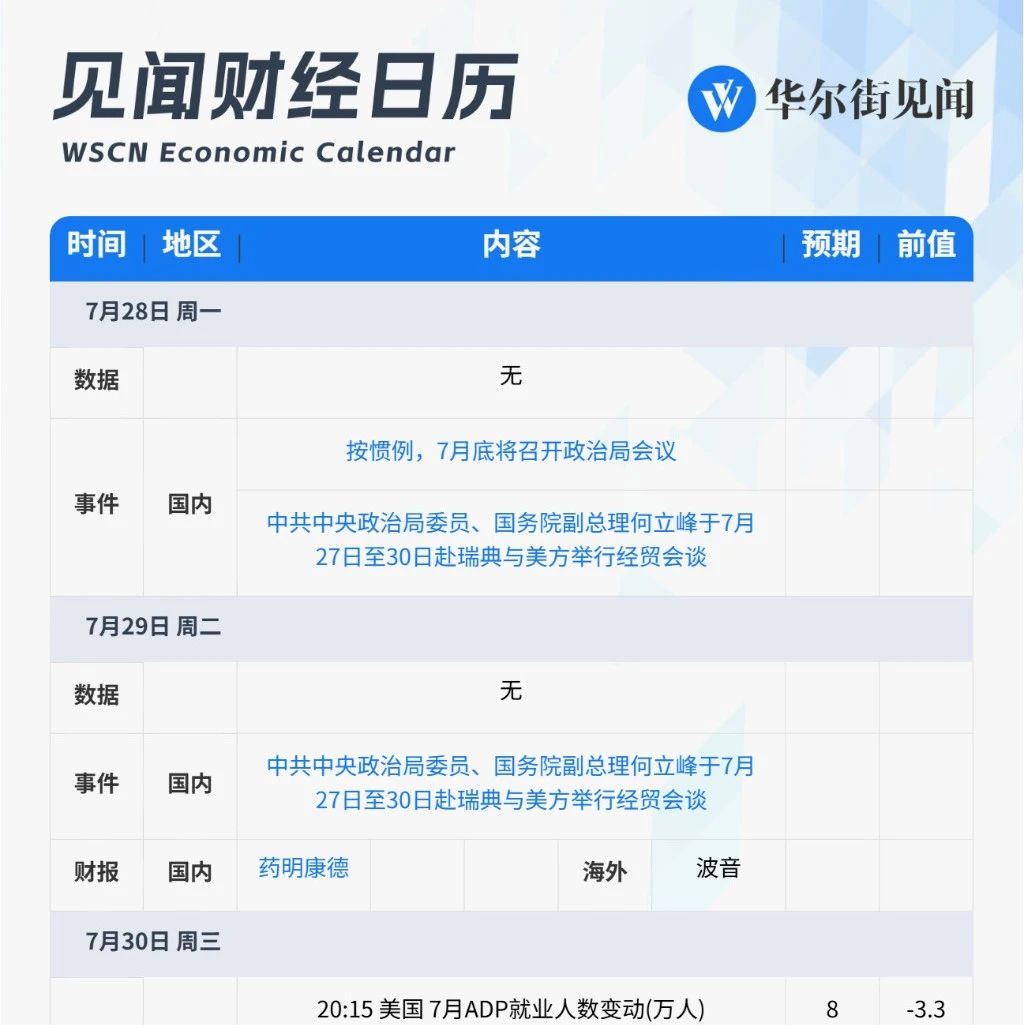
Group 1 - The core focus of the article is on significant economic events occurring from July 28 to August 3, particularly the US-China trade negotiations and the impending tariff deadline on August 1, which are expected to impact global trade dynamics [1][4][10] - The Federal Reserve's interest rate decision is highly anticipated, with expectations that there will be no rate cuts in July, despite ongoing discussions about economic conditions [13][14][16] - Major US companies, including Microsoft, Meta, Apple, Amazon, Qualcomm, Boeing, and Starbucks, are set to release their earnings reports, which could lead to market volatility [3][25] Group 2 - The article highlights the ongoing trade talks between the US and China, with a focus on the tariffs that are set to take effect on August 1, including a 50% tariff on copper imports [4][6][10] - The article discusses the economic outlook for China, with expectations that the upcoming political bureau meeting will affirm a stable economic environment while acknowledging external pressures [11][12][21] - The article notes that the Japanese central bank is likely to maintain its target interest rate at 0.5%, influenced by ongoing US-Japan trade negotiations and domestic inflation concerns [22][23] Group 3 - Microsoft is expected to report strong earnings driven by its investments in artificial intelligence and operational efficiency, with a target price set at $530 [26] - Meta's second-quarter revenue is projected to reach $44.71 billion, reflecting a 14% year-over-year growth, with a consistent track record of exceeding market expectations [28] - Apple's revenue for the quarter is anticipated to be $90.7 billion, a 5.8% increase from the previous year, primarily due to strong iPhone sales [29] - Amazon's revenue is expected to hit $162 billion, supported by growth in its AWS and retail sectors, despite concerns over tariffs [30][31] - Qualcomm is in the process of acquiring Alphawave for approximately $2.4 billion, pending regulatory approval [32] - Boeing forecasts a significant increase in earnings per share and revenue, driven by strong demand for commercial aircraft [33] - Starbucks is launching free study areas in select stores in China to boost customer traffic amid increasing competition [34] - WuXi AppTec's stock has reached a new high, reflecting strong institutional support and positive market sentiment [35]



国信期货有色(镍、不锈钢)月报:盘整蓄势,未来可期-20250727
Guo Xin Qi Huo· 2025-07-27 07:30
Industry Investment Rating - No investment rating for the industry is provided in the report. Core Viewpoints - The Shanghai nickel main contract 2509 closed at 124,360 yuan/ton on July 24, 2025, and the nickel price showed an overall fluctuating upward trend this month. The market is currently in the stage of trading expectations, and it is expected that subsequent "anti - involution" supporting policies will continue to increase. If so, the market may continue to rise. It is predicted that the Shanghai nickel and stainless steel will mainly show a fluctuating upward trend in the future [3][42]. Summary by Directory 1. Market Review - In July 2025, nickel showed an overall fluctuating upward trend. The nickel futures price was gradually repairing the gap caused by the tariff storm in early April. Due to weak demand, the overall market fluctuated with a slightly lower center. This month, it rose due to the impact of the "anti - involution" policy [9]. 2. Fundamental Analysis 2.1 Supply - side Analysis - **LME and SHFE inventory**: Since the second half of 2023, both LME and SHFE nickel inventories have shown a stable recovery trend. As of late July 2025, SHFE inventory was 25,277 tons, and LME inventory was 204,456 tons. As of July 18, 2025, the nickel port inventory was 6.2896 million tons [12][15]. - **Chinese nickel ore port inventory and imported Philippine nickel ore quantity**: The import of nickel ore sand and concentrates from the Philippines shows seasonal fluctuations [16]. - **Electrolytic nickel price**: The prices of domestic and imported electrolytic nickel have been in a weak and fluctuating trend since the beginning of this year, and closed at around 121,300 yuan/ton in mid - July [20]. - **Nickel sulfate price**: As of July 24, 2025, the nickel sulfate price dropped to 27,830 yuan/ton [22]. - **Nickel iron import volume and price**: On July 24, 2025, the Fubao price of nickel iron (8% - 12%) was 930 yuan/nickel [28]. 2.2 Demand - side Analysis - **Stainless steel price and position**: The stainless steel futures price is currently fluctuating at a low level, and the expected fluctuation range is 12,600 - 13,300 yuan/ton [31]. - **Stainless steel inventory**: According to data released by WIND, on July 18, 2025, the inventories of 300 - series stainless steel in Wuxi and Foshan were 477,100 tons and 179,200 tons respectively [33]. - **Power and energy - storage battery production**: The production of power and energy - storage batteries shows certain trends, but specific data trends are not elaborated in detail in the text [37]. - **New - energy vehicle production**: The production of new - energy vehicles shows certain trends, but specific data trends are not elaborated in detail in the text [40]. 3. Future Outlook - The Shanghai nickel market rebounded in mid - and early April, then declined due to weak fundamentals, and continued to fluctuate this month. Recently, due to the hot trading sentiment of industrial products, the Shanghai nickel price has risen. At the industrial level, the spot trading of refined nickel is average, and the changes in the spot premiums and discounts of each refined nickel are small. The supply shortage of nickel ore has been alleviated, and the current supply is relatively loose. The nickel - iron price remains weak, and many factories are in the red. The nickel sulfate price maintains a weak downward trend, and the downstream demand has not improved significantly. The demand for stainless steel is weak, the inventory reduction progress is slow, and the inventory pressure still exists. Whether it will improve in the medium and long term remains to be verified by further data [42].
数字人民币APP上新
Jin Rong Shi Bao· 2025-07-26 10:04
Core Insights - The central economic work conference emphasizes boosting consumption as a key task for the year, highlighting the importance of digital currency in enhancing payment convenience and supporting domestic demand [1][11]. Group 1: Digital Currency App Enhancements - The digital currency app has undergone continuous iterations since its launch in 2022, focusing on improving user experience and simplifying payment processes [2][10]. - Recent updates include an optimized bank card binding process, allowing users to link cards from 81 banks, with 27 banks offering a no-input card number feature [2][4]. - A "one-click login" feature has been introduced, enabling users to log in using their mobile number without entering a password or verification code [2][10]. Group 2: Desktop Widget Features - The app now includes a desktop widget that allows users to access frequently used functions such as payment codes and QR scanning directly from their home screen [4][6]. - Users can customize the widget's appearance with various themes, enhancing both functionality and aesthetic appeal [7][10]. Group 3: Consumer Incentives and Marketing - The government and market institutions continue to issue digital currency consumption red envelopes to stimulate consumer spending, aligning with national policies to enhance consumption mechanisms [11][13]. - The app's recent updates improve its marketing capabilities, allowing for a wider range of merchant discounts and promotional activities, enhancing consumer engagement [11][13]. - Digital currency subsidies are reported to effectively boost social consumption and local economic development, with smart contracts ensuring direct and efficient fund distribution [13][14].