数字技术

Search documents
“短视频+小生意” 燃旺生活服务业的燎原星火
Xiao Fei Ri Bao Wang· 2025-07-18 02:34
Core Insights - The report highlights the transformative impact of short videos and live streaming on small and micro enterprises in the service industry, enabling them to create new consumption scenarios and achieve professional and scalable growth [1][3][4] Group 1: Industry Overview - The service industry, particularly the life service sector, is crucial for employment and economic stability in China, with over 520 million users engaging in short video platforms [1][2] - Small and micro enterprises, which account for over 95% of service industry market participants, face challenges due to rising labor costs and stagnant output growth, necessitating the adoption of digital technologies [2][3] Group 2: Digital Transformation - Digital technologies, particularly through platforms like Douyin, have allowed small businesses to expand their reach beyond traditional geographical limitations, transforming their operational models [3][4] - The integration of recommendation algorithms and data feedback mechanisms has enhanced service quality and expanded the range of products and services offered by small enterprises [4][5] Group 3: Business Growth and Opportunities - The case of a small lamb skewer shop illustrates how live streaming can significantly increase sales, with the shop's daily sales rising from 200 to 1,000 skewers after adopting Douyin for marketing [3][4] - In 2024, over 3.2 million small businesses are expected to leverage online platforms, with order volumes increasing by 69% year-on-year, showcasing the potential for rapid business expansion [3][6] Group 4: Cost Reduction and New Job Creation - Short videos and live streaming reduce customer acquisition costs and address information asymmetry, allowing small businesses to build consumer trust more effectively than traditional methods [5][6] - The rise of digital platforms has led to the emergence of new job roles in content production, live streaming, and video editing, contributing to economic growth beyond the service industry [6][7]
最新发布的《全球供应链促进报告》及指数矩阵显示——技术创新驱动作用越发显著
Jing Ji Ri Bao· 2025-07-17 22:05
Core Viewpoint - The report and the global supply chain index matrix released by the China Council for the Promotion of International Trade highlight China's commitment to enhancing global supply chain development and cooperation, showcasing significant advancements in infrastructure and technology over the past year [1][2]. Summary by Relevant Sections Global Supply Chain Development - The report outlines that global infrastructure connectivity has improved, with traditional infrastructures like railways, airports, and ports, as well as new infrastructures such as 5G and computing power, showing significant growth [1]. - Technological innovations, including augmented reality and generative artificial intelligence, are increasingly driving global supply chains, leading to a new phase characterized by digitalization and sustainability [1]. China's Role in Global Supply Chains - China has been enhancing infrastructure connectivity, promoting high-level opening-up, and facilitating global supply chain cooperation, thereby injecting more certainty into global supply chain collaboration amidst global uncertainties [2]. - The report emphasizes China's efforts in developing new productive forces and improving global supply chain financial services [2]. Global Supply Chain Index Matrix - The index matrix visually represents the trends in global supply chains, indicating that all four indicators from 2018 to 2024 have shown an upward trend, affirming the direction of economic globalization [3]. - However, the resilience index has increased at a slower rate compared to other indices, indicating that the internal quality of global supply chains remains relatively unstable and vulnerable to adverse factors [3]. Recommendations for Supply Chain Stability - To ensure stable global supply chain operations, it is recommended to build efficient and connected infrastructure networks, maintain open and inclusive bilateral rules, and create mutually beneficial supply chain policies [3]. - Additionally, fostering a vibrant innovation environment and improving financial service systems are essential for safeguarding global supply chain operations [3].
以数智之笔擘画中国城市全域数字化转型新蓝图——中国联通AI赋能城市治理标杆实践
Xin Hua Cai Jing· 2025-07-17 10:35
Group 1 - The central urban work conference proposed the goal of building a modernized people's city, emphasizing the construction of a "smart city" that is convenient and efficient [2] - The rise of new technologies such as big data and artificial intelligence is a significant driving force for developing new productive forces and modernizing urban governance systems [2] - China Unicom has established a capability system centered on "data aggregation, foundation building, and intelligence integration," serving 407 cities and 1488 districts and counties [2] Group 2 - In Nanjing, the "City Eye" perception system integrates various sensing devices to enhance urban governance efficiency, achieving an 80% increase in algorithm production efficiency and a 40% improvement in event response efficiency [3] - The "City Eye" platform connects 67 types of sensing terminals, transforming Nanjing into a smart city with enhanced decision-making capabilities [3] Group 3 - In Chengdu, the dual-stream district's intelligent dispatch system has improved work order accuracy by 35% and reduced processing cycles by 66% through the use of AI [4][5] - The intelligent dispatch system addresses challenges in traditional governance models, enhancing efficiency in urban management [4] Group 4 - In Changchun's Erdao District, AI has been utilized to create a "Safety Assistant" that enhances early warning capabilities for various safety issues, improving problem detection efficiency by over 80% [5] - The system automates the entire process from warning to resolution, significantly increasing the speed of issue handling [5] Group 5 - In Hainan's Danzhou, the port's "Smart Safety Guardian" leverages cloud and AI technologies to enhance risk monitoring and emergency response, improving incident detection efficiency by 60% [6] - The integration of various departments through this platform has reduced approval times from 2 days to 2 hours [6] Group 6 - In Suining, the "AI Report Pass" initiative has reduced report submission frequency by 61%, significantly decreasing redundant data entry and streamlining data collection processes [7] - The platform promotes a collaborative data-sharing environment, enhancing efficiency in grassroots governance [7] Group 7 - In Jining, the "Smart Social Worker" initiative employs ASR technology to improve community service response times by 65% and reduce resident complaints by 92% [8] - This initiative aims to simplify community governance and free up staff to address more pressing resident needs [8] Group 8 - China Unicom is committed to leading the digital transformation of cities by integrating cloud networks, urban data, and intelligent algorithms, contributing to the development of more livable and smart urban environments [8]


“流量狂欢”变消费增量 “文化IP+首发经济”彰显强大号召力
Zheng Quan Ri Bao· 2025-07-16 16:14
Core Viewpoint - The development of the "first release economy" is being actively promoted by various cities in China, focusing on long-term health and sustainability through supportive policies and measures [1][2]. Group 1: Policy and Economic Measures - Multiple cities, including Tianjin, are implementing measures to construct an ecosystem for the first release economy, aiming to boost consumption and facilitate industrial transformation [1]. - The introduction of supportive policies and incentive measures is expected to enhance corporate participation in the first release economy, broadening its sustainable development path [2]. Group 2: Technological Integration - Digital technologies such as big data and artificial intelligence are increasingly penetrating the first release economy, allowing companies to analyze consumer behavior and sales data before launching new products [2]. - Technological innovations are helping companies create appealing products that attract a large user base, setting benchmarks for others in the industry [2]. Group 3: Cultural Influence - The recognition of traditional culture and the popularity of contemporary culture have created favorable conditions for the rise of cultural IP, which is significantly influencing the first release economy [3]. Group 4: Market Growth and Challenges - The market size of the first release economy is projected to exceed 1.2 trillion yuan in 2024, accounting for 2.8% of total retail sales, with an expected growth rate of 18.5% to reach 1.42 trillion yuan by 2025 [4]. - Despite its growth, the first release economy faces challenges such as homogenized competition, insufficient supply chain collaboration, and limited financing channels [4].
“世界超市”的外贸突围:义乌为何必须建设第六代市场?
Di Yi Cai Jing· 2025-07-16 08:20
Core Insights - Yiwu, known as the world's largest small commodity distribution center, is undergoing a significant transformation in response to changing trade dynamics and fragmented demand patterns [1][2] - The city is focusing on a structural upgrade centered around digital technology, aiming to transition from traditional intermediaries to organizers and enablers within the supply chain [1] - This transformation includes the establishment of the "sixth-generation market" or global digital trade center, enhancing service ecosystems and operational efficiencies [1] Summary by Sections Market Transformation - The traditional large order model is being replaced by fragmented demand, leading to squeezed profit margins and challenges for Yiwu's growth [1] - Yiwu's response involves leveraging digital technology to create a more efficient and responsive trading environment [1] Digital Upgrade - The core of Yiwu's strategy is to build a global digital trade center, moving from reliance on intermediaries to becoming key organizers in the supply chain [1] - The use of AI for product selection and big data analysis allows businesses to better understand market needs, shifting from intuition-based inventory management to data-driven production [1] Efficiency and Experience - Digital tools such as 3D displays and online negotiations have significantly reduced transaction cycles from several months to within a month, enabling a 24/7 global digital showroom [1] - The new market integrates comprehensive services including customs, tax, logistics, and financing, facilitating smoother international trade for merchants [1] Broader Implications - Yiwu's exploration serves as a valuable case study for the adaptability and resilience of Chinese private enterprises in the face of global economic challenges [2] - The success of this "digital rebirth" is crucial not only for Yiwu's future but also for the broader Chinese foreign trade sector's ability to ascend the value chain [2]
特别策划丨杨赫:国际货币体系重构的市场逻辑与演进路径
Sou Hu Cai Jing· 2025-07-16 05:54
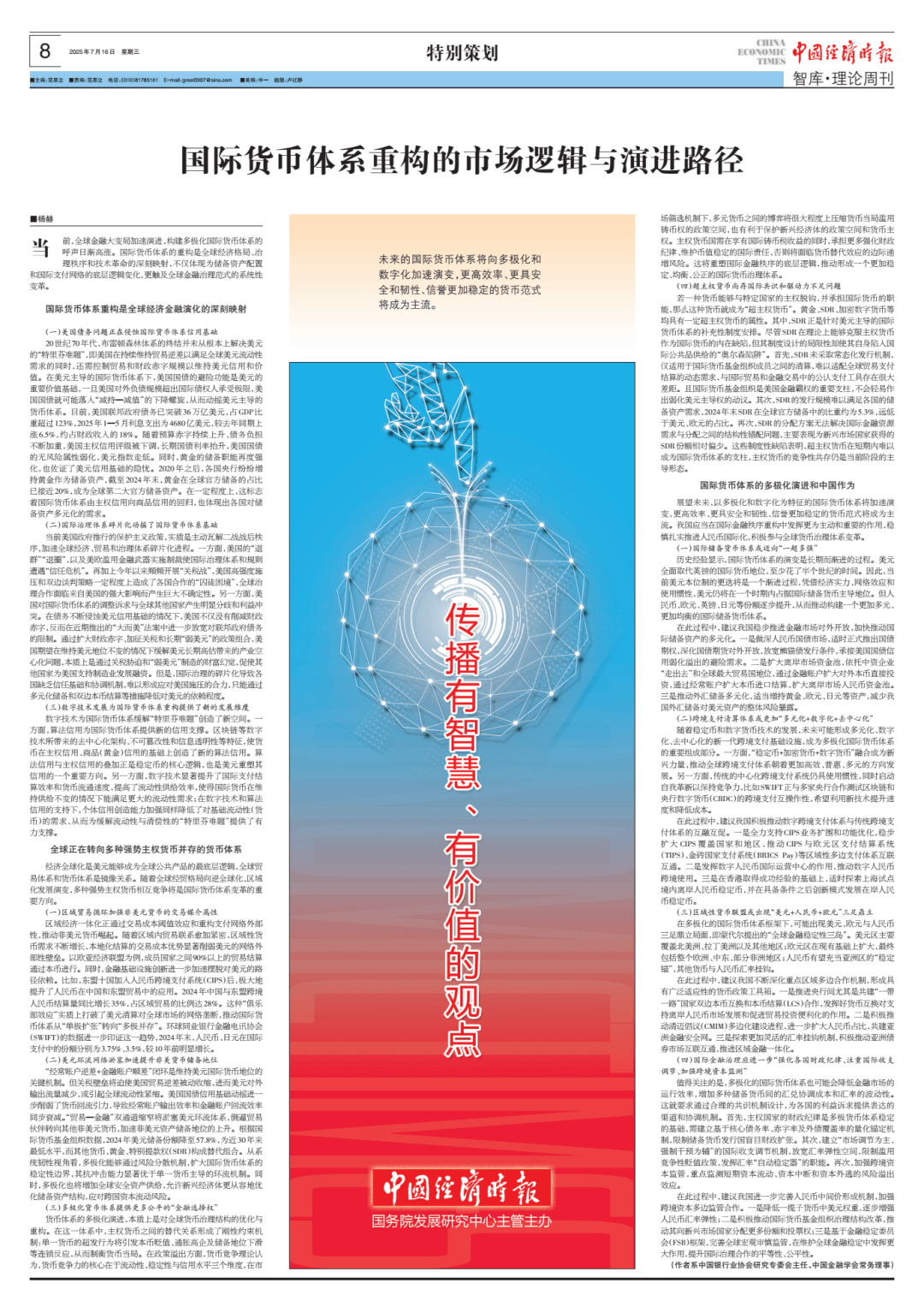
Core Viewpoint - The U.S. Treasury market is facing structural issues, including rising debt levels, declining liquidity, and increasing volatility, which are undermining the credibility of the international monetary system. The U.S. political landscape complicates the resolution of these risks, leading to a search for systemic solutions globally, particularly from countries like China [2][4][5]. Group 1: U.S. Debt and International Monetary System - The U.S. federal government debt has surpassed $36 trillion, exceeding 123% of GDP, with interest payments projected at $468 billion for the first five months of 2025, a 6.5% increase year-on-year, constituting 18% of fiscal revenue [4][9]. - The weakening of the U.S. Treasury's risk-free status and the declining dollar index are evident as the U.S. continues to face rising budget deficits and a downgraded sovereign credit rating [4][5]. - The shift towards gold as a reserve asset is notable, with its share in global official reserves nearing 20% by the end of 2024, indicating a return to commodity credit from sovereign credit [4][9]. Group 2: Fragmentation of International Governance - U.S. protectionist policies are fragmenting the post-World War II order, leading to a trust crisis in international governance and complicating global cooperation [5][6]. - The U.S. has not reduced its fiscal deficits but has instead expanded them through recent legislation, which may further erode the dollar's credibility [5][6]. - Countries are increasingly diversifying their reserves and engaging in bilateral currency settlements to reduce reliance on the dollar due to the fragmentation of international governance [5][6]. Group 3: Digital Technology and Monetary System Reconstruction - Digital technologies, including blockchain, are creating new credit support for the international monetary system, potentially alleviating the "Triffin dilemma" [6][9]. - The efficiency of international payment systems is expected to improve significantly due to advancements in digital technology, enhancing liquidity supply without increasing the base money supply [6][9]. Group 4: Emergence of a Multi-Currency System - The global economic landscape is shifting towards a multi-currency system, with regional trade integration enhancing the transactional role of non-dollar currencies [7][8]. - The share of the dollar in global reserves is projected to drop to 57.8% by 2024, the lowest in nearly 30 years, as other currencies and gold gain prominence [9][10]. - The evolution towards a multi-polar currency system is seen as a means to enhance financial stability and provide emerging economies with more options for reserve asset diversification [10][11]. Group 5: Recommendations for China - China is advised to deepen its financial market openness and promote the internationalization of the renminbi, including enhancing the renminbi bond market and diversifying foreign exchange reserves [14][25]. - The establishment of a more diversified and digitalized cross-border payment system is recommended, leveraging stablecoins and digital currencies to improve efficiency [15][26]. - Strengthening regional currency alliances and enhancing cooperation in monetary policy are suggested to support the renminbi's role in the international monetary system [16][27].
普惠金融要围绕产业振兴做文章
Jin Rong Shi Bao· 2025-07-15 03:07
Core Insights - The implementation plan aims to establish a high-quality inclusive financial system within five years, focusing on rural financial services to promote common prosperity [1] - Agricultural industrialization is key to rural revitalization, enhancing the resilience of the agricultural sector and creating diverse financial service demands [2] Group 1: Policy and Strategic Framework - The "Implementation Plan" emphasizes the need for banks and insurance companies to enhance financial services in rural areas, particularly around agricultural industry revitalization [1] - The goal is to build a modern rural industrial system by 2027, improving the agricultural supply chain and international competitiveness [2] Group 2: Financial Innovations and Products - Innovative financial products like "Planting e-loan," "Rice-Fish Loan," and "Carbon Credit Loan" are being developed to cater to specific agricultural needs [3] - The introduction of digital technologies in agriculture is transforming financial services, enabling banks to monitor crop conditions and manage risks more effectively [4][5] Group 3: Digital Transformation in Financial Services - The plan highlights the importance of digital empowerment in enhancing credit supply and optimizing service models in the agricultural sector [4] - Financial institutions are increasingly adopting digital tools to improve efficiency and reduce costs in providing inclusive financial services [5] Group 4: Future Trends and Recommendations - There is a growing need for tailored financial products that align with local agricultural characteristics to facilitate smoother capital flow [6] - The focus should be on enhancing the integration of financial services with agricultural production scenarios, promoting high-quality development of inclusive finance [6]
欧盟对美关税反制再延期,强硬反击为何“底气不足”
2 1 Shi Ji Jing Ji Bao Dao· 2025-07-14 13:34
Group 1 - The EU has chosen to handle the new round of US tariffs with restraint, extending the suspension period for countermeasures until early August, indicating a preference for negotiation over confrontation [1][2] - The US plans to impose tariffs ranging from 25% to 50% on imports from various countries, including Mexico and the EU, starting August 1, which has raised concerns among European leaders about inflation and uncertainty [2][3] - Experts suggest that the EU's hesitation in negotiations stems from its limited leverage due to the intertwined economic and defense interests with the US, making it unlikely for the EU to gain significant benefits from any trade agreement [1][8] Group 2 - The EU is facing pressure from the US to reduce the trade deficit, particularly in sectors like aerospace and automotive, but the EU's ability to make concessions is constrained by strong domestic industries [4][5] - The EU's trade surplus with the US is substantial, estimated at over €190 billion in 2024, but the EU's reliance on the US market complicates its negotiating position [8][9] - The ongoing trade negotiations are influenced by broader geopolitical considerations, with the EU's defense dependency on the US limiting its willingness to adopt a confrontational stance [9][10] Group 3 - The potential for a trade agreement between the US and EU remains, but the likelihood of reaching a deal before the August 1 deadline is uncertain, and any agreement may not significantly enhance trade relations [10][11] - Experts predict that the EU may have to accept higher baseline tariffs as part of any agreement, with estimates suggesting a range of 15% to 20% for the EU [11]
云端逐梦 80余位达人助力山西交城县好物“出圈”
Sou Hu Cai Jing· 2025-07-14 08:35
Group 1 - The 2025 E-commerce Entrepreneurship Competition in Jiaocheng, Shanxi Province, was officially launched with the theme "Cloud Empowerment New Jiaocheng, Digital Engine Creates the Future" [1] - The competition attracted over 80 participants, including local internet celebrities, short video enthusiasts, self-media teams, business operators, and individual entrepreneurs [1][2] - The competition focuses on three main areas: county specialty products, cultural tourism resources, and traditional crafts, requiring participants to showcase regional brand stories, product highlights, and cultural connotations through short videos [2] Group 2 - The competition aims to cultivate local entrepreneurs who are skilled in short videos, live streaming, and rooted in their communities, leveraging the flow effect of short videos to enhance e-commerce conversion and industrial efficiency [2][3] - Awards include one first prize, two second prizes, and three third prizes, with all participants receiving incubation support packages [2] - The event is supported by a jury composed of experts from the internet field, academic scholars, and practical professionals to ensure transparency [2]

数字技术让七大石窟艺术“活”起来!
Hang Zhou Ri Bao· 2025-07-14 03:28
Group 1 - The exhibition titled "Beyond Time and Space - An Immersive Experience of Cave Art" opened on July 8 at the Zhejiang Provincial Museum, showcasing a blend of ancient cave art and modern technology [1] - The exhibition features a 1200 square meter immersive space that integrates "material reality," "augmented reality (AR)," and "virtual reality (VR)" to transport visitors through various significant Chinese cave art sites [1][2] - The exhibition emphasizes the concept of "digital activation of cultural heritage," utilizing mixed reality (MR) and VR technologies to vividly recreate ancient stone carvings and murals for the audience [2] Group 2 - The exhibition transforms the traditional museum experience by engaging visitors as active participants in the exploration journey, allowing them to experience the timeless charm of cave art firsthand [3] - This technology-art fusion exhibition is a paid event and will be on display until October 31, 2026, inviting audiences to immerse themselves in the ancient cave art experience [3]