反内卷政策

Search documents
新能源及有色金属日报:多晶硅监管趋严,需注意持仓变动风险-20251202
Hua Tai Qi Huo· 2025-12-02 02:29
Report Industry Investment Rating No relevant content provided. Core Viewpoints - For industrial silicon, the recent supply - demand pattern may improve, and the current valuation is low. If there are relevant policies, the disk may have room to rise. For short - term trading, it is recommended to operate within a range, and go long on dry - season contracts when the price is low [3]. - For polysilicon, the supply and demand on both ends are weakening, with large inventory pressure and general consumer - end performance. The fundamentals are weak. The disk is affected by anti - involution policies and weak reality, and with stricter supervision, the disk is expected to gradually fall back to the fundamentals. Short - term trading should be cautiously bearish, and the main contract is expected to fluctuate in the range of 50,000 - 57,000 yuan/ton [7]. Summary by Related Catalogs Industrial Silicon Market Analysis - On December 1, 2025, the industrial silicon futures price fluctuated. The main contract 2601 opened at 9,120 yuan/ton and closed at 9,145 yuan/ton, a change of - 15 yuan/ton (- 0.16%) from the previous settlement. The position of the 2511 main contract was 203,274 lots at the close, and the total number of warehouse receipts on December 1 was 6,596 lots, unchanged from the previous day [1]. - The spot price of industrial silicon remained stable. The price of East China oxygen - passing 553 silicon was 9,500 - 9,600 yuan/ton, 421 silicon was 9,700 - 9,900 yuan/ton, Xinjiang oxygen - passing 553 silicon was 8,800 - 9,000 yuan/ton, and 99 silicon was 8,800 - 9,000 yuan/ton. In November 2025, the domestic industrial silicon output was 401,700 tons, a month - on - month decrease of 11.2% and a year - on - year decrease of 0.7%. From January to November 2025, the cumulative output of industrial silicon was 3.8716 million tons, a year - on - year decrease of 15.2% [1]. Consumption End - The quoted price of organic silicon DMC was 13,100 - 13,300 yuan/ton. In November, the domestic organic silicon DMC output increased by 3.82% month - on - month and decreased by 1.33% year - on - year. In December, due to the joint emission - reduction plan in November, the industry's overall operating rate is expected to decline month - on - month, and the domestic organic silicon DMC output is expected to decrease by about 3.08% month - on - month compared with November [2]. Strategy - The spot price is stable, and the recent supply - demand pattern may improve. After the old warehouse receipts were cancelled in November, the number of new warehouse receipts registered decreased significantly. The industrial silicon disk is mainly affected by the overall commodity sentiment and policy news. If there are policies to promote, the disk may have room to rise. Short - term trading should operate within a range, and go long on dry - season contracts when the price is low [3]. Polysilicon Market Analysis - On December 1, 2025, the main contract of polysilicon futures 2601 rose, opening at 57,000 yuan/ton and closing at 57,705 yuan/ton, a 3.26% change from the previous trading day. The position of the main contract was 142,133 lots (144,759 lots the previous day), and the trading volume was 338,696 lots [4]. - The spot price of polysilicon remained stable. The price of N - type material was 49.70 - 55.00 yuan/kg, and n - type granular silicon was 50.00 - 51.00 yuan/kg. The inventory of polysilicon manufacturers and silicon wafers increased. The latest polysilicon inventory was 28.10, a 3.69% month - on - month change, and the silicon wafer inventory was 19.50GW, a 4.17% month - on - month change. The weekly polysilicon output was 24,000 tons, a - 11.40% month - on - month change, and the silicon wafer output was 12.02GW, a - 5.95% month - on - month change [4][5]. - In October, the polysilicon output was expected to be about 133,500 tons, an increase from September, exceeding market expectations. In November, the output in the southwest region was expected to decline significantly [5]. - The prices of battery cells and silicon wafers remained stable. In November, the output of component enterprises decreased by 2.43% month - on - month compared with October. It is expected that the output in December will continue to decline significantly, and the terminal demand will return to the off - season, with the expected month - on - month decline in the operating rate compared with October being 14.77% [5][6]. - From December 3, 2025, the speculative trading margin standard for the polysilicon futures PS2601 contract will be adjusted to 13%, and the hedging trading margin standard will be adjusted to 12%. From December 3, 2025, the single - day opening volume of non - futures company members or customers in the polysilicon futures PS2601 contract shall not exceed 500 lots [6]. Strategy - The supply and demand of polysilicon have both weakened, with large inventory pressure and general consumer - end performance. The fundamentals are weak. After the old warehouse receipts were cancelled in November and few new ones were registered, there was more delivery game in the near - month contracts. The disk is affected by anti - involution policies and weak reality, and the policy is still being promoted, with large disk fluctuations. Short - term trading should be cautiously bearish, and the main contract is expected to fluctuate in the range of 50,000 - 57,000 yuan/ton [7].
中原证券:化工行业逐步进入景气阶段 从供给与需求两端寻找投资机会
智通财经网· 2025-12-02 01:44
Core Viewpoint - The chemical industry is expected to see a marginal recovery in overall profitability due to the continuous improvement of China's macro economy and consumer stimulus policies, despite a slowdown in fixed asset investment [1][2]. Group 1: Industry Demand and Supply - The gradual recovery of downstream demand and the slowdown in new production capacity are contributing to a stabilization in chemical industry profits, with sectors like agrochemicals, fluorochemicals, and new energy experiencing rapid revenue and profit growth [2]. - The chemical industry has seen a decline in fixed asset investment growth in 2023, with further reductions expected from 2025, alleviating the pressure of overcapacity in the future [2]. - The demand from sectors such as automotive, home appliances, and textiles is expected to recover moderately starting in 2024, driven by both supply and demand factors [2]. Group 2: Regulatory Environment and Industry Structure - The ongoing implementation of anti-involution policies is expected to strengthen supply-side constraints in the chemical industry through administrative regulation and industry self-discipline [2]. - The decline in fixed asset investment is anticipated to gradually reverse the overcapacity situation in the industry, promoting a gradual recovery in industry prosperity [2]. - Enhanced regulatory requirements regarding environmental protection, safety supervision, and emissions reduction are expected to optimize the industry structure and promote high-quality development [2]. Group 3: Investment Strategy - Investment strategies should focus on sectors with orderly supply-demand dynamics and good self-discipline foundations, such as organic silicon and polyester filament industries [3]. - Attention should also be given to the phosphate chemical industry, which is benefiting from rapid growth in downstream energy storage demand, indicating a positive outlook for industry prosperity [3]. - The biofuel industry, which is supported by national policies and the dual carbon policy, is also recommended for investment [3]. - Key integrated leading companies to watch include Wanhua Chemical, Satellite Chemical, and Baofeng Energy, along with opportunities in organic silicon, polyester filament, phosphate chemicals, and biofuels [3].

中银晨会聚焦-20251202
Bank of China Securities· 2025-12-02 01:27
Core Insights - The manufacturing PMI index for November is at 49.2%, showing a slight month-on-month increase of 0.2 percentage points, indicating a minor recovery within the contraction zone [6][7] - The new orders index for November is also at 49.2%, with a month-on-month increase of 0.4 percentage points, while the new export orders index rose by 1.7 percentage points to 47.6%, likely driven by the upcoming holiday shopping season [6][7] - The production index stands at 50.0%, reflecting a month-on-month increase of 0.3 percentage points, indicating stability at the threshold level [6][7] Macroeconomic Overview - Manufacturing purchasing and inventory intentions are still in the contraction zone, suggesting a need for further improvement in procurement sentiment [6][7] - Fixed asset investment projects, particularly in infrastructure and affordable housing, are expected to gain momentum towards the end of the year and the beginning of the next [6][7] Market Performance - The Shanghai Composite Index closed at 3914.01, up by 0.65%, while the Shenzhen Component Index rose by 1.25% to 13146.72 [3] - The performance of various industry indices shows that non-ferrous metals and telecommunications sectors led with increases of 2.85% and 2.81%, respectively, while agriculture and forestry sectors saw declines [4] Sector Analysis - The manufacturing sector's price index showed a recovery in November, with the main raw material purchase price index rising by 1.1 percentage points to 53.6%, indicating a high level of activity [7] - The equipment manufacturing and raw materials industries are sensitive to downstream fixed asset investments, with some signs of demand recovery in November [8]




山西证券研究早观点-20251202
Shanxi Securities· 2025-12-02 01:15
Market Trends - The domestic market indices showed positive performance with the Shanghai Composite Index closing at 3,914.01, up by 0.65% [4] - The Shenzhen Component Index increased by 1.25% to close at 13,146.72, while the CSI 300 Index rose by 1.10% to 4,576.49 [4] Coal Industry Analysis - Coal imports in October 2025 continued to show a contraction, with cumulative import volume decreasing by 11.0% year-on-year [6] - The price of imported coal in October was $71 per ton, reflecting a month-on-month increase of $3.65, although it remains lower compared to the previous year [6] - The reduction in coal imports is attributed to decreased supply from Mongolia and Indonesia, influenced by transportation issues and domestic production challenges in Mongolia [6] - The report suggests a potential rebound in Mongolian coal imports, with a target of 100 million tons set for 2025, although achieving this may be challenging [6] - The fourth quarter is expected to present investment opportunities in the coal sector, with a positive outlook on coal prices due to anticipated demand during the winter season [6] Company Analysis: Bosideng - Bosideng reported a revenue of 8.928 billion yuan for the first half of the 2025/26 fiscal year, a year-on-year increase of 1.4%, with a net profit of 1.189 billion yuan, up by 5.3% [7][10] - The brand's down jacket segment led revenue growth, achieving 6.568 billion yuan, a rise of 8.3% [7] - The company has seen a significant increase in its retail store count, with a net addition of 88 stores, bringing the total to 3,558 [8] - The gross margin for the brand's down jacket business decreased slightly to 59.1%, while overall gross margin improved to 50.0% [8][10] - The company is optimistic about meeting its annual sales targets, driven by product innovation and improved channel quality [10] Company Analysis: Huhua Co., Ltd. - Huhua Co., Ltd. is a leading enterprise in the civil explosive industry, with a complete industrial chain from R&D to sales and blasting services [11] - The company has shown steady growth, with revenues increasing from 556 million yuan in 2020 to 1.101 billion yuan in 2024, representing a CAGR of 25.58% [11] - The company is expanding its market presence, particularly in the western regions of China, benefiting from increased demand for civil explosives in mining and infrastructure projects [12] - Huhua Co., Ltd. is also actively developing intelligent blasting technologies and has entered the military sector, enhancing its growth prospects [12]
供需偏紧,碳酸锂继续引领新能源金属走势
Zhong Xin Qi Huo· 2025-12-02 01:10
1. Report Industry Investment Rating The report does not mention the industry investment rating. 2. Core Viewpoints of the Report - The supply and demand of lithium carbonate are both increasing, and the supply - demand tightness persists. It continues to lead the trend of new energy metals. In the short - term, after the negative impact on investor sentiment, the price stops falling and rebounds. In the long - term, the supply - demand surplus is expected to narrow, and the annual supply - demand inflection point may appear earlier [2]. - The supply and demand of industrial silicon are both weak, and the silicon price fluctuates in a range. The supply is affected by the dry season in the southwest and potential environmental protection and power - limit factors in the north, while the demand from polysilicon, organic silicon, and aluminum alloy is weakening [6]. - The policy expectation for polysilicon is rising again, and the price fluctuates at a high level. The supply is shrinking due to the dry season, and the "anti - involution" policy is expected to have an impact. The demand is weakening in November [7][9]. - The supply - demand gap of lithium carbonate is slightly improved, and the lithium price fluctuates at a high level. The supply is expected to remain strong, the demand is better than in previous years, and the inventory is being depleted. The short - term supply - demand is in tight balance [11]. 3. Summary by Relevant Catalogs 3.1 Market Views 3.1.1 Industrial Silicon - **Information Analysis**: The spot price is stable, the inventory is under pressure to accumulate, the production in November decreased, the export in October decreased, the photovoltaic new - installed capacity in October increased month - on - month but decreased year - on - year, and the organic silicon industry may enter a production - cut and price - support stage [6]. - **Main Logic**: The supply in the southwest is expected to decline slightly in December, and the demand from polysilicon, organic silicon, and aluminum alloy is weakening. The inventory is high, and attention should be paid to the progress of new warehouse receipt registration [6]. - **Outlook**: If the organic silicon industry cuts production, the demand will further weaken, and the inventory - accumulation pressure may increase. The price is expected to fluctuate [6][7]. 3.1.2 Polysilicon - **Information Analysis**: The transaction price of N - type re - feeding materials is stable, the warehouse receipt quantity has increased slightly, the export and import volumes have decreased, the photovoltaic new - installed capacity from January to October increased year - on - year, and the industry association is promoting "anti - involution" work [7]. - **Main Logic**: The policy expectation is rising, the warehouse receipt quantity is low, providing support for near - month contracts. The supply is shrinking in the dry season, and the demand is weakening in November. The price is expected to fluctuate widely [7][9]. - **Outlook**: The "anti - involution" policy can boost the price, but the actual demand is weak, so the price is expected to fluctuate widely [9]. 3.1.3 Lithium Carbonate - **Information Analysis**: On December 1st, the closing price of the main contract increased, the total position increased, the spot price increased, and the warehouse receipt quantity increased [9][10]. - **Main Logic**: The supply is expected to remain strong, the demand is better than in previous years, and the inventory is being depleted. The short - term supply - demand is in tight balance, and the resumption of production of Jiaxiawo is a key factor [11]. - **Outlook**: The short - term supply - demand is in tight balance, but the sentiment has cooled down, and the price is expected to fluctuate at a high level [11]. 3.2 Market Monitoring The report only lists the sub - items of industrial silicon, polysilicon, and lithium carbonate in the market monitoring section but does not provide specific content. 3.3 Commodity Index - The comprehensive index, special index, and plate index of CITIC Futures show different degrees of increase. The comprehensive index includes the commodity index, commodity 20 index, industrial product index, and PPI commodity index, with increases of 0.76%, 1.09%, 0.74%, and 1.26% respectively. The new energy commodity index has a daily increase of 0.91%, a 5 - day increase of 1.94%, a 1 - month increase of 7.96%, and a year - to - date increase of 11.19% [53][54].
债海观潮,大势研判:多空交织,利率低位震荡
Guoxin Securities· 2025-12-01 14:12
Group 1 - The report indicates that in November, most bond varieties experienced a rise in yields, with all interest rate bonds showing a slight increase in yield [2][6] - Long-term low-grade credit bonds saw a decline in yields, with the 5-year AA- credit bond yield decreasing by 16 basis points [17][18] - The report highlights a rebound in default amounts in November, totaling 7.75 billion yuan, which is an increase from the previous month [27] Group 2 - The overseas economic outlook shows a stabilization in US inflation expectations, while economic conditions in Europe and Japan are improving [40][35] - Domestic economic growth in China showed a significant slowdown in October, with GDP growth dropping to 4.2%, down 1.1 percentage points from September [2][56] - The report notes that the high-frequency macro diffusion index for November indicates that domestic economic growth momentum remains weak [74][79] Group 3 - The monetary policy outlook suggests a low probability of interest rate cuts in the fourth quarter, as the central bank has engaged in net absorption in the open market [93][104] - The report emphasizes a shift from "disconnected stock and bond markets" to a scenario where they are more aligned, driven by macroeconomic factors [106][111] - The bond market is expected to experience low-level fluctuations, with a continued decline in government bond financing growth anticipated for the fourth quarter [2][92]
【招银研究】海外降息预期升温,国内风险偏好回暖——宏观与策略周度前瞻(2025.12.01-12.05)
招商银行研究· 2025-12-01 10:55
Group 1: U.S. Macro Strategy - The U.S. job market shows signs of stabilization, with initial jobless claims falling to 216,000, below seasonal levels, and continuing claims at 1.96 million, indicating a steady high level [2] - Market optimism regarding the Federal Reserve's interest rate cuts is rising, with expectations for a December rate cut supported by recent comments from voting members [2][3] - The dollar is facing downward pressure due to the return of rate cut trading and potential changes in Fed leadership, with expectations that it will remain within the 96-101 range [3] Group 2: Chinese Macro Strategy - The manufacturing PMI for November is at 49.2%, indicating a slight increase, while the non-manufacturing index shows a decline, particularly in the service sector [6] - Real estate transactions continue to decline, with new home sales down 31.7% and second-hand home sales down 14.8% in major cities [6] - Industrial profits have turned negative, with a year-on-year decline of 5.5%, reflecting weak recovery momentum and significant fluctuations in profit growth [8] Group 3: Policy and Market Outlook - A new policy document aimed at enhancing consumer goods supply and demand compatibility has been issued, targeting significant growth in specific sectors by 2027 and 2030 [9] - The central bank is expected to maintain liquidity support through increased MLF and reverse repos, indicating a focus on long-term liquidity [10] - The bond market is experiencing volatility, with a slight increase in 10-year treasury yields, but expectations of a stable interest rate environment due to weak economic data [11][12] Group 4: Stock Market Performance - The A-share market saw a rebound, with the Shanghai Composite Index up 1.4% and the ChiNext Index up 4.5%, driven by renewed Fed rate cut expectations [12] - The Hong Kong stock market also rebounded, with the Hang Seng Index up 2.5%, supported by similar factors as the A-share market [13] - The technology sector is highlighted as a key area for investment, benefiting from liquidity expectations and the ongoing AI wave [13]

基础化工行业年度策略:行业逐步进入景气阶段,从供给与需求两端寻找投资机会
Zhongyuan Securities· 2025-12-01 08:51
Core Insights - The basic chemical industry is gradually entering a prosperous phase, with investment opportunities identified from both supply and demand sides [1][7] - The industry is expected to see a marginal recovery in profitability due to the gradual rebound in downstream demand and a slowdown in new capacity releases [7][11] - The report maintains a "market perform" rating for the industry, suggesting a focus on integrated leading companies such as Wanhua Chemical, Satellite Chemical, and Baofeng Energy [7][8] Industry Overview - The chemical industry has shown signs of bottoming out, with profitability stabilizing after a decline in 2023 [11][15] - In the first three quarters of 2025, the chemical raw materials and chemical products manufacturing industry achieved a revenue of CNY 67,246.8 billion, a year-on-year increase of 1.0%, while total profits fell by 4.4% [13][17] - The chemical product price index has seen a cumulative decline of 10.29% since the beginning of 2025, indicating ongoing price pressures [13][14] Sub-Industry Performance - Among 33 sub-industries, 18 reported revenue growth, with significant increases in carbon fiber (49.12%), synthetic resin (33.63%), and lithium battery chemicals (21.31%) [17][18] - Conversely, industries such as organic silicon and soda ash experienced substantial revenue declines of 17.37% and 15.75%, respectively [18][21] - Profitability varied widely, with pesticide, polyester, and fluorochemical sectors showing strong profit growth, while organic silicon and rubber products faced severe profit declines [18][22] Investment Strategy - The report suggests focusing on sectors with improving supply-demand dynamics, such as organic silicon and polyester filament, as well as those benefiting from rapid growth in downstream energy storage demand, like phosphate chemicals [7][8] - The biobased fuel industry is highlighted as having significant growth potential due to national policy support and the dual carbon policy [7][8] - The overall investment strategy emphasizes structural opportunities within the industry, driven by regulatory changes and demand recovery [7][8]
山西证券:煤炭10月进口环比收缩 看好四季度煤炭板块投资机会
智通财经网· 2025-12-01 07:02
Group 1 - Shanxi Securities is optimistic about investment opportunities in the coal sector for Q4, citing that coal prices are unlikely to drop significantly and there is an expectation of high operational levels [1] - The report indicates that Q4 performance may exceed that of Q3, suggesting the sector has investment value, with potential for substantial earnings recovery in 2026 if prices remain high [1] - The trend of shrinking imported coal volumes continues, with a cumulative decline of 11.0% from January to October, and October's imports showing a year-on-year decrease of 9.75% [1] Group 2 - In October, the significant reduction in imported coal volumes, particularly in thermal and lignite coal, is attributed to decreased imports from Mongolia and Indonesia, influenced by transportation issues and domestic production challenges in Mongolia [2] - The political turmoil in Mongolia and the impact of the rainy season in Indonesia have contributed to reduced coal supply, affecting China's procurement strategies [2] - There is a possibility of a rebound in Mongolian coal imports, as the Mongolian Prime Minister reiterated a target of 100 million tons of coal exports to China by 2025, although achieving this target may face challenges [3]

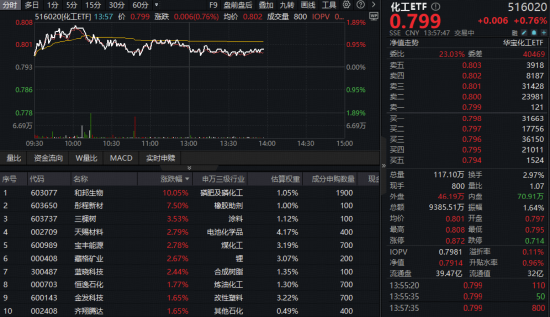
六氟磷酸锂价格或继续上涨?化工板块全天强势,化工ETF(516020)上探1.89%冲击日线三连阳!
Xin Lang Ji Jin· 2025-12-01 06:27
Group 1 - The chemical sector continues to rise, with the Chemical ETF (516020) showing a maximum intraday increase of 1.89% and closing up 0.76% as of the report [1][2] - Key stocks in the sector include phosphorous chemicals, rubber additives, lithium batteries, and coatings, with notable gains from companies like Hebang Biological, Tongcheng New Materials, and Tinci Materials [1][2] - The Chemical ETF has outperformed major indices this year, with a year-to-date increase of 27.76%, compared to the Shanghai Composite Index's 16.02% and the CSI 300 Index's 15.04% [1][3] Group 2 - The lithium battery sector is expected to see a threefold increase in shipments from 2025 to 2035, leading to price increases for lithium hexafluorophosphate, projected to exceed 250,000 yuan per ton by 2026 [4] - The current price-to-book ratio of the Chemical ETF is 2.32, indicating a relatively low valuation compared to the past decade, suggesting a favorable long-term investment opportunity [4] - The Chemical ETF (516020) tracks the CSI Sub-Industry Chemical Theme Index, with nearly 50% of its holdings in large-cap stocks, providing exposure to leading companies in various chemical sub-sectors [5] Group 3 - The chemical industry is currently at a valuation and profit bottom, with net profits of 116 billion yuan in the first three quarters of 2025, reflecting a year-on-year increase of 7.45% [9] - Demand is expected to improve due to the Federal Reserve's potential interest rate cuts and stabilization of global political conditions, while cost pressures from oil and coal prices are anticipated to weaken [9] - The chemical sector is poised for a turning point driven by anti-involution policies, with a significant decrease in construction projects expected in the first half of 2025 [9]