
AI医疗

Search documents
【早报】证监会提高“吹哨人”奖励标准;天普股份股价异常波动公告涉嫌重大遗漏被立案调查
财联社· 2026-01-11 23:14
Macroeconomic News - The State Council, led by Premier Li Qiang, has implemented a package policy to promote domestic demand through coordinated fiscal and financial measures, emphasizing the need for social capital to participate in consumption and investment expansion [4]. - The China Securities Regulatory Commission (CSRC) aims to enhance the institutional environment for long-term investments, encouraging various types of long-term funds to increase their market participation [4][3]. - The CSRC has introduced a new reward system for whistleblowers reporting securities and futures violations, significantly increasing the reward standards, with a maximum reward of 1 million yuan [4][3]. Industry News - The State Administration for Market Regulation is investigating the competitive landscape of the food delivery platform service industry under the Anti-Monopoly Law [6]. - The Ministry of Finance and the State Taxation Administration announced the cancellation of the VAT export tax rebate for photovoltaic products starting April 1, 2026, and will reduce the VAT export tax rebate rate for battery products from 9% to 6% during 2026 [6]. - The retail market for passenger vehicles in December 2025 saw a decline of 14.5% year-on-year, with expectations for the overall vehicle market in 2026 to remain flat compared to 2025 [6]. - The pressure from rising storage costs has begun to affect the consumer electronics sector, leading to price increases for key products like smartphones and laptops [6]. - China has applied for frequency resources for over 200,000 satellites from the International Telecommunication Union (ITU), indicating a strategic focus on satellite internet development [6]. Company News - The CSRC has launched an investigation into Tianpu Co., Ltd. for significant omissions in announcements regarding abnormal stock trading, with the company stating it has no AI-related technology or personnel [9]. - Wanda's proposal to extend a $400 million bond, due on February 13, 2026, with an interest rate of 11%, has been approved [11]. - Defu Technology announced the termination of its acquisition of 100% equity in Luxembourg Copper Foil due to regulatory conditions imposed by the Luxembourg Ministry of Economy [11]. - Aerospace Changguang has forecasted a net loss of approximately 220 million yuan for the year 2025 [12].


打通AI医疗落地的“最后一公里”
Xin Lang Cai Jing· 2026-01-11 20:19
Core Insights - The new generation of artificial intelligence (AI) technology, represented by large models, shows significant potential and application value in the healthcare sector, particularly in medical imaging interpretation, disease risk warning, and assisted diagnosis decision-making [1][2] - The integration of AI in healthcare is crucial for optimizing clinical diagnosis models and addressing the uneven distribution of medical resources, ultimately benefiting public health [1][2] Group 1: Current Challenges - There are significant barriers to the circulation of medical data, with the "data island" phenomenon hindering inter-institutional and inter-regional data connectivity, which is essential for AI model training [2][3] - The evaluation system for clinical applications of algorithms is underdeveloped, with a lack of authoritative clinical evaluation standards and dynamic regulatory frameworks for AI-assisted diagnostic tools [2][3] - Ethical governance frameworks need to be proactively established to address new ethical challenges arising from AI's deep involvement in clinical decision-making [2][4] Group 2: Proposed Solutions - A new national health data governance system should be established, focusing on unified, open, and interoperable medical data standards to eliminate data barriers between institutions [3][4] - A comprehensive clinical evaluation and regulatory mechanism covering the entire lifecycle of AI medical products should be developed, including guidelines for research, testing, approval, and monitoring [3][4] - A forward-looking ethical governance paradigm for AI in healthcare should be constructed, including guidelines for ethical review and algorithm governance to ensure transparency and fairness in AI applications [4][5]
股市必读:1月9日美年健康现202.29万元大宗交易
Sou Hu Cai Jing· 2026-01-11 16:23
截至2026年1月9日收盘,美年健康(002044)报收于6.13元,上涨10.05%,涨停,换手率4.37%,成交量 169.29万手,成交额10.25亿元。 当日关注点 交易信息汇总资金流向 1月9日主力资金净流入4.22亿元;游资资金净流出1.86亿元;散户资金净流出2.36亿元。 大宗交易 1月9日美年健康现202.29万元大宗交易。 董秘最新回复 投资者: 董秘您好!想请教下公司与蚂蚁阿福有什么合作吗,谢谢! 董秘: 尊敬的投资者,您好!感谢您对公司业务发展的关心!敬请关注公司公告。谢谢! 投资者: 尊敬的董秘您好!请问公司目前是否与蚂蚁阿福(原 AQ 平台)存在业务合作,或在健康管 理、AI 医疗等相关领域有接入合作计划?已知蚂蚁阿福聚焦医疗健康服务生态建设, 战略并与多家科 技企业合作,想请问公司与蚂蚁阿福是否存在产品接入、技术协同等方面的合作? 来自交易信息汇总:1月9日主力资金净流入4.22亿元,显示主力对美年健康股票的积极介入。 来自交易信息汇总:当日发生202.29万元大宗交易,反映特定投资者之间的较大规模股份转让。 ...

医药行业周报(26/1/5-26/1/9):小核酸领涨创新药,2026年还有哪些催化?-20260111
Hua Yuan Zheng Quan· 2026-01-11 15:08
Investment Rating - The report maintains a "Positive" investment rating for the pharmaceutical industry [4] Core Insights - The pharmaceutical index rose by 7.81% from January 5 to January 9, outperforming the CSI 300 index by 5.03%. The brain-machine interface and AI medical sectors are expected to remain active in Q1 2026, with a strong rebound in innovative drugs, particularly small nucleic acids [5][25] - The report highlights the potential for significant advancements in small nucleic acids in 2026, driven by breakthroughs in liver-targeted delivery technologies and a surge in clinical data readouts [8][22] - The report emphasizes the importance of selecting innovative drug stocks with strong fundamentals and suggests focusing on companies that have undergone sufficient adjustments [5][49] Summary by Sections Industry Performance - The pharmaceutical index saw 443 stocks rise and 25 fall during the week, with notable gainers including Innovative Medical (+61.04%) and Sanbo Brain Science (+56.15%). Conversely, Baohua Pharmaceutical saw a decline of -21.65% [5][26][27] Small Nucleic Acids - 2026 is projected to be a pivotal year for the small nucleic acid sector, with advancements in liver-targeted delivery technologies and a high frequency of clinical data readouts expected [8][22] - Arrowhead's delivery platform has shown promising results in clinical trials, validating the feasibility of RNAi therapies for obesity and other conditions [9][11] Investment Recommendations - The report suggests focusing on companies with leading platform capabilities and differentiated pipeline layouts, such as Rebio Biotech, Yuyuan Pharmaceutical, and Frontier Biotech [20][24] - It also recommends a diversified investment approach, including innovative drugs, brain-machine interfaces, and AI medical technologies [47][48] Market Trends - The report notes that the aging population and increasing healthcare demands are driving growth in the pharmaceutical sector, with a focus on chronic diseases and innovative medical technologies [47] - The report highlights the ongoing trend of domestic companies enhancing their capabilities in the global market, particularly in innovative drug development and medical devices [46][47] Key Companies to Watch - Recommended stocks include China National Pharmaceutical Group, Rebio Biotech, Shanghai Yizhong, and Yuyuan Medical [49]





AI 产业跟踪:OpenAI 正式推出 ChatGPT Health,关注 AI 医疗板块机遇与价值重估
Changjiang Securities· 2026-01-11 14:50
Investment Rating - The investment rating for the industry is "Positive" and is maintained [8] Core Insights - On January 7, OpenAI launched ChatGPT Health, specifically designed for health and wellness, indicating a significant shift towards AI integration in healthcare [2][5] - The report highlights the growing demand in the lower-tier markets for healthcare, validating the transition to AI agents managing personal health [11] - The collaboration with b.well, a major real-time health data network, aims to address the fragmented nature of healthcare data, enhancing user experience by allowing seamless access to personal health records [11] - The report emphasizes the importance of privacy and security in healthcare AI applications, as demonstrated by the separate storage of health-related data in ChatGPT Health [11] Summary by Sections Event Description - OpenAI's ChatGPT Health is a dedicated experience for health management, combining user health information with AI capabilities to enhance user preparedness and confidence [5] Event Commentary - The report discusses the shift in consumer healthcare towards AI agents, which are expected to provide continuous health management, transforming infrequent serious medical interactions into frequent health engagements [11] - It notes that recent developments in AI healthcare, both domestically and internationally, indicate a positive trend towards commercialization and practical applications of AI in the medical field [11] - The report suggests that the healthcare AI sector is moving from conceptual technology to tangible commercial applications, marking a pivotal moment for the industry [11]
北交所策略专题报告:AI医疗迎政策红利,北交所成智能诊疗标的布局阵地
KAIYUAN SECURITIES· 2026-01-11 13:06
Group 1 - The report highlights the launch of "ChatGPT Health" by OpenAI, which integrates health-related conversations and connects to electronic medical records, indicating a significant potential market for AI in healthcare [9][12] - The "Artificial Intelligence + Manufacturing" initiative aims to achieve reliable supply of core AI technologies and maintain a leading position in the industry by 2027, with specific targets including the application of 3-5 general large models in manufacturing and the creation of 100 high-quality industrial datasets [12][14] - The report identifies key sectors such as AI healthcare, AI pharmaceuticals, and AI biomanufacturing as focal points for development, proposing measures like building intelligent drug discovery platforms and smart supply chain management systems [16][12] Group 2 - The North Exchange's biopharmaceutical sector saw a weekly increase of 5.85%, with medical devices rising by 7.81%, indicating strong market performance [23][26] - Among the biopharmaceutical companies, 90.48% experienced stock price increases, with notable performers including BeiYikang (+45.1%) and XinGanjian (+10.46%) [33][34] - As of January 9, 2026, there are 15 companies in the biopharmaceutical sector awaiting approval on the North Exchange, with an average projected revenue of 424 million yuan for 2024 [34][38] Group 3 - The report emphasizes the importance of AI in enhancing drug development efficiency and supply chain management, aiming to reduce costs and time in pharmaceutical processes [16][12] - The global AI healthcare market is projected to reach approximately $26.65 billion in 2024, with a compound annual growth rate (CAGR) of 38.8% expected until 2033 [18][17] - The Chinese AI healthcare industry is expected to grow from 97.3 billion yuan in 2023 to 159.8 billion yuan by 2028, reflecting significant growth potential in this sector [18][19]
涨停复盘:今日全市场共111只股涨停,连板股总数19只,AI应用概念志特新材20CM 5连板!
Sou Hu Cai Jing· 2026-01-09 11:10
Market Overview - The market experienced a significant rally on January 9, with the Shanghai Composite Index breaking through 4100 points and the Shenzhen Component Index rising over 1% [1] - The total trading volume in the Shanghai and Shenzhen markets reached 3.12 trillion yuan, an increase of 322.4 billion yuan compared to the previous trading day, marking the fifth time in history that the trading volume surpassed 3 trillion yuan [1] - Over 3900 stocks in the market rose, with more than 100 stocks hitting the daily limit up for two consecutive days [1] Sector Performance - The AI application sector saw a collective surge, with over 20 constituent stocks hitting the daily limit up, including notable performers like Yiyuan Media and Provincial Advertising Group [1][2] - The commercial aerospace sector initially dipped but saw a strong recovery in the afternoon, with over 40 stocks either hitting the daily limit or rising over 10%, including Lu Xin Investment and Goldwind Technology [1] - The controllable nuclear fusion concept continued its strong performance, with Hongxun Technology and China First Heavy Industries both achieving three consecutive limit ups [1] Stock Highlights - In the AI application sector, Zhi Te New Materials led the charge with five consecutive limit ups, followed by other stocks like Fast Elevator and Yiyuan Media [2][11] - In the commercial aerospace sector, Lu Xin Investment achieved four limit ups in 11 days, driven by its stake in Blue Arrow Aerospace [10] - The controllable nuclear fusion sector saw Hongxun Technology and China First Heavy Industries both achieving three consecutive limit ups, indicating strong investor interest [12] Trading Statistics - A total of 94 stocks hit the daily limit up across the market (excluding ST and delisted stocks), with 19 stocks achieving consecutive limit ups and a limit up rate of 67% [2] - The Shanghai Composite Index closed up 0.92%, the Shenzhen Component Index up 1.15%, and the ChiNext Index up 0.77% [1]



1月9日主题复盘 | 大盘放量超3万亿,AI应用、AI医疗全线大涨,航天板块热度不减
Sou Hu Cai Jing· 2026-01-09 09:05
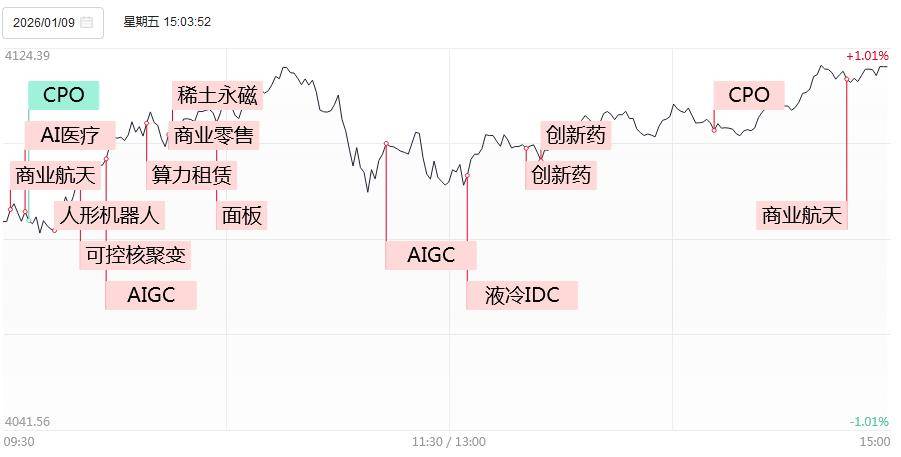
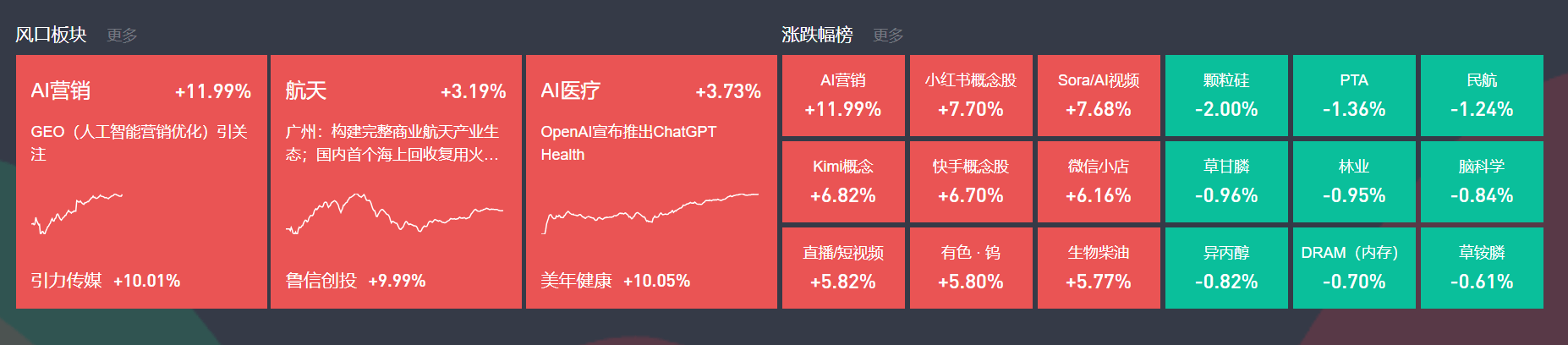
Market Overview - The market showed strong fluctuations throughout the day, with the Shanghai Composite Index surpassing the 4100-point mark. The AI marketing concept saw a collective surge, with companies like Yili Media achieving a 10.01% increase and others like Provincial Advertising Group hitting the daily limit. The AI medical sector also rose, with companies such as Meinian Health and Guoxin Health reaching their daily limits. The commercial aerospace sector continued its strong performance, with China Satellite Communications achieving a new high after five consecutive days of gains. The controlled nuclear fusion concept maintained its strength, with companies like Hongxun Technology and China First Heavy Industries achieving three consecutive gains. Overall, approximately 3900 stocks in the Shanghai and Shenzhen markets rose, with total trading volume exceeding 3 trillion yuan [1]. Hot Topics AI Marketing - The AI marketing sector experienced significant gains, with companies like Yili Media, Lio Co., Jishi Media, and Easy Point Tianxia hitting their daily limits. According to a report from CITIC Securities, GEO is expected to drive the evolution of business models in the advertising marketing industry, allowing advertising companies to expand from marketing services to technology services [4][5]. Aerospace - The aerospace sector continued to perform strongly, with companies like Luxin Investment, Goldwind Technology, Galaxy Electronics, Aerospace Electronics, and China Satellite Communications hitting their daily limits. A recent government plan highlighted Guangzhou's focus on developing reusable rocket technology and supporting the construction of rocket assembly bases, which is expected to enhance the commercial aerospace industry [7][8]. AI Medical - The AI medical sector saw substantial growth, with companies like Meinian Health, Guoxin Health, and Yueshin Health reaching their daily limits. OpenAI announced the launch of ChatGPT Health, a dedicated space for health-related discussions, which is expected to enhance user engagement in health inquiries [11][12]. The demand for AI in healthcare is projected to grow significantly, driven by an aging population and increasing chronic disease cases, highlighting the value of AI in improving diagnostic efficiency and addressing healthcare resource gaps [14].

港股收评:恒指涨0.32%,有色金属股活跃,智谱上市第二日大涨超20%再创新高
Ge Long Hui· 2026-01-09 08:28
Market Overview - The Hong Kong stock market experienced slight gains, with the Hang Seng Index rising by 0.32%, while the Hang Seng China Enterprises Index and the Hang Seng Tech Index increased by 0.1% and 0.15% respectively [1] Sector Performance - Large technology stocks showed mixed performance, with Alibaba and JD.com rising nearly 3%, while Baidu and Meituan fell over 2%, and Tencent experienced a slight decline [1] - Barclays significantly raised its price forecasts for gold, silver, and copper, leading to renewed activity in copper and gold stocks, particularly with Zhaojin Mining hitting a historical high [1] - International oil prices rebounded to a two-week high, and the announcement of a merger between Sinopec and China Aviation Oil resulted in a general increase in oil stocks [1] - The AI healthcare sector saw a new era of growth, with internet healthcare concept stocks rising collectively [1] - Gaming stocks, which had been declining, saw a rebound, with MGM Resorts ending a five-day losing streak [1] Airline and Solar Industry - Airline stocks faced a significant drop in ticket prices, leading to a decline in the three major airline stocks, with China Eastern Airlines falling over 4% [1] - Six leading solar companies were reportedly summoned for discussions, resulting in a lackluster performance for solar stocks throughout the day [1] New Listings and Market Activity - Three new stocks were listed today, with MINIMAX-WP soaring by 109%, Jin Xun Resources rising by 29%, and Reborn Bio-B increasing by 41.6% [1] - Zhihui's stock surged over 20% on its second day of trading, reaching a market capitalization of 72 billion HKD at one point [1] Fund Flows - The Hang Seng Technology Index ETF (513180) saw a net inflow of over 5.4 billion HKD, marking 23 consecutive days of significant investment [1] - The largest Hang Seng Pharmaceutical ETF (159892) rose by 1.5%, aiming for a third consecutive day of gains, while the Hang Seng Internet ETF (513330) also saw a net inflow exceeding 3.3 billion HKD [1]
MiniMax上市引爆人工智能应用 讯飞医疗涨超20%领跑AI医疗板块
Zhi Tong Cai Jing· 2026-01-09 08:25
Core Viewpoint - The stock of iFlytek Medical Technology (02506) surged by 20.58% to HKD 97.55, with a trading volume of HKD 190 million, following significant developments in the AI healthcare sector [1] Group 1: Market Reaction - iFlytek Medical Technology's stock experienced a peak increase of 25% before closing at a 20.58% gain [1] - The trading volume reached HKD 190 million, indicating strong investor interest [1] Group 2: Industry Developments - The debut of domestic large model company MiniMax saw its stock price soar over 100%, highlighting a growing interest in AI applications [1] - The AI healthcare sector is witnessing intensified catalysts, particularly with OpenAI launching the ChatGPT Health feature, which offers health-related answers and connects smart devices [1] Group 3: Policy and Investment Trends - Northeast Securities notes that large model companies are increasingly focusing on healthcare, which is becoming a key investment area supported by policy initiatives [1] - Southwest Securities emphasizes that traditional healthcare IT investments are under pressure due to stricter local finance and medical insurance controls, but AI is seen as a means to enhance grassroots healthcare and optimize resource allocation [1] - The ongoing support from policies, such as the "14th Five-Year" National Health Information Planning, reinforces the growth potential of AI in healthcare [1] Group 4: Company Positioning - iFlytek Medical Technology is recognized as the leading AI healthcare company with the broadest coverage in the industry, positioned to benefit from policy dividends and national projects [1]