
AI泡沫

Search documents
南华期货金融期货早评,大宗商品早评-20251203
Nan Hua Qi Huo· 2025-12-03 03:12
金融期货早评 宏观:关注下任美联储主席人选动态 【市场资讯】1)特朗普称明年初将宣布美联储主席人选,暗示哈塞特。新美联储通讯社: 哈塞特当选美联储主席已"内部确定"。2)美国假日购物季"开门红"!美国零售联合会:感 恩节假日购物人数飙至超 2 亿人次。3)欧元区 11 月 CPI 回升至 2.2%,服务业价格顽固, 欧央行 12 月降息"几无可能"。 【核心逻辑】国内方面,10 月份受上年同期基数抬高、财务费用增长较快等因素影响,规 模以上工业企业利润同比下降 5.5%。当前工业企业利润增速受"量价双弱"格局拖累,边际 回落特征显著,营收利润率偏弱的态势未得到明显改善。展望短期,预计年内规模以上工 业企业利润增速将持续面临较大压力,大概率维持弱势震荡格局。中长期来看,随着宏观 托底政策逐步落地见效,叠加"反内卷"相关政策推动行业竞争格局优化,企业经营环境将 逐步改善,2025 年工业企业盈利有望进入逐步修复通道。中国 11 月官方制造业 PMI 环比 回升至 49.2,整体呈现边际改善趋势,但弱于季节性表现。海外方面,11 月以来,美元指 数两度站上 100 点。回顾两轮突破 100 点的过程,我们认为其强势 ...
中外资机构热议“AI泡沫”
中国基金报· 2025-12-03 03:12
【导读】中外资机构热议:AI是否存在泡沫?实体经济贡献几何?科技股能否继续领跑? 中国基金报记者 郭玟君 近日,"AI泡沫论"成为市场及产业界、科技界争论的焦点。当前,AI是否存在泡沫?围绕AI创 新、应用及基础设施建设的竞赛,能否真正创造经济效益,又将如何影响科技股的表现?就 此,中国基金报采访了多位中外资机构人士。 AI是否存在泡沫? 受访机构认为,"AI泡沫论"的出现主要有以下四个原因。 第一,持仓过度集中。渣打中国财富管理部首席投资策略师王昕杰指出,当前市场AI持仓不仅 集中度过高,还聚集了大量获利盘,叠加其他市场不确定性,如关税、美联储降息预期,私 募信贷市场可能引起的连锁反应,以及美国流动性问题等,市场偏向先获利了结。 第二,投资回报之忧。南方东英CIO王毅指出,AI叙事最大的分歧来源于资本开支从自有现金 流到债务融资的转变。以甲骨文和Meta为代表的债务融资对于上市公司本身的现金流预期造 成了巨大影响,从而引发市场对于AI资本开支可持续性的质疑。 王昕杰也认为,很多数据中心建设背负了巨额债务。在美联储降息预期下降的情况下,投资 者从收益率角度考虑,对于如此巨大的AI基础设施投入能否创造足够大的经 ...


“大空头”炮轰美联储
Xin Lang Cai Jing· 2025-12-03 03:01
Core Viewpoint - Michael Burry, a well-known short-seller, argues that the Federal Reserve is unnecessary for the U.S. economy, suggesting that its functions could be effectively managed by the Treasury Department [1][2]. Group 1: Burry's Critique of the Federal Reserve - Burry claims that the Federal Reserve's role is "the simplest job in the world" and believes it has caused significant damage over the past century [1][2]. - He expresses a radical view that if former President Trump were to take control of the Federal Reserve, it could lead to the institution's downfall, as public sentiment would turn against it [2]. - Burry questions the rationale behind the Fed's potential interest rate cuts, stating there is no current justification for lowering rates [2]. Group 2: Economic Implications of Fed Policies - The Federal Reserve is expected to lower interest rates in December, despite rising inflation pressures, which Burry warns could harm savers and fixed-income investors [2][3]. - Burry's short positions on high-valuation tech stocks like Nvidia and Palantir could be negatively impacted by Fed rate cuts, as these stocks are sensitive to interest rate changes [3].
12月美股策略:风高浪急之后重拾升势
Sou Hu Cai Jing· 2025-12-03 02:57
Group 1 - The Federal Reserve's decision-making is influenced by limited timely data on employment, inflation, and retail sales, with a focus on preventing labor market deterioration [1][9] - Investor confidence remains optimistic despite challenges such as government shutdowns and AI bubble discussions, with a positive sentiment index of 4.0 [1][11] - The S&P 500 index has shown double-digit year-on-year earnings growth in the first three quarters, with a projected growth of 10.8% for Q4 [3][21] Group 2 - Google's advancements in AI, particularly with its Gemini 3 model, have contributed to market rebounds, while concerns about an AI bubble persist among fund managers [2][30] - The market is experiencing a rotation between high and low valuation sectors, with healthcare and communication services leading gains [17][47] - The Bank of America Global Fund Manager Survey indicates that 53% of fund managers believe there is an AI bubble, with 45% identifying it as a significant tail risk [25][44] Group 3 - The VIX index peaked at 26.4 points in early November but declined as the market stabilized, indicating a rise in risk appetite [47] - The healthcare sector, with a ten-year PE-TTM percentile of 69%, and communication services benefiting from Google's AI advancements are expected to perform well [47] - The overall market narrative will continue to revolve around Federal Reserve monetary policy and AI developments, with a balanced investment strategy recommended [47]
“大空头”炮轰美联储
财联社· 2025-12-03 02:24
继警示AI泡沫,并接连向英伟达、特斯拉等股票开火后,知名做空投资者、素有"大空头"之称的迈克尔·伯里(Michael Burry)日前又瞄准 了新目标:美联储。 他抛出了一个新颖且劲爆的观点: 美国根本不需要美联储 。 Burry因在2008年金融危机前精准做空抵押贷款支持证券而声名鹊起,迈克尔·刘易斯(Michael Lewis)的著作《大空头》和奥斯卡获奖 影片《大空头》都记录了他的这一交易。 今年10月底,Burry在沉寂数年后重返公众视野。自那以来,他多次预警股市泡沫风险,披露了做空英伟达等AI股的新仓位,并推出了 Substack 付费通讯专栏,以向外界自由输出其投资观点。 周二,Burry在一档播客节目中阐述了其非主流立场。他表示, 美联储的工作是"世界上最简单的" 。 当被问及对美联储独立性的看法时,Burry表示,自己对此持 "偏激观点",并补充道, 若特朗普决意加强对美联储的掌控,这家央行的终 结或许即将到来 。 Burry表示,他相信货币政策可以由财政部指导。他对比了美联储与财政部当前的职能,并暗示二者的角色在很大程度上可相互替代。 "我的意思是,他们几乎已经是同一个部门了。"他表示。"我 ...

AI泡沫担忧加剧,甲骨文债务恐慌指标创2009年以来新高
Hua Er Jie Jian Wen· 2025-12-03 01:45
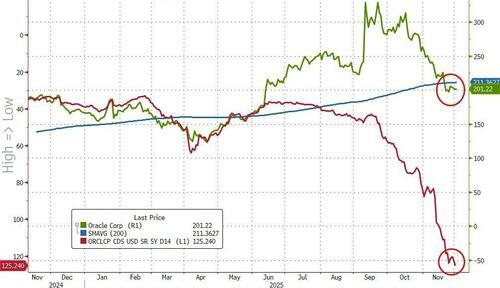
Core Viewpoint - Concerns about an AI bubble are escalating in the credit market, highlighted by Oracle's credit default swap (CDS) costs reaching their highest level since the 2009 financial crisis, indicating investor anxiety over the imbalance between massive AI investments and expected returns [1][3]. Group 1: Credit Market Indicators - Oracle's CDS prices rose to approximately 1.28% at the close in New York, marking the highest level since March 2009, and have more than doubled from a low of 0.36% in June [1][3]. - The surge in CDS prices reflects market worries about the vast capital expenditures in the AI sector, with Oracle having issued hundreds of billions in bonds recently, making its CDS a key tool for investors hedging against potential AI downturns [3][4]. Group 2: Debt Levels and Market Sentiment - Oracle is the lowest-rated among major cloud service providers, with a total debt of approximately $105 billion as of the end of August, including $95 billion in dollar bonds that are part of the Bloomberg U.S. Corporate Bond Index [4]. - The trading volume of Oracle's CDS has surged to about $5 billion over seven weeks, compared to just over $200 million in the same period last year, indicating heightened investor interest in hedging against its debt [4]. Group 3: Historical Context and Future Projections - The rising cost of default protection signals investor anxiety about the timing gap between massive AI investments and productivity gains or profit growth [5]. - Predictions suggest that the spending spree on AI infrastructure and power capacity will continue into next year, with U.S. investment-grade bond issuance expected to reach a record $2.1 trillion by 2026, having already surpassed $1.57 trillion this year [6]. Group 4: Supply and Demand Dynamics in Credit Markets - A new wave of large-scale bond issuance may overwhelm buyers, leading companies to offer higher yields to attract investors, with spreads expected to reach 100 to 110 basis points above benchmark rates next year [7]. - Historical precedents exist where industries have leveraged significantly without disastrous outcomes, but concerns remain about the credit quality of debt investments as companies continue to invest heavily in AI [7].

英国央行下调银行资本要求 警示AI泡沫与地缘风险加剧全球金融脆弱性
Xin Hua Cai Jing· 2025-12-03 00:23
Core Viewpoint - The Bank of England's Financial Policy Committee (FPC) has made key decisions regarding capital requirements and has raised concerns about global financial stability risks, particularly related to geopolitical tensions and high valuations in AI-related technology companies [1][2]. Group 1: Capital Requirements - The FPC has lowered the system-wide Tier 1 capital requirement from 14% to 13%, corresponding to a Common Equity Tier 1 (CET1) ratio of approximately 11% [1]. - The overall CET1 capital adequacy ratio of the UK banking sector is currently about 2 percentage points above regulatory requirements, indicating a strong capital position [2]. - The adjustment in capital requirements reflects structural changes in the UK financial system since 2015, including a decrease in average risk weights and optimization of risk measurement methods [2]. Group 2: Countercyclical Capital Buffer (CCyB) - The FPC has decided to maintain the CCyB rate at 2%, citing low household and corporate debt levels and overall easing credit conditions [3]. - This "neutral setting" aims to ensure banks retain sufficient risk absorption capacity to prevent disorderly credit supply contraction during future shocks [3]. Group 3: Financial Stability Risks - The FPC has highlighted significant global financial stability risks, including rising geopolitical tensions, fragmentation in trade and financial markets, and increasing sovereign debt pressures [1][2]. - Concerns have been raised regarding the high valuations of AI-related technology companies, which could amplify financial system risks if asset prices decline [1]. - The FPC noted structural vulnerabilities in financial institutions, such as high leverage and weak underwriting standards, which were exposed by recent corporate defaults in the U.S. [1]. Group 4: Support for Sustainable Economic Growth - The FPC has introduced measures to support sustainable economic growth, including reforms to the Solvency II framework and initiatives to enhance financing for high-growth firms [4]. - The committee supports the launch of exploratory scenario testing for private markets to assess systemic risks under stress conditions [4]. - The FPC has expressed support for the Bank of England's regulatory framework for systemic stablecoins, aiming to balance payment innovation with financial stability [4]. Group 5: Market Reaction and Future Outlook - The market reaction to the FPC's decisions has been generally stable, with analysts suggesting that the capital requirement reduction could enhance banks' lending potential [5]. - The FPC plans to focus on optimizing regulatory buffer designs and reviewing the implementation of leverage ratio standards, with further detailed analysis expected in the Financial Stability Report scheduled for December 2025 [5][6].
“私募魔女”李蓓:中国富人的钱放在海外越来越不安全
Xin Lang Cai Jing· 2025-12-02 14:59
Group 1 - The current environment for Chinese wealth is characterized by a lack of safe investment options, with significant events highlighting the risks of holding assets overseas, such as the freezing of Russian oligarchs' assets and the seizure of cryptocurrency by the U.S. [1][29] - UBS's potential relocation to the U.S. to comply with regulatory demands signals an escalation in international asset capture efforts, raising concerns among Chinese entrepreneurs about the safety of their overseas investments [1][11] - The A-share and Hong Kong stock markets are viewed as "small blessings" in the current global asset landscape, with the CSI 300 index having a PE ratio of approximately 13 times and an implied return of 7% [21][30] Group 2 - Despite ongoing economic deflation, core ROE has stabilized due to the exit of weaker firms, allowing leading companies in sectors like construction and real estate to improve profitability [2][21] - Leading companies in struggling industries are beginning to see profit recovery, with some construction firms reporting net profits of 6% and real estate companies achieving over 10% net profit on new projects [21][34] - There is a significant amount of wealth in China currently concentrated in fixed income, with low risk appetite among residents, which could drive future capital migration towards equities [2][21] Group 3 - The potential for a bull market in A-shares and Hong Kong stocks is anticipated if the Chinese economy stabilizes and ROE improves, especially as global capital may shift towards Chinese assets due to challenges in the U.S. [2][21][36] - The mismatch between China's manufacturing share in the global market and its international currency status suggests that as the economy recovers, the renminbi's role in trade settlements and reserves may increase [21][36] - The current low risk appetite and the concentration of wealth in fixed income could act as catalysts for a significant reallocation of assets towards equities in the future [2][35]

OpenAI告急!进入“红色代码”状态改进ChatGPT、推迟广告计划 巨头围攻下行业王座摇摇欲坠?
Zhi Tong Cai Jing· 2025-12-02 10:55
Core Insights - OpenAI is entering a "red code" status to improve ChatGPT and is postponing other plans, including advertising initiatives, amid increasing competition from tech giants [1][2] - The competitive landscape is shifting, with Google's Gemini 3 model outperforming ChatGPT in early tests, indicating a potential loss of OpenAI's market dominance [2][3] Group 1: Competitive Landscape - OpenAI's leading position is being challenged as Google has released its AI model Gemini 3, which has surpassed ChatGPT in various benchmarks [2] - Anthropic has formed a strategic partnership with Microsoft and Nvidia worth $350 billion, potentially weakening OpenAI's resource advantages [3] - User engagement metrics show that Google's Gemini application has 650 million monthly active users, while OpenAI's ChatGPT has 800 million weekly active users, highlighting a narrowing user gap [3] Group 2: Commercialization Challenges - OpenAI's focus on improving ChatGPT and delaying other commercial plans suggests a slowdown in its commercialization efforts [4] - Approximately 70% of OpenAI's annual recurring revenue comes from ChatGPT subscriptions, but only 5% of its user base is willing to pay for the service [5] - OpenAI's financial struggles are evident, with a net loss of $13.5 billion in the first half of 2025, significantly up from $3.1 billion in the same period last year [6] Group 3: Valuation and Market Concerns - OpenAI's valuation has skyrocketed to nearly $1 trillion, but concerns about its ability to generate sustainable revenue are growing [7] - The company reported $4.3 billion in revenue for the first half of the year, a year-over-year increase of over 200%, but lacks a clear and credible profit model [7] - Critics warn that the current financing model, where suppliers invest in OpenAI, may lead to a "circular financing" situation, increasing risk if OpenAI fails to generate sufficient profits [8][9]

AI投资关键时刻!最新研判来了
Zhong Guo Ji Jin Bao· 2025-12-02 10:41
Core Insights - The surge in interest around Google's AI narrative, particularly with the launch of the Gemini 3 model, has sparked discussions about the sustainability of the AI market and concerns over a potential "AI bubble" similar to the 2000 internet bubble [1] Group 1: AI Market Sustainability - The AI sector is currently characterized by high valuations but significant growth potential, with confidence in domestic AI development catching up to the U.S. [3][10] - The fundamentals of the AI sector are improving, with reasonable valuations and expectations of high growth continuing into 2026-2027, indicating strong sustainability for AI as a market leader [4][10] - The current AI market does not exhibit signs of a bubble, as the industry is supported by solid fundamentals and a diverse competitive landscape [12][13] Group 2: Technological Advancements - The launch of the Gemini 3 model represents a significant breakthrough in AI, showcasing advancements in multi-modal capabilities and a closed-loop ecosystem that enhances performance and cost efficiency [7][9] - Future breakthroughs in AI are expected to stem from algorithm upgrades and enhancements in computational infrastructure, which will drive commercial applications [24] Group 3: Investment Opportunities - The most promising investment opportunities are seen in the AI infrastructure sector, particularly in AI computing chips and related hardware, as major tech companies ramp up capital expenditures in this area [22][23] - The AI application landscape is still in its early commercial stages, with significant potential in areas like AI advertising, productivity tools, and vertical software platforms [19][20] Group 4: Competitive Landscape - China's AI industry has notable advantages, including a large digital market and strong infrastructure, but faces challenges in high-end chip manufacturing and model architecture [16][17] - The competitive dynamics are shifting, with large tech firms gaining dominance in the AI ecosystem, potentially sidelining smaller startups [15][23]