
原油供需平衡

Search documents
国泰君安期货·原油周度报告-20251214
Guo Tai Jun An Qi Huo· 2025-12-14 10:44
国泰君安期货·原油周度报告 国泰君安期货研究所 黄柳楠 投资咨询从业资格号:Z0015892 赵旭意 投资咨询从业资格号:Z0020751 日期:2025年12月14日 GuotaiJunanFuturesallrightsreserved,pleasedonotreprint | 01 | CONTENTS 02 | 03 | 04 | 05 | 06 | | --- | --- | --- | --- | --- | --- | | 综述 | 宏观 | 供应 | 需求 | 库存 | 价格及价差 | | 原油:仍是下行趋势,考验 | 利率、贵金属与油价走势比较 | OPEC+核心成员国出口量一览 | 欧美炼厂开工率 | 美欧各类油品库存 | 基差 | | 支撑 | 海外服务业数据 | 非OPEC+核心成员国出口量一览 | 中国炼厂开工率 | 亚太各类油品库存 | 月差 | | | 中国信用数据 | 美国页岩油产量 | | | 内外盘原油价差 | | | | | | | 净持仓变化 | SpecialreportonGuotaiJunanFutures 2 观点综述 01 本周原油观点:仍是下行趋势,考验支撑 ...
【兴期研究·深度报告】2026年原油市场或迎转折
Jin Rong Jie· 2025-12-12 09:01
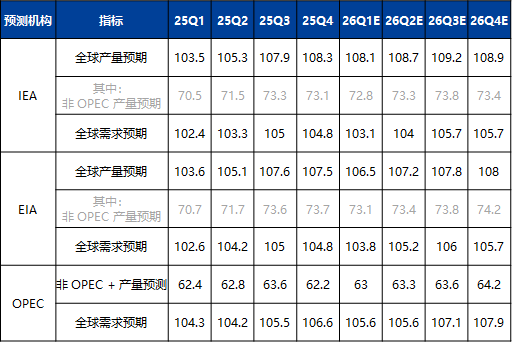
Core Viewpoint - 2026 is expected to be a turning point for the crude oil market, with global supply-demand surplus pressure peaking in Q1, followed by a gradual easing of supply pressure and potential upward price movement due to macroeconomic benefits such as interest rate cuts by the Federal Reserve [1][2]. Supply-Demand Balance Forecast - The global crude oil market is currently in a phase of oversupply, primarily due to OPEC+ rapidly restoring production cuts from 2022, leading to supply growth outpacing demand [4][38]. - The surplus pressure is projected to peak in Q1 2026, after which the degree of oversupply is expected to gradually ease [4][38]. Supply Side Analysis - OPEC's capacity for further production increases is limited, with a significant recovery already achieved in 2025 [7][17]. - U.S. shale oil production is anticipated to grow weakly due to rising costs and a decrease in capital expenditure, with the average cost of new shale wells projected to be above $60 to $70 per barrel [24][38]. - Non-OPEC supply growth is also expected to slow, with EIA forecasting a decline in growth rates from 4.66% in 2025 to 1.84% in 2026 [29][38]. Demand Side Analysis - Overall demand for crude oil is expected to maintain low but steady growth, primarily driven by developing countries, with a projected increase of 1.04 million barrels per day in 2025 and 1.07 million barrels per day in 2026 [39][40]. - China's strategic stockpiling is likely to continue, contributing to demand stability [44][46]. - U.S. demand growth is expected to be modest, with strategic reserves at historically low levels, indicating a persistent need for replenishment [46][49]. Macroeconomic Environment - The Federal Reserve is expected to enter a rate-cutting cycle, which historically supports commodity prices, including crude oil [49][54]. - The anticipated decline in the federal funds target rate could enhance demand expectations for oil priced in dollars [54][59]. Strategic Recommendations - As the surplus pressure peaks in early 2026, there may be opportunities to gradually position for long-term bullish strategies, particularly when prices are depressed due to temporary oversupply [3][59]. - Close monitoring of OPEC+ policies, geopolitical risks, and inventory dynamics in the U.S. and China is advised [3][59].

原油价格跌破30美元每桶时,沙特作为主要产油国,主动挑起价格战,意欲为何?
Sou Hu Cai Jing· 2025-12-11 17:15
Core Viewpoint - The article discusses the significant impact of the COVID-19 pandemic on Saudi Aramco's market value and the global oil market, highlighting the strategic moves by Saudi Arabia and Russia in response to falling oil prices [1] Group 1: Market Impact - Saudi Aramco's market value dropped by the equivalent of 1.2 times that of PetroChina due to a 30% decline in international oil prices [1] - The pandemic led to a drastic reduction in air travel, causing oil demand to plummet and prices to reach critical lows [1] Group 2: Strategic Responses - Saudi Arabia, reliant on oil for 60% of its fiscal revenue, sought to stabilize prices by proposing production cuts in collaboration with OPEC and Russia [1] - Russia resisted production cuts due to concerns over losing market share and allowing U.S. shale oil producers to benefit, leading to a breakdown in negotiations [1] Group 3: Competitive Dynamics - In retaliation, Saudi Arabia announced a $10 price reduction and plans to increase production, aiming to drive higher-cost producers out of the market [1] - The cost of oil extraction is significantly lower for Saudi Arabia at $3 per barrel compared to $17 for Russia, indicating a competitive advantage in a price war [1] - The ongoing situation is characterized as a war of attrition, with the outcome dependent on which country can endure the longest before returning to negotiations [1]

国内成品油价格迎第11次下调,加50升92号汽油少花2元
Bei Ke Cai Jing· 2025-12-08 10:21
Core Viewpoint - The National Development and Reform Commission announced a reduction in domestic gasoline and diesel prices by 55 yuan per ton, effective from December 8, due to fluctuations in international oil prices [1] Group 1: Price Adjustments - The price reduction translates to a decrease of 0.04 yuan per liter for 92-octane gasoline, 0.05 yuan for 95-octane gasoline, and 0.05 yuan for 0-octane diesel [2] - This year, domestic refined oil retail prices have undergone 24 adjustment cycles, including 7 increases, 6 instances of no change, and 11 decreases [2] Group 2: Impact on Consumers - Following the price reduction, consumer fuel costs will continue to decrease; for example, filling a 50-liter tank of 92-octane gasoline will save consumers 2 yuan [3] - For a small car running 2,000 kilometers a month with an 8-liter per 100 kilometers fuel consumption, the cost will decrease by 3 yuan before the next price adjustment [3] - In the logistics sector, a heavy truck running 10,000 kilometers a month with a fuel consumption of 38 liters per 100 kilometers will see a reduction of approximately 89 yuan in fuel costs [3] Group 3: Market Dynamics - The current market shows a "strong gasoline, weak diesel" scenario, with overall weak demand for diesel and gasoline prices experiencing slight declines [5] - Analysts indicate that while gasoline demand remains stable, diesel demand is showing signs of weakness, leading to a downward trend in diesel prices [5][6] - Despite expectations of a price decrease, the limited anticipated reduction is not expected to significantly impact the oil market [5] Group 4: Future Outlook - The next price adjustment is anticipated to be the last for the year 2025, with expectations of a slight increase based on current international oil price levels [4] - The global oil supply is currently loose, with OPEC+ having increased production significantly, although there are concerns about future supply due to geopolitical tensions [7] - Seasonal demand is expected to decline, which may exert downward pressure on oil prices, despite some support from geopolitical factors and expectations of interest rate cuts [7]
原油周报(SC):OPEC+继续暂停增产,国际油价暂获支撑-20251208
Guo Mao Qi Huo· 2025-12-08 06:24
投资咨询业务资格:证监许可【2012】31号 【原油周报(SC)】 OPEC+继续暂停增产,国际油价暂获支撑 国贸期货 能源化工研究中心 2025-12-08 资料来源:Wind、钢联、国贸期货研究院 主要周度数据变动回顾 叶海文 从业资格证号:F3071622 投资咨询证号:Z0014205 本报告非期货交易咨询业务项下服务,其中的观点和信息仅供参考,不构成任何投资建议;期市有风险,投资需谨慎 01 PART ONE 主要观点及策略概述 原油:OPE C +继续暂停增产,国际油价暂获支撑 | 影响因素 | 驱动 | 主要逻辑 | | --- | --- | --- | | | | (1)EIA:EIA继续小幅上调对2025年和2026年全球原油及相关液体产量预测,预计2025年全球原油及相关液体产量为10,597万桶/日,较2024年上升 280万桶/日。(2)OPEC:10月份OPEC国家原油产量为2846万桶/日,较9月份上升3.3万桶/日,Non-OPEC DoC国家原油产量为1456.4万桶/日,较9月份 | | 供给(中长期) | 偏空 | | | | | 下降10.6万桶/日。(3)IEA:10 ...
国泰君安期货原油周度报告-20251207
Guo Tai Jun An Qi Huo· 2025-12-07 07:19
Report Overview - Report Title: Guotai Junan Futures·Crude Oil Weekly Report [1] - Date: December 7, 2025 [2] - Analysts: Huang Liunan, Zhao Xuyi [2] 1. Report Industry Investment Rating No specific industry investment rating is provided in the report. 2. Report's Core View - Short - term: Observe the impact of geopolitical factors on oil transportation, and it is recommended to stay on the sidelines. - Medium - term: Be cautious about further significant price drops. Brent and WTI may test the lows before April at the end of this year or early next year, and may even reach $50 per barrel. The decline of SC may be less than that of foreign benchmarks. - Long - term: Although the decline in oil prices has accelerated under the influence of trade frictions, a long - term decline is unlikely to happen overnight. Pay attention to potential reversals in macro - expectations, which may amplify oil price fluctuations. [5] 3. Summary by Directory 3.1 Macro - The gold - oil ratio has strengthened again. - Attention should be paid to inflation transmission. - The RMB exchange rate has strengthened again, and social financing has declined. [23][26][28] 3.2 Supply - OPEC+ decided at the November 30 meeting to suspend further production increases in Q1 2026, maintaining the existing output path. - OPEC 8's production increase completion rate in October remained at 80%. OPEC 8's exports in September reached a high and then declined by 480,000 barrels per day in October. - Non - OPEC countries' supply is growing strongly. For example, the production of Guyana and Brazil has remained at a high level, and the production of the United States reached a record high in September. [30][31][32] 3.3 Demand - The refinery operating rates in the United States and Europe have declined, and the operating rate of major Chinese refineries has dropped significantly. The "Rizhao Port Incident" may continue to have an impact. - Global refinery capacity is changing. Some refineries are expanding or newly built, while others are shutting down or reducing capacity. [68][71] 3.4 Inventory - US commercial inventories have stabilized, and the inventory in Cushing is still significantly lower than the historical average. - European diesel inventories have declined, while gasoline inventories have increased. - Global in - transit crude oil inventories and floating storage are at high levels. - Domestic refined oil profit margins have rebounded. [73][78][80] 3.5 Price and Spread - Spot market overview: Geopolitical factors have disrupted the market, and the purchases of Russian oil by India and Turkey have declined. Saudi Aramco has lowered the OSP for Asia in January to the lowest level in five years. - North American basis has rebounded, and the monthly spread has rebounded slightly. The valuation of SC is at a medium - low level, and the monthly spread has stabilized. [90][96][97]
【原油年报】静待花开
Xin Lang Cai Jing· 2025-12-01 12:17
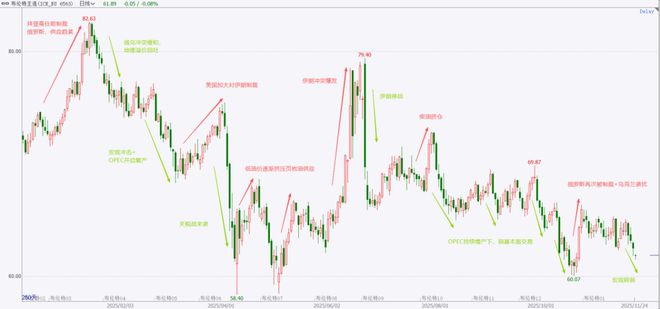
来源:市场资讯 (来源:油市小蓝莓) 市场回顾 行情回顾 库存:平衡表的弱平衡Q4才体现到显性库存 弱平衡对库存的传导逐渐兑现,除了旺季以外,整体显性库存的大规模累积于9月后才更为明显。 拆分当下的水上原油库存,9月初至今累库2亿桶,水上库存累库月1.7亿桶。其中浮仓累库5千万 桶(伊朗3千万桶、俄罗斯1千万桶),在途库存累库1.2亿桶(OPEC大概1亿桶)。 数据来源:紫金天风期货研究所 供应:如期增产的OPEC 自上半年以来OPEC开启增产进程,根据IEA统计,和1月相比,9月全球原油产量增长约700万桶 日,拆分来看,其中OPEC+ 9月产量相较于1月产量增长约400万桶日,Americas Quintet国家增长 约200万桶日,Biofuel增长约100万桶日。 我们去年年报给出了230万桶日的年度增量(包含美国制裁伊朗的100万桶日),就兑现结果来看 供应端整体评估较为合理,平均下来年度增长量级约为250-300万桶日左右。 数据来源:紫金天风期货研究所 回顾2025年的原油市场,波动区间80-55(以Brent为例),价格重心整体继续下移,两次主要的 冲高分别位于年初(美国制裁俄罗斯)和年中(伊 ...
天风证券:近月原油价格或仍有压力 Brent长期中枢价格较为坚挺
智通财经网· 2025-12-01 03:18
Group 1 - The oil market is currently in a contango structure, with the latest Brent long-term contract price at $68 per barrel as of November 20, 2025. The near-term prices may face pressure, but long-term prices are expected to be supported by improved OPEC strategies and nearing depletion of OPEC's spare capacity [1] - There is a significant discrepancy between mainstream institutions' expectations of oil surplus and actual inventory accumulation, particularly after OPEC announced accelerated production increases mid-year. In November, OPEC's production strategy shifted, indicating a pause in production increases for Q1 2026, reflecting their interest in maintaining oil prices [1] - For 2026, if OPEC resumes production in Q2, the global supply increase is projected to be 1.93 million barrels per day, which is an increase of 930,000 barrels per day compared to the surplus in 2025. If OPEC does not resume production throughout 2026, the supply increase is expected to be 1.65 million barrels per day, an increase of 650,000 barrels per day compared to 2025 [1] Group 2 - The average breakeven cost for U.S. shale oil is approximately $55 per barrel, as indicated by the latest Q3 2025 reports. Most shale oil companies have lowered their capital expenditure guidance for 2025 but have raised their annual production forecasts [2] - The spot market basis has weakened, and the crack spread for refined oil has reached a new high for the year. The Dubai spot price relative to Brent has weakened, and Saudi Arabia has announced a decrease in official selling prices for December, reflecting concerns over weak supply and demand [3] - Since November, the Brent month-on-month differentials have strengthened, with increases of $0.41, $1.55, and $2.50 per barrel for the 1-2, 1-6, and 1-12 month spreads, respectively. This may indicate instability in supply due to escalating sanctions on Russian oil by Europe and the U.S. [3]

【石化化工】地缘缓和预期下油价低位震荡,关注OPEC+产量政策——行业周报第430期(1124—1130)(赵乃迪/王礼沫等)
光大证券研究· 2025-11-30 23:06
点击注册小程序 查看完整报告 风险分析: 上游资本开支增速不及预期、原油和天然气价格大幅波动。 本订阅号中所涉及的证券研究信息由光大证券研究所编写,仅面向光大证券专业投资者客户,用作新媒体形势下研究 信息和研究观点的沟通交流。非光大证券专业投资者客户,请勿订阅、接收或使用本订阅号中的任何信息。本订阅号 难以设置访问权限,若给您造成不便,敬请谅解。光大证券研究所不会因关注、收到或阅读本订阅号推送内容而视相 关人员为光大证券的客户。 报告摘要 地缘冲突缓和预期走强,本周油价低位震荡 OPEC+有望在周日的会议上维持现有的石油产量水平不变,并将推动制定一项新机制,以评估成员国最 大产能;而OPEC+自愿减产8国将维持其暂停增产的决定。当前原油市场仍面临供需过剩,本次 OPEC+放缓增产决策有望改善过剩风险。需求端,IEA于2025年11月月报预计2026年原油需求增长77 万桶/日,供给端,IEA预计2026年全球原油供给增长250万桶/日,其中非OPEC+增长120万桶/日, OPEC+增长130万桶/日。当前美联储重启降息周期,全球贸易冲突风险仍具不确定性,建议关注26年需 求预期变化对油价的影响。 "三桶油" ...

供需结构性矛盾仍存,高低硫市场或延续分化
Hua Tai Qi Huo· 2025-11-30 09:06
Report Industry Investment Rating - Not provided in the content Core Viewpoints - Based on the expectation of a downward shift in the oil price center next year, the unilateral prices of FU and LU will be continuously constrained. The current market contradictions of high - and low - sulfur fuel oils are relatively limited, with overall sufficient supply. The supply pressure of low - sulfur fuel oil has marginally eased, and the market structure has slightly repaired. In the future, the supply - demand pattern of high - sulfur fuel oil will be better, and after the crack spread is adjusted, it may stimulate refinery demand and drive the market to strengthen again. Low - sulfur fuel oil still faces contradictions such as excess capacity and declining terminal demand, with a weak market outlook, but the downward space of the crack spread is relatively limited [6]. - The expectation of oversupply in the oil market will gradually materialize, and the upside resistance at the crude oil end may continue. In 2025, the unilateral prices of fuel oil followed the decline of crude oil, and the market structure alternated between strength and weakness. In 2026, the structural contradictions of fuel oil may continue, with Russia being an important variable. The change in consumption tax policy has led to a decline in domestic refinery demand, but the basic demand remains. The substitution effect is emerging, and the demand elasticity at the power generation terminal is increasing. The risk of trade war is temporarily controllable, but the structure of marine fuel demand is facing continuous transformation. The upgrading and elimination of refinery capacity are concurrent, and the downward trend of high - sulfur fuel oil yield may continue. OPEC is gradually exiting production cuts, releasing the supply of medium - and heavy - quality crude oil and fuel oil. The Russia - Ukraine situation is still unclear, and there are uncertainties in Russia's supply. The remaining capacity of low - sulfur fuel oil is still relatively abundant, and profit factors will restrict supply growth. There is still support at the bottom for high - sulfur fuel oil, while the market outlook for low - sulfur fuel oil is weak [8]. Summary by Directory Supply - demand Structural Contradictions and Market Differentiation - The structural support factors for high - sulfur fuel oil still exist. After the crack spread回调, opportunities for going long on dips can be considered [5]. Crude Oil Market - In 2025, international oil prices were in a wide - range volatile decline. Taking Brent as a reference, the annual average price was 68.87 US dollars/barrel, a 13.76% decline from 2024. In 2026, under the neutral expectation, the crude oil market still has downward pressure due to the inability of demand growth to offset supply surplus, and inventory accumulation. However, factors such as China's import strength, Saudi's supply regulation, and changes in Russia's sanctions policy may affect the market [13][14][15]. Fuel Oil Market in 2025 - The unilateral prices of high - and low - sulfur fuel oils showed a volatile decline, driven by the cost of crude oil. The high - sulfur fuel oil market structure first strengthened due to supply tightening and seasonal demand, then weakened due to demand suppression and increased supply. The low - sulfur fuel oil market structure had smaller fluctuations, with short - term strengthening and subsequent weakening due to trade, policy, and production factors [28][29]. Fuel Oil Market in 2026 Demand Side - Domestic refinery demand for fuel oil declined due to consumption tax policy changes, but the basic demand remains. Overseas, refineries' demand for high - sulfur fuel oil was boosted. The demand for fuel oil at the power generation terminal has elasticity due to seasonality and substitution effects, but may be squeezed by Saudi's increased use of crude oil. The risk of trade war is temporarily controllable, and marine fuel demand is expected to grow, but the demand structure is facing transformation, with low - sulfur fuel oil's market share being squeezed [58][77][91]. Supply Side - The upgrading and elimination of refinery capacity will continue, which may further reduce the high - sulfur fuel oil yield. OPEC's gradual exit from production cuts will increase the supply of medium - and heavy - quality crude oil and high - sulfur fuel oil. The Russia - Ukraine situation is uncertain, and Russia's fuel oil supply may increase or decrease. The remaining capacity of low - sulfur fuel oil is abundant, and profit factors will restrict supply growth [108][112][125]. Market Outlook - The supply - demand pattern of high - sulfur fuel oil is better than that of low - sulfur fuel oil. After the crack spread adjustment, the high - sulfur fuel oil market may strengthen. Low - sulfur fuel oil still faces problems such as excess capacity and declining terminal demand, with a weak market outlook, but the downward space of the crack spread is relatively limited [141].