市场回调

Search documents
“美股所有卖出信号都已触发!” 美银Hartnett:但真正的引爆点是它
华尔街见闻· 2025-07-20 11:44
Core Viewpoint - The recent surge in the US stock market, particularly the Nasdaq, has raised concerns as Bank of America's chief investment strategist Michael Hartnett indicates that all proprietary trading rules have triggered sell signals, suggesting a potential market correction [1][3]. Group 1: Market Signals - The stock market has reached critical technical thresholds, with multiple indicators showing that risks are accumulating [2]. - Hartnett's latest "Flow Show" report highlights that the Bank of America fund manager survey's cash rules, global breadth rules, and global fund flow trading rules have all issued sell signals [3][9]. - The proportion of cash held by fund managers has dropped to 3.9%, triggering a sell signal; historically, such signals have led to an average decline of 2% in the S&P 500 index [4][10]. Group 2: Bond Market Concerns - Hartnett believes that the true catalyst for a sell-off may not be in the stock market but rather in the bond market. A breakout of the 30-year US Treasury yield above 5% could shift market sentiment from "risk-on" to "risk-off" [4][14]. - The 30-year Treasury yield briefly surpassed 5% amid fears of potential actions by Trump against Powell, with current yields at 5.1% in the US, 5.6% in the UK, and 3.2% in Japan [15]. Group 3: Market Breadth and Economic Indicators - Despite the stock market reaching new highs, market breadth is at historical lows, indicating potential economic slowdown or a bubble in US equities [5][20]. - The equal-weighted S&P 500 index relative to the S&P 500 is at a 22-year low, and the Russell 2000 index is near a 25-year low, suggesting a concentration of performance among a few tech giants [21][26]. Group 4: Historical Context and Policy Implications - Hartnett draws parallels between current events and the policy conflicts of the 1970s, particularly regarding Trump's relationship with the Federal Reserve and potential repercussions if Powell were to be ousted [6][27]. - The historical context includes Nixon's economic policies in the early 1970s, which led to a cycle of initial prosperity followed by a downturn, suggesting that similar outcomes could occur if current policies shift dramatically [28][31].



美银Hartnett:关于美股,所有卖出信号都已触发,但是.....
Hua Er Jie Jian Wen· 2025-07-20 02:03
Core Viewpoint - The recent surge in the US stock market, particularly the Nasdaq hitting new highs, has triggered sell signals from Bank of America's proprietary trading rules, indicating a potential market correction ahead [1][4]. Group 1: Sell Signals - Bank of America's chief investment strategist Michael Hartnett noted that three key sell signals have been triggered: the cash rule, global breadth rule, and global fund flow trading rule [1][4]. - The cash allocation by fund managers has dropped to 3.9%, reaching a sell signal level, historically leading to an average decline of 2% in the S&P 500 index following similar signals [4]. - The global breadth rule indicates that only 64% of the MSCI global stock index is trading above its 50-day and 200-day moving averages, down from 80% the previous week, which is below the 88% sell signal threshold [4]. - The global fund flow trading rule shows that the inflow of funds into global stocks and high-yield bonds has decreased to 0.9% of assets under management, down from 1.0% the previous week, triggering a sell signal [4]. Group 2: Bond Market Risks - Hartnett emphasized that the bond market, rather than the stock market, may be the key trigger for the next adjustment, as bond market volatility often precedes stock market corrections [5]. - The 30-year US Treasury yield briefly surpassed 5% amid concerns over potential actions by Trump against Powell, with current yields at 5.1% for the US, 5.6% for the UK, and 3.2% for Japan [6]. - If long-term bond yields reach new highs and the MOVE index exceeds 100, Hartnett will shift to a risk-averse stance [8]. Group 3: Market Breadth Concerns - Despite the stock market reaching new highs, market breadth is at historical lows, with the equal-weighted S&P 500 index relative to the S&P 500 at a 22-year low and the Russell 2000 index at a 25-year low [9]. - This divergence suggests a slowdown in the US economy or a potential bubble in the stock market, as value and small-cap stocks are outperforming large-cap stocks in more normalized global markets [11]. - Hartnett believes this extreme market concentration reflects an over-reliance on a few tech giants while ignoring broader economic deterioration [13]. Group 4: Historical Policy Concerns - Hartnett draws parallels between current tensions between Trump and Powell regarding interest rate policies and the policy conflicts of the early 1970s, which led to significant market fluctuations [14][16]. - He anticipates that if Powell is forced out, the market may experience a similar policy cycle as seen in the past, characterized by initial declines followed by potential recoveries [16].
英伟达盘中再创新高,黄金、原油收涨!美联储官员:美国最新关税威胁可能会推迟降息!美股出现这一回调信号......
Sou Hu Cai Jing· 2025-07-11 23:11
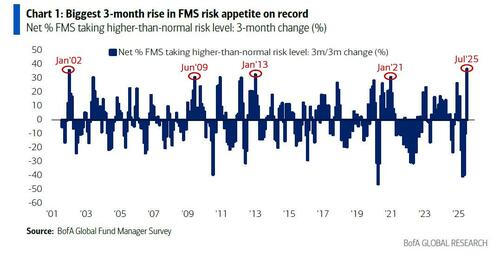
Group 1 - The Chicago Federal Reserve Bank President, Goolsbee, indicated that new tariffs announced by President Trump have disrupted inflation expectations, making it harder for him to support the requested interest rate cuts [1] - Goolsbee noted that the recent tariffs could reignite inflation concerns, potentially leading the Federal Reserve to maintain a wait-and-see approach until clearer information is available [1] - Despite political pressures, Goolsbee expressed confidence in the Federal Reserve's independence in interest rate decisions [1] Group 2 - U.S. stock markets closed lower, with the Dow Jones down 0.63%, Nasdaq down 0.22%, and S&P 500 down 0.33% [3] - Nvidia's stock reached a new all-time high of $167.89, with a market capitalization of $4.07 trillion, before closing at $164.92, a 0.50% increase [3][4] - Nvidia CEO Jensen Huang sold approximately $36.4 million worth of stock as part of a pre-established plan, having already sold shares worth about $15 million earlier this year [3] Group 3 - Bitcoin reached a historical high, rising 4% to $118,865, with a year-to-date increase of 26% and a 41% rise over the past three months [8] - The total market capitalization of the cryptocurrency industry has expanded to approximately $3.7 trillion [8] Group 4 - The S&P 500 index has set five historical highs in the past nine trading days, indicating exceptionally high market sentiment [11] - A warning was issued regarding potential market corrections, as the trading volume of declining stocks has reached its lowest level since 2020, suggesting over-optimism [12] - Concerns were raised about the U.S. facing "stagflation" pressures in the second half of the year, with inflation expected to rebound and the Federal Reserve remaining cautious about interest rate cuts [12]

利空突袭!深夜,大跌!
券商中国· 2025-07-11 15:30
Core Viewpoint - The article discusses the impact of Trump's renewed tariff threats on global markets, highlighting increased investor anxiety and potential economic repercussions in the U.S. and Europe [2][7][8]. Market Reactions - European stock markets experienced significant declines, with the Stoxx 600 and Stoxx 50 indices dropping over 1%, while U.S. stock indices also showed weakness, with the Dow Jones down 0.63% and the S&P 500 down 0.38% [2][5]. - Gold prices rebounded as a safe-haven asset, reaching $3,365.7 per ounce, a 1.2% increase, while silver surged 3.14% to $38.47 per ounce, the highest since September 2011 [10]. Economic Indicators - The UK economy unexpectedly contracted by 0.1% in May, marking the second consecutive month of decline, which negatively affected the GBP/USD exchange rate [3][10]. - Analysts warn of rising inflation in the U.S. due to increased import costs from tariffs, predicting a rebound in core CPI to 3.3% in Q4 [4][16]. Investor Sentiment - There is a growing concern among investors regarding the uncertainty of U.S. tariff policies, leading to a phenomenon described as "tariff fatigue" [9][17]. - Recent data indicates a significant drop in the trading volume of declining stocks, suggesting an overly optimistic market sentiment that may lead to a mild correction [13][15]. Future Outlook - Analysts predict that the upcoming weeks will be critical in assessing the impact of tariffs on economic data, with potential implications for U.S. monetary policy and corporate earnings [16][17].

美股的不祥之兆:指数创新高,卖家却在消失
Hua Er Jie Jian Wen· 2025-07-11 12:20
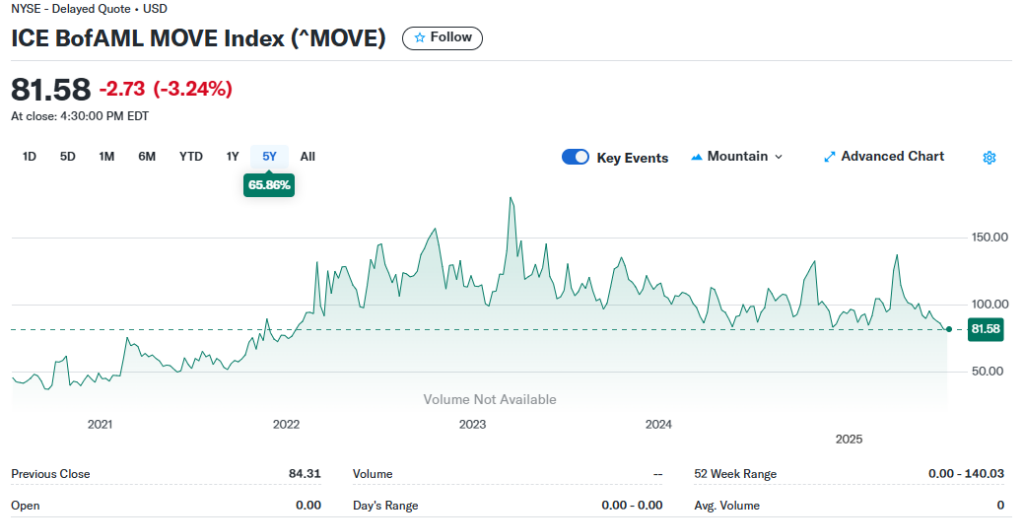
Group 1 - The core point of the article highlights a potential market correction as the number of sellers decreases, with the S&P 500 index reaching new highs while the volume of declining stocks is at its lowest since 2020 [1][5] - The average trading volume of declining stocks has been only 42% of total volume on U.S. exchanges over the past month, indicating a possible over-optimism in the market [1][5] - Historical data shows that similar low levels of declining stock volume have preceded at least 5% declines in the S&P 500 index in 2016, 2019, and 2020 [1][5] Group 2 - The VIX index has dropped to its lowest level since February, suggesting that investors have absorbed known risks such as trade disputes and economic growth concerns [1][8] - The ICE BofA MOVE index, which measures expected volatility in U.S. Treasury bonds, has also reached a near three-and-a-half-year low, indicating market stability [1][8] - Despite the low volatility indicators, there are concerns regarding the sustainability of the current market rally, especially with upcoming earnings reports and budget balance data [4][5] Group 3 - Analysts' confidence in corporate earnings forecasts is waning, despite consensus earnings predictions for the S&P 500 rising to $282 per share [6][7] - The standard deviation of earnings forecasts has increased by 11% since February, indicating greater disagreement among analysts [6][7] - The gap between the highest and lowest earnings forecasts for S&P 500 constituents has widened by 10% since February, reflecting increased uncertainty [7] Group 4 - The current market sentiment is mixed, with some indicators suggesting potential for further gains while others point to risks of a correction [5][6] - Investors are closely monitoring various market signals, including trading volume and earnings forecasts, to assess the sustainability of the recent market rebound [5][6]
廖市无双:冲高回落后,市场如何演化?
2025-05-18 15:48
Summary of Conference Call Records Industry or Company Involved - The discussion primarily revolves around the **A-share market** and the **Hang Seng Technology Index**. Core Points and Arguments 1. **Market Resistance Levels**: The Shanghai Composite Index faces strong resistance around 3,432 points, with expectations of a pullback to the 3,186-3,200 gap area to digest trapped and profit-taking positions for future upward momentum [1][5][20]. 2. **Hang Seng Technology Index Performance**: The index has seen a significant decline since March, dropping approximately 30% from 6,195 to 4,296 points. A rebound is expected, but it will likely face resistance between 5,250 and 5,470 points, indicating a need for further adjustment [3][4][23]. 3. **Market Volatility**: Increased bidirectional volatility suggests that investors should be cautious, focusing on short-term profit-taking and trapped positions while managing risks effectively [6][7]. 4. **Financial Sector Dynamics**: The recent rise in the financial sector is viewed as a short-term correction rather than the start of a new upward trend. Investors are advised to avoid blind chasing of stocks and to adjust their portfolio structures accordingly [1][12][13]. 5. **Fundamental Analysis**: Current market levels exceed those of early April, but the underlying fundamentals are weaker, indicating potential overvaluation. High tariff levels are also putting pressure on the market [1][17][20]. 6. **Market Structure and Future Trends**: The market is expected to undergo an ABC structural adjustment, with both the Shanghai Composite Index and the Hang Seng Technology Index likely to experience downward corrections before any significant upward movement [5][21][22]. 7. **Investment Strategy Recommendations**: Investors are advised not to chase high prices and to maintain a balanced style with a relatively conservative position. It is suggested to reduce exposure to short-term positions acquired in April and to wait for better market conditions to re-enter [25][33]. Other Important but Possibly Overlooked Content 1. **Impact of New Regulations on Public Funds**: The new regulations may lead public funds to favor large-cap and value styles, although the short-term impact will depend on the flexibility of benchmark selection [28][29]. 2. **Calendar Effects on Market Styles**: The calendar effect typically favors large-cap financial stocks in April, but this year has shown a divergence with small-cap growth stocks underperforming [27][32]. 3. **Long-term Market Outlook**: The market is expected to remain in a consolidation phase for an extended period, which could be beneficial for future upward movements. The anticipated recovery may begin around July 2025 [22][26]. This summary encapsulates the key insights and recommendations from the conference call, providing a comprehensive overview of the current market dynamics and future expectations.
黄金能稳住吗?
Hu Xiu· 2025-05-15 11:25
Group 1 - The global market is experiencing a chaotic pullback, with risk assets declining across Asia, including China, South Korea, Japan, and Hong Kong, while gold has also seen a significant drop, falling below $3200 per ounce [3] - The current market situation indicates a lack of consensus among investors, making it difficult to accumulate funds in a single direction for a breakthrough [3] - Despite the pullback, there is still short-term support in the market, particularly as the U.S. stock market, especially tech stocks, has shown significant rebounds, although the U.S. bond market remains under pressure [3] Group 2 - The U.S. needs to continue its efforts to support the market through both messaging and domestic policy, with recent developments in trade agreements with Japan and South Korea [4] - Ongoing trade negotiations between the U.S. and China are progressing, with both sides maintaining close contact following the first phase of talks [4]
A股上演逼空行情!极端上涨之后一般会怎样?该恐惧还是贪婪?
Sou Hu Cai Jing· 2025-05-05 08:06
Group 1 - The article discusses the phenomenon of a "short squeeze" in the A-share market, where short sellers are forced to cover their positions due to rapidly rising stock prices, leading to significant losses for them while long investors benefit [1][2] - A typical example is provided where a firm, such as CITIC Futures, faced losses exceeding 10 billion due to unexpected positive news that caused stock prices to surge, illustrating the pressure on short sellers [2] - The article outlines potential market trends following extreme price increases, including market corrections, sideways trading, and the risk of a peak followed by a decline [4][5] Group 2 - Market corrections are common after significant price increases, allowing investors who missed earlier opportunities to enter the market, as seen in historical bull markets [4] - Sideways trading may occur as investors take time to digest rapid price increases, which can lead to indecision among traders [4] - The most concerning scenario is a peak followed by a decline, where investor confidence wanes, leading to sustained downturns, as exemplified by the 2007 bull market collapse [5] Group 3 - Investors are advised to assess the overall market trend; if the trend is upward, corrections may present buying opportunities, while a weakening trend necessitates caution [7] - Understanding individual risk tolerance is crucial, as different investors react differently to market volatility, impacting their decision-making [9] - Monitoring the fundamentals of individual stocks is essential; strong fundamentals justify price increases, while weak fundamentals may indicate a temporary rise [9] Group 4 - The article suggests maintaining a balanced investment position, avoiding over-investment or panic selling during short-term fluctuations, emphasizing the importance of rational decision-making [10] - It encourages investors to remain calm and avoid emotional reactions to market volatility, highlighting the need for a clear understanding of market dynamics [10] - The overall sentiment suggests that while the market is currently vibrant, caution and preparedness are necessary for navigating potential future fluctuations [10]