
扩内需促消费

Search documents
规格升级、内容丰富,首届中国北方蔬菜粮油糖酒交易大会来了!
Qi Lu Wan Bao· 2025-12-13 02:42
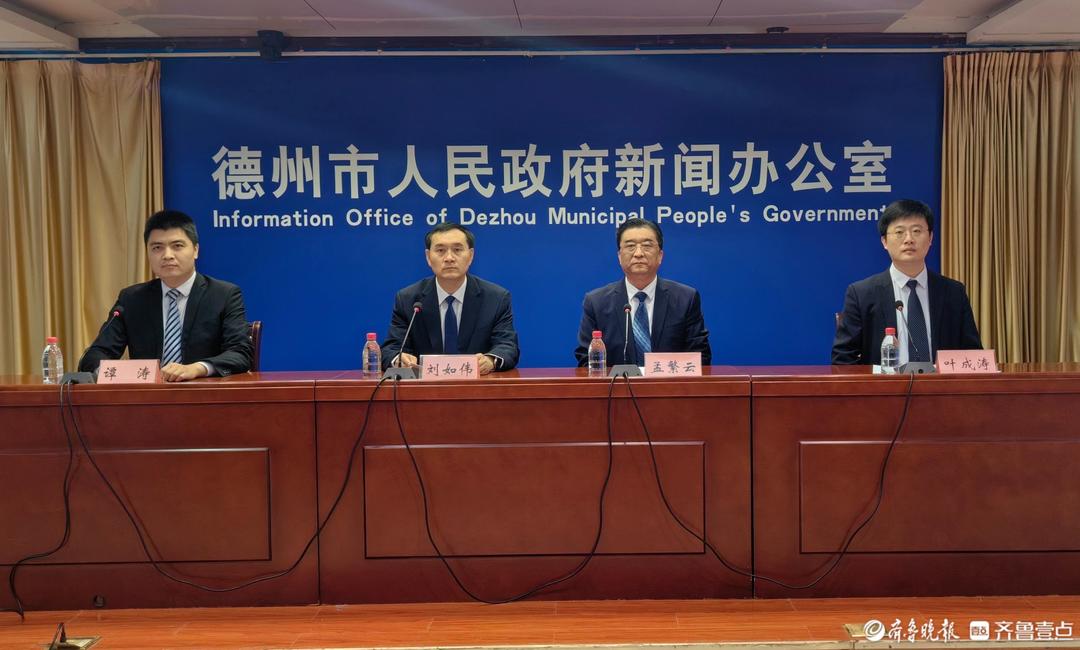
举办本次大会是德州市扎实推进区域消费中心城市建设的又一重要举措,具有重要意义: 本次大会在延续"对接京津冀优质农产品博览会"品牌效应的基础上,实现了两方面的显著提升: 一是规格全面升级。大会首次升格为"中国北方蔬菜粮油糖酒交易大会",由中国蔬菜流通协会主办,立足德州、辐射北方,参展范围扩展至新疆、宁夏、 内蒙古、河北及山东省临沂、聊城等地,平台能级和行业影响力显著增强。 二是内容更加丰富。在传统农产品展示交易基础上,新增全国首届村支书直播带货电商大赛、全国重点供应链企业集中采购对接会、京东中国特产馆选品 大会等配套活动,形成"展会+赛事+对接"多元融合的新模式。 齐鲁晚报.齐鲁壹点李梦晴 2025年12月26日至27日,首届中国北方蔬菜粮油糖酒交易大会将在德州市举办,12月12日,德州市举行新闻发布会,介绍本次大会的有关情况,并回答记 者提问。 为深入贯彻落实党中央、国务院"扩内需、促消费"决策部署,服务乡村振兴战略,扎实推进区域消费中心城市建设,畅通农产品产销对接,深化优质农产 品产销对接与电商融合,更好发挥德州市在北方商贸流通领域的节点作用,经积极筹备,定于2025年12月26日至27日举办"首届中国北方 ...

扩内需政策红利密集释放,多方聚力激活岁末消费潜能
新浪财经· 2025-12-10 12:38
Core Viewpoint - The article emphasizes the importance of enhancing the adaptability of supply and demand in consumer goods to promote consumption and achieve a dynamic balance at a higher level, ultimately laying a solid foundation for high-quality economic development [2]. Group 1: Policy Measures and Economic Impact - The central government has introduced multiple policies to boost consumption, including a 300 billion yuan special long-term bond to support the replacement of old consumer goods, injecting strong momentum into the consumption market [3]. - The "Special Action Plan to Boost Consumption" aims to enhance residents' income and reduce burdens, integrating consumption promotion into various economic and social policies [3]. - By the end of the first half of the year, the old-for-new policy had driven sales of 2.9 trillion yuan, benefiting approximately 400 million people [3]. Group 2: Consumer Trends and Market Dynamics - There is a notable shift in consumer behavior towards personalized, quality, and scenario-based consumption, indicating a transition from quantity to quality in consumer spending [4]. - The final consumption expenditure contributed 53.5% to economic growth in the first three quarters, an increase of 9 percentage points compared to the previous year, reinforcing its role as the main engine of economic growth [4]. Group 3: Seasonal Consumption and Cultural Influences - As the year-end approaches, consumer sentiment is focused on rewarding oneself and expressing hopes for the new year, leading to increased spending on products with positive connotations [6][7]. - Brands are leveraging cultural elements and consumer preferences for auspicious symbols in their product designs, such as themed food and jewelry, to attract buyers [7][8]. Group 4: Financial Sector Initiatives - Credit card companies, such as China Merchants Bank, are actively participating in consumption promotion by launching themed campaigns and additional discounts to align with government initiatives [4][8]. - The "Koi" themed campaign launched by China Merchants Bank aims to enhance the festive shopping experience, offering various rewards to cardholders, thus stimulating consumer spending [8][11].

东海期货11月宏观数据观察:CPI同比超预期回升,PPI降幅有望收窄
Xin Lang Cai Jing· 2025-12-10 09:38
Group 1 - In November, China's CPI increased by 0.7% year-on-year, matching expectations, and up from 0.2% in the previous month [1][19] - The PPI decreased by 2.2% year-on-year, slightly worse than the expected decline of 2.0% and a previous decline of 2.1% [1][19] - The rise in CPI was driven by a significant rebound in food prices, while PPI's decline was influenced by high base comparisons from the previous year and ongoing supply-demand structural optimization in certain industries [20][21] Group 2 - The overall improvement in domestic supply-demand relationships is expected to lead to a gradual narrowing of PPI declines, supported by ongoing capacity governance in key industries [20][21] - International commodity prices have generally risen, while domestic demand remains weak, but some industries are experiencing price increases due to improved supply-demand fundamentals [20][21] - The core CPI maintained a high year-on-year growth rate of 1.2%, with non-food prices rising by 0.8%, indicating effective consumer demand policies [20][21] Group 3 - Food prices shifted from a decline of 2.9% last month to an increase of 0.2%, significantly impacting the CPI [20][21] - Energy prices fell by 3.4% year-on-year, contributing to the overall inflationary pressure [20][21] - The service sector saw price increases, with notable rises in household appliances and clothing prices, reflecting the effectiveness of domestic demand expansion policies [20][21]

吴清主席署名文章解读:如何建设资本市场?
Huafu Securities· 2025-12-05 10:33
Group 1: Capital Market Development - The capital market will support high-quality development and technological innovation through a multi-layered, inclusive, and resilient market structure during the "14th Five-Year Plan" period[3] - A fair and robust regulatory system will help broaden channels for residents' property income, promoting domestic demand and consumption[3] - Enhancing the quality of listed companies is essential for stabilizing the macroeconomic foundation and boosting confidence in economic development[5] Group 2: Economic Impact and Consumer Behavior - The decline in net income growth for residents since 2022 has negatively impacted consumer willingness, influenced by the downturn in the real estate market and capital market volatility[4] - Expanding channels for residents' property income is crucial for effective income growth and stimulating consumption, which is a key direction for the capital market[4] - The "14th Five-Year Plan" emphasizes the need for a more equitable and effective regulatory system to ensure reasonable and stable returns for investors[17] Group 3: Risk Management - The complex external environment and internal pressures from the real estate cycle necessitate effective risk prevention and resolution in the capital market[6] - Emphasis on risk prevention and addressing major risk hazards is critical for maintaining a stable and healthy capital market during the "14th Five-Year Plan" period[22] - Historical financial crises highlight the importance of being prepared for potential risks in a highly market-oriented capital market[22]
中行四川省分行全力服务“十四五”高质量发展
Si Chuan Ri Bao· 2025-11-26 22:22
Core Insights - The China Bank Sichuan Branch has been actively supporting local economic development by aligning financial resources with the needs of the real economy, focusing on innovation to solve business challenges [3][4][5][6][10] Group 1: Support for Emerging Industries - The bank has significantly increased its financial support for emerging industries, achieving an annual loan growth rate of nearly 50% in strategic emerging industries, serving over 4,100 enterprises [5] - The bank has developed a tiered service system, providing tailored financial solutions for both leading enterprises and small emerging businesses, including products like "Expansion Loan" and "Innovation Points Loan" [5][6] Group 2: Agricultural Support and Rural Revitalization - The bank has launched the "Supply and Marketing Technology Planting Loan" to assist farmers in expanding their planting areas without collateral, while also providing insurance to mitigate risks [6][7] - The agricultural loan balance has exceeded 150 billion yuan, with an annual growth rate of over 15%, supporting nearly 3,800 agricultural enterprises [7] Group 3: Support for Cultural and Tourism Consumption - The bank has introduced the "Hui Ru Yuan·Agricultural and Cultural Tourism Loan" to help local tourism businesses upgrade their facilities, with a funding of 10 million yuan [8] - The bank has launched various consumer credit products to stimulate local consumption, including a themed credit card that integrates local cultural elements [9] Group 4: Future Outlook - The bank plans to continue deepening its integration with the real economy and developing products that meet local needs, contributing to high-quality development in Sichuan [10]

A股收评:创业板指涨超2%,医药商业、零售股大涨
Ge Long Hui· 2025-11-26 07:33
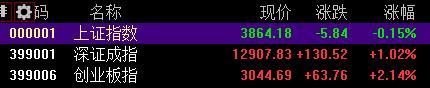
Market Overview - The A-share market showed mixed results with the Shanghai Composite Index down by 0.15% closing at 3864 points, while the Shenzhen Component Index rose by 1.02% and the ChiNext Index increased by 2.14% [1][2] - The total market turnover was 1.8 trillion yuan, a decrease of 29 billion yuan compared to the previous trading day, with nearly 3600 stocks declining [1] Sector Performance - The pharmaceutical retail sector saw significant gains, with stocks like Huaren Health and Ruikang Pharmaceutical hitting the daily limit [2][4] - The CPO concept stocks were active, with Yongding Co. and Zhongji Xuchuang reaching their daily limit, while other related stocks also saw substantial increases [2][6] - Retail stocks surged, with companies such as Dongbai Group and Guoguang Chain hitting the daily limit, and Guofang Group rising over 9% [8] Notable Stocks - In the pharmaceutical sector, stocks like Guangdong Wannianqing and Huaren Health saw increases of 20% and 20% respectively, while Haiwang Biological and Taida Co. also performed well [5][4] - CPO concept stocks like Changguang Huaxin and Saiwei Electronics saw increases of 20% and over 16% respectively [6][7] - Retail stocks such as Dongbai Group and Guoguang Chain experienced gains of 10% [9] Industry Trends - The flu-related stocks have shown a notable increase in interest, with a reported over 500% increase in the number of buyers for antiviral drugs [5] - The Ministry of Industry and Information Technology announced a commercial trial for satellite IoT services, which is expected to enhance market supply and stimulate industry growth [10] Future Outlook - Analysts suggest that the A-share market may see upward momentum in 2026, driven by policy support and high earnings growth in certain sectors [14] - Key investment opportunities are identified in sectors undergoing "new and old kinetic energy" transitions and those focusing on domestic demand and consumption [14]

今日视点:服务消费兴 中国经济旺
Zheng Quan Ri Bao· 2025-11-22 01:28
Core Viewpoint - The development of service consumption is essential for China's economic growth and is increasingly recognized as a necessary component for enhancing domestic demand and consumer spending [1][2]. Group 1: Economic Vitality - Service consumption is a key indicator of economic vitality, characterized by rich consumption levels, high frequency, broad reach, and sustainable growth [2]. - In the first ten months of this year, service retail sales increased by 5.3% year-on-year, outpacing the growth rate of goods retail sales [2]. Group 2: Innovation and Integration - "Business integration" is a core aspect of expanding service consumption, emphasizing the need for services to incorporate digitalization and AI tools while maintaining a personal touch [3]. - The service sector is seen as a "testing ground" for innovative integration due to its diverse forms compared to manufacturing [3]. Group 3: Employment Stability - The service sector plays a crucial role in job creation, with per capita service consumption expenditure rising to 46.8% of total per capita consumption expenditure in the first three quarters of this year [4]. - Sustained growth in service consumption contributes to employment stability, which in turn enhances consumer willingness to spend [4].
服务消费兴 中国经济旺
Zheng Quan Ri Bao· 2025-11-21 16:13
Core Viewpoint - The development of service consumption is essential for China's economic growth and is increasingly recognized as a necessary component for enhancing domestic demand and consumer spending [1][2]. Group 1: Economic Vitality - Service consumption is a key indicator of economic vitality, characterized by rich consumption levels, high frequency, broad reach, and sustainable growth [2]. - In the first ten months of this year, service retail sales increased by 5.3% year-on-year, outpacing the growth rate of goods retail sales [2]. - The thriving service consumption sector is expected to play a crucial role in driving high-quality economic development and expanding domestic demand [2]. Group 2: Innovation and Integration - "Business integration" is a core aspect of expanding service consumption, emphasizing the need for new service products and models that incorporate digitalization and AI tools [3]. - The current technological revolution and the trend of industrial transformation are driving the need for innovative service consumption that meets the personalized demands of new consumer groups [3]. - The service sector is viewed as a "testing ground" for social capital and private investment due to its diverse forms of innovation and integration compared to manufacturing [3]. Group 3: Employment Stability - The service sector is a significant area for job creation, with the proportion of per capita service consumption expenditure rising to 46.8% of total per capita consumption expenditure in the first three quarters of this year [4]. - The growth of service consumption contributes to employment stability, which in turn enhances residents' income and boosts their willingness to consume [4]. - Expanding service consumption requires ongoing efforts to broaden employment channels, increase employment flexibility, and improve worker income, thereby providing sustained momentum for domestic demand and consumption [4].
10月CPI同比转正 “反内卷”行业价格积极改善
Di Yi Cai Jing· 2025-11-09 04:05
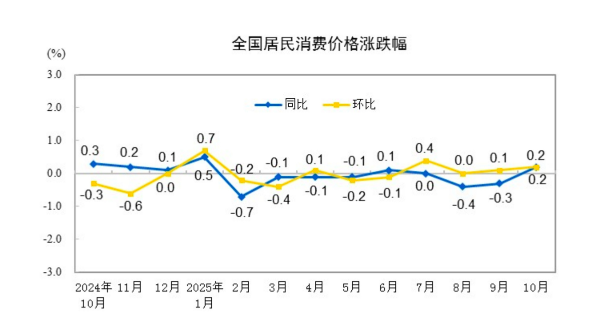
Core Insights - The inflation data for October released by the National Bureau of Statistics indicates positive signals for the economy, with the Consumer Price Index (CPI) rising 0.2% month-on-month and year-on-year, while the core CPI excluding food and energy prices increased by 1.2%, marking the sixth consecutive month of growth [1][4] CPI Analysis - The CPI turned from a decline of 0.3% in the previous month to an increase of 0.2% in October, with food prices decreasing by 2.9%, but the decline narrowed by 1.5 percentage points compared to the previous month [3] - The core CPI's continuous rise suggests a robust recovery in domestic consumption demand, particularly in service consumption, indicating a strengthening of the overall price foundation [4] PPI Analysis - The Producer Price Index (PPI) saw a month-on-month increase of 0.1%, marking its first rise of the year, while the year-on-year decline was 2.1%, with the decline narrowing by 0.2 percentage points for the third consecutive month [1][6] - Key industries are experiencing a reduction in price declines due to ongoing capacity governance and the release of consumption potential, with specific sectors like coal mining and manufacturing showing improved price stability [6] Future Outlook - Looking ahead, the CPI is expected to steadily rise, and PPI deflation pressures are likely to ease, supported by macro policies, restored market confidence, and expanded domestic demand [7]
10月CPI同比转正,“反内卷”行业价格积极改善
Di Yi Cai Jing· 2025-11-09 03:59
Group 1 - The CPI in October turned from a decrease of 0.3% in the previous month to an increase of 0.2%, indicating a positive shift in consumer prices [4] - Food prices decreased by 2.9%, but the decline narrowed by 1.5 percentage points compared to the previous month, impacting the CPI by approximately 0.54 percentage points [4] - The core CPI, excluding food and energy, rose by 1.2%, marking the highest increase since March 2024 and indicating a steady recovery in domestic consumption demand, particularly in service consumption [5] Group 2 - The PPI decreased by 2.1% year-on-year, but the decline narrowed by 0.2 percentage points for the third consecutive month, reflecting improvements in supply-demand relationships in key industries [7] - Prices in the photovoltaic equipment, battery manufacturing, and automotive manufacturing sectors saw a reduction in their decline by 1.4, 1.3, and 0.7 percentage points respectively, indicating a stabilization in these industries [7] - The manufacturing sector is experiencing a positive trend with price increases in various categories, such as 18.4% in arts and crafts, 3.3% in sports balls, and 2.1% in nutritional food manufacturing, driven by effective consumption-boosting policies [7] Group 3 - The overall economic vitality is steadily increasing, with domestic demand potential being released, as indicated by the positive inflation data [2] - The improvement in price data is comprehensive and solid, surpassing seasonal levels, reflecting a smoother economic internal circulation and enhanced growth quality [5] - Future inflation trends are expected to show a gradual recovery in CPI and alleviation of PPI deflationary pressures, contributing to a moderate upward shift in overall price levels [8]