
政策驱动

Search documents
牛市号角吹响,港股券商板块还能涨?
智通财经网· 2025-07-15 10:54
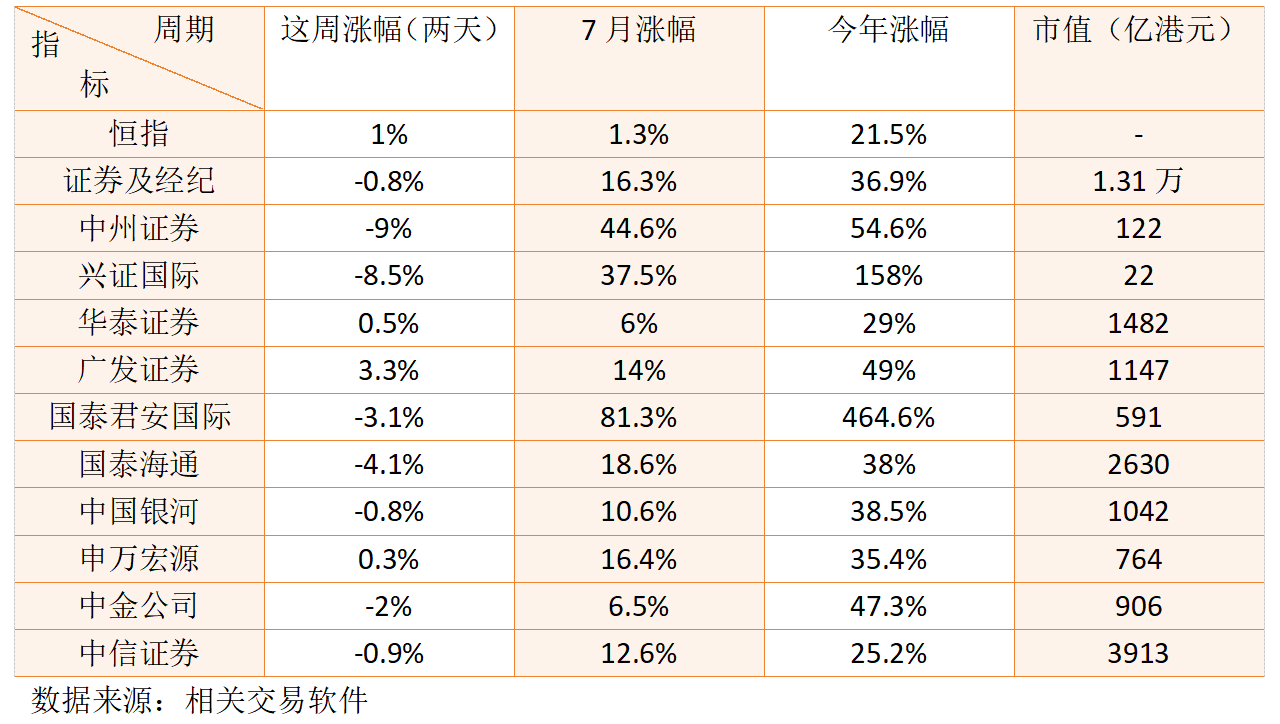
那么,港股这波阶段性牛市逻辑是什么,还能再涨吗? 板块个股雨露均沾,今年盘子较大的权重股涨幅较少,但平均也有30%以上,比如国泰海通及广发证券,涨幅分别为38%及49%,市值排第一的中信证券涨 幅也超过25%。这波阶段性牛市,给港股市场带来了更多的投资吸引力。 | 周期 指 | 这周涨幅(两天) | 7月涨幅 | 今年涨幅 | 市值 | | --- | --- | --- | --- | --- | | 标 | | | | | | 恒指 | 1% | 1.3% | 21.5% | | | 证券及经纪 | -0.8% | 16.3% | 36.9% | | | 中州证券 | -9% | 44.6% | 54.6% | | | 兴证国际 | -8.5% | 37.5% | 158% | | | 华泰证券 | 0.5% | 6% | 29% | | | 广发证券 | 3.3% | 14% | 49% | | | 国泰君安国际 | -3.1% | 81.3% | 464.6% | | | 国泰海通 | -4.1% | 18.6% | 38% | | | 中国银河 | -0.8% | 10.6% | 38.5% | | ...

中信期货晨报:国内商品期货涨跌互现,玻璃和工业硅大幅上涨-20250703
Zhong Xin Qi Huo· 2025-07-03 06:29
1. Report Industry Investment Rating No relevant content provided. 2. Core Viewpoints of the Report - Overseas macro: US consumer sentiment has improved, and the economic fundamentals are showing signs of recovery. However, there are still structural concerns, and inflation expectations are stabilizing. The market's expectation of a Fed rate cut has increased this week [7]. - Domestic macro: China's manufacturing PMI has risen for two consecutive months, with production and demand both picking up. However, the upward drive still depends on the acceleration of existing policies and the implementation of new policies. The real estate market is in a slow season, and infrastructure construction has seen a seasonal decline in physical work volume [7]. - Asset views: China's economy remains stable, and domestic assets present mainly structural opportunities. Policy - driven logic will be strengthened in the second half of the year. Overseas geopolitical risks may increase short - term market volatility, while in the long term, the weak - dollar pattern will continue [7]. 3. Summary by Related Catalogs 3.1 Macro Essentials - **Overseas**: The ISM manufacturing PMI in the US in June slightly rebounded to 49.0. In May, job openings rose to 7.769 million, and the job - opening rate was 4.6%. Core durable goods orders surged in May. In June, consumer confidence, current situation, and expectations all declined. This week, long - term inflation expectations were stable, short - term inflation expectations rose, and the market's expectation of a Fed rate cut increased [7]. - **Domestic**: In June, the manufacturing PMI was 49.7%, up 0.2 percentage points from the previous month, and the non - manufacturing business activity index was 50.5%, up 0.2 percentage points. The real estate market is in a slow season, and infrastructure physical work volume has decreased seasonally. Local special bond issuance showed a strong performance at the end of the month, and the remaining trade - in funds will be issued in July [7]. 3.2 Viewpoints Highlights 3.2.1 Financial Markets - **Stock Index Futures**: Policy starts to focus on manufacturing profits, with a short - term judgment of oscillatory rise [9]. - **Stock Index Options**: Adopt a covered - call defense strategy, with a short - term judgment of oscillation [9]. - **Treasury Bond Futures**: Bond market sentiment has stabilized, with a short - term judgment of oscillation [9]. - **Precious Metals**: Gold and silver continue to adjust, with a short - term judgment of oscillation [9]. - **Shipping**: Focus on the game between peak - season expectations and price - increase implementation for the European container shipping line, with a short - term judgment of oscillation [9]. 3.2.2 Black Building Materials - **Steel Products**: Affected by production - limit news, the market is strong, with a short - term judgment of oscillation [9]. - **Iron Ore**: Affected by emission - reduction news in Tangshan, the market declined slightly, with a short - term judgment of oscillation [9]. - **Coke**: Rumors have caused the market to oscillate weakly, with a short - term judgment of oscillation [9]. - **Coking Coal**: Affected by supply - demand rumors, the market is weak, with a short - term judgment of oscillation [9]. - **Ferrosilicon**: Due to the decline in coal valuation, the futures price is weak, with a short - term judgment of oscillation [9]. - **Silicomanganese**: With the increase in cost valuation, the market rebounds after reaching the bottom, with a short - term judgment of oscillation [9]. - **Glass**: Prices in Shahe and Hubei continue to decline, and the market oscillates weakly, with a short - term judgment of oscillation [9]. - **Soda Ash**: Maintenance disruptions still exist, and daily production begins to decline, with a short - term judgment of oscillation [9]. 3.2.3 Non - ferrous Metals and New Materials - **Copper**: With a weak US dollar index, copper prices remain high, with a short - term judgment of oscillation [9]. - **Alumina**: With a low number of warehouse receipts, the alumina market rises, with a short - term judgment of oscillation [9]. - **Aluminum and Zinc**: Aluminum prices rise due to low inventory and high premiums; zinc has an oversupply situation, with a short - term judgment of oscillation for aluminum and oscillatory decline for zinc [9]. - **Lead**: Cost support has strengthened again, and the downside space for lead prices is limited, with a short - term judgment of oscillation [9]. - **Nickel**: Supply and demand are under pressure, and nickel prices are weak in the short term, with a short - term judgment of oscillatory decline [9]. - **Stainless Steel**: Nickel - iron prices continue to decline, and the market is weak, with a short - term judgment of oscillation [9]. - **Tin**: Spot trading is dull, and tin prices oscillate, with a short - term judgment of oscillation [9]. - **Industrial Silicon**: Supply continues to increase, and silicon prices are under pressure to oscillate, with a short - term judgment of oscillation [9]. - **Lithium Carbonate**: Warehouse receipts have significantly decreased, and there is a risk of price fluctuations, with a short - term judgment of oscillation [9]. 3.2.4 Energy and Chemicals - **Crude Oil**: The rebound is limited, and attention should be paid to geopolitical disturbances, with a short - term judgment of oscillatory decline [11]. - **LPG**: The fundamentals are loose, but the market is still worried about geopolitical risks, and the PG market may oscillate, with a short - term judgment of oscillation [11]. - **Asphalt**: Asphalt futures prices oscillate, waiting for negative factors to ferment, with a short - term judgment of oscillatory decline [11]. - **High - sulfur Fuel Oil**: Negative factors for high - sulfur fuel oil are yet to ferment, with a short - term judgment of oscillatory decline [11]. - **Low - sulfur Fuel Oil**: Low - sulfur fuel oil futures prices decline following crude oil, with a short - term judgment of oscillatory decline [11]. - **Methanol**: The port market has weakened significantly, and methanol oscillates, with a short - term judgment of oscillation [11]. - **Urea**: The domestic supply - strong and demand - weak situation is difficult to change, and urea may oscillate weakly in the short term, with a short - term judgment of oscillation [11]. - **Ethylene Glycol**: Inventory has dropped to the lowest in five years, and the futures price should not be overly shorted, with a short - term judgment of oscillatory rise [11]. - **PX**: Supply is tight, and attention should be paid to geopolitical developments, with a short - term judgment of oscillation [11]. - **PTA**: Supply - demand has weakened marginally, but the current situation is okay and the cost is strong, with a short - term judgment of oscillation [11]. - **Short - fiber**: It fluctuates with raw materials, and the basis remains stable, with a short - term judgment of oscillatory rise [11]. - **Bottle Chips**: Processing fees fluctuate at a low level, and the absolute value follows raw materials, with a short - term judgment of oscillation [11]. - **PP**: Maintenance support is limited, and PP oscillates, with a short - term judgment of oscillation [11]. - **Plastic**: The improvement from maintenance is limited, and plastic oscillates, with a short - term judgment of oscillation [11]. - **Styrene**: Geopolitical risks have cooled down temporarily, and styrene prices decline, with a short - term judgment of oscillatory decline [11]. - **PVC**: With low valuation and weak supply - demand, PVC oscillates, with a short - term judgment of oscillation [11]. - **Caustic Soda**: Liquid chlorine is under pressure, and caustic soda rebounds weakly, with a short - term judgment of oscillation [11]. 3.2.5 Agriculture - **Oils and Fats**: The US biodiesel policy boosts demand expectations, and oils and fats may continue to oscillate strongly, with a short - term judgment of oscillatory rise [11]. - **Protein Meal**: It oscillates within a range, and long positions should be held, with a short - term judgment of oscillatory rise [11]. - **Corn/Starch**: After the import auction is confirmed, the market has corrected in advance, with a short - term judgment of oscillation [11]. - **Pigs**: Farmers are reluctant to sell, and attention should be paid to the impact of subsequent rainfall, with a short - term judgment of oscillation [11]. - **Rubber**: The strong performance of commodities has driven rubber prices up, with a short - term judgment of oscillation [11]. - **Synthetic Rubber**: The market oscillates within a narrow range, with a short - term judgment of oscillation [11]. - **Pulp**: Driven by the warm trading atmosphere in the financial market, pulp oscillates, with a short - term judgment of oscillatory decline [11]. - **Cotton**: The increase in the US cotton planting area has slowed down the rise of Zhengzhou cotton prices, with a short - term judgment of oscillation [11]. - **Sugar**: There is a lack of positive factors, and sugar prices have limited upward momentum, with a short - term judgment of oscillation [11]. - **Timber**: The market is dominated by fundamentals again, and the far - month contracts oscillate weakly, with a short - term judgment of oscillation [11].
多家充电宝品牌召回背后:消费电子行业电芯之殇
3 6 Ke· 2025-06-23 07:32
Group 1 - The core issue in the mobile power bank industry is the conflict between the pursuit of extremely low prices and the high cost requirements for lithium battery safety [6][8] - The recent safety incident involving Romoss and Anker Innovation highlights the hidden safety risks in the industry, particularly related to the use of common battery cells [1][4] - Anker Innovation has terminated its partnership with Amperex Technology Limited (ATL) and switched to other battery suppliers in response to the safety concerns [4][9] Group 2 - The mobile power bank market size has surpassed 120 billion RMB in 2024, with China accounting for 38.7% of the global market [6] - The low technical barriers and general market concentration have led to intense price competition, particularly in the segment of power banks priced below 200 RMB [6][8] - The recent recall of over 490,000 power banks due to safety issues has raised significant concerns about the quality control and regulatory compliance within the industry [1][3] Group 3 - The incident has prompted the Ministry of Industry and Information Technology to solicit opinions on the mandatory national standard for mobile power bank safety, which is seen as a crucial step to address safety issues [8][9] - The industry is expected to shift from a "price war" to a "quality war" as new regulations are implemented, focusing on production technology, quality monitoring, and product testing [9] - The collaboration between Anker and ATL, a major supplier for Apple, aims to enhance battery quality standards significantly [9]

2025年5月经济数据点评:政策驱动特征明显
CMS· 2025-06-16 15:12
Economic Performance - In May, the industrial added value of large-scale enterprises increased by 5.8% year-on-year, with a month-on-month growth of 0.61%[4] - Fixed asset investment from January to May grew by 3.7% year-on-year, marking the lowest level this year[4] - Retail sales in May reached 4.13 trillion yuan, with a year-on-year growth of 6.4%, exceeding market expectations of 4.85%[5] Industrial Sector Insights - The equipment manufacturing sector saw a 9.0% year-on-year increase in added value, contributing 54.3% to overall industrial growth[4] - High-tech manufacturing growth slowed to 8.6%, down by 1.4 percentage points from April, primarily due to high base effects and reduced policy stimulus[4] - The export delivery value of large-scale industrial enterprises increased by only 0.6% year-on-year, indicating weakened external demand[4] Investment Trends - Equipment and tool investment surged by 17.3% year-on-year, contributing 63.6% to overall investment growth, driven by policies like "old-for-new" and equipment upgrades[4] - Real estate investment in May fell by 10.7%, with residential investment declining by 10.0%, reflecting ongoing pressures in the property sector[5] - Infrastructure investment recorded a growth rate of 10.42%, supported by special bonds and long-term treasury bonds, despite a slight decline from April[5] Consumer Behavior - Essential consumer goods such as grain and oil saw a growth rate of 14.6%, indicating resilience in basic consumption[5] - The "old-for-new" policy significantly boosted retail sales in categories like home appliances and furniture, with growth rates of 53.0% and 25.6% respectively[5] - Automotive retail sales grew by only 1.1%, significantly lower than the overall retail growth, primarily due to the decline in subsidies for new energy vehicles[5] Future Outlook - Industrial growth may slow marginally in June, with high-frequency data indicating a shift towards the off-season for several upstream industries[5] - Manufacturing investment is expected to remain high, driven by policy support for equipment updates and green transformation, but may face constraints from low export demand[5] - Retail sales growth may slightly decline, with ongoing policy support being a key factor in sustaining consumer demand[5]
多地国补“暂停”来袭,电视机市场何去何从?
Xi Niu Cai Jing· 2025-06-12 14:05
Group 1 - The "National Subsidy" policy implemented in 2024 initially boosted the television market, but recent suspensions of the subsidy in multiple regions have created uncertainty for future market trends [2][3] - In May 2025, the brand shipment volume of the Chinese television market was 2.83 million units, a year-on-year decrease of 2.1%, marking two consecutive months of decline since April [2] - Despite the decline in May, the cumulative shipment volume from January to May reached 14.035 million units, showing a slight year-on-year increase of 1.7% [2] Group 2 - The suspension of the subsidy is primarily due to the rapid consumption of funds, with over 150 billion yuan already used by the end of May, accounting for more than half of the annual 300 billion yuan fund pool [2][3] - Regions like Chongqing and Jiangsu have exhausted their subsidy quotas, while Guangdong has suspended the issuance of smart appliance subsidies [3] - The adjustment of the subsidy policy aims to optimize the efficiency of fiscal fund usage and prevent price disruptions during major sales events [3] Group 3 - The adjustment of the subsidy policy is expected to push the television industry back to a market-driven logic, with a forecasted shipment volume of 9.8 million units in 2025, representing a year-on-year growth of 6.3% [3][4] - The contribution of policy stimulus to market growth is projected to decrease from 40% in 2024 to 25% in 2025, with technological innovation and consumer upgrades becoming the main driving forces [3] - The suspension of subsidies highlights the industry's reliance on financial support and compels companies to focus on technological competition [4]

6月开门红,A股迎来新一轮“结构牛”行情!
Sou Hu Cai Jing· 2025-06-03 14:47
Core Viewpoint - The A-share market experienced a rebound on June 3, with broad-based gains across indices, indicating a positive market response to domestic demand and policy support despite external trade tensions [2][7]. Market Dynamics - The market is characterized by "domestic demand-driven and policy-supported" dynamics, with financials, pharmaceuticals, and new consumption sectors attracting significant capital [2][10]. - Recent developments in U.S. tariff issues have heightened market risk aversion, leading to a surge in gold prices and declines in Hong Kong stocks, but the A-share market showed resilience by recovering losses [2][3]. Sector Performance - The consumer sector, particularly in beauty care, maternal and infant care, and pet products, has become a safe haven for funds due to policy support and consumption recovery [3][9]. - The banking sector is favored for its "high dividend and low volatility" characteristics, with several banks reaching historical highs amid increased institutional investment [7][10]. - The precious metals sector is gaining traction as a hedge against geopolitical conflicts and U.S. debt risks, becoming a core tool for mitigating uncertainty [3][9]. Structural Trends - The innovation drug sector is witnessing a fundamental reversal, driven by significant advancements showcased at international conferences, boosting industry confidence [4][9]. - Conversely, sectors like home appliances and steel are experiencing declines due to tariff impacts and reduced earnings certainty, reflecting a market strategy of "avoiding external demand and protecting internal demand" [5][10]. Outlook - Looking ahead to June, the marginal impact of tariff issues is expected to weaken, with domestic policies and industry fundamentals remaining focal points [6]. - In the absence of major catalysts, broad indices are likely to maintain a sideways trend, with structural opportunities emerging in new consumption, defensive sectors, and performance reversals in pharmaceuticals and beauty care [6][9].

【财经分析】A股上市公司为何密集赴港“二次上市”?
Xin Hua Cai Jing· 2025-05-26 14:05
Group 1 - The core viewpoint of the articles highlights the increasing trend of A-share companies planning to list in Hong Kong, driven by internationalization strategies, policy support, and improved liquidity in the Hong Kong market [1][2][6] - Weir Shares announced its plan to issue H-shares and apply for listing on the Hong Kong Stock Exchange to enhance its international financing capabilities and competitiveness [2][3] - Over 20 A-share companies have submitted applications to the Hong Kong Stock Exchange this year, including notable firms like Sany Heavy Industry and Haidilao, indicating a significant uptick in interest for dual listings [2][4] Group 2 - The China Securities Regulatory Commission (CSRC) has accelerated the review process for overseas listings, reducing the average approval time from over 100 days to less than 60 days [2][4] - The trend of A-share companies seeking dual listings is supported by favorable policies, such as the CSRC's measures to facilitate qualified domestic companies in raising funds in Hong Kong [4][5] - The Hong Kong market's liquidity has improved, attracting international capital and enhancing the pricing power of quality assets, which is beneficial for A-share companies looking to expand [6][7] Group 3 - The dual listing trend is expected to continue, with projections indicating that more large A-share companies and leading firms listed in the U.S. will seek to list in Hong Kong, potentially making it a focal point for new stock offerings [7][8] - Approximately 60% of the companies planning to list in Hong Kong are from the manufacturing sector, which will enhance the representation of quality manufacturing firms in the Hong Kong market [7] - The ongoing trend of A-share companies listing in Hong Kong is seen as a way to participate in global competition and improve the international presence of Chinese firms [8]

指数继续分化,耐心等待机会
格隆汇APP· 2025-04-22 09:08
今日, A 股市场延续近期震荡格局,三大指数涨跌不一,两市成交额 维持 万亿元 以上 。 一、指数表现: 各大指数继续分化 在黄金与贵金属板块,由于国际金价突破 3500 美元 / 盎司创历史新高, 四川黄金、西部黄 金 等相关个股上涨,反映出市场避险需求显著。 然而,市场并非普涨格局。算力与 AI 应用板块表现弱势,英维克 因业绩 跌停, AI 软件类板 块回调,反映资金从高估值科技股撤离。 消费电子板块受美股科技股拖累,立讯精密跌 3% ,板块整体承压。这些板块的下跌,一方面 是由于前期涨幅较大,存在回调需求;另一方面,也与市场对科技行业的盈利预期和宏观环境 变化有关。 三 、调整动因:获利回吐与内外压力并存 今日市场下跌的原因主要有以下几点: 一是科技成长 板块前期 积累了较大涨幅, 获利盘回吐压力较大,如算力与 AI 应用等板块, 在缺乏新的重大利好刺激下,资金选择落袋为安。 二是宏观经济数据及政策预期的不确定性, 尽管部分政策对部分板块有明显刺激,但整体市场 对于经济复苏的节奏和力度仍存在担忧,这使得投资者在配置上更为谨慎。 今日, A 股市场 继续 呈现出指数分化。截至收盘,沪指低开高走,最终收涨 ...