滞胀风险

Search documents
多重事件催化白银走强 现货市场再现逼空态势
Di Yi Cai Jing· 2025-10-17 10:16
Key Event Analysis - The U.S. is considering increasing tariffs on Chinese imports due to China's planned export controls on rare earths, prompting a strong response from China's Ministry of Commerce and Foreign Affairs [1] - The demand for precious metals has surged as a result of trade uncertainties, with gold prices rising above $4,300 per ounce [1] Federal Reserve's Stance - Federal Reserve Chairman Jerome Powell indicated that the labor market is under pressure, and there is an openness to a potential interest rate cut in October [2] - The probability of a 25 basis point rate cut in October is at 97.3%, with a high likelihood of further cuts by December [3] Geopolitical Developments - A ceasefire agreement in Gaza has been reached, although challenges remain regarding the implementation and future governance of the region [4] Silver Market Dynamics - Silver prices have entered a rapid upward trend due to increased investment demand and supply constraints, with current prices at $54.218 per ounce [5] - India's silver imports have surged, driven by seasonal demand, further tightening global supply [5] Liquidity Concerns - London silver inventories have decreased significantly, leading to liquidity issues in the market, with borrowing costs for silver exceeding 100% [6] - The tight liquidity situation is expected to persist, supporting a strong price trend for silver [6] Market Impact Analysis - Long-term trends indicate a shift in global investment away from the U.S. dollar and bonds towards gold, driven by declining confidence in these assets [7] - The expectation of a Fed rate cut is likely to lower the cost of holding gold, providing further support for precious metal prices [7] Short-term Outlook - The ongoing U.S. government shutdown and potential trade conflicts with China are heightening risk aversion in the market [8] Future Price Projections - Major international banks have raised their price forecasts for precious metals, with gold expected to reach $5,000 per ounce by 2026 [9] - Despite anticipated declines in silver demand, structural supply shortages are expected to support silver prices in the long term [9]
现货黄金突破4000美元!政府停摆、美联储降息预期持续升温等因素叠加催化,上海金ETF(518600)强势涨超4%
Sou Hu Cai Jing· 2025-10-09 03:12
Group 1 - During the National Day and Mid-Autumn Festival holiday (October 1 to October 8), international gold prices surged significantly, with COMEX gold prices reaching a historic high of $4,081 per ounce on October 8 [1] - The Shanghai Gold ETF (518600) saw a 4.43% increase as of October 9, 2025, marking its third consecutive rise, and has accumulated a 40.79% increase year-to-date [1] - Leveraged funds are actively investing, with the latest financing buy-in amount for the Shanghai Gold ETF reaching 18.32 million yuan and a total of 1.04 billion yuan attracted over the last four trading days [1] Group 2 - Goldman Sachs has raised its gold price forecast for December 2026 to $4,900 per ounce, up from a previous estimate of $4,300 [2] - The ongoing U.S. government shutdown, which began on October 1, is expected to delay the release of key economic data, including non-farm payrolls and CPI, increasing market uncertainty [2] - The combination of the government shutdown and weak employment data has strengthened expectations for the Federal Reserve to initiate a series of interest rate cuts, contributing to a bullish outlook for gold and silver [2]
深夜!美元跳水!美联储,降息大消息!
证券时报· 2025-10-01 14:08
Core Viewpoint - The unexpected decline in the U.S. ADP employment data for September has intensified market expectations for a Federal Reserve interest rate cut in October [1][6][7]. Employment Data Summary - The ADP employment report revealed a decrease of 32,000 jobs in September, significantly below the market expectation of an increase of 50,000 jobs, and a prior increase of 54,000 jobs [6][7]. - The annual benchmark revision by the Bureau of Labor Statistics indicated that the U.S. added 911,000 fewer non-farm jobs than previously estimated over the past year, suggesting a more fragile labor market than previously thought [6][7]. Federal Reserve and Monetary Policy - The decline in employment data has led to a heightened probability of a 25 basis point rate cut by the Federal Reserve in October, now estimated at 99% [7][8]. - Current economic conditions show a combination of a slowing labor market and rising inflation, presenting a challenge for the Federal Reserve in balancing economic downturn risks and inflation pressures [7][8]. Government Shutdown Impact - The U.S. government is facing a shutdown, which could halt the release of key economic data, complicating the Federal Reserve's decision-making process regarding interest rates [7][9]. - The shutdown has led to concerns about the economic impact, although it is believed to have a limited effect on GDP growth [11]. Market Reactions - Following the ADP report, the U.S. dollar index fell sharply, and gold prices surged, reflecting market anxiety over the employment data and government shutdown [1][10]. - The major U.S. stock indices opened lower, with the Dow Jones Industrial Average, Nasdaq, and S&P 500 all experiencing declines [3][4].


DLS MARKETS:多数经济学家偏向沃勒,却认为哈塞特将接替鲍威尔
Sou Hu Cai Jing· 2025-09-29 05:48
Group 1 - The overwhelming preference among academic economists for Waller as the next Federal Reserve Chair, with 82% of respondents selecting him, significantly surpassing other candidates [3] - Despite being a popular choice, only 20% of scholars believe he can succeed Powell in 2026, while 39% favor Hassett, indicating a split in expectations [3] - Waller's stance aligns with the academic expectation of a "prudent central bank manager," as he has opposed extreme monetary policy proposals [3] Group 2 - The real challenge for the next Federal Reserve Chair will be in policy execution, as the U.S. economy faces a weak labor market and inflation driven by tariffs [4] - Most Federal Reserve officials believe Trump's tariff policies will only cause temporary price increases for a few goods, potentially slowing job growth [4] - Academic economists express concerns about rising stagflation risks, predicting simultaneous deterioration in unemployment and inflation [4]
布米普特拉北京投资基金管理有限公司:美联储陷两难 通胀升温与就业疲软并存
Sou Hu Cai Jing· 2025-09-28 12:44
Group 1 - Recent data indicates a sharp increase in inflation risks in the U.S., raising widespread market concerns following the Federal Reserve's recent 25 basis point rate cut [1][5] - Approximately 72% of components in the U.S. Consumer Price Index have exceeded the Federal Reserve's 2% target, marking the highest level in three years, compared to 55% last year, suggesting a clear trend of accelerating inflation [3] - The broadness of current inflation has surpassed the pre-pandemic average of 57% in 2018 and 2019, indicating a significant rise in inflationary pressures [3] Group 2 - Signs of weakness in the U.S. labor market present a challenging decision for the Federal Reserve, balancing the need to address slowing economic growth while monitoring rising inflation data [5] - Economists warn of potential stagflation risks, where economic growth stagnates alongside high inflation [5][7] - The Federal Reserve has lowered the interest rate target range to 4.00% to 4.25%, with expectations of further rate cuts in October and December if labor market conditions worsen [5] Group 3 - Economic experts express concerns over the current situation, highlighting the need for vigilance as unemployment rises while inflation remains high [7] - Some officials indicate that the impact of tariff policies on the economy has yet to fully materialize, suggesting potential broader market risks [7] - The market is closely monitoring the Federal Reserve's next policy moves, with a focus on balancing economic growth support and inflation control as a primary challenge [8]

美联储Goolsbee:如果滞胀风险消退,利率可能进一步下降
Sou Hu Cai Jing· 2025-09-25 12:48
Core Viewpoint - The Chicago Fed President Goolsbee expresses concern over the excessive number of rate cuts in the past and describes the current employment and inflation risk environment as "strange" [1] Group 1 - Goolsbee indicates that if the risk of stagflation diminishes, interest rates may decrease further [1]
邢自强:美国经济面临滞胀风险,美元资产经历“祛魅”过程
Feng Huang Wang Cai Jing· 2025-09-25 03:48
Group 1 - The "Phoenix Bay Area Financial Forum 2025" was held in Guangzhou, focusing on the theme "New Pattern, New Path" and gathering global elites from politics, business, and academia to explore development opportunities amidst changing circumstances [1] Group 2 - Morgan Stanley's Chief Economist for China, Xing Zhiqiang, highlighted that the Federal Reserve's initiation of a rate-cutting cycle is a focal point for global financial markets, predicting a cumulative rate cut of nearly 125 basis points from the current level above 4% to around 3% by mid-next year [3] - Xing noted that U.S. immigration and tariff policies are exerting continuous pressure on inflation, with an expected U.S. inflation rate (CPI) maintaining around 3% [3] - A significant change is anticipated as U.S. real interest rates decline, potentially reducing the demand for the dollar and U.S. Treasury bonds, leading to increased volatility in the U.S. Treasury market [3] Group 3 - Future Federal Reserve chairs may face increased political pressure, complicating the process of raising interest rates to curb inflation, which could be detrimental to the dollar [4] - The long-held beliefs in "American exceptionalism" and "the dollar's dominance" are undergoing a reassessment, with markets likely to reevaluate the U.S.'s long-term fiscal discipline and monetary credibility [4]

黄金存量平衡下的风险与避险
2025-09-23 02:34
Summary of Key Points from Conference Call Industry Overview - The conference call discusses the gold market and its dynamics, particularly in relation to macroeconomic factors and central bank behaviors. The focus is on how these elements influence gold prices and investment strategies. Core Insights and Arguments 1. **Commodity Market Dynamics**: Agricultural and pig prices have declined due to oversupply, reflecting fundamental signals in the global commodity market, aligning with liquidity expectation trading judgments [1] 2. **Gold Price Sensitivity**: Gold prices are influenced by supply, inventory, consumption, and investment demand. A 25 basis point interest rate change can affect gold prices by approximately $40 to $50 per ounce [4][1] 3. **Investment Demand**: Investment demand is a crucial factor in determining the central price of gold, with private sector investments through ETFs significantly influenced by risk appetite. As of the end of 2024, the European and American markets accounted for over 90% of global ETF holdings, while China's share was 4% [6][7] 4. **Central Bank Purchases**: Central bank gold purchases have a significant impact on gold prices, with historical data showing a shift from net selling to net buying leading to high premiums. Major contributors to this trend include China, Russia, and India [11][10] 5. **ETF Role in Gold Market**: ETFs serve as a critical tool for reflecting risk-hedging behavior, with significant fluctuations in holdings during major uncertainty events. However, ETF funds typically do not remain in the market long-term, often exiting after the peak of uncertainty [9][8] 6. **Risk Hedging Function**: Gold is primarily viewed as a risk-hedging tool within asset allocation strategies, akin to insurance, protecting other assets from unexpected risk events [13][15] 7. **Economic Cycle Impact**: Future economic cycles will significantly influence gold prices. Continued Fed rate cuts amid recession risks may drive more investors toward gold, while an overheating economy could weaken this trend [14][20] 8. **Market Environment**: The current market is characterized as both promising and risky for gold, benefiting from factors like de-globalization, trade conflicts, inflation expectations, and potential stagflation risks [17][18] 9. **Oil Prices and Inflation**: Oil prices are currently low but could rise due to geopolitical risks, impacting inflation expectations and interest rate trading [19][20] Other Important Insights - **Weak Correlation with Other Assets**: The weak correlation of gold with other risk assets enhances its value in multi-asset portfolios, particularly in low-probability scenarios [15] - **Future Price Volatility**: The gold market is expected to experience volatility rather than consistent upward trends, influenced by macroeconomic indicators and policy changes [20] - **Long-term Investment Considerations**: Investors should focus on macro events and geopolitical risks rather than short-term price movements when considering gold investments [16]
“杀”疯了,金价再创新高!
Guo Ji Jin Rong Bao· 2025-09-22 13:40
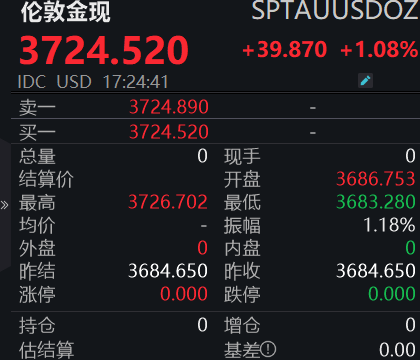
Core Viewpoint - Gold prices have surged recently, with London gold breaking the $3,720 per ounce mark and COMEX gold futures reaching $3,756.9 per ounce, both hitting historical highs [1][3]. Group 1: Price Movements - As of the latest report, London gold reached $3,720 per ounce, increasing over 1%, with an intraday high of $3,726.702 per ounce [1]. - COMEX gold futures rose nearly 1.4%, closing at $3,756.9 per ounce, with a peak of $3,761.2 per ounce during the trading session [1][2]. Group 2: Factors Driving Price Increase - The rise in gold prices is attributed to the Federal Reserve's "preventive rate cut" policy, concerns over stagflation risks, and worries about the Fed's independence [3][4]. - A decline in the U.S. dollar index and issues surrounding the security of cryptocurrencies, particularly the drop in Bitcoin prices, have also contributed to the upward momentum in gold prices [3]. Group 3: Market Analysis and Future Outlook - Analysts suggest that the market's expectation of a rate cut by the Federal Reserve has bolstered gold prices, especially following a dovish shift from Fed Chair Powell [3][5]. - The ongoing geopolitical tensions and economic pressures in regions like Europe and the Middle East have heightened risk aversion, further supporting gold's price increase [3][4]. - Looking ahead, analysts believe that the long-term upward trend for gold is likely to continue, with potential targets of $3,800 and even $4,000 per ounce by year-end [5].
降了,美联储年内首次降息:是特朗普胜利了,还是鲍威尔经济警告
Sou Hu Cai Jing· 2025-09-19 22:38
Core Viewpoint - The Federal Reserve's decision to cut the federal funds rate by 25 basis points is seen as a significant policy shift, marking the first rate cut of 2025 and a response to complex economic conditions rather than political pressure from Trump [1][4]. Economic Conditions - The current economic landscape is characterized by high inflation, with the core Consumer Price Index (CPI) rising by 3.1% year-on-year as of August, while the unemployment rate has climbed to 4.3%, the highest in two years [2][4]. - The Fed's rate cut is described as a "risk management" measure aimed at preventing a hard landing of the economy amid increasing employment risks [4]. Market Reaction - Following the rate cut announcement, market reactions were muted, with the Dow Jones Industrial Average showing only a slight increase, while the Nasdaq and S&P 500 indices both declined, indicating investor caution rather than celebration [1][4]. Fed's Future Outlook - The Fed's dot plot indicates expectations for two more rate cuts in 2025 (totaling 50 basis points) and an additional 25 basis points in 2026, reflecting a cautious approach rather than an aggressive easing policy [5][9]. - Powell's statements emphasize that the Fed is not inclined to pursue an "infinite easing" strategy, highlighting the potential for a quick reversal of policy if inflation rises [8][9]. Investor Insights - The real takeaway for investors is the acknowledgment of increasing economic uncertainty rather than an impending era of aggressive monetary easing, suggesting a need for a cautious and rational approach to market engagement [9].