
潮玩

Search documents
TOP TOY港股IPO:依赖授权IP、外采占比过半、名创优品是最大经销商 潮玩买手能否复刻泡泡玛特的资本神话?
Xin Lang Zheng Quan· 2025-10-14 06:59
Core Viewpoint - TOP TOY has submitted its listing application to the Hong Kong Stock Exchange, aiming to raise funds for diversifying its IP matrix, enhancing global market presence, and improving digital capabilities, despite facing significant challenges related to its business model and reliance on licensed IPs [3][6][21] Group 1: Financial Performance and Growth - TOP TOY has experienced rapid growth, with revenue increasing from 678.8 million RMB in 2022 to an expected 1.909 billion RMB in 2024, representing a compound annual growth rate (CAGR) of 67.7% [7][10] - The company’s net profit has also shown a positive trend, with adjusted net profits rising from -38.2 million RMB in 2022 to 180 million RMB in 2025 [7][10] - As of June 30, 2025, TOP TOY had 299 stores, with plans to expand to 1,000 stores globally within five years [8][7] Group 2: Business Model and Revenue Structure - TOP TOY's revenue is heavily reliant on licensed IP products, which account for nearly 100% of total revenue, while self-developed IP contributions are negligible [11][21] - The sales structure shows that the highest revenue share comes from distributors, with 51.6% of total revenue generated through this channel in the first half of 2025 [18][19] - The company’s sales model includes online and offline channels, with offline sales primarily through distributors and franchise partners [15][18] Group 3: Competitive Landscape - TOP TOY is positioned as a retail aggregator in the toy market, contrasting with competitors like Pop Mart, which focuses on proprietary brands [21][13] - The company faces challenges in creating its own IPs, which could limit its long-term profitability and market differentiation [13][21] - The competition with Pop Mart is expected to intensify, particularly in core urban markets and global expansion efforts [13][21] Group 4: Financial Health and Risks - TOP TOY's financial health is concerning, with a debt-to-asset ratio exceeding 100% and liquidity ratios below safe thresholds [20][21] - The reliance on the parent company, Miniso, as the largest distributor raises questions about the sustainability of its revenue model [19][21] - The gross margin of TOP TOY is significantly lower than that of Pop Mart, indicating a potential vulnerability in profitability [20][21]

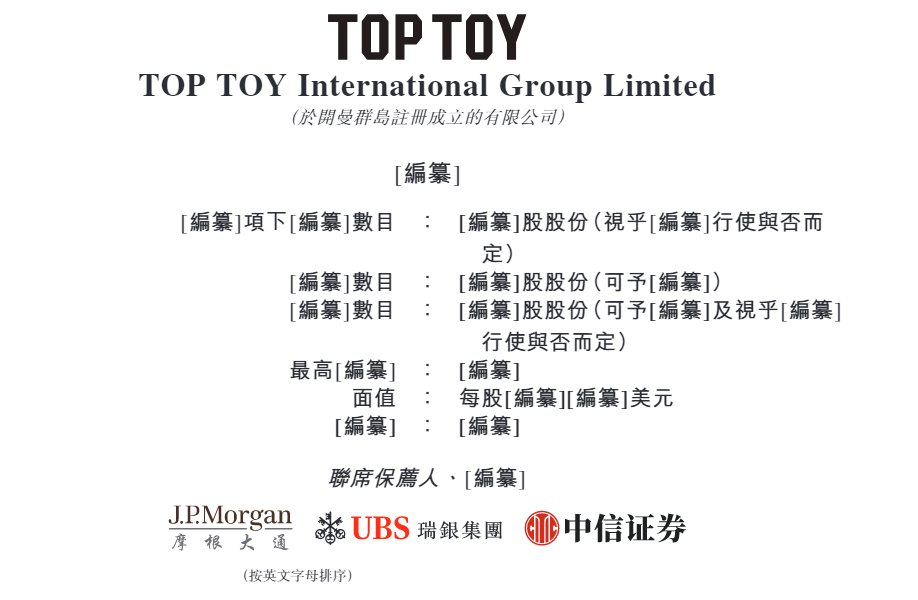
全球潮玩行业一周要闻(9.25-10.1)
Sou Hu Cai Jing· 2025-10-02 21:23
Group 1 - TOP TOY, a潮玩 brand under Miniso, submitted its IPO application to the Hong Kong Stock Exchange, aiming to raise funds for expanding its IP matrix, global market presence, brand marketing, and digital capabilities, with a projected GMV of 2.4 billion yuan in 2024 [3] - Hitcard, a card brand backed by阅文集团, is pushing for an IPO to become the "first card stock," with projected revenue of 400 million yuan in 2024, reflecting a year-on-year increase of over 600% and profitability [3] - Pop Mart achieved toy revenue of 13.876 billion yuan in the first half of 2025, surpassing Disney and Bandai Namco, marking a year-on-year growth of 204.4% [5][6] Group 2 - The new潮玩 IP "WAKAEMO" was launched by 巨星传奇 at a pop-up store in Shanghai, inspired by a three-leaf clover, designed to express emotions and block negative feelings [7] - AYOR TOYS, a new潮玩 brand, reported a sales figure exceeding 40 million yuan on its first day after announcing a celebrity endorsement, topping industry rankings on major platforms [8] - The ATM LAND潮玩 park, part of the POP FRIENDS brand, opened in Shanghai, featuring a wide range of潮玩 products from over 30 leading潮玩 brands [9] Group 3 - The Gundam Base opened a new store in Hefei, showcasing various limited models and providing a beginner-friendly area for new enthusiasts [10] - 灵动创想 launched its first official flagship store in Guangzhou, featuring interactive activities and promotions to attract customers [12] - The character "α-LIN" was globally premiered, combining physical figures with AR technology for interactive experiences, marking a new phase in潮玩 [14] - Liu Cixin's IP "超新星纪元" held an art pop-up in Shanghai, featuring collectible sculptures and interactive installations [16]
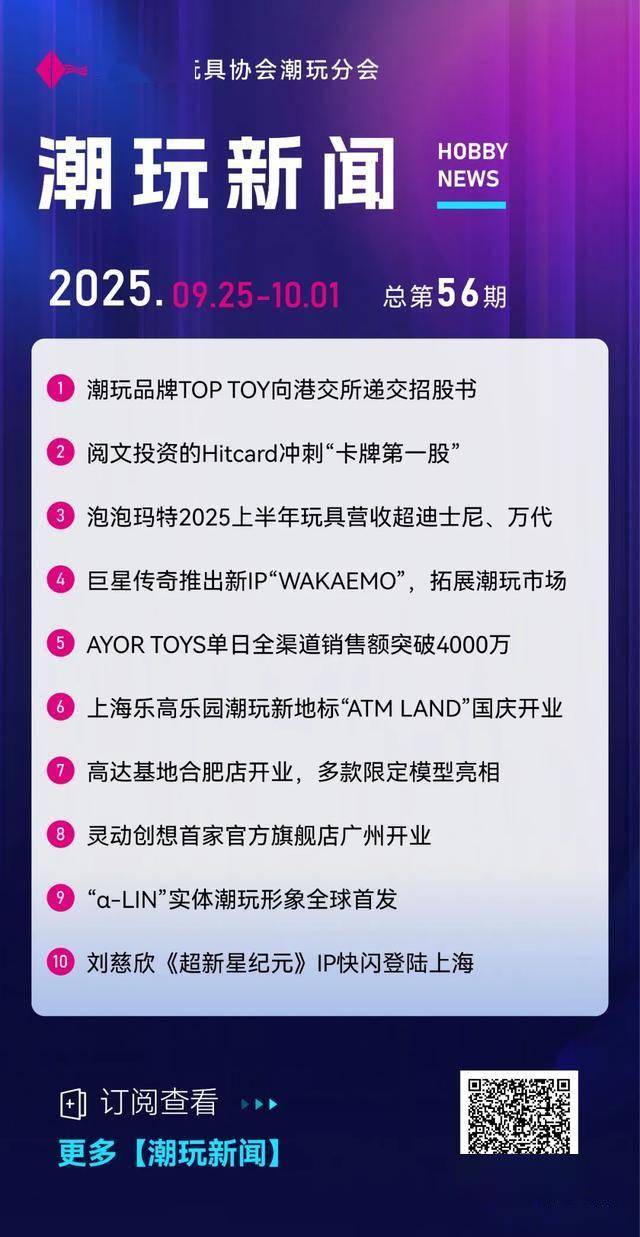
快讯|从名创优品分拆的TOP TOY,递交IPO招股书,拟赴香港上市
Sou Hu Cai Jing· 2025-09-28 03:04
Core Viewpoint - TOP TOY International Group Limited is planning to go public on the Hong Kong Stock Exchange, highlighting its rapid growth and significant market position in the collectible toy industry in China [1] Company Overview - TOP TOY is the largest and fastest-growing collectible toy brand in China, with a projected GMV of 2.4 billion yuan in 2024, where nearly 50% of its revenue comes from self-developed products [1] - Since opening its first store in December 2020, TOP TOY has established a comprehensive platform for the collectible toy industry, creating a multi-layered matrix of proprietary, licensed, and third-party IPs [1] Market Position and Growth - According to a report by Frost & Sullivan, TOP TOY's GMV is expected to have a compound annual growth rate (CAGR) of over 50% from 2022 to 2024, making it the fastest-growing collectible toy brand in China [1] - TOP TOY achieved the milestone of surpassing 1 billion yuan in GMV in the shortest time among Chinese collectible toy brands [1] Product Diversification - The company offers a diverse product matrix, including figurines and 3D assembly models, to meet varied consumer demands and expand its customer base [1]
1688平台将推出全球首个跨境电商AI智能体;霸王茶姬全球最大超级茶仓落地香港|36氪出海·要闻回顾
3 6 Ke· 2025-09-27 23:00
Group 1: E-commerce Innovations - Alibaba's 1688 platform is set to launch the world's first cross-border e-commerce AI agent named "Ao Xia," which will reduce product selection time from days to minutes by using visual recognition and semantic analysis [2] - Taobao is investing 1 billion yuan in marketing subsidies for its Double 11 event, aiming to help 100,000 merchants double their overseas sales, with a focus on 20 countries and regions [2] - Poland's e-commerce market is projected to reach 35.2 billion euros (approximately 294.39 billion yuan) in 2024, with cross-border e-commerce transactions accounting for nearly 20% of total online sales [9] Group 2: Market Expansion and New Store Openings - Bawang Chaji has opened its largest "super tea warehouse" in Hong Kong, marking its seventh store in the region, with plans for more openings in the coming months [3] - Cha Baidao has opened its first store in Paris, achieving nearly 500,000 yuan in sales in its first week, with plans for additional locations [4] - Yadi Group is set to enter the Japanese market with electric two-wheelers priced around 210,000 yen, significantly cheaper than local brands [6] Group 3: Strategic Partnerships and Collaborations - YTO Airlines has partnered with Freightos WebCargo, becoming the first private all-cargo airline in China to join the platform, enhancing digital booking and payment services for over 25,000 freight forwarding companies [5] - ByteDance and Mercedes-Benz have announced a strategic partnership covering various fields, including smart driving and digital marketing [5] - UBTECH and Yunzhihui Technology have signed a global strategic cooperation agreement to promote humanoid robots in China and globally [6] Group 4: Financing and Investment Activities - Xingmai Innovation has completed a 1 billion yuan A+ round of financing to enhance technology development and expand overseas markets, with products now available in 38 countries [7] - Haiguo Tuzhi Research Institute has secured nearly 10 million yuan in angel round financing for its solar energy storage vehicle project, which has already received initial orders in Bangladesh [8] - Resai Intelligent has completed a multi-million Pre-B round financing to expand its 3D printing solutions for dental applications [9]

这16家中国公司,2025半年玩具收入过亿元
3 6 Ke· 2025-09-17 23:44
Group 1 - Quantum Song reported its Q4 and full-year financial results for FY2025, with revenue from the trendy toy business reaching 65.78 million yuan, accounting for approximately 10.6% of total revenue. The company expects Q3 revenue to be between 100 million to 110 million yuan, and for FY2026, revenue is projected to be between 750 million to 800 million yuan [1] - The company has fully transformed into trendy toys and acquired Letsvan, rebranding it as "Qimeng Island," which now holds 11 proprietary IPs and 4 licensed IPs, operating over 40 blind box product lines and 30 plush card products [1] - The main IPs contributing to revenue include Wakuku, Ziyuli, and Siinono, with Wakuku generating 42.96 million yuan in Q2, and its series "Fox and Rabbit's Mischief Diary" selling over 1 million boxes since its launch in May [3][5] Group 2 - The online self-operated business launched in April 2025 achieved a GMV of over 18 million yuan by August, which is more than nine times the figure from April. The offline distribution network covers over 10,000 terminals, with plans to open at least three self-operated stores by the end of December [5] - The international distribution network is expanding to over 20 countries, including Japan and North America, with a successful pop-up test in Jakarta, Indonesia [5] - The production capacity for plush products exceeded 1 million units in August 2025, representing a growth of over 20 times since the beginning of the year [5] Group 3 - The toy industry in China has seen 16 companies report half-year revenues exceeding 100 million yuan, including prominent players like Pop Mart and Bilibili [7][8] - Bilibili's "IP derivatives and others" segment generated approximately 907 million yuan in revenue for H1 2025, with Q2 revenue around 434 million yuan [9] - TOP TOY reported a revenue of approximately 742 million yuan for H1 2025, a year-on-year increase of 73%, with an average store count increasing by about 60% [13][14] Group 4 - Aofei Entertainment's revenue for H1 2025 was approximately 1.198 billion yuan, with a net profit of about 37.01 million yuan, and toy business revenue around 459 million yuan [21][24] - Aofei is focusing on enhancing its K12 content advantages and pushing core IPs towards younger demographics, aiming to revitalize existing IPs and deepen cross-generational operations [24] - The company has partnered with major firms like Mihayou and Tencent to develop trendy toys, maintaining a focus on enhancing playability [27] Group 5 - Meili's revenue for H1 2025 was approximately 238 million HKD, a year-on-year increase of 22.5%, with a loss of about 12.24 million HKD, narrowing by 85.4% [30] - The company highlighted that 68.6% of its revenue came from the U.S. market, which has become increasingly significant [30] - The company is expanding its market presence in China while maintaining a strong focus on overseas markets [34] Group 6 - Star Shine Entertainment's toy business generated revenue of approximately 201 million yuan in H1 2025, with a net profit of about 33.01 million yuan, and a gross margin of 47.14% [36] - The company is divesting its football club business to concentrate on toys and games, planning to invest more resources into game development and AI technology applications [36] - The company has launched several new toy products, including remote-controlled cars and building blocks, with plans for further releases [36] Group 7 - Color Star Toys reported revenue of approximately 186 million HKD for H1 2025, a decrease of 58% due to the absence of major film releases for its key IPs [38] - The company anticipates further adjustments to tariff rates, which may increase operational uncertainties [40] - The company is preparing for the release of new products related to its IPs, including a sequel to "Teenage Mutant Ninja Turtles" [40] Group 8 - Huali Technology's revenue from anime IP derivative products reached approximately 166 million yuan in H1 2025, a year-on-year increase of 14.51%, although the gross margin declined from 44% to 39% [41][43] - The company is exploring strategic extensions by launching new IP operation brands and music labels to engage younger audiences [45] - The company has successfully launched new card products that have performed well in the market [43] Group 9 - Gao Le's revenue for H1 2025 was approximately 131 million yuan, a year-on-year increase of 36%, with a net loss of about 27.95 million yuan [46] - The company's toy and related business revenue was approximately 127 million yuan, reflecting a 40% increase [46] - The company has increased its focus on IP products, which saw a revenue increase of 96% [49] Group 10 - Shifeng Culture reported revenue of approximately 190 million yuan for H1 2025, a year-on-year increase of 22%, with a net profit of about 4.17 million yuan [51] - The company is diversifying its product strategy, focusing on AI smart toys and IP anime derivative toys [55][57] - The company has secured licenses for several popular IPs, including Pokémon and Super Wings, to develop new toy products [57] Group 11 - Cardao, a subsidiary of Yaoji Technology, reported revenue of approximately 105 million yuan for H1 2025, a year-on-year increase of 33%, with a net profit of about 12 million yuan [59] - The company has successfully returned to profitability after facing losses in the previous year [61]





商务部首次提出新业态新模式新场景试点城市建设
Huan Qiu Wang· 2025-09-17 00:57
Core Viewpoint - The Ministry of Commerce and nine other departments have released a set of policies aimed at expanding service consumption, highlighting 19 measures across five areas, with a focus on high-quality service supply [1] Group 1: Policy Measures - The document outlines initiatives such as launching a "Service Consumption Season" to promote consumption activities [1] - It supports collaboration between quality consumption resources and well-known IPs [1] - The plan includes expanding pilot programs in telecommunications, healthcare, and education sectors [1] - There is a proposal to gradually expand the list of countries with unilateral visa exemptions [1] - The document suggests optimizing student holiday arrangements and improving related policies [1] Group 2: New Consumption Models - The document introduces the concept of pilot cities for new consumption formats, models, and scenarios [1] - It emphasizes the importance of attracting more foreign visitors for consumption and encourages travel agencies and online platforms to create tailored travel routes for foreigners [1] - The proposal includes adjusting academic calendars to create more opportunities for service consumption, particularly in tourism [1] Group 3: Cultural and Entertainment Focus - The document highlights the potential of traditional cultural IP markets and the creation of new service consumption scenarios [3] - It supports local initiatives that leverage quality performances, animation, gaming, and film to drive innovation in offline experiences [3] - The report suggests focusing on tourism performance concepts such as Songcheng Performance and Fengshang Culture, as well as trendy toy concepts like Pop Mart [3]
港股异动 | 小黄鸭德盈(02250)早盘涨超7% 上半年IP授权业务高增 拟收购潮玩公司HIDDEN WOOO
智通财经网· 2025-09-15 03:01
Core Viewpoint - The company, 小黄鸭德盈, reported a significant increase in revenue and announced plans to acquire潮玩公司HIDDEN WOOO, aiming to enhance its IP matrix and expand its product line targeting the young consumer market [1] Financial Performance - For the first half of the year, the company achieved a revenue of 82.31 million HKD, representing a year-on-year growth of 37% [1] - The IP licensing business generated revenue of 38.44 million HKD, with a year-on-year increase of 46%, and the number of licensed partners grew to 577 [1] - The retail business revenue reached 43.87 million HKD, marking a 31% year-on-year growth, focusing on潮玩盲盒, plush toys, AI toys, and light home goods [1] Acquisition Details - The planned acquisition of HIDDEN WOOO is expected to enhance the company's IP matrix and expand its潮玩 product line [1] - After the transaction, HIDDEN WOOO's founder, 黄嘉乐, will become the Vice President of the group, responsible for the潮玩 business segment [1] - The collaboration aims to develop innovative潮玩 products, including盲盒, vinyl figures, collectible sculptures, and trendy accessories [1] Market Expansion Strategy - With the support of 小黄鸭德盈, HIDDEN WOOO plans to accelerate its overseas market expansion, particularly in Europe [1] - The strategy includes establishing brand flagship stores and creating immersive retail spaces combined with localized marketing activities to deepen brand recognition and emotional connection [1]
小黄鸭德盈早盘涨超7% 上半年IP授权业务高增 拟收购潮玩公司HIDDEN WOOO
Zhi Tong Cai Jing· 2025-09-15 02:56
Core Viewpoint - The company, 小黄鸭德盈 (02250), experienced a significant stock price increase following the release of its mid-term performance report, which highlighted strong revenue growth and a strategic acquisition plan [1] Financial Performance - The company reported a revenue of 82.31 million HKD for the first half of the year, representing a year-on-year increase of 37% [1] - The IP licensing business generated revenue of 38.44 million HKD, up 46% year-on-year, with the number of licensed partners increasing to 577 [1] - Revenue from retail sales reached 43.87 million HKD, reflecting a 31% year-on-year growth, focusing on trendy blind boxes, plush toys, AI toys, and light home goods [1] Strategic Acquisition - The company announced plans to acquire the trendy toy company HIDDEN WOOO, which will enhance its IP matrix and expand its product line targeting the young consumer market [1] - Following the acquisition, HIDDEN WOOO's founder, 黄嘉乐, will become the Vice President of the group, overseeing the trendy toy business segment [1] Market Expansion - The acquisition is expected to accelerate HIDDEN WOOO's expansion into overseas markets, particularly in Europe, with plans for flagship store development [1] - The strategy includes creating immersive retail spaces and localized marketing activities to deepen brand recognition and emotional connection with consumers [1]
韩国街边山寨labubu卖100元,二手溢价数倍
第一财经· 2025-09-13 15:03
Core Viewpoint - The article highlights the rapid popularity of Pop Mart's Labubu series in the South Korean market, driven by a young consumer base and changes in purchasing rules that have affected sales dynamics [4][12][14]. Group 1: Market Performance - Pop Mart's Labubu series has gained significant traction in South Korea, particularly among the post-2000 generation, with consumers from various countries participating in the buying frenzy [14]. - The company implemented new purchasing rules in June 2023, transitioning from direct sales to an online reservation system, which has led to increased demand and consumer engagement [12][14]. Group 2: Sales and Revenue - According to Pop Mart's 2025 semi-annual report, the company achieved a revenue of 13.88 billion yuan, marking a year-on-year growth of 204% [18]. - The revenue breakdown shows that the Chinese market contributed 8.28 billion yuan (up 135.2%), while the Asia-Pacific region saw a revenue of 2.85 billion yuan (up 257.8%) [18][19]. - The Americas reported a staggering revenue increase of 1,142%, totaling 2.26 billion yuan, and Europe and other regions experienced a 729.2% growth, reaching 480 million yuan [19]. Group 3: Market Challenges - The popularity of Labubu has led to a rise in counterfeit products, with reports of a significant seizure of fake Labubu dolls at Seattle-Tacoma International Airport, indicating the brand's high demand and the challenges of maintaining brand integrity [16].
广博股份(002103) - 002103广博股份投资者关系管理信息20250910
2025-09-10 10:26
Group 1: Company Overview - Guangbo Group has established itself as a leading manufacturer and seller of educational and office supplies in China, with a strong reputation in traditional stationery products such as paper products, writing instruments, and art materials [3] - The company is undergoing a strategic transformation from traditional stationery to cultural and creative products, responding to changing market demands and consumer preferences [3] Group 2: Product Strategy - Guangbo has launched multiple sub-brands, including "kinbor," "fizz," and "papiest," targeting different consumer needs and scenarios, particularly focusing on the younger demographic [3] - The company is expanding into the trendy toy market, developing products like badges, cards, and plush toys, aligning with current market trends [3] Group 3: Channel Strategy - The channel strategy focuses on consolidating traditional channels while exploring new ones, enhancing brand exposure, and strengthening self-operated channels [4] - Guangbo aims to penetrate overseas markets, particularly in Southeast Asia, where there is a growing demand for high-quality, personalized cultural products [4] Group 4: Future Outlook - The company is committed to continuous innovation and brand building, leveraging IP resources to drive growth and adapt to market changes [4] - Guangbo's proactive approach in capturing market trends and consumer demands positions it well for future expansion and success in the cultural and creative sectors [4]
