财政整顿

Search documents
老龄化的债务幻觉|宏观经济
清华金融评论· 2025-09-10 11:16
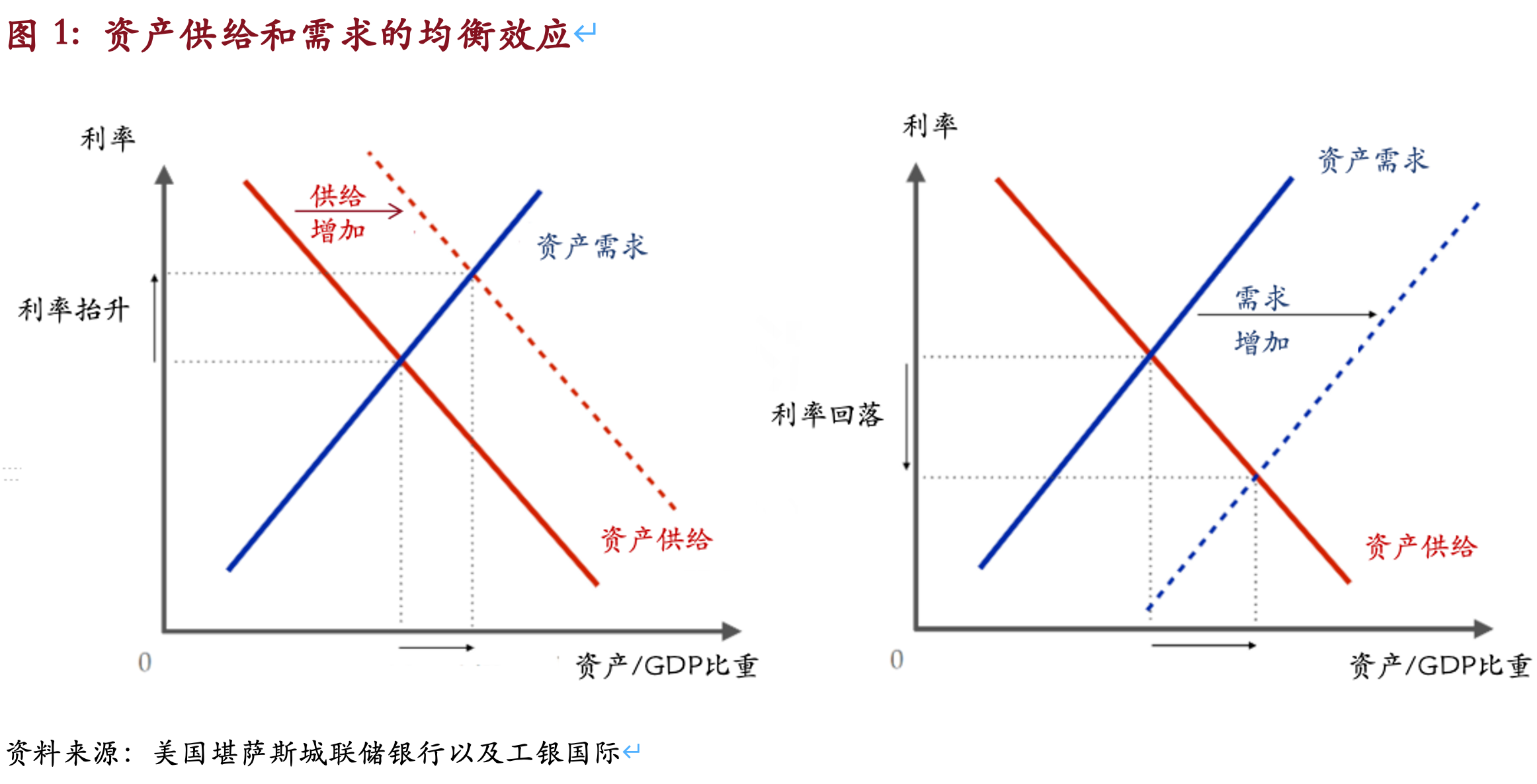
Core Viewpoint - The relationship between population aging and debt has become a focal point at the Jackson Hole Global Central Bank Conference, highlighting that global aging increases fiscal burdens and expands demand for debt assets, creating a "high debt - low interest rate" equilibrium. However, this equilibrium is fragile and not solely determined by demographic factors, as it also depends on interest rate sensitivity to debt, international capital flows, and political stability [2][4][7]. Group 1: Aging Population and Debt Dynamics - The aging population leads to significant increases in fiscal spending, including rising pension payments and healthcare costs, which contribute to persistent fiscal deficits and an upward trend in government debt [4][5]. - Aging not only raises government fiscal burdens but also expands societal demand for safe, long-term investment tools, such as government bonds, allowing governments to issue large amounts of debt at very low interest rates [5][6]. - The political landscape shifts towards older voters, making it more challenging to implement tax increases or spending cuts, resulting in a tendency for governments to opt for "more borrowing" rather than "spending less" [5][6]. Group 2: Fragility of the Current Equilibrium - Despite the apparent sustainability of the "high debt - low interest rate" equilibrium, its fragility is underscored by factors such as interest rate sensitivity to debt, global capital market demand, and political stability [7][8]. - The estimated Debt Sensitivity to Interest Rate (DSIR) is around 0.5 basis points, suggesting that a significant increase in debt-to-GDP ratios could lead to a more pronounced rise in interest rates, potentially worsening fiscal outlooks [7][8]. - Global demand for U.S. Treasury bonds may not remain constant, as geopolitical tensions and the emergence of alternative reserve currencies could weaken reliance on U.S. debt, exposing vulnerabilities in debt sustainability [8]. Group 3: Long-term Solutions - The long-term solution lies in structural fiscal reforms and productivity enhancements, as the current equilibrium, while providing short-term stability, poses long-term risks [12][14]. - Initiating structural fiscal adjustments can help stabilize market confidence and prevent debt expectations from spiraling out of control, while investments in technology, education, and labor market reforms are essential for boosting productivity [14]. - Future monetary policy may need to navigate complex trade-offs among inflation, employment, and fiscal constraints, with central banks facing greater discretion and associated credibility risks [14].


老龄化的债务幻觉
Sou Hu Cai Jing· 2025-09-07 16:35
Group 1 - The relationship between population aging and government debt accumulation is a central theme at the Jackson Hole global central bank conference, highlighting the structural logic behind the long-term decline in interest rates and the rise in government debt [2][3] - Aging populations lead to increased fiscal expenditures, such as rising pension payments and healthcare costs, which create a long-term basis for fiscal deficits and an upward trend in government debt [2][3] - Despite the fiscal burden, aging also expands the demand for safe debt assets, allowing governments to issue large amounts of debt at very low interest rates, creating a "high debt—low interest" equilibrium [2][3] Group 2 - The sustainability of this "high debt—low interest" equilibrium is fragile and depends on factors beyond demographic changes, including the sensitivity of interest rates to debt levels, international capital flows, and political stability [4][5] - The sensitivity of interest rates to debt (Debt Sensitivity to Interest Rates, DSIR) may be underestimated, with potential implications for fiscal sustainability if debt levels rise significantly [4] - Global demand for U.S. Treasury securities is not guaranteed, and geopolitical tensions or the rise of alternative reserve currencies could undermine the current reliance on U.S. debt [5] Group 3 - Fiscal crises can arise from "flow shocks" rather than unsustainable debt levels, with sudden events like auction failures or political deadlock posing significant risks [6] - The current "high debt—low interest" equilibrium provides short-term economic support but is not a sustainable long-term solution, necessitating structural fiscal reforms to stabilize market confidence [6][8] - Improving labor productivity is essential to alleviate the pressures of an aging population, and structural fiscal adjustments can help restore long-term growth momentum [8]
程实:老龄化的债务幻觉丨实话世经
Di Yi Cai Jing· 2025-09-07 11:30
Group 1 - The core argument of the articles is that global aging is creating a "high debt - low interest rate" equilibrium, which is fragile and influenced by various factors beyond just demographic changes [1][4][7] - Aging populations lead to increased fiscal burdens due to rising pension payments, healthcare costs, and social security obligations, resulting in a long-term trend of government debt accumulation [2][3] - Despite the rising fiscal pressures, aging also expands the demand for debt assets, allowing governments to issue debt at low interest rates, as entities like pension funds and insurance companies seek safe, long-term investments [2][3] Group 2 - The sensitivity of interest rates to debt levels (Debt Sensitivity to Interest Rates, DSIR) may be underestimated, with potential implications for fiscal sustainability if debt levels rise significantly [7][8] - The demand for U.S. Treasury bonds as a safe asset is not guaranteed to remain stable, as geopolitical tensions and the emergence of alternative reserve currencies could alter capital flows [8] - Short-term fiscal crises can arise from unexpected events, even if the overall debt structure appears stable, highlighting the need for caution regarding the perceived sustainability of the current equilibrium [8] Group 3 - The long-term solution to the challenges posed by aging populations lies in structural fiscal reforms and productivity enhancements, rather than relying solely on the current debt dynamics [11][12] - Improving labor productivity is essential for alleviating the pressures of aging, and initiating structural fiscal adjustments can help stabilize market confidence and prevent debt expectations from spiraling out of control [12] - Future monetary policy may need to adapt to the constraints imposed by high debt levels, requiring a balance between inflation, employment, and fiscal considerations [12]
美股深夜下挫,英伟达跌4%,中概股飘红,黄金涨破3590美元
2 1 Shi Ji Jing Ji Bao Dao· 2025-09-05 15:43
Economic Data and Market Reaction - The U.S. non-farm payroll data for August showed an increase of only 22,000 jobs, significantly below the market expectation of 75,000 [1] - The unemployment rate rose to 4.3%, marking the highest level since 2021 [1] - Following the release of the disappointing employment data, U.S. stock indices initially opened higher but later experienced a decline, with the Dow Jones falling by 0.82%, Nasdaq by 0.69%, and S&P 500 by 0.75% [1][2] Stock Performance - Notable stock movements included Tesla, which rose by 2.66%, while several Chinese concept stocks saw gains, with Alibaba initially increasing by nearly 3% before narrowing its gains [2][3] - The Nasdaq China Golden Dragon Index increased by 0.55%, and the Wande Chinese Technology Leader Index rose by 1% [1][2] Bond Market and Interest Rates - The yield on the 10-year U.S. Treasury bond fell by over 8 basis points to 4.08%, reaching a four-month low [11][14] - Following the weak labor market data, traders are betting on further interest rate cuts by the Federal Reserve, with a 100% probability of a rate cut expected in September [19][20] Commodity Market - Gold prices surged, reaching a record high of $3,590.93 per ounce, reflecting a 1.29% increase due to the disappointing non-farm payroll data [7] - The U.S. dollar index fell to 97.47, and crude oil prices also dropped, with WTI crude down by 2% to $62.17 per barrel [9][15] Economic Outlook - Analysts suggest that the weakening labor market and the potential for further monetary easing could provide some economic support in the latter half of the year [20] - Concerns remain regarding the sustainability of U.S. debt levels and the potential for rising bond yields in the future, as the market reassesses the risks associated with high debt and economic weakness [22][23]


政治危机叠加财政黑洞,英德法30年期国债收益率创多年新高
Hua Er Jie Jian Wen· 2025-09-02 13:54
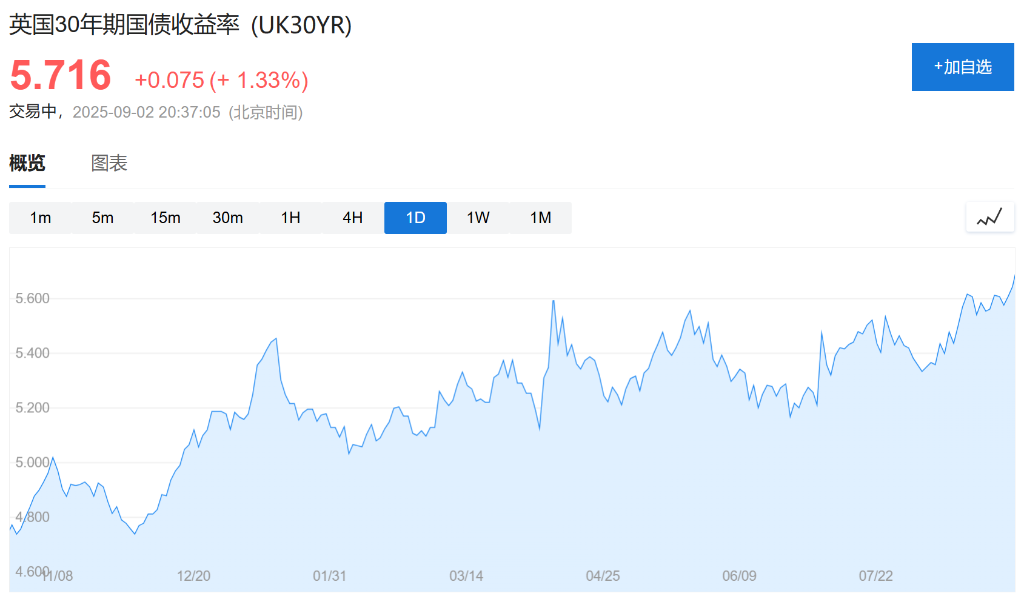
Core Viewpoint - The long-term government bond yields in major European economies are rising sharply, with the UK, Germany, and France reaching their highest levels since the financial crisis, driven by concerns over expanding fiscal deficits and policy uncertainty [1][4]. Group 1: Rising Bond Yields - The UK 30-year government bond yield has reached 5.72%, the highest since 1998, while Germany and France's yields have risen to 3.41% and 4.51%, respectively, marking their highest levels since 2011 and 2009 [1]. - The increase in yields is attributed to significant fiscal spending by European countries in response to geopolitical security and economic recovery, alongside political turmoil in France and the UK, which has heightened concerns about policy coherence [4][6]. Group 2: Fiscal Challenges and Political Uncertainty - The UK faces a £35 billion budget shortfall, with the Chancellor of the Exchequer, Rachel Reeves, struggling to alleviate investor concerns regarding fiscal prospects amid cabinet reshuffles [6]. - France's government is attempting to implement a $51 billion budget cut plan to curb deficits, but severe political divisions and uncertainty over trust votes complicate the situation, with last year's deficit reaching 5.8% of GDP [6]. - Germany's bonds, typically seen as safe assets, are also facing sell-offs due to increased defense and infrastructure spending, raising doubts about the sustainability of fiscal policies in the context of weak economic growth [6]. Group 3: Inflation and Central Bank Policies - Inflation pressures and uncertainties regarding central bank policies are significant factors contributing to rising yields [7]. - High inflation in the UK may limit the Bank of England's ability to cut interest rates further, reducing economic stimulus potential, while Eurozone inflation data exceeded expectations, leading to predictions of sustained high interest rates from the European Central Bank [8]. - Concerns over high debt levels and trade policies in both the US and Europe may introduce new inflationary pressures, further elevating global long-term interest rates [8].
法国市场获喘息契机:政治动荡中资产初稳,静待9月8日信任投票终极考验
智通财经网· 2025-08-27 08:29
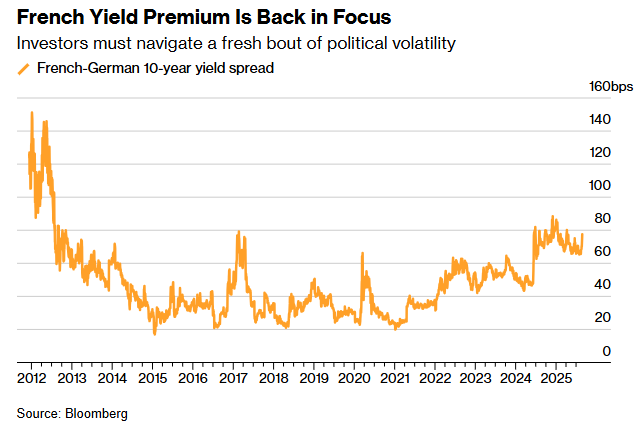
Group 1 - French assets stabilized in early trading, providing a respite ahead of a crucial vote next month that could trigger a government collapse [1] - The CAC 40 index rose by 0.4%, aligning with the broader European Stoxx 600 index, with leading gains from companies like Louis Vuitton, TotalEnergies, and Axa [1] - The yield premium on French bonds narrowed by 1 basis point to 77 basis points, following a recent peak not seen since April [1] Group 2 - Prime Minister François Bérou is facing political resistance due to a €44 billion ($51 billion) spending cut and tax increase plan, deemed essential to avoid a public finance disaster [4] - If the political crisis escalates, the yield spread on ten-year French government bonds could surge to 100 basis points, marking the highest level since 2012 [4] - Financial consolidation is viewed as a necessary action for the country, with expectations that French bonds will continue to perform poorly [4]
美联储首次回应特朗普解雇理事库克,特朗普:已有人选接替
2 1 Shi Ji Jing Ji Bao Dao· 2025-08-27 00:02
Core Viewpoint - The independence of the Federal Reserve is facing unprecedented challenges due to President Trump's dismissal of Fed Governor Lisa Cook, which has raised concerns about political interference in monetary policy [1][10][14]. Group 1: Federal Reserve's Response - The Federal Reserve stated that the long-term fixed terms of its governors and the protection against dismissal are crucial for ensuring that monetary policy decisions are based on data and the long-term interests of the American people [3][4]. - The Fed will comply with any court rulings regarding Cook's dismissal [4]. Group 2: Political Implications - Trump's actions are seen as part of a systematic intervention in the Federal Reserve, with previous appointments of loyalists and public criticisms of Fed Chair Jerome Powell's policies [6][7]. - Historically, no Fed governor has been dismissed by a president, and Trump's ability to remove Cook remains uncertain due to legal restrictions requiring substantial evidence of misconduct [8][9]. Group 3: Market Reactions - Following Trump's threats, the U.S. dollar index, U.S. Treasury yields, and S&P 500 futures experienced limited declines [10]. - Analysts suggest that if the Fed's decision-making is increasingly influenced by Trump's policies, it could lead to accelerated rate cuts, benefiting equities and global risk assets while causing fluctuations in commodity prices [10]. Group 4: Future Considerations - If Trump successfully removes Cook, he would gain a majority on the Fed's Board, potentially undermining the Fed's independence and affecting its ability to control inflation [14][15]. - The political cycle may increasingly influence the Fed's policy objectives, shifting from a dual mandate of price stability and employment growth to potentially incorporating political considerations [15].

美联储首次回应特朗普解雇理事库克,特朗普:已有人选接替
21世纪经济报道· 2025-08-26 23:57
Core Viewpoint - The independence of the Federal Reserve is facing unprecedented challenges due to President Trump's actions, including the dismissal of Federal Reserve Governor Lisa Cook, which has raised concerns about political interference in monetary policy [1][4][16]. Group 1: Federal Reserve's Response - The Federal Reserve stated that the law protects the long-term terms of its governors and that the President can only dismiss them for just cause, ensuring that monetary policy decisions are based on data and the long-term interests of the American people [4]. - Cook's legal team announced plans to seek judicial review of her dismissal, and the Federal Reserve will comply with any court rulings [4] Group 2: Trump's Position and Actions - Trump expressed his intention to fight the legal challenge posed by Cook and indicated he has candidates in mind to replace her, specifically mentioning Stephen Moore and David Malpass [6]. - Trump's actions are seen as part of a systematic intervention in the Federal Reserve, having previously appointed allies and criticized current policies [8][16]. Group 3: Historical Context and Implications - Historically, no Federal Reserve governor has been dismissed by a president, and while the president has the authority to do so, it is limited by the requirement of substantial evidence of misconduct [9]. - The potential dismissal of Cook could give Trump a majority on the Federal Reserve Board, which may lead to increased political influence over monetary policy decisions [16]. Group 4: Market Reactions and Economic Implications - Following Trump's threats, there was a limited decline in the dollar index, U.S. Treasury yields, and S&P 500 futures, indicating market sensitivity to the Federal Reserve's independence [11]. - Analysts suggest that if Trump's influence over the Federal Reserve increases, it could accelerate the pace of interest rate cuts, benefiting risk assets and commodities while creating uncertainty in policy direction [11][12]. Group 5: Future Considerations - The potential shift in the Federal Reserve's policy goals from dual mandates of price stability and employment growth to include political cycles could alter the landscape of U.S. monetary policy [17]. - The need for fiscal consolidation is emphasized as a means to support the Federal Reserve's efforts in controlling inflation, with the government facing a "quasi-war" fiscal state [13][16].

特朗普宣布解除库克职务,美联储独立性遭遇“前所未有”冲击
Sou Hu Cai Jing· 2025-08-26 13:05
Core Viewpoint - The independence of the Federal Reserve is facing unprecedented challenges due to President Trump's attempt to dismiss Federal Reserve Governor Lisa Cook, raising concerns about political interference in monetary policy [1][2][4]. Group 1: Dismissal of Lisa Cook - President Trump announced the immediate dismissal of Federal Reserve Governor Lisa Cook, citing alleged mortgage fraud as the reason for her removal [1][2]. - Cook responded by stating that Trump lacks the legal authority to dismiss her and intends to continue her duties [2][3]. - This event marks a potential first in the 111-year history of the Federal Reserve, where a sitting president attempts to remove a Federal Reserve governor [1][3]. Group 2: Implications for Federal Reserve Independence - Analysts suggest that Trump's actions represent a systematic intervention in the Federal Reserve, potentially undermining its independence and decision-making processes [2][8]. - If Cook is successfully dismissed, Trump would gain a majority on the Federal Reserve Board, which could lead to a shift in monetary policy towards more accommodative stances [8][9]. - Concerns are raised that the Federal Reserve's ability to combat inflation may be weakened due to increased political influence over its decisions [8]. Group 3: Market Reactions and Future Outlook - Following Trump's announcement, there was a limited decline in the U.S. dollar index, U.S. Treasury yields, and S&P 500 futures, indicating market sensitivity to the news [4]. - Analysts predict that if the Federal Reserve's agenda becomes more influenced by Trump's policies, it could accelerate the pace of interest rate cuts, benefiting risk assets and commodity prices [4][5]. - The potential shift in the Federal Reserve's policy objectives may include considerations of political cycles, particularly in light of upcoming midterm elections, which could further complicate monetary policy [9].
深度专题 | 美联储的“政治危机”与美债风险的“重估”(申万宏观·赵伟团队)
申万宏源宏观· 2025-08-19 16:05
Group 1 - The core issue behind the current "political crisis" surrounding the Federal Reserve is whether it can "manipulate" interest rates and the implications of a steepening U.S. Treasury yield curve [3][4] - Market expectations for the next "shadow Fed chair" candidates are led by Chris Waller (26.6%), Kevin Hassett (13.7%), and Kevin Warsh (7.9%), all of whom are perceived as having dovish monetary policy stances [10][16] - The Federal Reserve's ability to "set" but not "manipulate" policy rates is emphasized, with long-term interest rates being more influenced by macroeconomic factors than short-term rates [5][47] Group 2 - The transition from "loose fiscal + loose monetary" to "tight fiscal + loose monetary" is suggested as necessary for sustainable fiscal reform, with a historical correlation indicating that a 1% reduction in the fiscal deficit could lower 10-year Treasury yields by 12-35 basis points [7][9] - The U.S. government's fiscal and debt situation is described as being in a "quasi-war state," necessitating fiscal consolidation to manage rising deficits and leverage ratios [9][19] - The Federal Reserve's long-term ability to influence the yield curve is limited, with market pricing often being overly dovish during rate hike cycles and overly hawkish during rate cut cycles [6][41]