
核心CPI

Search documents
从“管高价”到“管低价”:如何提振核心
Soochow Securities· 2025-06-12 09:16
Group 1: CPI Trends and Influences - Since February 2025, CPI has experienced four consecutive months of negative growth, primarily driven by food and energy prices, while core CPI has shown a significant recovery since September 2024[1] - The average CPI year-on-year growth from February to May 2025 was -0.25%, with food contributing -0.24 percentage points and energy contributing -0.29 percentage points, while core CPI contributed +0.28 percentage points[1] - The CPI growth target was adjusted from 3% to 2% in March 2025, indicating a shift in policy focus from preventing high prices to preventing low prices[1] Group 2: Core CPI Components - Core CPI can be divided into three main components: core goods, housing services, and other services, with housing services being a significant drag on core CPI growth[1] - Housing services prices have averaged 0.07% since 2022, down from 1.74% from 2013 to 2022, contributing approximately 0.4 percentage points to the decline in core CPI growth[1] - Other services prices are closely linked to overall wage trends, with a potential for price increases driven by rising demand and improved corporate profits[1] Group 3: Policy Recommendations - To boost core CPI, service consumption subsidies are recommended, which could increase core CPI by approximately 0.3 percentage points, offsetting the negative impact from declining housing service prices[1] - The expected core CPI growth for the second half of 2025 is projected to reach around 1.0% before slightly declining, remaining within the 0.6%-1.0% range[1] - The core goods price is expected to rise initially before a slight decline, while housing service prices are anticipated to remain stable around zero[1]
帮主郑重解读:CPI数据藏玄机,美联储降息节奏要变?
Sou Hu Cai Jing· 2025-06-11 23:50
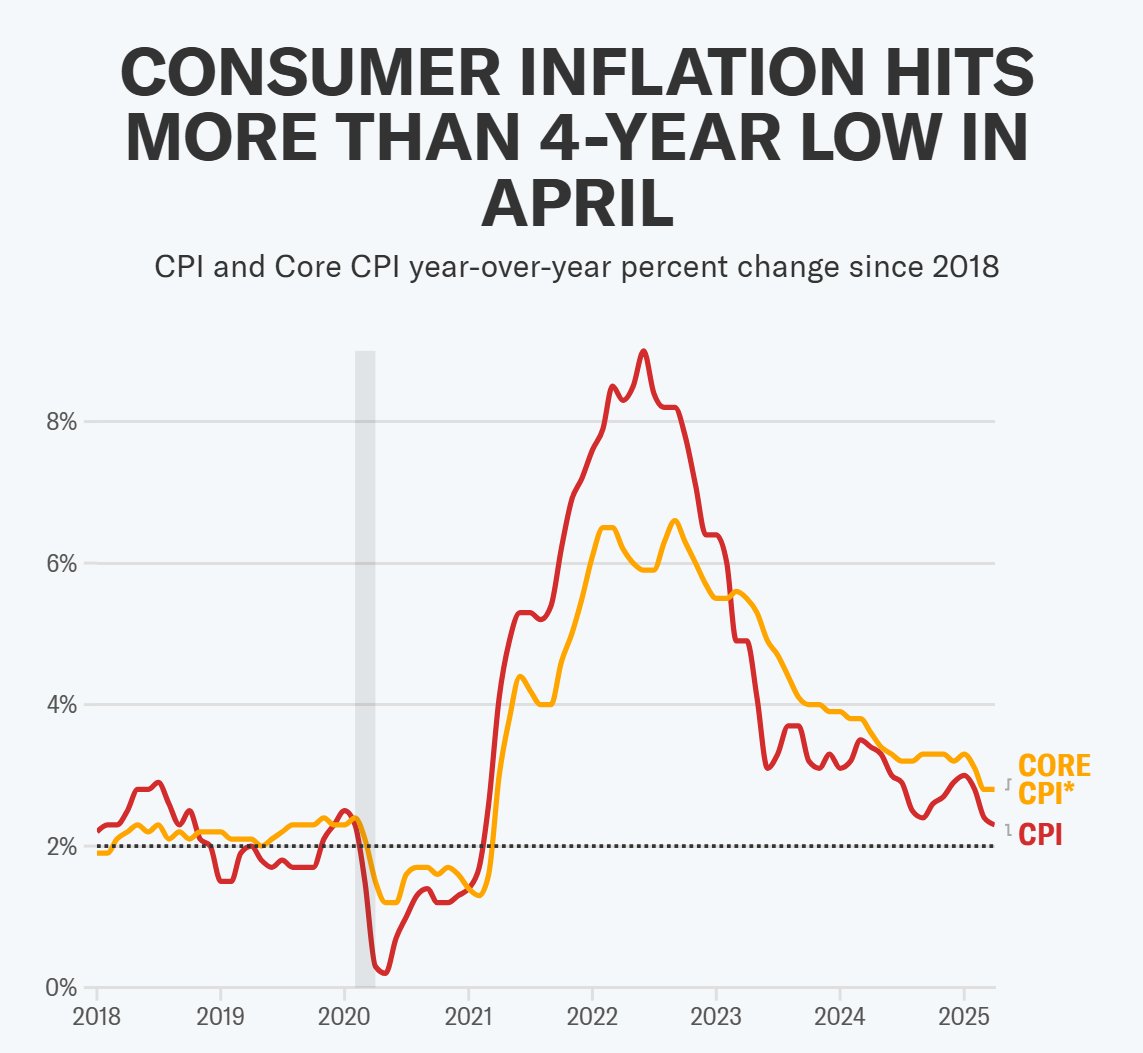
各位朋友晚上好,我是帮主郑重。干了20年财经记者,现在更爱以中长线投资者的视角跟大家唠唠市场那些事儿。今儿个美股一开盘就挺热闹,高开的 背后啊,其实藏着俩关键信号——中美在日内瓦会谈的共识框架有了新进展,还有美国5月CPI数据悄悄给市场"递了个眼神"。 作为中长线投资者,我觉得这会儿更该看清楚大逻辑:中美关系往共识框架走,对市场情绪是个支撑;美国通胀压力虽有缓解,但内生动力还没完全消 退,美联储降息大概率是"慢撒气"不是"猛放水"。咱做投资啊,就像开车,得盯着前方路况,别被路边广告牌晃了眼。后续核心CPI怎么走,中美具体合 作咋落地,都是值得持续琢磨的关键点。 行,今儿就先唠到这儿。关注帮主郑重,咱下回接着拆解市场里的"明牌"和"暗牌"。 先说说这CPI。数据一出来,环比涨0.1%,比大伙儿预期的还低点儿,同比2.4%也算是温和。乍一听好像就是"通胀压力松了口气",但细琢磨就有意思 了。你想啊,买菜买肉的价格没咋猛涨,可核心CPI(剔除食品能源的)同比还在2.8%晃悠,说明服务啊、非必需品这些价格还挺"坚挺"。华尔街那帮分 析师说得挺明白,高关税这事儿正慢慢往商品价格上传导呢,摩根士丹利和高盛都押注6月核心C ...


\"美联储传声筒\":一个全线低于预期的五月CPI
news flash· 2025-06-11 13:05
金十数据6月11日讯,"美联储传声筒"Nick Timiraos:5月CPI数据全线低于预期,核心CPI环比上升 0.13%,整体CPI环比上升0.08%。核心CPI同比增幅从2.78%升至2.79%,整体CPI从2.31%微升至 2.35%,同比数据所呈现的平稳态势夸大了这一数据的鸽派程度。 "美联储传声筒":一个全线低于预期的五月CPI ...
美联储传声筒:汽车和服装价格下降,导致5月核心CPI的读数低于预期
news flash· 2025-06-11 12:45
Group 1 - The core CPI reading for May was lower than expected due to a decline in automobile and clothing prices [1] - Some forecasters anticipated that these two categories would show early signs of tariff impacts in May [1]
美国5月季调后CPI及核心CPI月率、未季调CPI及核心CPI年率将于十分钟后公布。
news flash· 2025-06-11 12:23
美国5月季调后CPI及核心CPI月率、未季调CPI及核心CPI年率将于十分钟后公布。 ...
关税冲击下首份CPI答卷:华尔街预计5月核心通胀或创一年来最大环比涨幅
智通财经网· 2025-06-11 02:30
Group 1 - The May Consumer Price Index (CPI) is expected to show a slight increase in inflation from April, with an overall inflation rate projected to rise from 2.3% to 2.4% [1][4] - Core CPI, excluding volatile food and energy prices, is anticipated to increase to 2.9% year-on-year, up from 2.8% in April, with a month-on-month rise of 0.3% [1][4] - The report coincides with the impact of President Trump's tariff declarations, with existing tariffs on various goods, including a 30% effective rate on Chinese products [4][5] Group 2 - Economists from Wells Fargo expect the May CPI report to be a critical test of how tariffs are affecting consumer prices, predicting a moderate rise in overall and core inflation [4] - Goldman Sachs anticipates that future tariffs may exert greater upward pressure on monthly inflation, projecting a core CPI month-on-month increase of around 0.35% in the coming months [4] - Concerns have been raised about the uncertainty surrounding tariff policies, which may lead to delayed inflation effects and more chaotic market responses [5][6]
新世纪期货交易提示(2025-6-10)-20250610
Xin Shi Ji Qi Huo· 2025-06-10 07:00
Report Industry Investment Ratings - Iron ore: Rebound and short [2] - Coking coal and coke: Rebound [2] - Rebar: Volatile [2] - Glass: Rebound [2] - Shanghai and Shenzhen 300 Index Futures/Options: Volatile [2][4] - Shanghai 50 Index Futures/Options: Rebound [2][4] - CSI 500 Index Futures/Options: Upward [4] - CSI 1000 Index Futures/Options: Upward [4] - 2 - year Treasury Bond: Volatile [4] - 5 - year Treasury Bond: Volatile [4] - 10 - year Treasury Bond: Rebound [4] - Gold: High - level volatile [4] - Silver: Strong - side volatile [4] - Pulp: Weak - side volatile [6] - Logs: Volatile [6] - Edible oils: Weak - side volatile [6] - Meal products: Rebound [6] - Live pigs: Volatile [8] - Rubber: Volatile [8] - PX: On - the - fence [8][10] - PTA: Try shorting at high prices [10] - MEG: On - the - fence [10] - PR: On - the - fence [10] - PF: On - the - fence [10] Core Viewpoints - The overall supply - demand relationship in the black - series commodities market is gradually loosening, with the iron ore market facing the impact of reduced demand and increased tariffs, and the coking coal and coke markets suffering from high supply and weak demand [2]. - The real - estate market remains in an adjustment period, which restricts the demand for glass [2]. - The stock index shows a certain degree of differentiation, and the market sentiment is affected by economic data and policies [4]. - The price of gold is influenced by multiple factors such as central - bank gold purchases, inflation, and trade policies [4]. - The pulp market is under pressure due to cost reduction and weak demand [6]. - The supply of logs is expected to decrease, while the demand remains relatively stable [6]. - The edible - oil market is in a weak - side volatile state due to factors such as production increase and seasonal consumption [6]. - The meal - product market is expected to rebound, affected by weather conditions and supply - demand relationships [6]. - The live - pig market is in a situation of weak supply and demand, and the price is expected to remain weakly volatile [8]. - The rubber market presents a pattern of increasing supply and decreasing demand, and the price lacks strong upward momentum [8]. - The polyester - related product markets have different supply - demand situations, and the prices are affected by cost and downstream demand [8][10]. Summary by Categories Black - Series Commodities - **Iron ore**: The global iron - ore shipping volume has rebounded, but the iron - water production has declined for four consecutive weeks, and the supply - demand relationship is gradually loosening. The port inventory is still decreasing, but attention should be paid to the continuous decline of iron - water production. Trump's tariff increase has a negative impact on the market. It is recommended to hold short positions and add positions during emotional rebounds [2]. - **Coking coal and coke**: Some coal mines have stopped or reduced production, but the high - supply and weak - demand pattern is difficult to change. The coke enterprises' profits will be compressed, and the inventory pressure is increasing. The market mainly follows the trend of finished products [2]. - **Rebar**: Trump's tariff increase has weakened the market sentiment. The supply is at a high level, and the demand is poor. The total inventory of steel products is decreasing, but the decline has slowed down. The price is likely to fall rather than rise [2]. Building Materials - **Glass**: The fundamentals lack positive factors, and the price has rebounded due to environmental - protection restrictions. The production capacity utilization rate has increased, and the inventory has decreased for the first time in two months. In the long term, the demand is difficult to recover significantly due to the adjustment of the real - estate industry [2]. Financial Futures - **Stock index futures/options**: The performance of different stock indexes varies. The market is affected by economic data such as CPI and PPI, and it is recommended to hold long positions [4]. - **Treasury bonds**: The market interest rate is consolidating, and the Treasury - bond price has a narrow - range rebound. It is recommended to hold long positions with a light position [4]. Precious Metals - **Gold and silver**: The pricing mechanism of gold is changing, and it is affected by central - bank gold purchases, inflation, and trade policies. The short - term price is affected by factors such as the US non - farm data and tariff policies. Attention should be paid to economic data and trade negotiations [4]. Forestry Products - **Pulp**: The cost support for pulp prices has weakened, and the demand has entered the off - season. It is expected to be weakly volatile [6]. - **Logs**: The demand is relatively stable, and the supply is expected to decrease. The price is expected to be volatile [6]. Agricultural Products - **Edible oils**: The Southeast Asian palm - oil production is in an increasing cycle, and the domestic edible - oil market is affected by factors such as production increase and seasonal consumption. It is expected to be weakly volatile [6]. - **Meal products**: The meal - product market is expected to rebound, affected by weather conditions and supply - demand relationships. Attention should be paid to weather and supply - arrival situations [6]. - **Live pigs**: The live - pig market is in a situation of weak supply and demand, and the price is expected to remain weakly volatile with limited downward space [8]. - **Rubber**: The supply is expected to increase, and the demand has decreased. The price lacks strong upward momentum [8]. Chemical Products - **PX**: The supply has increased, and the demand is affected by polyester production reduction. The price follows the trend of oil prices, and the PXN spread still has support [8][10]. - **PTA**: The supply - demand relationship has weakened, and the spot price follows the cost - end to fluctuate within a range. Attention should be paid to the changes in polyester devices [10]. - **MEG**: The short - to - medium - term supply - demand structure is good, and the price is supported. Attention should be paid to the change in polyester load [10]. - **PR**: The raw - material support is weak, and the market is adjusted weakly and steadily [10]. - **PF**: The market is expected to be sorted warmly under the game of multiple factors [10].
5月通胀数据点评:能源价格拖累物价表现
Mai Gao Zheng Quan· 2025-06-10 05:25
Inflation Data Summary - In May, the CPI decreased by 0.2% month-on-month and recorded -0.1% year-on-year, remaining in the negative growth range[2] - Core CPI remained flat month-on-month and increased by 0.6% year-on-year, indicating the effectiveness of consumption-boosting policies[2] - Food prices fell by 0.4% year-on-year, with a month-on-month decrease of 0.2%[2] - Seasonal vegetable supply increased, leading to a 5.9% drop in fresh vegetable prices, while fresh fruit prices rose by 3.3% due to supply constraints[13] Producer Price Index (PPI) Insights - The PPI continued to decline, recording -3.3% year-on-year and -0.4% month-on-month[3] - International commodity prices fell sharply, impacting sectors like oil and gas extraction, which saw a price drop of 5.6%[20] - Consumer goods prices showed some recovery, with clothing and durable goods prices increasing by 0.2% and 0.1% respectively[20] - New energy sectors like photovoltaics and lithium batteries experienced a narrowing of price declines, with reductions of -12.1% and -5.0% respectively[21] Economic Outlook - Overall inflation data indicates a low operating level, with both CPI and PPI in negative growth ranges, reflecting insufficient effective demand in the economy[23] - Despite short-term pressure from food and energy prices, core CPI stabilization and structural improvements suggest that policy measures are gradually taking effect[23] - The monetary policy is expected to remain flexible and appropriate, potentially utilizing tools like reserve requirement ratio cuts and interest rate reductions to stabilize domestic demand and market expectations[5]