产能扩张

Search documents
雪峰科技(603227):2025年半年报点评:化工品价格下滑拖累业绩,静待产能注入助力公司成长
Huachuang Securities· 2025-08-29 11:43
Investment Rating - The report maintains a "Strong Buy" rating for Xuefeng Technology (603227) with a target price of 11.52 CNY, indicating an expectation to outperform the benchmark index by over 20% in the next six months [1][7][17]. Core Views - The company reported a revenue of 2.679 billion CNY for H1 2025, a decrease of 4.96% year-on-year, and a net profit attributable to shareholders of 233 million CNY, down 40.64% year-on-year. The second quarter of 2025 saw a revenue of 1.555 billion CNY, reflecting a year-on-year decline of 5.11% but a quarter-on-quarter increase of 38.40% [1][3]. - The decline in chemical product prices has negatively impacted performance, but the company is expected to benefit from capacity injections that will enhance growth [1][7]. Financial Summary - Total revenue projections for 2024A, 2025E, 2026E, and 2027E are 6.101 billion CNY, 6.439 billion CNY, 7.103 billion CNY, and 7.812 billion CNY, respectively, with year-on-year growth rates of -13.1%, 5.5%, 10.3%, and 10.0% [3][8]. - Net profit attributable to shareholders is projected to be 668 million CNY for 2024A, 584 million CNY for 2025E, 769 million CNY for 2026E, and 957 million CNY for 2027E, with corresponding growth rates of -21.7%, -12.6%, 31.8%, and 24.3% [3][8]. - The company’s earnings per share (EPS) is expected to be 0.62 CNY for 2024A, 0.54 CNY for 2025E, 0.72 CNY for 2026E, and 0.89 CNY for 2027E [3][8]. Market Performance - The company’s stock price as of August 28, 2025, was 9.63 CNY, with a 12-month high of 10.08 CNY and a low of 6.90 CNY [4][8]. - The company’s market capitalization is approximately 10.32 billion CNY, with a circulating market value of about 9.38 billion CNY [4].

德林国际(01126):毛绒玩具提速明显,看好东南亚产能扩张
NORTHEAST SECURITIES· 2025-08-29 09:28
Investment Rating - The report assigns a "Buy" rating for the company, indicating a positive outlook for the stock price over the next six months [5]. Core Insights - The company has shown robust revenue growth of 12.39% year-on-year, reaching HKD 2.578 billion in the first half of 2025, despite a slight decline in gross margin [1]. - The company is expanding its production capacity, particularly in Indonesia, which is expected to enhance cost efficiency and support order fulfillment for markets like Japan and the USA [3]. - The anticipated revenue for 2025-2027 is projected to be HKD 62.30 billion, HKD 65.22 billion, and HKD 68.29 billion respectively, with net profits expected to grow steadily [3]. Summary by Sections Financial Performance - In the first half of 2025, the company achieved a net profit of HKD 307 million, reflecting a 10.10% increase, with a net profit margin of 11.91% [1]. - The SG&A expenses decreased to HKD 211 million, with an overall SG&A expense ratio of 8.20%, indicating improved operational efficiency [1]. Product Categories - Revenue from plush toys reached HKD 1.324 billion, growing by 11.7%, primarily driven by contributions from Asian theme parks [2]. - The plastic model segment generated HKD 1.069 billion in revenue, up 14.2%, due to increased demand in Asia and North America [2]. Regional Performance - Revenue from Hong Kong increased by 19.8% to HKD 173 million, while North America saw a 7.2% growth to HKD 1.047 billion [2]. - Japan's revenue surged by 30.3% to HKD 702 million, highlighting strong demand in that market [2]. Capacity Expansion - The company operates 28 factories, with a capacity utilization rate of 84.7%. Plans are in place to add more facilities in Vietnam and Indonesia by the second half of 2025 [3]. - The Indonesian factory is expected to provide labor cost and tariff advantages, enhancing the company's competitive position [3]. Investment Outlook - The report emphasizes the company's strong design capabilities and scale, which are expected to maintain its leading position among key clients while expanding its customer base [3]. - The projected earnings per share (EPS) for 2025 is HKD 1.16, with a price-to-earnings (P/E) ratio of 12.00 [4].
里昂:升福莱特玻璃目标价至12港元 重申跑赢大市评级
Zhi Tong Cai Jing· 2025-08-29 08:27
Core Viewpoint - Credit Lyonnais has downgraded the net profit forecasts for Fuyao Glass (601865) for the years 2025 to 2027 by 55.3%, 39.8%, and 22.6% respectively, reflecting a slowdown in capacity expansion and a decrease in solar glass prices, while raising the target price from HKD 10 to HKD 12 and maintaining an outperform rating [1] Company Performance - Fuyao Glass's performance in the first half of the year met earlier profit forecasts, with estimated unit net profit around RMB 0.5 per square meter [1] Industry Trends - Many companies in the industry are beginning to conduct cold repairs and maintenance on their furnaces, delaying capacity expansion, which has contributed to a reduction in industry inventory to approximately 24 days by the end of August [1] - The price of solar glass is expected to increase by RMB 1.5 to 2 per square meter [1]

里昂:升福莱特玻璃(06865)目标价至12港元 重申跑赢大市评级
Zhi Tong Cai Jing· 2025-08-29 08:21
Core Viewpoint - Citi has downgraded the net profit forecast for Fuyao Glass (06865) for the years 2025 to 2027 by 55.3%, 39.8%, and 22.6% respectively, due to a slowdown in capacity expansion and a decrease in solar glass prices, while raising the target price from HKD 10 to HKD 12 and maintaining an outperform rating [1] Group 1 - The company's first-half performance aligns with earlier profit forecasts, with estimated unit net profit around RMB 0.5 per square meter [1] - The company's Vietnam plant may experience significant price premiums due to demand from the U.S. market [1] - Many industry players are beginning to conduct cold repairs and maintenance on their furnaces, delaying capacity expansion, which has contributed to a reduction in industry inventory to approximately 24 days by the end of August [1] Group 2 - The company expects the price of solar glass to increase by RMB 1.5 to 2 per square meter [1]
亚钾国际(000893):价格上行带动业绩兑现 关注产能增量
Xin Lang Cai Jing· 2025-08-29 02:39
Core Viewpoint - The company reported significant growth in revenue and net profit for the first half of 2025, driven by high operational capacity and favorable potassium fertilizer market conditions [1][2]. Financial Performance - In the first half of 2025, the company achieved revenue of 2.522 billion yuan, a year-on-year increase of 48.54%, and a net profit attributable to shareholders of 855 million yuan, up 216.64% [1]. - In Q2 2025, revenue reached 1.309 billion yuan, reflecting a 23.00% year-on-year growth, while net profit was 470 million yuan, marking a 149.17% increase [2]. Operational Analysis - The company maintained high operational loads, with potassium fertilizer production and sales in Q2 at 507,900 tons and 517,100 tons, respectively, remaining stable compared to Q1 [3]. - Global potassium fertilizer prices have risen, with Southeast Asia prices increasing by approximately 268 yuan/ton and domestic prices by about 106 yuan/ton, contributing to improved profitability [3]. - The company’s gross margin in Q2 was approximately 60.63%, an increase of over 6 percentage points from Q1 [3]. - A significant contract signed in June is expected to support potassium fertilizer prices in the second half of the year [3]. Capacity Expansion - The company is advancing two new 1 million tons/year potassium fertilizer projects, which are in the later stages of construction [4]. - The second project is progressing with the main shaft construction, while the third project has completed preliminary mining support work and is entering the electromechanical installation phase [4]. - The release of these new capacities is anticipated to significantly enhance the company’s product supply capability and drive performance [4]. Profit Forecast - The company’s board has increased the profit forecast for 2025 by 24%, projecting revenues of 5.427 billion yuan, 8.501 billion yuan, and 11.700 billion yuan for 2025-2027, with net profits of 1.905 billion yuan, 2.962 billion yuan, and 3.920 billion yuan respectively [5]. - The expected earnings per share (EPS) for 2025-2027 are 2.06 yuan, 3.20 yuan, and 4.24 yuan, with corresponding price-to-earnings (PE) ratios of 16, 10, and 8 times [5].

东山精密:10亿美元投资规划,新增产能明年释放
Sou Hu Cai Jing· 2025-08-28 13:15
he xun.con 和讯财经 和而不同 迅达天下 - 87 t 【东山精密为Multek规划10亿美元投资,部分新增产能明年上半年释放】8月28日,东山精密公布投资者 关系活动记录表,公司为Multek制定10亿美元投资规划,投资预计持续2 - 3年。目前已投入约2亿美元升级 现有基地高层高速线路板设备,新增产能计划明年上半年逐步释放。泰国约1亿美元硬板投资正推进,部 分生产设备进入安装调试阶段。此外,公司在AR眼镜领域与国外厂商合作良好,还参与国内知名品牌量 产项目。 本文由 AI 算法生成,仅作参考,不涉投资建议,使用风险自担 扫码查看原文 ...


申洲国际(02313):1H25订单增长超预期,毛利率阶段性承压
Haitong Securities International· 2025-08-28 12:33
Investment Rating - The report assigns a rating of "Outperform" for Shenzhou International, indicating an expected total return over the next 12-18 months that exceeds the return of its relevant broad market benchmark [19]. Core Insights - Order growth exceeded market expectations, with revenue for the first half of 2025 reaching RMB 14.966 billion, a year-on-year increase of 15.3%, primarily driven by volume growth [2][7]. - Gross profit was RMB 4.058 billion, up 7.9% year-on-year, but gross margin decreased by 1.9 percentage points to 27.1% due to rising labor costs, increased raw material and freight costs, and inefficiencies in newly commissioned factories [2][7]. - Net profit attributable to shareholders rose 8.4% year-on-year to RMB 3.177 billion, with a net margin of 21.2%, down 1.4 percentage points year-on-year [2][7]. - The interim dividend was HKD 1.38 per share, reflecting a 10.4% increase year-on-year, with a maintained payout ratio of 60% [2][7]. Customer Structure and Performance - The four core customers accounted for 82.1% of revenue, an increase of 2.6 percentage points year-on-year, with significant order growth from Uniqlo and Adidas at nearly 30% year-on-year [2][8]. - Nike's orders increased by mid-single digits, while Puma's orders grew by mid-teens year-on-year, indicating stable relationships with core clients [2][8]. - New clients such as Polo and Lacoste also showed strong order growth, demonstrating the company's capability in client development [2][8]. Regional and Product Performance - Sportswear revenue increased by 9.9% year-on-year to RMB 10.129 billion, while casual wear surged by 37.4% year-on-year to RMB 3.792 billion, driven by overseas demand recovery [3][9]. - The U.S. market saw the most significant growth, with revenue up 35.8% year-on-year to RMB 2.555 billion, while domestic sales in China fell by 2.1% year-on-year to RMB 3.646 billion due to weak demand for sports products [3][9]. Capacity Expansion and Future Outlook - The company is expanding capacity through multiple initiatives, including a new fabric plant in Vietnam and a garment plant in Cambodia, with a total capital expenditure of RMB 1.53 billion in the first half of 2025 [4][10]. - Management expects stable orders for the full year, with limited impact from tariffs, as the company focuses on high-value-added products to maintain leading gross margins [4][11].
GGII:磷酸铁锂赛道“淘汰赛”加剧
高工锂电· 2025-08-28 10:25
Core Viewpoint - The phosphoric iron lithium (LiFePO4) cathode material industry is entering a new phase of expansion after a period of overcapacity and stagnation, driven by high growth in demand for energy storage lithium batteries and the mass production of next-generation materials from H2 2024 to H1 2025 [5][14]. Group 1: Industry Overview - The phosphoric iron lithium cathode material industry is experiencing a downturn due to overcapacity, but is expected to see a resurgence in production starting in 2024 H2 [5]. - By H1 2025, the shipment volume of phosphoric iron lithium cathode materials in China is projected to reach 1.61 million tons, representing a 68% year-on-year increase [5]. - The effective capacity utilization rate for phosphoric iron lithium materials is expected to exceed 70% by 2025 and 75% by 2027 [5]. Group 2: Structural Capacity Issues - There is a structural capacity shortage in the phosphoric iron lithium materials industry, with some leading companies achieving over 90% capacity utilization, while many others struggle due to quality issues [8][9]. - The industry is witnessing a significant upgrade in product quality, with the introduction of third and fourth generation phosphoric iron lithium materials, which is driving the adoption of advanced production processes [8]. - Certain capacities are expected to be eliminated due to inefficiencies and inability to meet new product standards, leading to structural tightness in the industry [9][10]. Group 3: Seasonal Fluctuations and International Expansion - The phosphoric iron lithium materials industry experiences seasonal fluctuations, with the second half of the year typically seeing 151% of the first half's shipment volume [11]. - Due to trade barriers, overseas capacity for phosphoric iron lithium materials is limited, with only 30,000 tons currently established, while plans for overseas capacity reach 580,000 tons [13]. Group 4: Future Expansion Characteristics - The next round of expansion in the phosphoric iron lithium cathode material industry will primarily involve companies with product advantages, focusing on western regions and overseas markets [14]. - High-end products will dominate the expansion, particularly those utilizing advanced production lines [14]. - Equipment for production is expected to become larger and more efficient, with a focus on longer kilns [14]. Group 5: Impact on Equipment Manufacturers - Leading phosphoric iron lithium equipment manufacturers are likely to see an increase in market share as the industry recovers, while many smaller companies may struggle to secure orders [15]. - Companies with product, quality, and scale advantages are expected to continue winning contracts in a competitive environment [15].
美盈森(002303) - 2025年8月28日投资者关系活动记录表
2025-08-28 10:06
Group 1: Business Development - The domestic business is the foundation for the company's stable development, with a focus on maintaining continuous healthy growth [2] - The overseas business is a significant operational goal, with rapid growth driven by industry transfer and competitive market conditions [2][3] Group 2: Production and Automation - The company has a relatively high level of production automation [3] - There are five factories in Vietnam, Thailand, Malaysia, and Mexico, with plans for a new factory in Mexico to be operational within the year [3] Group 3: Profitability and Margins - The gross margin for overseas business remains stable, while the domestic export business has seen a decline due to a reduction in high-value orders and price adjustments [3] - The higher gross margin for overseas operations is attributed to a greater proportion of high-value orders and differing supply-demand dynamics compared to domestic markets [3] Group 4: Material Sourcing and Pricing - The company primarily sources raw materials locally, and in the event of significant price fluctuations, it negotiates product pricing with clients [3] - Currently, there have been no substantial changes in raw material prices [3] Group 5: Dividend Policy - The company has maintained a stable operating cash flow, providing a solid foundation for ongoing dividends [4] - Future dividend amounts and ratios will be determined based on operational performance, financial conditions, and capital expenditures [4]

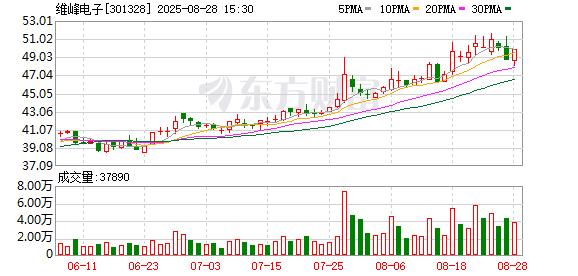
维峰电子:昆山维康工厂主要服务于华东区域客户
Zheng Quan Ri Bao· 2025-08-28 08:45
Group 1 - The core viewpoint of the article is that Weifeng Electronics is expanding its production capacity through the Kunshan Weikang factory, which will serve as the company's second-largest capacity extension [2] - The Kunshan factory will primarily cater to customers in the East China region, providing a strong impetus for future business growth [2] - The specific products to be produced at the Kunshan factory will depend on customer demand [2]