人民币汇率

Search documents
金融大家评 | 人民币为何走强?明年能否破“7”?
清华金融评论· 2025-12-20 09:14
Core Viewpoint - The article discusses the recent appreciation of the RMB against the USD, highlighting the factors driving this trend and the outlook for the currency in 2026, emphasizing the importance of external and internal economic conditions [2][3][7]. Group 1: Reasons for RMB Appreciation - The appreciation of the RMB is primarily driven by two forces: the weakening of USD credit and the Federal Reserve's easing policies [3]. - A significant factor supporting the RMB's appreciation is the shift in foreign trade enterprises' willingness to convert their earnings, reversing a three-year trend of reluctance to do so [3]. - The recent capital inflow, particularly after the Fed announced a new easing cycle, has been largely attributed to foreign trade enterprises' increased currency conversion activities [3]. Group 2: Central Bank's Management of Cross-Border Liquidity - The central bank has effectively managed cross-border liquidity by lowering swap market premiums to control the pace of foreign capital inflow and guiding domestic expectations through the midpoint rate [4]. - The goal is to align domestic and foreign pricing with the central bank's expectations, achieving a "three-price unification" [4]. Group 3: Changes in RMB Exchange Rate Dynamics - Since April, the negative spread between the RMB midpoint and spot exchange rates has been notable, indicating that the midpoint has been guiding the appreciation of the spot rate [5]. - Seasonal factors, such as increased currency conversion by foreign trade enterprises and overseas workers sending money home before the Lunar New Year, are expected to support the RMB's strength [5]. - The recent shift from a negative to a positive spread between the midpoint and spot rates may reflect adjustments in the central bank's stance [6]. Group 4: Outlook for RMB Exchange Rate in 2026 - The RMB is expected to appreciate gradually in 2026, influenced by the restructuring of the international monetary system and the U.S. government's preference for a weaker dollar [8]. - The narrowing of interest rate differentials between China and the U.S. is likely to support the RMB, as the Fed continues its easing cycle [8]. - Increased internationalization of the RMB, supported by China's competitive manufacturing sector, is anticipated to enhance the currency's attractiveness and stability [8]. Group 5: External Factors and Uncertainties - The impact of U.S.-China tariffs on the RMB is expected to diminish as both economies show resilience under trade pressures [9]. - However, uncertainties remain, including domestic economic stability and external trade relations, which could affect the RMB's performance [12]. - The potential for further depreciation of the USD, driven by the Fed's policies and economic conditions, may also influence the RMB's trajectory [11].


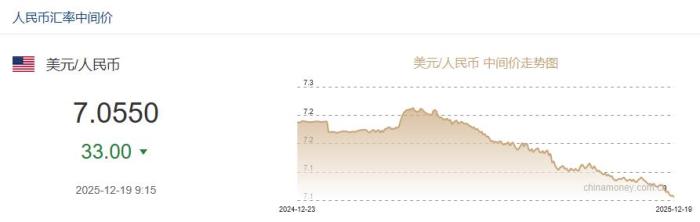
12月19日人民币对美元中间价报7.0550 上调33个基点
Zhong Guo Xin Wen Wang· 2025-12-19 01:43
图源:中国外汇交易中心网站截图 12月19日人民币对美元中间价报7.0550 上调33个基点 中新网12月19日电 据中国外汇交易中心网站消息,中国人民银行授权中国外汇交易中心公布,2025年 12月19日银行间外汇市场人民币汇率中间价为:1美元对人民币7.0550元,上调33个基点。 本文为转载内容,授权事宜请联系原著作权人 中新经纬版权所有,未经书面授权,任何单位及个人不得转载、摘编或以其它方式使用。 关注中新经纬微信公众号(微信搜索"中新经纬"或"jwview"),看更多精彩财经资讯。 来源:中国新闻网 编辑:郭晋嘉 广告等商务合作,请点击这里 ...
人民币对美元中间价报7.0550 调升33个基点
Zhong Guo Jing Ji Wang· 2025-12-19 01:35
中国人民银行授权中国外汇交易中心公布,2025年12月19日银行间外汇市场人民币汇率中间价为: 1美元对人民币7.0550元,1欧元对人民币8.2616元,100日元对人民币4.5274元,1港元对人民币0.90675 元,1英镑对人民币9.4267元,1澳大利亚元对人民币4.6578元,1新西兰元对人民币4.0655元,1新加坡 元对人民币5.4639元,1瑞士法郎对人民币8.8700元,1加拿大元对人民币5.1131元,人民币1元对1.1365 澳门元,人民币1元对0.57946马来西亚林吉特,人民币1元对11.3508俄罗斯卢布,人民币1元对2.3739南 非兰特,人民币1元对209.46韩元,人民币1元对0.52147阿联酋迪拉姆,人民币1元对0.53250沙特里亚 尔,人民币1元对46.9184匈牙利福林,人民币1元对0.50874波兰兹罗提,人民币1元对0.9047丹麦克朗, 人民币1元对1.3174瑞典克朗,人民币1元对1.4419挪威克朗,人民币1元对6.07374土耳其里拉,人民币1 元对2.5529墨西哥比索,人民币1元对4.4624泰铢。 (责任编辑:华青剑) 中国经济网北京12月19日 ...
“十五五”首席观察|专访明明:明年长债利率有望阶段性下行
Bei Jing Shang Bao· 2025-12-18 07:32
Group 1: Economic Outlook for 2026 - In 2026, China's economic policies will focus on releasing consumption potential, particularly in service consumption, durable goods renewal, and new consumption scenarios [1][4] - The core contradiction restricting consumer spending is the cautious expectations under medium to long-term uncertainties, rather than just insufficient current income [5] - The monetary policy is expected to shift from total easing to structural optimization, with the People's Bank of China likely to implement more targeted measures to guide funds to key sectors of the economy [6] Group 2: Currency and Debt Market Insights - The RMB is expected to appreciate moderately in 2026, supported by trade surplus resilience and improved capital flow structure, despite uncertainties from US-China interest rate differentials and geopolitical factors [7] - Long-term bond yields are anticipated to experience a phase of decline in 2026, influenced by fiscal expansion and the central bank's supportive monetary policy, although short-term market disturbances may persist [8] Group 3: Internal and External Economic Strategies - Strengthening "internal circulation" does not imply weakening external openness; instead, it aims to enhance the economy's autonomy and resilience [10] - Coordinated efforts between expanding domestic demand and promoting high-level institutional openness are essential for stabilizing foreign trade and investment expectations while responding to external shocks [10]

“十五五”首席观察|专访连平:扩大内需,推动内外循环深度融合
Bei Jing Shang Bao· 2025-12-18 06:01
Core Viewpoint - The macroeconomic environment in China is characterized by both opportunities and challenges as it transitions from the "14th Five-Year Plan" to the "15th Five-Year Plan," with a focus on stimulating domestic consumption and optimizing financial supply [1] Economic Policy and Monetary Measures - The People's Bank of China (PBOC) continues to maintain a loose monetary policy through tools like reserve requirement ratio (RRR) cuts and interest rate reductions to support economic recovery [1][8] - In 2026, there is a likelihood of a 0.25-0.5 percentage point RRR cut, and policy interest rates may be lowered by 0.1-0.3 percentage points to stimulate consumption and investment [2][9] Consumer Spending and Real Estate - Weak consumer spending is primarily attributed to a sluggish real estate market and income constraints, with future policies expected to focus on income growth and targeted real estate measures to unlock consumption potential [2][5] - The core issues affecting consumer spending include a decline in housing transactions impacting related consumption and the overall growth of various income sources [5] Consumption Growth Strategies - In 2026, China aims to expand the supply of quality consumer goods and services, fostering new consumption growth points and creating new consumption scenarios [6] - Policies will include increasing subsidies for consumption, optimizing the implementation of new policies, and enhancing income through various channels [6][7] Structural Financial Policies - The central economic work conference emphasizes the need for financial institutions to support key areas such as expanding domestic demand and technological innovation [10] - Structural monetary policy tools are expected to be expanded, with potential interest rate reductions to enhance support for small and micro enterprises and other critical sectors [10] Currency Outlook - The Chinese yuan is expected to appreciate in 2026, supported by factors such as stronger economic growth compared to the U.S., a favorable trade balance, and changing market expectations [12][11] - However, significant fluctuations in the yuan's value are unlikely, as regulatory measures will aim to maintain stability within a reasonable range [13] International Trade and Investment - The restructuring of global trade and the spillover effects of major economies' policies will remain significant external variables for China's economic development in 2026 [14] - Strategies will include enhancing foreign trade quality, expanding import trade, and promoting digital trade to foster a more integrated domestic and international market [15][16]

人民币大涨!重回“6时代”?
Sou Hu Cai Jing· 2025-12-18 01:51
(来源:船务资讯) 来源:市场资讯 近期外汇市场上,人民币对美元汇率表现强势,呈现持续升值态势。12月16日,在岸与离岸人民币对美 元汇率双双走强,均突破7.05关口。其中,离岸人民币汇率盘中最高升至7.0358,在岸人民币汇率盘中 最高触及7.0417,两者均创下自2024年10月8日以来的新高,市场关注点逐渐聚焦于人民币能否进一步 逼近乃至突破"7.0"这一重要心理关口。 近期走强的主要原因 政策层面的引导也为汇率稳健运行奠定了基础。市场观察到,尽管人民币市场汇率快速上升,但央行每 日设定的人民币中间价调整幅度相对温和。这表明当前政策方向旨在维持汇率在合理均衡水平上的基本 稳定,允许市场力量驱动人民币适度升值,同时避免形成单边的升值或贬值预期。从全年整体表现来 看,人民币汇率走出了渐进升值的轨迹,截至12月15日,离岸人民币年内累计升值幅度约为4%。 市场关注点与短期展望 随着人民币汇率不断接近"7.0"关口,市场对其后续走势讨论热烈。综合机构观点来看,在年底结汇需 求支撑、美元偏弱以及稳健的汇率政策共同作用下,人民币短期内大概率将维持偏强运行格局。存在观 点认为,在季节性因素影响下,汇率阶段性突破"7. ...
人民币对美元中间价报7.0583 调贬10个基点
Zhong Guo Jing Ji Wang· 2025-12-18 01:39
中国经济网北京12月18日讯 来自中国外汇交易中心的数据显示,今日人民币对美元汇率中间价报 7.0583,较前一交易日调贬10个基点。 中国人民银行授权中国外汇交易中心公布,2025年12月18日银行间外汇市场人民币汇率中间价为: 1美元对人民币7.0583元,1欧元对人民币8.2759元,100日元对人民币4.5299元,1港元对人民币0.90736 元,1英镑对人民币9.4251元,1澳大利亚元对人民币4.6525元,1新西兰元对人民币4.0645元,1新加坡 元对人民币5.4597元,1瑞士法郎对人民币8.8612元,1加拿大元对人民币5.1126元,人民币1元对1.1357 澳门元,人民币1元对0.58001马来西亚林吉特,人民币1元对11.4148俄罗斯卢布,人民币1元对2.3789南 非兰特,人民币1元对209.42韩元,人民币1元对0.52120阿联酋迪拉姆,人民币1元对0.53229沙特里亚 尔,人民币1元对46.9909匈牙利福林,人民币1元对0.50895波兰兹罗提,人民币1元对0.9030丹麦克朗, 人民币1元对1.3199瑞典克朗,人民币1元对1.4480挪威克朗,人民币1元对6.06 ...
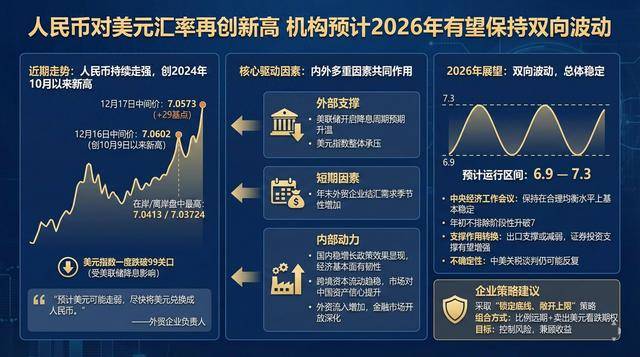
人民币对美元汇率再创新高 机构预计2026年有望保持双向波动
Sou Hu Cai Jing· 2025-12-17 15:08
Core Viewpoint - The recent strengthening of the RMB against the USD is attributed to multiple internal and external factors, including expectations of a US interest rate cut and seasonal demand for currency exchange among export enterprises [2][3]. Group 1: Currency Exchange and Market Dynamics - Dongguan Xile Toy Co., Ltd. has reduced its USD holdings and is quickly converting USD to RMB after export transactions due to expectations of a weaker USD [2]. - On December 17, the RMB's central parity rate against the USD was reported at 7.0573, an increase of 29 basis points from the previous trading day [2]. - The RMB's onshore and offshore rates reached new highs since October 2024, with the onshore rate peaking at 7.0413 and the offshore rate at 7.03724 [2]. Group 2: Economic Factors Influencing RMB Strength - The market's anticipation of the Federal Reserve's interest rate cuts has placed downward pressure on the USD index, providing support for non-USD currencies, including the RMB [3]. - Domestic policies aimed at stabilizing growth are showing positive effects, enhancing confidence in Chinese assets and stabilizing cross-border capital flows [3]. - Seasonal increases in foreign trade enterprises' demand for currency exchange have also contributed to the short-term rise in RMB demand [3]. Group 3: Future Outlook on RMB Exchange Rate - Analysts predict that the RMB may continue to appreciate against the USD, with potential for the exchange rate to temporarily exceed 7 due to seasonal demand [4]. - By 2026, the RMB's exchange rate is expected to exhibit two-way fluctuations while maintaining overall stability, with a projected central rate increase of 2%-3% compared to 2025 [4]. - Companies are advised to adopt strategies that lock in exchange rates while allowing for potential gains from RMB appreciation and fluctuations [4].
洪灝:大宗商品未来会继续有所表现,人民币被严重低估,AI谈泡沫破裂还是过早
对冲研投· 2025-12-17 12:01
Core Viewpoint - The focus of policies is expected to shift from external trade competition to domestic economic development in 2026, which could positively impact the stock market if economic performance is stable [4][8][9]. Policy Shift - The upcoming year is the first year of the five-year plan, indicating a high probability of significant policy announcements and support for economic growth [8]. - Monetary policy is expected to remain moderately loose, with increased fiscal efforts to support domestic economic construction [8]. AI Market Analysis - Current valuations in the U.S. AI market are at historical highs, but conditions for a bubble burst, such as weakened liquidity and high leverage, have not yet been observed, making it premature to discuss a bubble collapse [10][12]. - Despite high valuations, major tech companies continue to show strong cash flow and growth rates, indicating that while a bubble exists, its timing for a potential burst is uncertain [11][12]. Investment Strategy - Investors are advised to allocate 50% of their portfolio to non-U.S. markets due to the peak performance of U.S. stocks and anticipated depreciation of the U.S. dollar [13][15]. - The upcoming change in the U.S. Federal Reserve leadership may lead to more accommodative monetary policies, increasing pressure on the dollar's value [15]. Currency Outlook - The Chinese yuan is considered severely undervalued, with recent strengthening indicating the beginning of an appreciation trend, potentially reaching 7.05 against the dollar [16][17]. - The actual exchange rate of the yuan has depreciated by over 25% in recent years, despite strong export performance, suggesting significant room for appreciation [17]. AI Sector Investment - Continued investment in leading Chinese AI companies is recommended, as the technological gap between China and the U.S. is narrowing [18][19]. - The trend of large tech companies transitioning to AI-focused operations is expected to become more pronounced [19]. Commodity Market Outlook - The demand for commodities is anticipated to remain strong due to the resource needs driven by AI development and the economic cycle entering its mid-to-late phase [21][23]. - The performance of precious metals and industrial metals is expected to continue to strengthen, supported by the capital-intensive nature of AI technologies [22][23].

人民币汇率新动态:对美元创阶段性新高,哪些人受益,哪些行业承压?
Sou Hu Cai Jing· 2025-12-17 06:14
Core Viewpoint - The recent appreciation of the Chinese yuan against the US dollar has significant implications for various groups, with both positive and negative effects depending on their economic activities and exposure to foreign currencies [1][3]. Group 1: Impact on Different Groups - For individuals planning to study abroad, travel, or shop internationally, the stronger yuan means they can exchange less money for more foreign currency, effectively reducing costs [1]. - Export-oriented companies, particularly in traditional manufacturing, face increased pressure as their products become more expensive in international markets, potentially harming competitiveness and profit margins [1]. - Companies with dollar-denominated debts, such as real estate firms that borrowed in USD, benefit from a lower repayment cost in yuan, easing financial burdens [1]. Group 2: Factors Behind Yuan Strength - The appreciation of the yuan is driven by several key factors, including a shift in macroeconomic policies abroad, particularly the end of the US interest rate hike cycle, which diminishes the dollar's attractiveness [3]. - China's economic policies remain stable, and strong export performance has led to significant foreign exchange inflows, supporting the yuan's value [3]. - A robust trade surplus increases demand for the yuan internationally, further bolstering its strength [3]. Group 3: Understanding Exchange Rates - The yuan's exchange rate can be observed through two main windows: onshore and offshore rates, with the former being influenced more directly by domestic policies [5]. - The yuan operates under a managed floating exchange rate system, allowing for fluctuations based on market supply and demand while also permitting policy interventions to prevent extreme volatility [5]. Group 4: Strategic Financial Planning - Individuals are encouraged to adopt a strategic approach to currency exchange, such as staggered currency conversion during favorable exchange rate periods, rather than attempting to predict short-term fluctuations [7]. - Maintaining financial health through diversified asset allocation and stable cash flow is emphasized, as the impact of exchange rate changes is often indirect and complex [7].