
指数化投资

Search documents
助力提升获得感 深交所携投资者走进新希望
Zhong Zheng Wang· 2025-05-09 13:58
Group 1 - The core activity of the event was to provide investors with insights into New Hope's competitive advantages in the agricultural and livestock food production sector [1] - New Hope, founded in 1982, has become a leading listed company in China's agricultural and livestock food industry, focusing on feed production, pig farming and slaughtering, and food processing and sales [1] - The company is leveraging its full industry chain advantages to significantly reduce costs and improve efficiency, utilizing modern technology for pig breeding and AI in cold chain distribution [1] Group 2 - The Shenzhen Stock Exchange (SZSE) is committed to promoting the ETF market through product innovation, service enhancement, and frontline regulation [2] - The SZSE aims to support the healthy development of the capital market and provide strong backing for the high-quality development of the real economy [2] - The exchange is focused on creating better investment services and value for investors through various investment strategies, including core ETF single product and combination investment strategies [2]

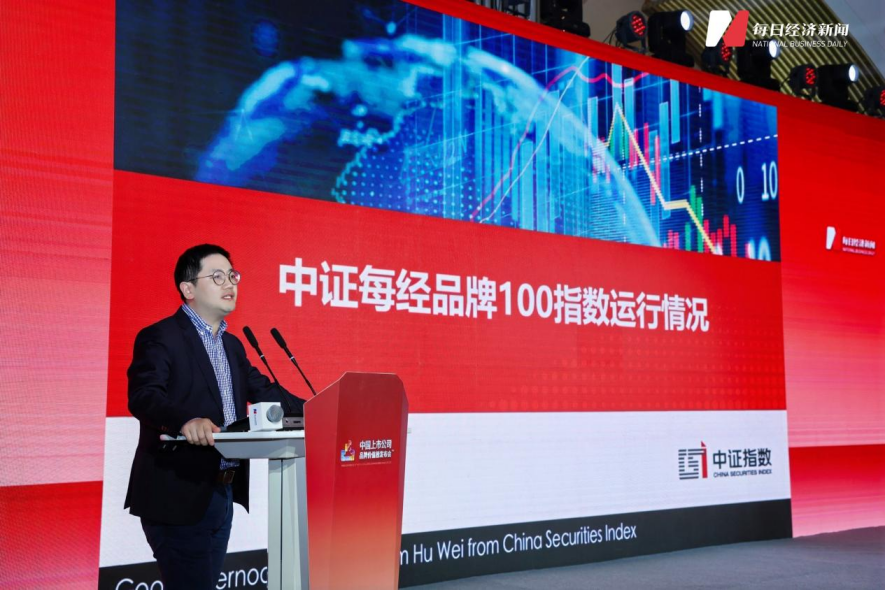
中证指数有限公司市场服务部副总经理胡威:每经品牌100指数长期收益表现良好 大市值风格属性突出
Mei Ri Jing Ji Xin Wen· 2025-05-09 11:48
Core Insights - The "2025 9th China Listed Company Brand Value List Release Conference" was held on May 9, focusing on the theme "Digital Intelligence Upgrade, Brand Resonance" with participation from economists, brand experts, and executives from nearly 200 listed companies [1] Group 1: Index Development and Performance - The "Everyday Brand 100 Index" (code: 931852) was discussed, highlighting its annual performance, which shows good long-term returns, significant large-cap characteristics, strong dividend traits, and positive ESG practices [2][5] - Global ETF market continues to grow, with the total size expected to exceed $15 trillion by the end of 2024, and net inflows reaching nearly $1.8 trillion, doubling the amount from 2023 [3] - Domestic index investment is rapidly expanding, with 2,575 index products totaling over 5 trillion yuan, a nearly 70% year-on-year increase [3] Group 2: Brand Value Index Characteristics - The "Everyday Brand 100 Index" reflects the recognition and expectations of the capital market for high brand value and sound financial conditions among listed companies [5] - The index is heavily weighted towards sectors such as consumer discretionary, communication services, finance, and industrials, accounting for 90.09% of the total weight [5] - The average total market capitalization of the index's sample is 3.537 billion yuan, significantly higher than the 1.495 billion yuan of the CSI 300 [5] Group 3: Dividend and ESG Performance - The index's sample companies announced a total dividend of 1.28 trillion yuan for 2024, representing 54.70% of the total dividends declared by A-share companies [6] - The dividend yield of the index is 2.48%, surpassing the 2.10% yield of the CSI All Share Index [6] - The average ESG score of the index's sample companies is 0.89, significantly higher than the market average of 0.49 [6]

公募基金行业2024年业绩全景透视:头部机构韧性凸显 中小公司差异化突围
Zheng Quan Ri Bao· 2025-05-07 16:16
Core Insights - The public fund industry in China has shown a trend of "the strong getting stronger and niche breakthroughs" amid market reforms and international financial turbulence, with the total industry scale reaching 32.83 trillion yuan by the end of 2024, an increase of 5.23 trillion yuan or 18.95% year-on-year [1] - The number of products in the industry has grown to 12,367, an increase of 839 from the end of 2023, indicating a diversification in offerings [1] Group 1: Performance of Leading Institutions - Leading public fund institutions demonstrated resilience in 2024, with seven top firms, including E Fund, Tianhong Fund, and Southern Fund, collectively contributing 43% of the net profit of the industry despite facing pressure from fee reductions [2] - E Fund led with a revenue of 12.11 billion yuan and a net profit of 3.9 billion yuan, achieving a net profit growth of 15.33% year-on-year despite a slight revenue decline of 3.13% [2] - Tianhong Fund and Southern Fund also reported strong performances, with net profit growth rates of 19.29% and 16.92%, respectively, driven by diversified business strategies [2][3] Group 2: Strategies of Small and Medium Institutions - In contrast to the leading firms, some small and medium public funds achieved remarkable growth through differentiated strategies, with firms like Dongwu Fund and Zhongjin Fund seeing net profit increases exceeding 45% [4] - Dongwu Fund's net profit surged by 274.84% through a "fixed income + equity" dual-drive strategy, while Zhongjin Fund's focus on public REITs led to a 170.17% increase in net profit [4] - The growth of index funds has also benefited firms like Huatai-PB Fund, which saw a 45.53% increase in net profit, supported by its leading position in the non-monetary ETF market [4] Group 3: Path to High-Quality Development - The path to high-quality development for the public fund industry is becoming clearer, with institutions focusing on enhancing core investment research capabilities and asset allocation skills [6] - Institutions like Zhongjin Fund are prioritizing the development of high-quality fixed income products and public REITs, while firms like Southern Fund are optimizing customer service systems to improve investor satisfaction [6] - The industry is at a crossroads, with leading firms needing to leverage their scale for continuous innovation, while smaller firms must focus on differentiation to survive [6] Group 4: Strategic Recommendations - Public fund institutions are advised to focus on three strategic areas: product innovation, investment research system enhancement, and operational management optimization [7] - Key product trends include increasing exposure to index investments, optimizing fixed income product lines, and exploring green finance and ESG investments [7] - Strengthening investment research capabilities and enhancing investor engagement are also critical for creating long-term value and satisfaction [7]
2025年6月沪深核心指数成分股调整预测【国信金工】
量化藏经阁· 2025-05-07 14:46
Core Viewpoint - The increasing acceptance of index investing among investors has led to a significant growth in the scale of index funds, reaching a total of 3.26 trillion yuan as of March 31, 2025 [1][8]. Index Predictions CSI 300 Index - Predictions indicate that seven stocks, including Guohang Airlines, Lingyi Technology, and Softcom Power, will be added to the CSI 300 Index, while seven stocks, such as Hualan Biological and 37 Interactive Entertainment, will be removed [2]. SSE 180 Index - Twelve stocks, including Yutong Bus and Shengyi Technology, are expected to be added to the SSE 180 Index, while twelve stocks, such as China Satellite and Zhangjiang Hi-Tech, are predicted to be removed [3]. SSE 50 Index - Four stocks, including AVIC Shenfei and China Aluminum, are forecasted to be added to the SSE 50 Index, while four stocks, such as Tongwei Co. and China Railway, are expected to be removed [4]. STAR 50 Index - It is predicted that Hengxuan Technology will be added to the STAR 50 Index, while Zhongfu Shenying will be removed [5]. CSI 500 Index - Fifty stocks, including GeKong Micro and HuaiBei Mining, are expected to be added to the CSI 500 Index, while fifty stocks, such as Goodway and Guangqi Technology, are predicted to be removed [6]. ChiNext Index - Eight stocks, including Changying Precision and Jiejie Micro, are forecasted to be added to the ChiNext Index, while eight stocks, such as Anke Bio and Dongfang Risheng, are expected to be removed [7].

什么是价值投资
雪球· 2025-05-07 05:48
Core Viewpoint - The essence of value investing lies in assessing the intrinsic value of a company relative to its market price, emphasizing a significant margin of safety in investment decisions [2][4]. Group 1: Value Investing Principles - Value investing requires viewing stocks as parts of businesses and providing an absolute valuation, which distinguishes it from index investing [2]. - The concept of safety margin is crucial, where an investor must determine the intrinsic value of a stock before making a purchase [7]. Group 2: Dividend Investing - Dividend investing can evolve into value investing if the dividend yield significantly exceeds government bond rates, focusing on income rather than outperforming the market [4]. - The Gordon dividend model can be applied to perpetual dividend portfolios to assess their value [5]. Group 3: Performance Metrics - The long-term average annual return of the CSI 300 is approximately 10%, which sets a benchmark for evaluating dividend growth rates [6]. - If the goal is not to outperform the market, a lower discount rate can be applied, making it easier to achieve reasonable growth expectations [6]. Group 4: Valuation and Safety Margin - Clear valuation is essential for determining safety margins, with examples illustrating the need for significant discounts to intrinsic value when investing in high-profile stocks like Moutai [7]. - A rough estimate of intrinsic value should be established, with a target of purchasing at a significant discount, ideally below 50% of the estimated value [7]. Group 5: Investment Strategy - The Snowball Three-Factor Method promotes long-term investment and asset allocation through diversification across assets, markets, and timing to achieve diversified returns and risk mitigation [8].


金融深一度 | 指数力量崛起重塑A股定价逻辑
Zheng Quan Ri Bao· 2025-05-06 16:17
Core Insights - The rise of passive index funds, particularly ETFs, is significantly influencing the A-share market and its pricing logic, marking a shift in the investment landscape [1][2][3] Group 1: ETF Growth and Market Impact - The total scale of ETFs in the domestic market has surpassed 4 trillion yuan, with the latest expansion cycle taking only about 6 months, indicating rapid growth [2][5] - The growth of ETFs is driven by policy support, market conditions, public fund development, and increasing investor demand for diversified investment options [2][5] - ETFs are reshaping the public fund industry and significantly affecting the pricing logic of the A-share market, as they gain more "voice" in investment decisions [2][3] Group 2: Structural Changes in A-share Pricing Logic - The development of index-based investment is expected to structurally reshape the pricing logic of the A-share market, enhancing the liquidity premium of constituent stocks [3][4] - The passive tracking nature of index funds may lead to a systematic increase in the valuation of stocks included in mainstream indices, while the price discovery function for smaller non-constituent stocks may weaken [3][4] Group 3: Role of ETFs in Supporting Innovation and Economic Development - The growth of ETFs is facilitating the flow of resources towards technology innovation and sectors aligned with national strategic development, creating a synergy between policy and market [7][8] - ETFs are acting as a stabilizer in the market, especially in challenging market conditions, and are expected to play a central role in investment strategies [4][7] Group 4: Long-term Implications for Listed Companies - The long-term investment logic of passive index funds is likely to encourage listed companies to focus more on market capitalization management and long-term strategic planning [8][9] - Companies are expected to enhance their governance structures and increase investments in innovation and sustainable development to improve their competitiveness [8][9] Group 5: Future of Index Investment Ecosystem - The index investment ecosystem in China is still developing, with significant room for growth, requiring collaboration among market participants to enhance its quality [10][11] - Regulatory bodies are actively promoting the high-quality development of index investment, aiming to create a favorable environment for long-term capital inflow [10][11]



大资管结构巨变,保险及公募成C位!华宝证券张青:打破以产品为中心的传统运营
券商中国· 2025-05-02 05:50
Core Viewpoint - The report "2025 Financial Products Annual Report: Ecological Leap" by Huabao Securities highlights significant changes in the asset management industry, emphasizing the growing gap between insurance, public funds, and other asset management businesses, as well as the shift towards a buyer-centric investment advisory model [1][2]. Group 1: Industry Structure and Trends - The asset management industry in China has seen a substantial shift, with insurance and public funds significantly outpacing other asset management sectors in terms of scale [5]. - The public fund sector surpassed bank wealth management products in 2023, with expectations to further widen the gap in 2024 due to accelerated indexation [5]. - The transition to net value-based operations has not only transformed bank wealth management products but has also reshaped the entire industry ecosystem [6]. Group 2: Drivers of Growth - The growth of insurance asset management is attributed to a steady increase in funding sources and long-term stability, driven by rising insurance awareness and wealth preservation needs [7]. - Public funds have experienced rapid growth due to policy support, increased demand for wealth management, and innovation within the sector [8]. - The shift towards index-based investment strategies has significantly contributed to the growth of both public funds and ETFs, with the latter experiencing explosive growth in 2024 [17]. Group 3: Competitive Landscape - The asset management industry is facing common challenges such as the need for differentiated strategic positioning, diversified strategies, and enhanced client service capabilities [9][10]. - The competition is increasingly focused on improving customer service capabilities and leveraging AI technologies to optimize investment decisions and operational efficiency [9][10]. - The industry is moving away from a product-centric operational model towards a more service-oriented approach, emphasizing the importance of understanding and meeting client needs [10][13]. Group 4: Talent and Technology - The rise of smart investment advisory tools is reshaping the talent structure within the asset management industry, reducing reliance on traditional human advisors while creating demand for new skills in financial technology and data analysis [14][15]. - The integration of advanced technologies like generative AI and big data is enhancing operational efficiency and enabling personalized wealth management services [14][15]. Group 5: Market Insights - In the bank wealth management market, the total scale reached 30 trillion yuan in 2024, driven by declining deposit rates [16]. - The public fund market is witnessing a significant increase in the issuance of fixed-income funds, which accounted for approximately 70% of new fund issuance in 2024 [17]. - The securities asset management sector is evolving, with a focus on enhancing research capabilities and diversifying product offerings, although the pace of public fund establishment has slowed [18].
五一快乐;螺丝钉精华文章汇总|2025年4月
银行螺丝钉· 2025-05-01 13:54
Core Viewpoint - The article emphasizes the importance of gathering and summarizing valuable investment knowledge and data-driven insights for better decision-making in the financial markets [2][3]. Summary by Sections Dividend Valuation Table - The article provides a summary of the weekly dividend index valuations and dividend-paying index funds for reference [5]. - Key metrics include: - Shanghai Dividend Index: Earnings Yield 10.20%, P/E 9.80, P/B 0.98, Dividend Yield 6.07% [7]. - CSI Dividend Index: Earnings Yield 10.14%, P/E 9.86, P/B 1.00, Dividend Yield 5.81% [8]. Market Signals and Investment Strategies - The article discusses the current market conditions, indicating that the market is relatively undervalued, suggesting opportunities for active selection and index-enhanced investment strategies [14]. - It highlights the importance of being patient and waiting for the right investment opportunities during market fluctuations [20]. Fund Manager Insights - The article summarizes insights from fund managers based on their 2024 annual reports, focusing on their investment styles and market outlooks [16]. - It notes that different fund managers have varying preferences, such as value-oriented managers favoring undervalued stocks, while growth-oriented managers prioritize growth rates [16]. Index and Investment Tools - The article introduces the "Preferred 300 Index," which selects stocks with high and stable ROE and strong dividend capabilities, indicating a value investment strategy [21]. - It also mentions the development of index funds in the A-share market, predicting a rapid growth trajectory similar to that of overseas markets [15]. Educational Resources - The article promotes a collection of investment literature and resources, including a list of recommended books for enhancing investment knowledge [17]. - It encourages readers to engage with educational content to build their investment acumen [17].
出口含“新”量更足!沪市主板公司以积极笔触描摹出中国经济大格局的稳健形制
Zheng Quan Ri Bao Zhi Sheng· 2025-04-30 14:41
Core Viewpoint - The Shanghai Stock Exchange's main board companies have shown resilience and stability in their performance, supported by a series of incremental policies, reflecting a robust economic structure in China [1] Group 1: Export Market Diversification - In 2024, companies on the Shanghai main board achieved overseas revenue of 6.09 trillion yuan, a year-on-year increase of 7%, with non-US exports accounting for over 80% [2] - Key export destinations include ASEAN, Africa, and countries involved in the Belt and Road Initiative, with significant growth in sales for companies like SANY Heavy Industry and SAIC Motor [2] - Major construction state-owned enterprises have actively expanded overseas, signing new orders worth 1.87 trillion yuan, a year-on-year increase of 15% [2] Group 2: High-Tech Product Exports - High-tech products such as high-end equipment, integrated circuits, smart home appliances, and electric vehicles have accelerated exports, leading to revenue growth in related industries [3] - Companies like Oriental Cable and Zhaoyi Innovation have made significant strides in international markets, with Zhaoyi Innovation achieving record high shipments [3] - The rise of new business models like cross-border e-commerce has boosted overseas sales for various sectors, including light manufacturing and retail [3] Group 3: Mergers and Acquisitions Activity - From 2024 to the first quarter of 2025, over 1,500 new M&A transactions were recorded on the Shanghai main board, with a total transaction value exceeding 1.4 trillion yuan [4] - Notable M&A cases include Guotai Junan's acquisition of Haitong Securities and China Shipbuilding's proposed merger with China CSSC, each exceeding 100 billion yuan [4] - The trend of private acquisitions and the purchase of quality non-profitable assets has emerged, indicating a shift in M&A strategies [4][5] Group 4: Quality Improvement and Efficiency - By 2024, 946 companies on the Shanghai main board disclosed "quality improvement and efficiency return" action plans, with nearly 60% participation [6] - Among the companies that disclosed plans, nearly 90% achieved profitability, and almost 50% reported performance growth [6] - The total cash dividend announced by 1,259 companies reached 1.77 trillion yuan, a year-on-year increase of 6%, with a dividend payout ratio of 39% [7] Group 5: ESG Reporting and Progress - In 2024, 1,068 companies on the Shanghai main board disclosed ESG reports, achieving a disclosure rate of approximately 63%, an increase of 6 percentage points year-on-year [9] - The number of companies included in the MSCI ESG rating increased, with 90 companies receiving upgrades in their ratings [9] - Companies have actively engaged in social responsibility initiatives, contributing to employment and environmental sustainability [10] Group 6: Index Investment Growth - In 2024, net inflows into ETFs on the Shanghai main board reached nearly 840 billion yuan, with significant participation from foreign capital [11] - The trading volume of ETFs ranked first in Asia, with a total trading amount of nearly 30 trillion yuan [11] - Foreign investment preferences are concentrated in sectors such as banking, food and beverage, and public utilities, indicating a strategic focus on stable industries [12] Group 7: Exit Mechanisms and Risk Mitigation - Since 2025, 19 companies on the Shanghai main board have faced various forms of delisting, with a significant portion resulting from financial issues [13] - The introduction of diverse exit channels, including voluntary delisting and asset restructuring, has become more prominent [13] - Companies have actively taken measures to improve operations and mitigate risks, with several successfully lifting delisting warnings [13]




两大指数公司行动!下调ETF等指数使用费 指数化投资有望提速发展
2 1 Shi Ji Jing Ji Bao Dao· 2025-04-30 14:20
21世纪经济报道特约记者 庞华玮 广州报道 指数使用费调整 "我们确实已经收到中证指数公司和深圳证券信息公司(国证指数)下发的降费通知,且调整方案已明 确从 2025 年 4 月 1 日起正式执行。"一位不愿透露名字的基金公司人士告诉21世纪经济报道记者。 中证指数公司取消新增授权指数产品的许可使用固定费,基点费率下调20%,并调整基点费季度下限, 股票指数产品的基点费下限统一调整至2万元/季度,非股票指数产品及规模在1亿元以下的股票指数产 品不设基点费季度下限。 同时,深证信息公司同步调降,股票指数ETF、场外基金基点费率分别降至0.024%、0.016%,增强型产 品基点费率为对应产品类型的八折,同时将季度收取下限调降至2万元,扩大了不设季度收取下限的指 数产品范围。 多家基金公司也证实,收到中证指数公司和深圳证券信息有限公司调降指数授权费的通知。两家指数公 司的调降方案均自4月1日起正式生效。指数管理费率是按季度收取,也即是今年二季度相关指数产品授 权费用实施此次的调降方案。 指数费率改革进一步推进。 4月28日,中证指数公司和深圳证券信息有限公司同时宣布调整指数基金使用费。 调整指数授权费内容涉及三方 ...