
去美元化

Search documents
一旦伊朗倒了,真能如西方所愿拖垮中国?恐怕最先慌的是美利坚
Sou Hu Cai Jing· 2026-02-08 08:41
Core Insights - The importance of Iranian oil in the global market is often overstated by Western media, with actual export predictions for 2024-2025 indicating a daily average of 1.4 to 1.8 million barrels, accounting for less than 2% of global demand [1][3] - Major oil producers like Saudi Arabia, Russia, Iraq, and the UAE can easily compensate for any shortfall in Iranian oil supply, as Iran's oil constitutes only 10% to 15% of China's total crude imports [3][5] - China's energy landscape is evolving, with significant advancements in energy transition, reducing reliance on imported crude oil, and increasing the share of renewable energy sources [5][7] Group 1 - Iranian oil exports are projected to be between 1.4 million and 1.8 million barrels per day, which is less than 2% of global oil demand [1] - Despite Iran's oil being relatively cheaper, China's diversified import sources mean that any disruption in Iranian supply would not significantly impact its economy [3][5] - China's strategic oil reserves can support consumption for approximately 180 days, exceeding the International Energy Agency's requirement of 90 days [5] Group 2 - In the event of rising global oil prices due to Iranian supply issues, China, as the largest producer of intermediate and capital goods, would face increased manufacturing costs, which would be passed down the supply chain [7] - The U.S. economy is more vulnerable to oil price fluctuations due to its unique refinery structure and consumption patterns, which could lead to inflationary pressures [7] - The geopolitical landscape is shifting, with China becoming less dependent on oil imports and more resilient in the face of potential supply disruptions, while the U.S. may face greater economic challenges [7]


美元霸权开始塌方,全球去美元化加速,人民币为何还不出手?
Sou Hu Cai Jing· 2026-02-08 07:15
Core Viewpoint - The article discusses the evolving dynamics of global currency, particularly focusing on the decline of the US dollar's dominance and the strategic positioning of the Chinese yuan in the international market [1][3][5]. Group 1: Dollar's Decline - The US dollar's share in global foreign exchange reserves has decreased from 71% to 59% over the past 20 years, indicating a loosening of its absolute dominance [5] - Countries are diversifying their reserves and reducing reliance on the dollar, reflecting a trend towards a more multipolar currency system [5][15] - The article emphasizes that while the dollar remains strong, its supremacy is being challenged by countries like China and Russia, which are seeking alternatives to dollar-based transactions [3][5] Group 2: China's Strategy - China is not aggressively pursuing the status of the world's leading currency but is instead focusing on a strategic approach to internationalize the yuan [7][15] - The Chinese Cross-Border Interbank Payment System (CIPS) connects with 189 countries and regions, facilitating trade without relying on Western financial systems [9][7] - The goal is to ensure that the yuan can be used for essential commodities like energy and food during critical times, rather than aiming for immediate dominance over the dollar [9][11] Group 3: Economic Foundations - The yuan is backed by China's extensive industrial capabilities and supply chain networks, providing it with a tangible basis compared to the dollar, which is increasingly seen as backed by US debt [11][13] - The article argues that the true strength of a currency lies in its ability to secure real goods during crises, rather than its perceived value in financial markets [11][13] - China's approach aims to avoid the pitfalls of dollar hegemony, such as economic disparity and industrial hollowing, by promoting a healthier global financial system [13][15] Group 4: Future Outlook - The future may see a coexistence of multiple currencies rather than a return to a single dominant currency, as countries continue to diversify their payment methods and reserve holdings [15][17] - The article suggests that the focus should be on strengthening domestic industries, technology, and financial infrastructure to prepare for global economic shifts [17]
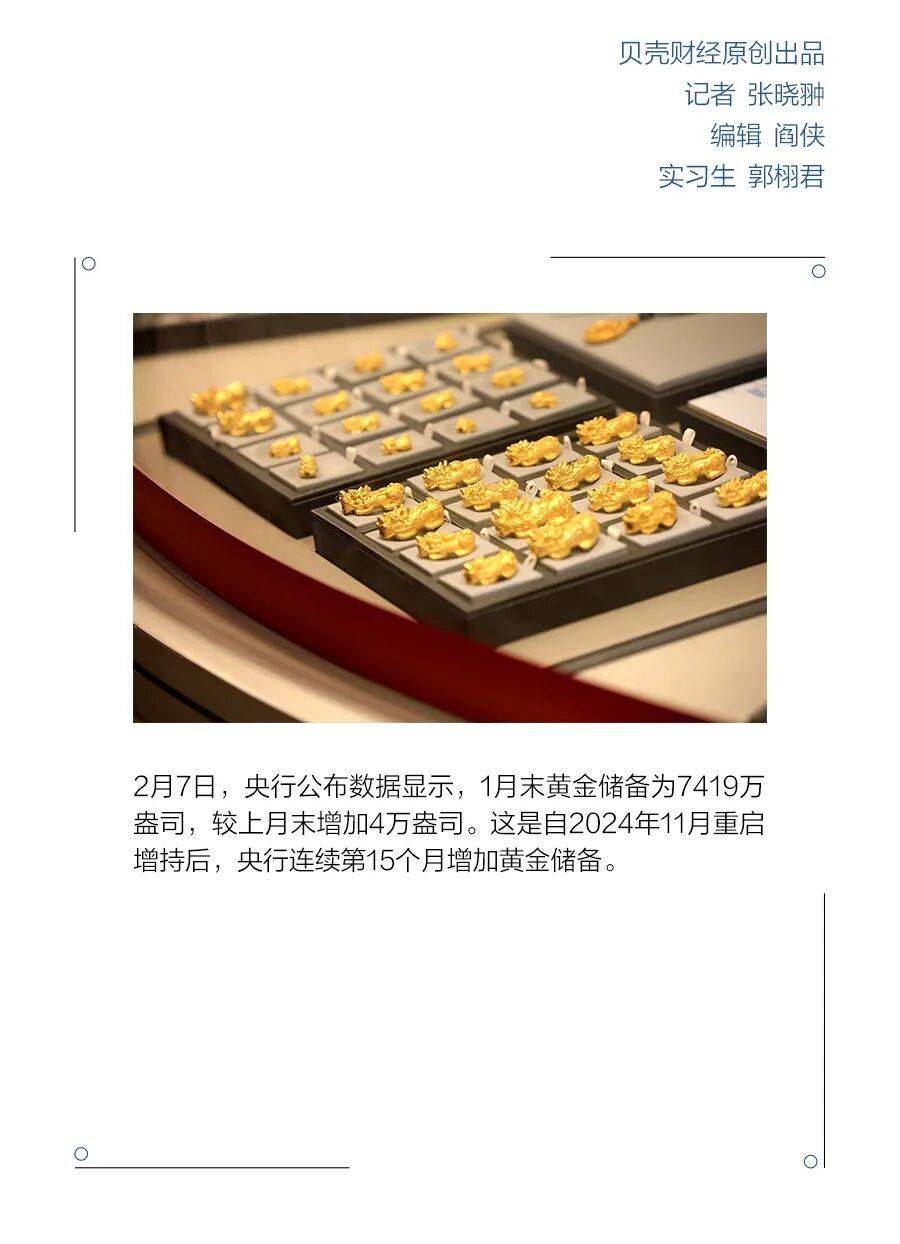
我国外汇储备规模已经连续6个月稳定在3.3万亿美元以上 黄金储备持续增加
Sou Hu Cai Jing· 2026-02-07 23:02
Group 1 - As of January 2026, China's foreign exchange reserves have remained stable above $3.3 trillion for six consecutive months, reaching $33,991 billion, an increase of $412 billion or 1.23% from December 2025 [1] - The increase in foreign exchange reserves is attributed to the depreciation of the US dollar and the overall rise in global financial asset prices, influenced by fiscal and monetary policies of major economies [1] - The People's Bank of China has increased its gold reserves for the 15th consecutive month, with gold reserves reported at 74.19 million ounces [2] Group 2 - The global central bank gold purchases in 2025 totaled 863 tons, which is lower than the previous three years but still at historically high levels, with 95% of surveyed central banks expecting to increase their gold reserves in the next 12 months [2][3] - The increase in gold reserves by central banks is seen as a strategic move to diversify foreign exchange reserves and reduce reliance on the US dollar, enhancing the stability and autonomy of national financial systems [3] - The demand for gold from global central banks is expected to remain high in 2026, indicating that the trend of increasing gold reserves is a long-term strategy not significantly affected by short-term factors [3]
紧急提醒!黄金暴跌只是开始,三大少见信号齐现,最大变盘将至!
Sou Hu Cai Jing· 2026-02-07 17:36
Core Insights - The recent volatility in the gold market, with prices soaring to $5,600 per ounce before plummeting 20%, indicates potential for significant market shifts ahead [1] Group 1: Rare Signals - Signal One: The hawkish shift in the Federal Reserve's policy under new Chairman Waller has dampened market expectations for easing, leading to a rebound in the dollar index and a surge in U.S. Treasury yields, which has burst the short-term gold bubble [3] - Signal Two: The extreme positioning in the market is evident, with gold ETF holdings reaching historical highs and silver futures' open interest accounting for 30% of global production, suggesting a crowded trade that could lead to a rapid sell-off [4] - Signal Three: The traditional safe-haven appeal of gold is showing signs of weakening as "de-dollarization" trends emerge, with central banks slowing gold purchases and investors shifting towards gold ETFs and accumulated gold, making gold price movements resemble those of stocks rather than safe-haven assets [5] Group 2: Support Before Potential Shift - Central banks remain a stabilizing force, with annual gold purchases exceeding 800 tons and significant buyers like Poland still active in the market [6] - The persistent issue of U.S. debt, with the debt-to-GDP ratio surpassing 130%, may exacerbate inflationary pressures under Waller's policies [6] - Technical indicators suggest a support range for gold between $4,600 and $4,800, where ten-year moving averages are concentrated, indicating potential for a rebound after recent declines [6]
金价从涨到跌仅1天!2月7日每克新价抄底者动了?
Sou Hu Cai Jing· 2026-02-07 17:24
Group 1 - The market for gold has experienced extreme volatility, with prices recently peaking at $5,600 per ounce before a dramatic drop of over 9% in a single day, reflecting divided market sentiment [1][3] - The forces driving gold prices upward remain intact, overshadowed temporarily by profit-taking waves, with central bank gold purchases and the ongoing de-dollarization process supporting long-term value [3][5] - Current market dynamics involve a struggle between speculative fund withdrawals and long-term capital positioning, with domestic gold-themed ETFs seeing a reduction of approximately 42.7 billion yuan, although net redemptions were relatively moderate [3][4] Group 2 - The silver market has shown even more volatility, the most significant since 1980, with its industrial and speculative attributes making it more sensitive to monetary policy and market sentiment changes [4] - Investors are advised to adopt a cautious approach to silver investments, waiting for speculative sentiment to fully release before making decisions based on fundamentals [4] - For asset allocation, it is generally recommended that gold constitutes 5-10% of total household assets, which can be increased to 15% in uncertain market conditions to serve as a hedge against inflation [4] Group 3 - Future gold price movements will depend on multiple factors, with UBS providing scenario-based forecasts of $7,200 per ounce in a bullish scenario and $4,600 per ounce in a bearish scenario, reflecting current market uncertainty [5] - The essence of the gold market is a confidence game, where gold's appeal as a hard currency increases when fiat currency credibility wanes, positioning gold as a strategic asset against currency devaluation risks [5] - The market's volatility presents opportunities for prepared investors, with each pullback potentially serving as a long-term investment window, emphasizing the importance of patience and discipline over chasing short-term price differences [5]
2月7日金价变天记!预期涨实际跌,价差打脸多少人?
Sou Hu Cai Jing· 2026-02-07 16:20
Core Viewpoint - The recent dramatic drop in gold prices, attributed to the unexpected nomination of Kevin Warsh as the head of the Federal Reserve, signals a potential shift towards tighter monetary policy, leading to a stronger dollar and undermining the foundation for gold's rise [1] Group 1: Market Reaction - On January 29, gold prices reached a historic high of $5,626 per ounce before experiencing a record single-day drop, marking the largest decline in 40 years [1] - The market reaction was immediate, with trading platforms experiencing system delays due to a surge in sell-offs, reflecting a sudden freeze in market sentiment [1] - Domestic gold jewelry prices fell, with brands like Chow Tai Fook and Lao Feng Xiang reducing prices from a high of 1,700 yuan per gram [3] Group 2: Investor Behavior - The atmosphere in Shenzhen's wholesale market was mixed, with some eager to liquidate their holdings fearing further price drops, while others viewed the decline as a buying opportunity [3] - A vendor noted that after the price drop, gold bar sales surged, indicating a strong demand for physical gold despite the volatility [3] - The market had been in an extreme overbought state, with gold prices rising over 29% in a single month, leading to speculative trading that was exacerbated by increased margin requirements from the Chicago Mercantile Exchange [3] Group 3: Long-term Outlook - Despite the short-term decline, long-term factors supporting gold prices remain intact, including the trend of de-dollarization, geopolitical uncertainties, and ongoing gold purchases by central banks [5] - Analysts suggest that this may not signify the end of a bull market but rather a technical adjustment following extreme price increases, potentially setting the stage for healthier future trends [5] - The market is closely monitoring the progress of Warsh's nomination in Congress and subsequent Federal Reserve policy signals, which will provide critical insights into gold's future direction [5] Group 4: Consumer Guidance - For ordinary consumers and investors, it is advised to view gold as part of an asset allocation strategy rather than a short-term speculative tool, to avoid impulsive decisions driven by market fluctuations [5] - Investment gold bars offered by banks are recommended for those prioritizing investment preservation, as their prices are more closely aligned with international gold prices and have standardized buyback channels [5] - Wholesale markets like Shenzhen's provide a transparent pricing model, with lower processing fees compared to branded stores, appealing to consumers familiar with market dynamics [5]
连续15个月!金价“史诗级波动”下央行仍在买黄金
Sou Hu Cai Jing· 2026-02-07 12:30
Group 1 - As of the end of January, China's foreign exchange reserves reached $339.91 billion, an increase of $41.2 billion from December 2025, marking a rise of 1.23% [3] - China's foreign exchange reserves have remained above $3.3 trillion for six consecutive months, showing a stable upward trend [3][10] - The increase in foreign exchange reserves is attributed to the decline in the US dollar index and the overall rise in global financial asset prices [11] Group 2 - In January, despite significant fluctuations in international gold prices, the People's Bank of China continued to increase its gold holdings, albeit at a lower volume of 40,000 ounces [5] - The international gold market experienced extreme volatility in January, with prices reaching nearly $5,600 per ounce before a significant drop of 9.25% at the end of the month, the largest single-day decline since 1983 [5] - The increase in gold prices was driven by geopolitical risks, expectations of Federal Reserve policy changes, and shifts in dollar confidence [5] Group 3 - In 2025, China's gold consumption was 950.096 tons, a year-on-year decrease of 3.57%, with gold jewelry consumption dropping by 31.61% [6] - The consumption of gold bars and coins increased by 35.14%, indicating a shift in consumer perception towards gold as an investment [6] - The total annual increase in domestic gold ETFs was 133.118 tons, a significant rise of 149.91% compared to 2024 [6] Group 4 - The World Gold Council reported that global physical gold demand exceeded 5,000 tons in 2025, a historical high, with central bank purchases remaining at elevated levels [7] - Structural factors such as high debt levels and ongoing geopolitical risks are expected to continue driving central bank gold purchases [7] - The long-term price structure of gold has been on a continuous upward trend since 2020, with recent price movements becoming more sensitive to external disturbances [8]
黄金+白银,究竟是地狱,还是天堂?
格隆汇APP· 2026-02-07 08:09
Core Viewpoint - The article discusses the recent surge in gold prices, attributing it to a new era of global finance and the implications of "de-dollarization" as central banks increase gold reserves [1][4]. Group 1: Gold Price Surge - Gold prices have seen unprecedented increases, with a 26.66% rise in 2024 and a staggering 63.68% in 2025, reaching $5,598.88 per ounce by January 29, 2026 [1][4]. - The total value of gold reached $38.2 trillion, comparable to the U.S. national debt of $38.5 trillion, marking a significant moment since the 1980s [1][4]. - The rapid increase in gold prices has led to extreme market volatility, with a 28% rise followed by a 21% drop within a short period [4][5]. Group 2: Causes of Price Fluctuations - The sudden drop in gold prices was linked to market over-exuberance and high leverage, with the market reacting sharply to news regarding the nomination of a hawkish Federal Reserve chair [5][12]. - Historical data shows that the speed of gold price increases has been unprecedented, with significant gains occurring in a matter of days [7][9]. Group 3: Central Bank Actions - Central banks globally have been increasing their gold reserves, with China alone adding 7.415 million ounces by the end of 2025, marking 14 consecutive months of increases [17][20]. - From 2022 to 2024, global central banks purchased over 1,000 tons of gold annually, significantly exceeding annual gold production [20]. Group 4: Future Outlook - The ongoing "de-dollarization" process and concerns over U.S. debt are expected to sustain the demand for gold, with predictions of gold prices potentially reaching $8,000 to $10,000 per ounce in the future [26][27]. - The article suggests that a true market recovery and a significant drop in gold prices would only occur in a thriving economic environment, where investor confidence is restored [28]. Group 5: Investment Considerations - The gold-silver ratio is highlighted as a potential indicator for investment decisions, with the current ratio nearing historical norms, suggesting a possible entry point for investors [29]. - The article also notes that other commodities may follow gold and silver trends, indicating broader market implications [31].

星石投资1月投资手记:中国核心资产有望迎来系统性重估 2026重点关注两大主线
Xin Lang Cai Jing· 2026-02-07 07:57
Market Review - The market experienced a volatile upward trend in January, with increased activity and risk appetite, particularly in small-cap stocks outperforming large-cap stocks, reflecting a spring rally [1] - In the first half of January, themes such as commercial aerospace and AI applications gained traction, leading to a sustained increase in trading volume and the Shanghai Composite Index reaching a ten-year high [1] - Mid-January saw policy signals that cooled market enthusiasm, resulting in a shift to a more stable phase, with cyclical industries like non-ferrous metals performing strongly due to price increase cues [1] Market Outlook - The U.S. actions in Venezuela and Greenland, along with statements at the Davos Forum, indicate a clear intention to alter the existing international order, accelerating the end of the old system [2] - The transition from efficiency to security prioritization in global order reconstruction will increase the importance of supply chain and resource security, driving demand for physical assets like gold, energy, and key minerals [2] - The evolution of the global order will continue to erode the dollar liquidity system centered around U.S. Treasuries, with the misuse of long-arm jurisdiction by the U.S. accelerating the de-dollarization process, significantly impacting global capital flows [2] Economic Insights - China's GDP growth in Q4 2025 exceeded expectations at 4.5%, supported by a balance between new and old economic drivers, despite traditional sectors like real estate and infrastructure being sluggish [3] - The transition to a stable asset-liability ratio for households is underway, as the decline in property prices and stock markets has led to a reduction in total wealth, but with a stabilization trend expected as loans cease to grow [3] - The decline in the proportion of real estate in total assets will lessen the impact of falling property prices on household wealth, coupled with ongoing growth in savings, contributing to the recovery of the traditional economy [3] Core Asset Revaluation - China’s stable policy environment, complete supply chain, and large market size provide a relatively certain investment landscape [4] - The focus on domestic demand in 2026, along with the stabilization of household asset-liability ratios, is expected to support the recovery of the traditional economy and enhance global confidence in China [4] - Since Q3 2025, net inflows of foreign exchange have been observed, supported by narrowing interest rate differentials between China and the U.S. and a trend of RMB appreciation, which will bolster domestic asset prices [4] Investment Strategy - The market's upward momentum in 2024 and 2025 will primarily be driven by valuation, with signs of profit stabilization in 2025 contributing less to market growth [5] - The current risk premium in A-shares has returned to a historically low level, limiting the space for further valuation-driven market increases [5] - In 2026, high-growth sectors such as AI, advanced manufacturing, and traditional industries are expected to see profit recovery, with performance becoming a key driver for market advancement [6] - Investment focus will be on two main themes: high-growth industries like AI, innovative pharmaceuticals, machinery, and military, as well as sectors like transportation, discretionary consumption, and real estate that are improving supply-demand dynamics [6]
黄金飙破5000美元,德国开始动手了!千吨黄金启动撤美行动
Sou Hu Cai Jing· 2026-02-07 05:00
德国的黄金储备,在全球排名稳居第二,仅次于美国。手握大约3350吨黄金,这份沉甸甸的家底,是德国战后通过不断壮大工业、做精密制造一步步积累起 来的硬底气。而这1236吨黄金的存放历史,源自特殊的时代背景,并非德国的自愿之举。回溯到二战结束后的布雷顿森林体系确立,美元与黄金直接挂钩, 纽约自然成为了全球黄金交易的枢纽。为了避免频繁的运输和核验,各国的黄金纷纷存放在了纽约,而当时的冷战局势使得德国深陷苏联的军事威胁之中。 为了确保黄金不被夺走,德国的黄金被存放到了美联储地下20米深的花岗岩金库,这里安保措施严密,远离欧洲战场,成为西方国家的共同保险柜。 于 是,德国黄金存放的格局逐渐固定:50%留在法兰克福,37%存放在纽约,剩下的13%放在伦敦。随着时间的流逝,这样的安排已经持续了几十年。然而, 随着2026年金价的飙升,每盎司突破5000美元,这1236吨黄金的价值已经接近2000亿美元。这巨额财富使得德国再也坐不住了。黄金与其他资产不同,它是 国家金融安全的最后一道防线。在全球经济不确定性加剧、地缘政治日益复杂的当下,黄金储备的重要性愈发突出。每一盎司黄金,都是国家抵御风险的支 柱。 而德国此次急于回收黄金 ...
