积极财政政策

Search documents
盘点2024北京“账本”,市人大常委会批准2024年市级决算
Xin Jing Bao· 2025-07-25 10:34
Core Viewpoint - Beijing's 2024 fiscal budget shows stable growth in revenue and effective expenditure management, supporting the city's economic recovery and social stability [1][2]. Fiscal Revenue and Expenditure - The city's general public budget revenue reached 637.27 billion yuan, an increase of 3.1%, with tax revenue accounting for 85.9% [2][3]. - General public budget expenditure totaled 839.65 billion yuan, growing by 5.3%, focusing on key areas such as education, employment, and healthcare [2][5]. Support for Economic Growth - The government implemented tax reductions and refunds exceeding 150 billion yuan to support technological innovation and manufacturing [3]. - New government bonds issued amounted to 121.6 billion yuan, funding major projects in infrastructure and housing [3]. Social Welfare Initiatives - The city introduced a universal childcare subsidy policy, adding nearly 19,000 new childcare places, with a 93% enrollment rate for eligible children [4]. - The minimum living guarantee was raised to 1,450 yuan per month, benefiting over 4 million people [5]. Budget Management and Efficiency - A reduction of 3.03 billion yuan in non-essential expenditures was achieved through strict budget management practices [6]. - The city adopted a comprehensive performance management system to enhance budget execution and monitoring [6][7].
透过数据看上半年财政运行成绩单 “更加积极”“民生含量”托举稳稳幸福感
Yang Shi Wang· 2025-07-25 10:21
Core Viewpoint - The overall fiscal situation in China for the first half of the year shows a stable trend, with a slight decline in revenue but an increase in expenditure, reflecting the implementation of a more proactive fiscal policy to support economic recovery and social welfare [1][2]. Fiscal Revenue and Expenditure - National general public budget revenue reached 11.5566 trillion yuan, a year-on-year decrease of 0.3%, with the decline narrowing by 0.8 percentage points compared to the first quarter [1]. - National general public budget expenditure was 14.13 trillion yuan, representing a year-on-year increase of 3.4% [1]. Proactive Fiscal Policy - The government continues to implement a more proactive fiscal policy, focusing on accelerating budget approvals and ensuring timely fund allocation [2][4]. - By the end of June, the central government had allocated 9.29 trillion yuan in transfer payments to local governments, accounting for 89.8% of the annual budget, which is an increase of 1.7 percentage points from the previous year [4]. Support for Key Projects - In the first half of the year, 2.6 trillion yuan in new local government bonds were issued to support major projects in key areas [6]. - Special government bonds totaling 500 billion yuan were issued to enhance the core tier-one capital of four major state-owned commercial banks, improving their ability to serve the real economy [6]. Social Welfare and Basic Livelihood - The proactive fiscal policy has supported the enhancement of basic pension guarantees, ensuring timely and full payment of pensions [8]. - Increased funding for basic public health services and urban-rural resident medical insurance has been implemented, along with policies to improve educational resources and support for childcare [8]. Consumer Spending and Employment - A total of 162 billion yuan in special long-term bonds has been allocated to promote consumer spending through trade-in subsidies and to enhance consumer capacity and willingness [10]. - The government has extended unemployment insurance and increased funding for employment support, with 66.74 billion yuan allocated for employment subsidies [12]. Healthcare and Elderly Care - Basic public health service funding per capita has increased to 99 yuan per year, while urban and rural resident medical insurance funding has risen to 700 yuan per year [14]. - Initiatives to enhance elderly care services and establish a childcare subsidy system are underway to reduce family costs associated with child-rearing [16]. Support for Vulnerable Groups - The central government has allocated 156.68 billion yuan for assistance to vulnerable groups, ensuring basic living standards and support for those in need [18]. - Future plans include increasing investment in social welfare to enhance the quality of life for citizens and strengthen the social safety net [20].

北京市养老机构开设医疗服务拟纳入医保
Bei Jing Qing Nian Bao· 2025-07-25 01:01
Group 1: Core Points of the Draft Regulation - The draft regulation focuses on the comprehensive legal framework for elderly care services in Beijing, addressing the needs of elderly individuals, particularly those who are disabled or suffering from dementia [1][2] - It emphasizes the development of various services such as meal assistance, home care beds, and integrated medical care, while supporting the establishment of medical institutions within qualified elderly care facilities [1][7] Group 2: Responsibilities of Stakeholders - The draft regulation clarifies the responsibilities of different stakeholders in elderly care, including government, market, society, and families, promoting a collaborative approach to address the challenges in elderly care [2][3] - It reinforces the obligation of children to provide financial support, care, and emotional comfort to elderly parents, thereby strengthening the foundation of family-based elderly care [3] Group 3: Service Supply and Infrastructure - The draft regulation aims to expand the supply of inclusive and professional elderly care services, establishing a multi-tiered service network that includes district-level guidance centers, community service stations, and home care services [4][5] - It highlights the need for improved elderly care facilities in new residential areas and the renovation of old neighborhoods to meet the growing demand for elderly services [6] Group 4: Integration of Medical and Elderly Care Services - The draft regulation outlines the integration of medical and elderly care services, ensuring that elderly individuals, especially those with high needs, are included in family doctor services and that qualified elderly care facilities can offer medical services covered by basic health insurance [7] Group 5: Financial and Policy Support - The draft regulation indicates that the government will enhance planning and policy support for elderly care services, optimizing the supply of basic elderly care services and encouraging market participation [3][4] - It also mentions the allocation of significant financial resources to support the development of elderly care services, with a focus on improving the quality and accessibility of these services [10]
今年上半年,北京全市一般公共预算支出八成以上用于民生
Xin Jing Bao· 2025-07-24 09:26
政府采购合同授予中小微企业比重超七成 报告指出,今年以来,全市各级财政部门聚焦经济社会发展重点领域和关键环节,强化资金统筹和政策 协同,推动积极财政政策效能持续释放,形成共促首都高质量发展合力。 7月24日,市财政局局长韩杰受市人民政府委托,向北京市十六届人大常委会第十八次会议作《关于北 京市2025年上半年预算执行情况的报告》。 2025年上半年,全市财政部门坚持稳中求进工作总基调,积极应对外部挑战,推动财政收入平稳增长、 财政支出加力提效、财政管理持续加强,实现改革任务、预算执行目标"双过半",为首都经济社会高质 量发展提供坚实支撑。 报告披露,2025年上半年,全市一般公共预算收入完成3571.2亿元,增长2.6%。全市一般公共预算支出 完成4589.8亿元,超时间进度4.6个百分点。支出重点向民生和发展领域倾斜,全市民生支出占比继续保 持八成以上。 三大主体税种均为正增长,税收占比达87.3% 2025年上半年,随着国家及北京市多项经济政策效应逐步释放,全市经济总体延续稳定向好发展态势, 带动财政收入量稳质优。全市一般公共预算收入完成3571.2亿元,增长2.6%,超时间进度3.9个百分 点。 三大主 ...
李迅雷专栏 | 下半年:还将出台哪些新政策?
中泰证券资管· 2025-07-23 09:41
Core Viewpoint - The article discusses the economic performance in the first half of the year, highlighting a GDP growth of 5.3% and the necessity for continued policy support to achieve the annual growth target of 5% in the second half of the year [2][4][6]. Economic Performance - The actual GDP growth in the first half of the year was 5.3%, with the first quarter at 5.4% and the second quarter at 5.2%, exceeding the annual target [4][6]. - The nominal GDP growth in the second quarter was only 3.9%, with a GDP deflator index decline of 1.2%, indicating persistent supply-demand imbalances [4][6]. Policy Drivers - Economic growth was supported by proactive policies and early implementation of consumption-boosting measures, such as the "trade-in" policy, which significantly improved retail sales in various categories [6][9]. - Retail sales of consumer goods increased by 5% year-on-year, with categories related to the "trade-in" policy showing substantial growth, such as home appliances and communication equipment [6][9]. Investment Trends - Fixed asset investment grew by only 2.8% year-on-year, with infrastructure investment at 4.6% and manufacturing investment at 7.5%, while real estate investment declined by 11.2% [9]. - Investment in equipment and tools surged by 17.3%, contributing 86% to overall investment growth [9]. Export Performance - Exports showed resilience, with a year-on-year increase of 5.9% in dollar terms, despite a 10.9% decline in exports to the U.S. [13][20]. - Diversification of exports helped mitigate the decline in U.S. exports, with significant growth in exports to Africa, ASEAN, and the EU [13][20]. Economic Concerns - Despite positive growth indicators, there are concerns about potential weaknesses in the economy, particularly in consumer spending, manufacturing investment, and real estate [15][16]. - The "trade-in" policy's impact on consumer spending may weaken in the second half due to lower absolute funding compared to the first half and higher base effects from last year [16]. Policy Outlook - The article anticipates that the second half of the year will see targeted policies rather than large-scale stimulus, focusing on optimizing existing budget allocations and supporting key sectors [27][28]. - Consumption policies may be refined to benefit lower-income groups and address unreasonable restrictions on consumer spending [29]. Investment and Infrastructure - Infrastructure investment is expected to be a key growth driver, with ongoing projects and new policy tools aimed at supporting technology innovation and stabilizing foreign trade [31][32]. - The government is likely to focus on urban renewal and improving housing quality while avoiding excessive stimulus measures [34]. Monetary Policy - A slight reduction in reserve requirements and interest rates may occur, but significant monetary easing is not anticipated in the short term [36][37]. - The stability of the RMB against the USD is expected to be maintained, with potential slight depreciation against other currencies [36][37].

下半年:还将出台哪些新政策?
李迅雷金融与投资· 2025-07-22 13:30
Core Viewpoint - The article discusses the economic performance in the first half of the year, highlighting a GDP growth of 5.3% and the need for continued policy support to achieve the annual growth target of 5% in the second half of the year. It anticipates the introduction of new policies to stimulate the economy in response to various challenges [1][2]. Economic Performance - The actual GDP growth in the first half of the year was 5.3%, with the first quarter at 5.4% and the second quarter at 5.2%, exceeding the 5% annual target. However, the GDP deflator index fell by 1.2% in the second quarter, marking nine consecutive quarters of negative growth in the index, indicating a supply-demand imbalance [2][3]. - The growth in the first half was primarily driven by proactive policies and early consumer demand stimulation, particularly through the "trade-in" policy, which significantly boosted consumption [3][4]. Consumption and Investment - Social retail sales increased by 5% year-on-year, with notable growth in categories related to the "trade-in" policy, such as home appliances and communication equipment, which saw retail sales growth of 30.7%, 25.4%, 24.1%, and 22.9% respectively [3][4]. - Fixed asset investment grew by only 2.8% year-on-year, with infrastructure investment up by 4.6% and manufacturing investment by 7.5%. However, real estate investment declined by 11.2%. Equipment investment surged by 17.3%, contributing 86% to total investment growth [6][7]. Trade and Export - Exports showed resilience, with a 5.9% year-on-year increase in dollar terms, despite a 10.9% decline in exports to the U.S. The diversification of exports helped mitigate the impact of reduced U.S. demand [9][10]. Economic Concerns - Despite positive data, there are concerns about potential weaknesses in the economy, particularly in consumer spending, manufacturing investment, and real estate. The article notes that the base effect from last year's policies may lead to weaker economic data in the second half [12][14]. - Real estate sales and prices have shown signs of decline, with new housing sales down by 3.5% and sales revenue down by 5.5% year-on-year in the first half [17][18]. Policy Outlook - The article anticipates that the government will focus on targeted policies rather than large-scale stimulus, with an emphasis on optimizing existing budgets and addressing specific economic challenges [20][21]. - Consumption policies may be refined to benefit lower-income groups and stimulate demand, while investment strategies will likely shift towards infrastructure projects to counteract declining manufacturing and real estate investments [22][25]. Monetary Policy - The monetary policy is expected to remain supportive, with potential for minor adjustments such as a small reduction in reserve requirements or interest rates, particularly in response to global economic conditions [26][27]. Structural Issues - The article emphasizes that the main issues facing the Chinese economy are structural rather than total output, suggesting that a focus on domestic and international circulation and supply-demand relationships is crucial for understanding economic pressures [18][29].

瑞达期货碳酸锂产业日报-20250722
Rui Da Qi Huo· 2025-07-22 09:27
Report Industry Investment Rating - Not provided in the given content Core Viewpoints - The fundamentals of lithium carbonate may be in a state where industry expectations are somewhat restored but still weak in reality. There is an accumulation of industrial inventory, and more effective demand is needed to drive industry destocking. The option market sentiment is bullish, and the implied volatility has slightly increased. The technical indicator shows that the 60 - minute MACD has double - lines above the 0 - axis with a shrinking red column. The operation suggestion is to conduct light - position oscillatory trading and control risks by paying attention to the trading rhythm [2] Summary by Relevant Catalogs Futures Market - The closing price of the main contract is 72,880 yuan/ton, up 1,600 yuan. The net position of the top 20 is - 148,507 lots, down 1,651 lots. The position of the main contract is 411,638 lots, up 30,453 lots. The spread between near - and far - month contracts is 1,000 yuan/ton, down 60 yuan. The warehouse receipts of GZEE are 9,969 lots, down 270 lots [2] Spot Market - The average price of battery - grade lithium carbonate is 68,000 yuan/ton, up 1,350 yuan. The average price of industrial - grade lithium carbonate is 67,450 yuan/ton, up 1,100 yuan. The basis of the Li₂CO₃ main contract is - 4,880 yuan/ton, down 250 yuan [2] Upstream Situation - The average price of spodumene concentrate (6% CIF China) is 0 US dollars/ton, down 730 US dollars. The average price of amblygonite is 6,325 yuan/ton, up 250 yuan. The price of lepidolite (2 - 2.5%) is 1,878 yuan/ton, up 51 yuan [2] Industry Situation - The monthly output of lithium carbonate is 44,100 tons, up 2,000 tons. The monthly import volume is 21,145.78 tons, down 7,190.11 tons. The monthly export volume is 286.74 tons, down 447.55 tons. The monthly operating rate of lithium carbonate enterprises is 52%, up 5%. The monthly output of power batteries is 129,200 MWh, up 5,700 MWh. The price of lithium manganate is 29,000 yuan/ton, up 500 yuan. The price of lithium hexafluorophosphate is 4.93 million yuan/ton, unchanged. The price of lithium cobalt oxide is 222,000 yuan/ton, unchanged. The price of ternary material (811 - type) in China is 144,000 yuan/ton, unchanged. The price of ternary material (622 power - type) in China is 119,000 yuan/ton, unchanged [2] Downstream and Application Situation - The price of ternary material (523 single - crystal type) in China is 124,000 yuan/ton, unchanged. The monthly operating rate of ternary cathode materials is 51%, down 4%. The price of lithium iron phosphate is 3.05 million yuan/ton, unchanged. The monthly operating rate of lithium iron phosphate cathodes is 52%, up 3%. The monthly output of new energy vehicles (according to CAAM) is 1,268,000 vehicles, down 2,000 vehicles. The monthly sales volume is 1,329,000 vehicles, up 22,000 vehicles. The cumulative sales penetration rate of new energy vehicles (according to CAAM) is 44.32%, up 0.33%. The cumulative sales volume of new energy vehicles is 6,937,000 vehicles, up 1,993,000 vehicles. The monthly export volume of new energy vehicles is 205,000 vehicles, down 70,000 vehicles. The cumulative export volume of new energy vehicles is 1.06 million vehicles, up 455,000 vehicles. The 20 - day average volatility of the underlying is 21.89%, down 0.38%. The 40 - day average volatility of the underlying is 22.75%, down 0.04% [2] Option Situation - The total subscription position is 194,993 lots, up 11,479 lots. The total put position is 89,197 lots, up 5,667 lots. The put - to - call ratio of the total position is 45.74%, up 0.2267%. The implied volatility of at - the - money IV is 0.35%, up 0.0343% [2] Industry News - Guangdong and Anhui, as strong provinces in automobile manufacturing in China, will standardize the competition order of the new energy vehicle industry, shifting from "price war" to "value war". Xiamen Tungsten New Energy (688778.SH) announced that its operating income in the first half of 2025 was 7.534 billion yuan, a year - on - year increase of 18.04%, and the net profit was 307 million yuan, a year - on - year increase of 27.76%. The sales volume of lithium cobalt oxide increased by 56.64% year - on - year, and the sales volume of power battery cathode materials increased by 20.76% year - on - year. In the first half of 2025, the national economy showed a stable and positive trend, and the more proactive fiscal policy was effective. In the second half of the year, the fiscal policy will continue to play a leading role in promoting consumption and investment [2]
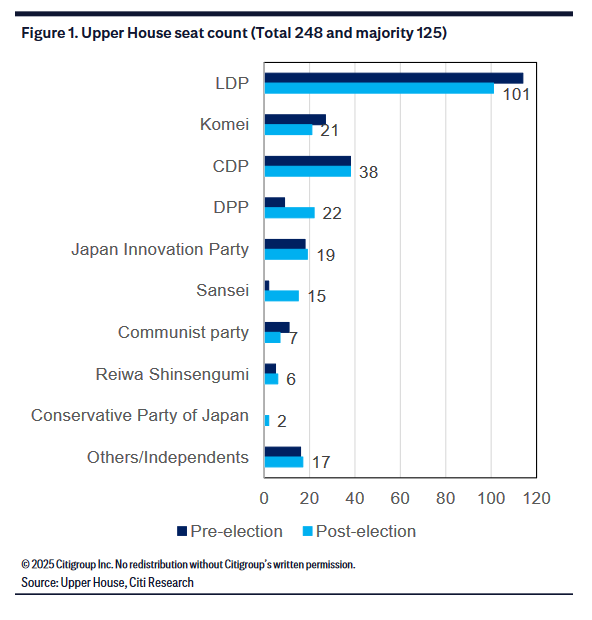
没有预期那么糟!花旗:日本可能维持“少数派政府”执政的局面
Hua Er Jie Jian Wen· 2025-07-22 08:06
Core Viewpoint - The recent Japanese Senate election results indicate a significant political shift, with the ruling coalition of the Liberal Democratic Party (LDP) and Komeito losing its majority, yet the market reacted positively, with both the yen and Nikkei futures rising [1][2]. Short-term Outlook - The LDP and Komeito coalition lost their majority in the Senate for the first time since the LDP's establishment in 1955, falling short by three seats [2]. - Despite the disappointing results, the situation is not as dire as some had feared, allowing the LDP to potentially continue governing as a minority [2][5]. Political Dynamics - Prime Minister Kishida plans to remain in power, citing national crises such as tariff negotiations and high prices, despite internal calls for accountability [4]. - All major opposition parties currently refuse to form a coalition government with the LDP, indicating a challenging political landscape for the ruling party [4][6]. Future Political Developments - The likelihood of a snap election in the House of Representatives this year is low, as both the LDP and opposition parties face challenges in regaining or expanding their seats [5]. - The LDP may continue to operate as a minority government, collaborating with opposition parties on policies, although some parties may reconsider their positions over time [5][6]. Long-term Projections - There is increasing pressure on Prime Minister Kishida to resign, which could lead to a new LDP leadership election and potentially a dissolution of the House of Representatives [7]. - The election results reflect voter support for active fiscal policies and conservatism, suggesting a shift in the LDP's approach under new leadership [8]. - The political situation is expected to stabilize over the next three months, with potential implications for fiscal policy and the stock market, despite short-term risks [8].
积极财政政策靠前发力稳经济
Liao Ning Ri Bao· 2025-07-22 01:03
Economic Overview - The province's economy showed overall stability in the first half of the year, with a focus on high-quality development [1] - General public budget revenue reached 166.5 billion, a year-on-year increase of 2.8%, while expenditure was 331.3 billion, up 3.9% [1] - The province's fiscal revenue completed 55.1% of the annual budget, exceeding the scheduled progress by 5.1 percentage points [1] Fiscal Policy and Investment - The province's fiscal policy has been proactive, with expenditure growth outpacing revenue by 1.1 percentage points, and exceeding the national average by 1.3 percentage points [2] - Significant investments were made in various sectors, including 180.4 billion for "two heavy" projects and 50 billion for consumer upgrades, contributing to a 6.3% increase in retail sales and a 15.9% rise in manufacturing investment [3] Social Welfare and Public Spending - The province has increased spending on social welfare, with 77.6% of the general public budget allocated to this area, up 1.6 percentage points from the previous year [4] - Notable increases in social security and employment spending were reported, with a 19% rise compared to last year [4] - The government has implemented measures to protect the rights of new employment forms, such as couriers and ride-hailing drivers, enhancing their social security [4] Future Outlook - The fiscal department plans to adapt to changing conditions and implement national policies to support economic and social development in the second half of the year [5]
新华财经晚报:打击战略矿产走私出口专项行动推进会召开
Zhong Guo Jin Rong Xin Xi Wang· 2025-07-19 10:01
Domestic News - The Yarlung Tsangpo River downstream hydropower project officially commenced on July 19 in Nyingchi, Tibet, with a total investment of approximately 1.2 trillion yuan, aiming to construct five tiered power stations primarily for power transmission and local consumption [2] - The Ministry of Finance's Deputy Minister Liao Min announced at the G20 finance ministers and central bank governors meeting that China will implement a more proactive fiscal policy in the second half of the year and expand high-level opening-up [2] Industry News - The State-owned Assets Supervision and Administration Commission (SASAC) released the list of A-level enterprises for the 2024 annual performance assessment, including major companies such as State Grid Corporation of China and China National Petroleum Corporation [3] - The Lixun Robot Headquarters project broke ground in Changshu with a total investment of 5 billion yuan, expected to achieve an annual output value of 10 billion yuan upon completion [4] - FAW Qiji New Power Technology Co., Ltd., a wholly-owned subsidiary of FAW Group, held its inaugural conference in Changchun, focusing on developing leading technologies in new energy powertrains [4]