
银发经济

Search documents
上海发布28条新政促消费
第一财经· 2026-01-13 10:11
Core Viewpoint - The article discusses the recent measures introduced by Shanghai to enhance the quality of the service industry and stimulate consumption, emphasizing a strategic shift from short-term stimulus to long-term systemic development [3][5]. Group 1: Policy Measures - Shanghai has issued 28 policy measures aimed at optimizing supply and expanding consumption to foster new growth points in service supply and consumer demand [3][5]. - The focus of the new policies is on systemic linkage, emphasizing quality competition on the supply side to enhance service industry value and stimulate consumption [3][6]. Group 2: Economic Context - Since 2025, Shanghai's service industry has shown a positive growth trend, with a 5.9% increase in value added and a 5% rise in retail sales of consumer goods, both surpassing national averages [5][6]. - The measures aim to address challenges such as supply structure lagging behind consumption upgrades and the need for better integration of service and consumption sectors [5][6]. Group 3: Key Industries - The policies target six key sectors: finance, information services, transportation, cultural and entertainment services, life services, and inspection and certification, which together account for about 60% of Shanghai's service industry value added [7][8]. - The integration of these sectors is expected to create a closed-loop policy chain that enhances service consumption [7]. Group 4: Financial Innovation - The new policies emphasize the integration of consumption scenarios with consumer finance, supporting the development of financial products tailored to needs such as elderly care and wealth management [8]. - E-commerce platforms are encouraged to shift from price competition to quality competition, driving traffic to offline and quality consumption [8]. Group 5: Cultural and Entertainment Sector - The measures include initiatives to enhance the supply of cultural and entertainment services, such as supporting high-quality exhibitions and sports events, which have shown significant demand growth [9]. - For instance, a recent exhibition in Shanghai attracted over 2.77 million visitors and generated over 760 million yuan in revenue, significantly boosting overall city consumption [9]. Group 6: Institutional Support - The policies aim to strengthen institutional support by transitioning from policy support to a dual-driven approach of "institution + market," focusing on regulatory standards and credit systems to foster sustainable development [10]. - Key initiatives include enhancing brand certification, improving standard systems, and strengthening inspection and testing services to boost consumer confidence [10]. Group 7: Implementation and Coordination - The Shanghai government plans to ensure effective implementation of the measures by coordinating service supply with consumer demand and creating a conducive environment for policy support [12][13]. - Emphasis is placed on cross-departmental collaboration to avoid policy fragmentation and to establish a dynamic evaluation mechanism to monitor the effectiveness of the policies [13].


精准施策推动“银发经济”健康有序高质量发展 进一步激发经营主体活力
Yang Shi Wang· 2026-01-13 09:28
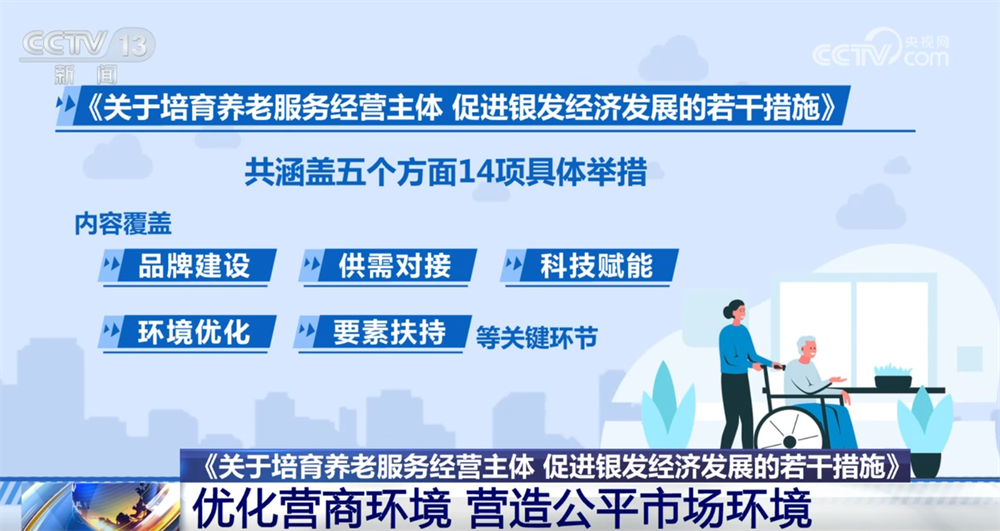
Core Viewpoint - The Ministry of Civil Affairs and seven other departments have jointly issued measures to cultivate the elderly care service industry and promote the silver economy through systematic and targeted policy support, aiming to enhance the vitality of various elderly care service providers and optimize the development environment [1][3]. Group 1: Policy Measures - The measures include 14 specific initiatives across five key areas: brand building, supply-demand matching, technological empowerment, environmental optimization, and support for essential factors [1]. - A fair competitive environment is to be established by accelerating the classification reform of elderly care institutions and optimizing support policies for various types of operators [3]. - The Ministry of Civil Affairs will rationally determine the frequency, methods, and scope of administrative inspections for elderly care institutions, implementing a "double random, one public" regulatory approach to minimize interference with normal operations [5]. Group 2: Standards and Certification - The measures call for the establishment of national standards for elderly products and services, along with a certification system for silver products and services, including a mechanism for tracking certified information and a credit evaluation system [6]. Group 3: Support for Operators - By the end of 2025, there will be a total of 41,700 elderly care institutions in China, with private institutions (including privately-run non-enterprise units) accounting for 52.2% [8]. - The measures propose to regularly publish information on the elderly population, distribution and utilization of elderly care facilities, and support policy lists, providing robust support in terms of land, duration, and funding for elderly care service providers [9]. - There will be an optimization of the licensing process for elderly care institutions, encouraging cross-regional online processing of licenses and exploring the application of electronic licenses [11]. Group 4: Land and Funding Support - Support will be provided from land, duration, and funding perspectives to ensure stable operations of elderly care institutions, prioritizing land supply for elderly care facilities based on local aging population levels [13]. - The Ministry of Civil Affairs aims to resolve site issues for operators, ensuring that elderly care facilities have available land for construction and optimizing funding support through various subsidies [15]. Group 5: Market Demand and Supply Matching - The measures emphasize the establishment of supply-demand matching platforms, encouraging e-commerce platforms and large supermarkets to create dedicated areas for silver consumption [16][18]. - There is a push to support the development of specialized medical accompaniment services for the elderly and promote the use of mobile bathing services in communities [17]. - The Ministry encourages the creation of unique shopping experiences for elderly products and the optimization of e-commerce platforms to cater to the elderly demographic [20].
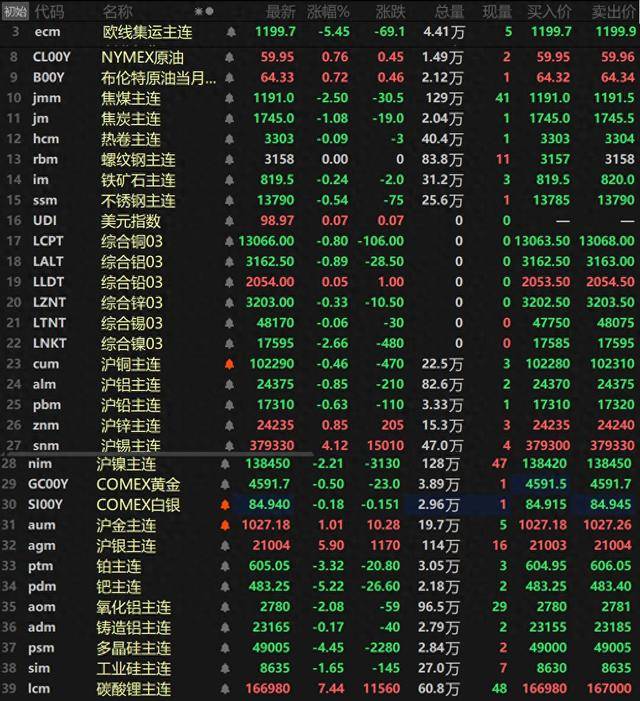
金属多飘绿 碳酸锂涨逾7% 沪金银续刷新高 钯主连跌超5%
Sou Hu Cai Jing· 2026-01-13 08:23
Metal Market - Domestic base metals experienced a general decline, with only Shanghai zinc and tin showing gains, increasing by 0.85% and 4.12% respectively. Nickel fell by 2.21%, while other metals saw declines of less than 1% [1] - Lithium carbonate surged by 7.44%, reaching a peak of 174,060 yuan/ton, marking a new high since October 2023, before closing at 166,980 yuan/ton. Industrial silicon and polysilicon fell by 1.65% and 4.45% respectively [1] - In the black metal sector, stainless steel dropped by 0.54%, while coking coal and coke fell by 2.5% and 1.08% respectively [1] - On the international front, base metals generally declined, with London nickel leading the drop at 2.66% [1] - Precious metals saw COMEX gold and silver decrease by 0.5% and 0.18% respectively, while domestic gold rose by 1.01%, reaching a historical high of 1,035.34 yuan/gram, and silver increased by 5.9%, also hitting a historical high of 21,518 yuan/kilogram [1][2] Macroeconomic Developments - The National Development and Reform Commission (NDRC) will lead the formulation of the "14th Five-Year" plan for circular economy development, focusing on resource recycling and efficiency improvements [5] - The Ministry of Industry and Information Technology (MIIT) emphasized the promotion of humanoid robots and health monitoring devices in various settings, aiming to enhance elderly care services through technology [6][7] - The People's Bank of China conducted a net injection of 342.4 billion yuan through reverse repos, maintaining the operation rate at 1.40% [7] Oil Market - Oil prices rose, with West Texas Intermediate increasing by 0.76% and Brent crude by 0.72%, amid concerns over potential declines in Iranian oil exports due to heightened U.S. sanctions [10] - Experts warned that further U.S. actions against Iran could lead to the closure of the Strait of Hormuz, potentially disrupting a significant portion of global oil transport and causing prices to spike by several dollars per barrel [10]
收评:沪指跌0.64% 医疗服务股领涨 军贸概念股领跌
Xin Hua Cai Jing· 2026-01-13 07:35
Market Performance - The Shanghai and Shenzhen stock markets opened slightly higher on January 13, with the Shanghai Composite Index reaching a maximum increase of 0.35% and the Shenzhen Component Index a maximum of 0.64% before experiencing a downward trend, ultimately closing lower [1] - The Shanghai Composite Index closed at 4138.76 points, down 0.64%, with a trading volume of approximately 148.16 billion yuan; the Shenzhen Component Index closed at 14169.40 points, down 1.37%, with a trading volume of approximately 216.95 billion yuan; the ChiNext Index closed at 3321.89 points, down 1.96%, with a trading volume of approximately 108.69 billion yuan [1] Sector Performance - The healthcare and pharmaceutical sectors showed strong performance, with significant increases in various sub-sectors such as medical services, CRO concepts, immunotherapy, AI healthcare concepts, weight loss drugs, innovative drugs, vitamins, and hepatitis concepts [1] - Other sectors that saw notable gains included precious metals, insurance, oil, and banking, while military trade concepts experienced significant declines, particularly in aerospace, commercial space, satellite navigation, and military information technology [1] Investment Insights - According to institutional views, the market is expected to continue its upward trend despite recent fluctuations, with a focus on sectors like semiconductors, consumer electronics, artificial intelligence, robotics, and commercial aerospace for mid-to-long-term investment opportunities [2] - In the AI healthcare sector, companies with practical applications and clear commercialization paths are anticipated to achieve rapid expansion and improved profitability as AI healthcare enters a commercialization acceleration phase [2] Policy Developments - The Ministry of Civil Affairs and other departments issued measures to promote the development of the elderly care service industry, emphasizing the integration of technology in elderly care services, including the use of big data, cloud computing, and AI for health monitoring and personalized services [4] - The measures encourage the development of elderly care robots to meet the daily care and emotional support needs of the elderly, promoting cross-industry collaboration and technological integration [4] Medical Supplies Procurement - The sixth batch of national organized high-value medical consumables procurement opened for bidding, including drug-coated balloons and urological intervention supplies, which are used in vascular stenosis and urinary system stone surgeries [7] - Previous procurement batches have included a wide range of medical supplies across various treatment fields, indicating a comprehensive approach to managing high-value medical consumables [7]
助力培育优质养老服务经营主体
Xin Lang Cai Jing· 2026-01-13 07:26
Group 1 - The core viewpoint of the article is the release of measures by the Ministry of Civil Affairs and eight other departments to promote the development of the elderly care service industry and the silver economy in China [1] Group 2 - The document includes 14 specific measures across five areas: brand building, supply-demand matching, technological empowerment, environmental optimization, and support for resources [1] Group 3 - In terms of brand building, the document encourages the establishment of distinctive brand signage for chain elderly care service providers to enhance brand recognition [1] - It also supports the registration of easily identifiable trademarks for various elderly care service providers and aims to include outstanding brands in the China Consumer Brand Matrix [1] Group 4 - To promote market-oriented supply-demand matching in elderly care services, the document guides institutions to integrate resources through chain operations within communities [1] - It encourages home care services for the elderly by supporting housekeeping companies and suggests local platforms to establish dedicated elderly care sections based on local conditions [1]
A股收评 | 沪指收跌0.64% 商业航天赛道退潮 创新药表现强势
智通财经网· 2026-01-13 07:22
Market Overview - The market experienced a significant adjustment today, with all three major indices closing lower, particularly the ChiNext and Sci-Tech 50 indices leading in declines. The trading volume exceeded 3.6 trillion yuan for two consecutive days, with over 3,700 stocks declining [1][2] - Concerns are rising regarding the adjustment risks following the sustained increase in trading volume. Historical data indicates that instances of trading volumes exceeding 3 trillion yuan are primarily concentrated in October 2024 and August-September 2025, which were followed by significant market fluctuations [1] Sector Performance - The commercial aerospace sector saw a downturn, with several stocks hitting the daily limit down. Companies in this sector issued warnings to investors about the need for cautious decision-making amid the ongoing price increases [1] - Conversely, the innovative drug concept showed strong performance, with stocks like Rongchang Bio and Nossger reaching the daily limit up. The precious metals sector was also active, with Mingpai Jewelry hitting the daily limit up, and oil and gas stocks rebounding [2] Fund Flow - Major funds focused on sectors such as medical services, energy metals, and chemical pharmaceuticals, with notable net inflows into stocks like Haige Communication, Ganfeng Lithium, and Yongyou Network [3] Policy Developments - A research team from the Chinese Academy of Sciences made significant progress in the development of high-performance sodium-ion battery cathode materials, which could enhance sodium ion transport and cycling stability [4] - Guangzhou is seeking support from the national integrated circuit industry fund for major project construction, aiming to bolster the city's position in the integrated circuit industry [5] - The National Development and Reform Commission plans to lead the formulation of the "14th Five-Year" plan for circular economy development, focusing on resource utilization efficiency and green low-carbon transformation [6] Economic Outlook - According to Zhongtai Securities, long-term capital is expected to support the market, with policies likely to maintain active trading. The macroeconomic environment suggests that China may remain in a weak recovery phase in 2026, with technology sectors benefiting from sustained policy support [8] - Dongfang Securities noted that while the market is currently healthy, there are concerns about potential volatility due to the high turnover and the possibility of sector rotation, which could impact stock valuations [9]
工信部加大养老服务机器人等产品研发力度!机器人ETF(562500) 震荡整固,天智航飙涨超18%
Mei Ri Jing Ji Xin Wen· 2026-01-13 07:20
Group 1 - The core viewpoint of the news highlights the performance and potential of the robotics sector, particularly focusing on the Robot ETF (562500), which is experiencing a slight decline but remains in a reasonable range for low-cost positioning [1] - The Robot ETF has a market capitalization exceeding 20 billion, making it the only robot-themed ETF of this scale in the market, covering various segments such as humanoid robots, industrial robots, and service robots, thus facilitating investors' access to the entire robotics supply chain [2] - The liquidity in the market is robust, with trading volume surpassing 1.635 billion and a turnover rate exceeding 6%, indicating significant capital participation during the sector's fluctuations [1] Group 2 - The Ministry of Civil Affairs has introduced measures to foster the elderly service industry and promote the silver economy, focusing on integrating new information technologies with elderly services [2] - Key initiatives include enhancing the development of elderly-friendly products, increasing research on elderly service robots, and improving standards in the elderly goods and smart health sectors [2] - CITIC Construction Investment Securities reports that the humanoid robot supply chain is undergoing technological upgrades and deeper collaboration, leading to accelerated industry advancements [2][3] Group 3 - The adjustment of the Robot ETF's constituent stocks has resulted in an increase of humanoid robot representation to nearly 70% in the index, effectively removing underperforming stocks and retaining stronger candidates [3]

视频丨优化养老服务发展环境 民政部等八部门出台多项措施
Yang Shi Xin Wen Ke Hu Duan· 2026-01-13 07:12
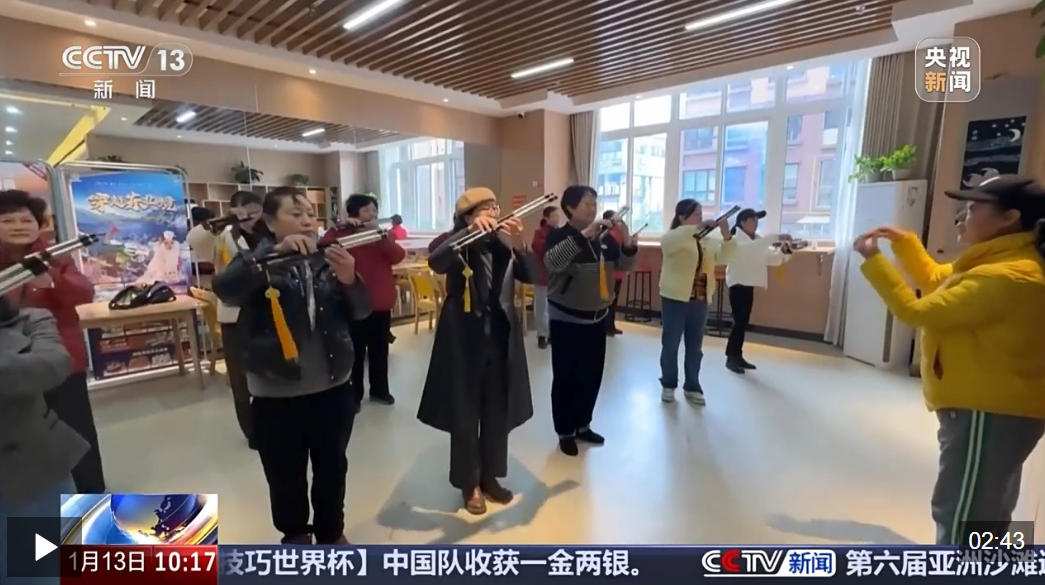
Core Viewpoint - The Ministry of Civil Affairs and seven other departments have introduced measures to cultivate the elderly care service industry and promote the silver economy, aiming to enhance the vitality of various elderly care service providers and better meet the diverse needs of the elderly population [2] Group 1: Brand Development - The measures emphasize strengthening brand building for elderly care services, encouraging the establishment of distinctive brand signage and enhancing brand recognition [3] - Provincial civil affairs departments are encouraged to standardize the names and signage of various elderly care service providers to improve brand identification [3] - Support for trademark registration and protection for well-known brands in the elderly care sector is also highlighted [3] Group 2: Market Supply and Demand - The measures propose optimizing the supply of elderly care services and age-friendly products, promoting community-based service integration [4] - Encouragement for the development of specialized medical accompaniment services and mobile bathing services for the elderly is included [4] - The initiative also promotes the development of age-appropriate clothing and food products tailored to the elderly [4] Group 3: Supply-Demand Platform - Support for local governments to establish dedicated elderly care sections within existing platforms to enhance service demonstration and resource linkage is outlined [5] - The measures encourage the use of trade fairs and exhibitions to facilitate connections between manufacturers, service providers, and consumers in the elderly care market [5] - E-commerce platforms and supermarkets are encouraged to create special shopping events and interfaces for elderly consumers [5] Group 4: Technological Empowerment - The measures advocate for technological advancements in elderly care, including the use of big data, AI, and smart home technologies [6] - Support for the development of care robots and other innovative technologies to meet the daily needs of the elderly is emphasized [6] - The initiative encourages collaboration between elderly care institutions and technology developers to enhance user experience with smart products [6] Group 5: Development Environment - The measures call for the creation of a fair competitive environment for elderly care institutions, including the reform of classification and support policies [7] - Restrictions that hinder fair competition in government procurement processes for elderly care services are to be eliminated [7] Group 6: Standards and Certification - The establishment of national standards for elderly products and services is prioritized, along with a certification system to guide procurement practices [8] - The measures aim to protect the rights of the elderly by combating fraudulent practices and ensuring compliance in the elderly care market [8] Group 7: Support and Resources - Local civil affairs departments are tasked with providing regular updates on elderly population statistics and available support policies [9] - The measures encourage the establishment of a nurturing mechanism for elderly care service providers and the optimization of licensing processes [9] - Support for stable operations of elderly care institutions through land supply and financial assistance is also included [9]
商务部:促进扩大养老服务消费 促进银发经济发展
Yang Shi Xin Wen· 2026-01-13 06:55
Core Viewpoint - The Ministry of Commerce is focusing on enhancing the elderly care service sector to promote the silver economy through five key initiatives aimed at improving service supply and meeting the needs of the aging population [1][2]. Group 1: Development of Elderly Care Services - The Ministry of Commerce will develop home care services for the elderly in conjunction with domestic service sectors, aiming to implement policies that enhance the quality and standardization of home care services [1]. - The ministry plans to promote the "15-minute convenient living circle" initiative, which will include elderly care services as essential components, with a target of establishing 6,255 living circles across 210 pilot areas by July 2025, covering 150.3 million service points and reaching 129 million people [1]. Group 2: Consumer Engagement and Market Expansion - The Ministry of Commerce will create new consumption scenarios for elderly services by accelerating the development of new business models and organizing the "Service Consumption Season" in 2026, while also promoting online platforms to enhance the supply of age-appropriate products and services [2]. - The ministry aims to foster an open cooperative environment for the elderly care industry by expediting the national service industry expansion pilot and guiding foreign investment towards the elderly care sector [2].
加大养老机器人等研发力度 工信部最新部署
Yang Guang Wang· 2026-01-13 06:42
Core Viewpoint - The Ministry of Civil Affairs emphasizes that technological innovation and supply optimization are essential for addressing labor shortages in the elderly care sector and enhancing service efficiency and quality, supporting the transition from a "traditional care model" to a "smart quality enhancement model" in elderly services [1] Group 1: Strategic Focus Areas - The Ministry of Industry and Information Technology (MIIT) is focusing on the development needs of the silver economy, aiming to enhance product variety, quality, technology, and standards in the elderly care industry [1] - MIIT plans to integrate new generation information technology with elderly services, maintaining a demand-oriented and problem-oriented approach [1] Group 2: Key Initiatives - MIIT will continue to promote high-quality elderly products and services, updating and publishing a directory of excellent cases for age-friendly products and services, and advancing the silver-age certification for elderly products [1] - The ministry will focus on addressing the pain points in elderly living by increasing the R&D of products such as elderly care robots, age-friendly clothing, and easy-to-swallow foods [1] - There will be ongoing optimization of the standard system for elderly products and smart health services, accelerating the implementation of key standards in smart terminals, smart communities, and smart homes [1] - MIIT will deepen the application of the internet and the age-friendly transformation of smart terminals, continuously improving the convenience of life for the elderly, thereby providing strong support for the high-quality development of the silver economy [1]
