AIoT

Search documents
汉朔科技(301275) - 投资者关系活动记录表
2025-06-06 10:40
Group 1: AI and Technology Integration - Hanshu Technology focuses on integrating AI technologies such as machine vision and big data analysis with digital retail scenarios to enhance operational efficiency and consumer experience [3] - The company is actively exploring AIoT applications and has partnered with Microsoft to leverage Azure Open AI for innovative retail solutions [3] - Hanshu Technology has established a competitive edge as the first partner in China to receive "Certified Software Designation for Retail AI" from Microsoft [3] Group 2: Electronic Price Tags Market - The global penetration rate of electronic price tags remains low, with France leading at over 40% [4] - Major markets like China, the USA, and Japan have significant growth potential due to their low penetration rates [4] - Future growth drivers include market penetration increases, replacement demand for existing electronic price tags, and the provision of SaaS and technical services [4] Group 3: Revenue and Market Strategy - Approximately 10% of the company's revenue comes from the US market, which has been minimally impacted by recent tariff increases [5] - The company is focusing on strategic expansion in Europe, Japan, Australia, Southeast Asia, and within China to mitigate tariff risks [6] - Hanshu Technology is committed to monitoring tariff policy changes and adjusting production and operational strategies accordingly [6] Group 4: Robotics and New Business Development - The company emphasizes research and application of AI technologies in robotics, having secured multiple patents for inspection robots [6] - Hanshu Technology is developing various solutions, including smart shopping carts and AI cameras, to support digital transformation in retail [6] - A commercial partnership has been established for smart shopping carts with a leading overseas client, enhancing operational efficiency and consumer experience [6]
乐鑫科技(688018):2025年中期策略会速递:需求景气延续,AI玩具应用落地
HTSC· 2025-06-05 10:20
Investment Rating - The report maintains a "Buy" rating for the company with a target price of RMB 173.70 [5][8]. Core Insights - The company is experiencing sustained demand growth, particularly in the AIoT sector, with significant opportunities in smart home applications and AI toys [2][4]. - The company plans to raise funds through a private placement to enhance its product lineup, focusing on Wi-Fi 7 and AI edge chips, which will support long-term growth [4][5]. - The developer ecosystem is thriving, with over 140,000 open-source projects on GitHub, indicating strong community engagement and innovation [3]. Summary by Sections Demand and Growth - In Q1 2025, the company reported a 30% year-on-year revenue growth in the smart home sector, with faster growth in industrial, energy, and healthcare markets [2]. - The company anticipates continued demand growth in Q2, driven by new applications such as AI toys [2]. Product Development and Strategy - The company is focused on a "processing + connectivity" strategy, with ongoing product upgrades and a commitment to maintaining a gross margin target of 40% [2][5]. - New products, including the P4, are entering mass production, while older products like ESP8266/ESP32 are seeing extended lifecycles due to high customer loyalty [2]. Financial Projections - The company forecasts revenues of RMB 2,632 million in 2025, with a net profit of RMB 461.47 million, reflecting a 36% increase from the previous year [7]. - The expected EPS for 2025 is RMB 2.94, with a projected net profit margin of 17.53% [7]. Capital Raising and Investment - The company plans to raise up to RMB 1.778 billion through a private placement, allocating funds for Wi-Fi router chips, AI edge chips, and the construction of a research center [4]. Market Position - The company aims to maintain its leading position in the Wi-Fi MCU market and expects the revenue contribution from smart home products to continue evolving [2].

小米集团-W(01810.HK):各业务表现亮眼 看好IOT与汽车持续增厚业绩
Ge Long Hui· 2025-05-31 17:48
Core Viewpoint - The company reported record high revenue and net profit for Q1 2025, driven by strong performance in automotive and IoT sectors, alongside a recovery in smartphone market share and continued high-end product strategy [1][2][3] Group 1: Financial Performance - Q1 2025 revenue reached 111.29 billion yuan, up 47.4% year-on-year and 2.1% quarter-on-quarter, marking a historical high [1] - Adjusted net profit for Q1 2025 was 10.68 billion yuan, an increase of 64.5% year-on-year and 28.4% quarter-on-quarter, also a record high [1] - Gross margin stood at 22.8%, up 0.5 percentage points year-on-year and 2.2 percentage points quarter-on-quarter [1] Group 2: Automotive Business - Automotive revenue for Q1 2025 was 18.58 billion yuan, up 11.5% quarter-on-quarter, with losses narrowing to 500 million yuan [1] - The automotive gross margin reached 23.2%, an increase of 2.8 percentage points quarter-on-quarter [1] - SU7 series deliveries totaled 75,869 units, up 8.9% quarter-on-quarter, with the number of sales outlets expanding to 235 across 65 cities [1] Group 3: Smartphone Market - Smartphone revenue for Q1 2025 was 50.61 billion yuan, up 8.9% year-on-year but down 1.4% quarter-on-quarter, with a gross margin of 12.4% [2] - Smartphone shipments reached 41.8 million units, a 3.0% increase year-on-year, with global market share rising to 14.1% [2] - In China, market share increased to 18.8%, regaining the top position, while the ASP rose by 5.8% to 1,211 yuan [2] Group 4: IoT and New Retail - IoT revenue for Q1 2025 was 32.34 billion yuan, up 58.7% year-on-year and 4.8% quarter-on-quarter, with a gross margin of 25.2% [2][3] - Air conditioning, refrigeration, and washing machine shipments exceeded 1.1 million, 880,000, and 740,000 units respectively, with growth rates exceeding 65% [3] - The number of new retail stores expanded to 16,000, with a target of 20,000 by the end of 2025, supporting growth in IoT and consumer products [3] Group 5: Future Outlook - The company is expected to benefit from high-end product strategies and global expansion in its smartphone and AIoT businesses [3] - Profit forecasts for 2025, 2026, and 2027 have been raised to 39.6 billion, 53.4 billion, and 65.9 billion yuan respectively [3]

北水动向|北水成交净买入96.47亿 北水抢筹美团(03690)超19亿港元 再度抛售盈富基金(02800)
智通财经网· 2025-05-30 10:17
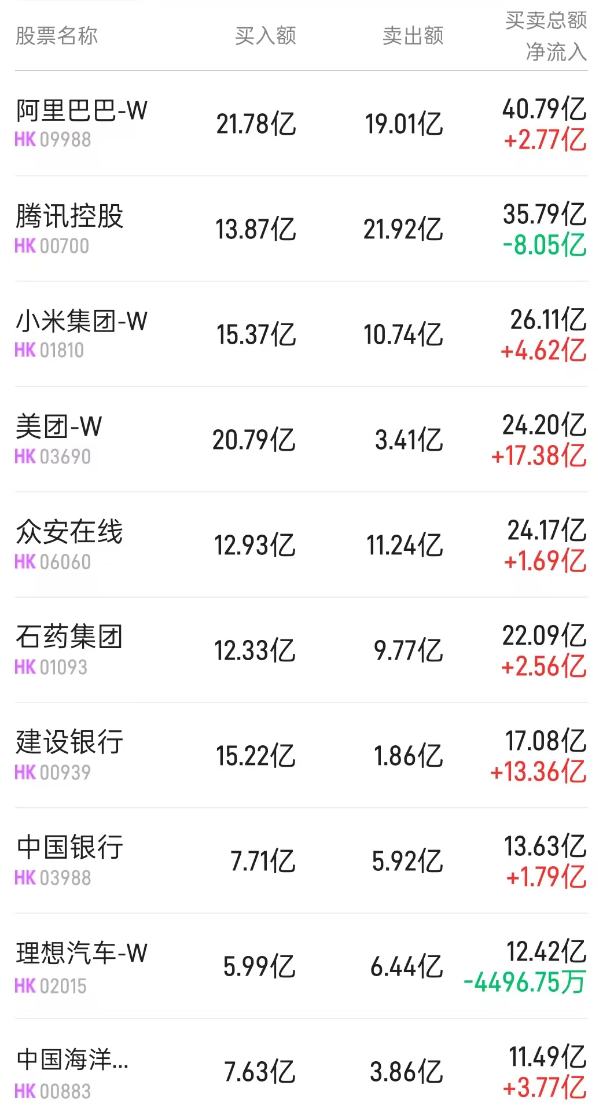
Group 1: Market Overview - Northbound trading recorded a net buy of HKD 96.47 billion, with HK Stock Connect (Shanghai) contributing HKD 81.67 billion and HK Stock Connect (Shenzhen) contributing HKD 14.79 billion [1] - The most bought stocks included Meituan-W (03690), China Construction Bank (00939), and Xiaomi Group-W (01810) [1] - The most sold stocks were the Tracker Fund of Hong Kong (02800), Tencent (00700), and SMIC (00981) [1] Group 2: Stock Performance - Alibaba-W (09988) saw a net inflow of HKD 2.77 billion, with buy and sell amounts of HKD 21.78 billion and HKD 19.01 billion respectively [2] - Meituan-W (03690) received a net buy of HKD 19.21 billion, with significant growth in sales during the "Meituan 618" promotion, achieving a year-on-year increase of twofold [6] - Xiaomi Group-W (01810) had a net buy of HKD 6.35 billion, benefiting from strong growth in major appliances and AIoT revenue, which increased by 59% year-on-year [7] Group 3: Sector Insights - China Construction Bank (00939) and Bank of China (03988) received net buys of HKD 13.36 billion and HKD 1.79 billion respectively, indicating a continued interest in domestic bank stocks [6] - The pharmaceutical sector saw Stone Pharmaceutical Group (01093) with a net buy of HKD 6.25 billion, as it engages in potential transactions that could total around USD 5 billion [7] - Ideal Auto-W (02015) received a net buy of HKD 3.55 billion, with expectations of increased production capacity and upcoming model launches [8] Group 4: Notable Sell-offs - SMIC (00981) faced a net sell of HKD 1.44 billion, with guidance indicating a revenue decline of 4%-6% quarter-on-quarter for Q2 2025 [9] - The Tracker Fund of Hong Kong (02800) experienced a net sell of HKD 8.85 billion, attributed to a lack of catalysts in market sentiment and economic conditions [9] - Tencent (00700) saw a net sell of HKD 8.65 billion, reflecting ongoing market challenges [9]



小米1Q25业绩超预期,未来一个月活动密集 - 买入评级
Goldman Sachs· 2025-05-30 03:00
分组1 - Investment Rating: Buy for Xiaomi, PDD, Kuaishou, Link REIT, Hesai, and Telstra [1][3][5][9] - Xiaomi's 1Q25 results exceeded expectations with revenue growth of +47% year-over-year to Rmb111 billion and adjusted net profit growth of +65% year-over-year to Rmb10.7 billion [1] - PDD's 1Q25 profit declined significantly due to increased user and merchant investments, leading to a negative share price reaction despite a +15% growth in online marketing revenue [3] - Kuaishou maintained its FY25 guidance and showed sequential improvement in advertising and eCommerce, indicating strong growth momentum [5] - Hesai's 1Q25 results showed a net profit beat driven by higher gross margins and lower operating expenses, with a revised target price increase to US$23.30 [5][9] 分组2 - Key segments for Xiaomi include AIoT and EV, which continue to outperform expectations [1] - PDD's domestic GMV profit margin is expected to stabilize at 2.0% to 2.2% for FY25E to FY27E, down from previous estimates [3] - Kuaishou's strong position in AI applications and better-than-industry ad growth are potential drivers for stock re-rating [5] - Telstra's strategy focuses on consistent earnings growth and maximizing shareholder returns, with a financial capacity exceeding A$20 billion through FY30 [9]
XIAOMI(1810.HK):1Q25 STRONG BEAT; POSITIVE ON PREMIUMIZATION YU7 RAMP-UP AND SOC BREAKTHROUGH IN 2H25E
Ge Long Hui· 2025-05-30 01:47
Core Viewpoint - Xiaomi's 1Q25 adjusted earnings reached RMB 10.7 billion, reflecting a 28% quarter-over-quarter and 64% year-over-year increase, surpassing expectations due to strong sales and improved gross profit margins across all segments [1][2] Financial Performance - Revenue for 1Q25 grew 47% year-over-year to RMB 111.3 billion, driven by growth in all segments: - Smartphone sales increased 9% year-over-year, with an average selling price (ASP) reaching a record high of RMB 1,121, supported by a successful premiumization strategy and a market share of 18.8% in China [2] - IoT sales surged 58.7% year-over-year, particularly in air conditioners, refrigerators, and washing machines, with a gross profit margin (GPM) improvement of 5.4 percentage points to 25.2% due to ASP hikes and better product mix [2] - Smart EV segment showed rapid growth with GPM improving to 23.2%, aided by resilient ASP and cost optimization, while operating loss narrowed to RMB 0.5 million [2] Strategic Outlook - The company anticipates continued growth in 2025 through strategies focused on smartphone and EV premiumization, ramping up IoT and EV capacity, and developing in-house SoC chips [1][2] - Key management focus areas include: - Premiumization strategy targeting the RMB 6,000+ smartphone segment and expansion into non-smartphone/EV categories and overseas markets [2] - Maintaining a shipment guidance of 180 million smartphones for FY25E, with an emphasis on improving product mix [2] - Accelerating capacity expansion in AIoT amidst SKU shortages [2] - Positive outlook on smart EV shipments, ASP, and profitability [2] Valuation and Recommendations - The target price has been raised to HK$ 65.91, reflecting a 37.7x FY25E P/E, with FY25-27E EPS forecasts increased by 5-10% due to the strong 1Q25 results and outlook [3] - The company maintains a BUY rating, with upcoming catalysts including Investor Day, updates on smart glasses, EV Phase 2 plant, and YU7 ASP [3]
澄天伟业(300689) - 2025年5月29日投资者关系活动记录表
2025-05-30 00:10
Group 1: Company Overview and Market Position - The company operates in the smart card industry, which has a market capacity that is stabilizing but facing saturation in traditional applications. However, new applications in IIoT, AIoT, and eSIM are driving growth [1] - The gross margin for the smart card business is approximately 20%, positioning the company at a medium level within the industry [1] - The company is transitioning towards the super SIM card sector to enhance value and market space [2] Group 2: Competitive Advantages - The company is the first in the industry to offer a one-stop service, integrating the entire supply chain from chip application development to end-user delivery, which enhances product consistency and customer loyalty [2] - Over 60% of the company's product sales are international, with established partnerships with global leaders like THALES and IDEMIA, showcasing strong global operational capabilities [2] - The company has a robust project delivery and local service capability, having secured contracts with major Chinese telecom operators [2] Group 3: Semiconductor Business Development - The company entered the power semiconductor packaging materials sector in 2019, leveraging its existing technology to tap into a high-potential market [3] - Future plans include accelerating production of thermal management products and expanding customer bases in the power module sector [3] Group 4: Research and Development Investment - The company maintains a consistent investment in R&D, focusing on core technologies and optimizing resource allocation based on market feedback and financial status [4] - R&D personnel compensation is a significant portion of the R&D budget, with ongoing employee stock ownership plans to incentivize innovation [4] Group 5: Overseas Market and Production Capacity - Overseas operations account for over 60% of revenue, with production facilities in India and Indonesia achieving utilization rates of 70%-80% and 80%-90%, respectively [5] - The company emphasizes local production to enhance responsiveness to customer needs [5] Group 6: Customer Stability and Risk Management - The smart card business remains the primary revenue source, with a high customer concentration. Long-term agreements with major clients mitigate dependency risks [6] - The revenue share from the top five customers decreased from 87.92% in 2023 to 77.75% in 2024, indicating diversification efforts [7] Group 7: Liquid Cooling Business - The company has developed liquid cooling products with integrated designs that enhance efficiency and reliability, targeting high-performance computing needs [7] - The products are in the final stages of preparation for mass production, with a focus on meeting the rising demand in AI and data center markets [7] Group 8: Smart Security Business - The company is leveraging its expertise in digital information security to develop smart security solutions, particularly in transportation safety [8] - Current efforts are focused on market promotion, with ongoing exploration of business models [8] Group 9: Challenges and Opportunities - Key challenges include rapid technological changes and market entry risks for new businesses, which could impact production efficiency and competitiveness [9] - Opportunities exist in the growing demand for efficient cooling and packaging materials in AI and high-performance computing sectors, with potential for rapid growth [9] Group 10: Chip Production and Partnerships - The company primarily sources smart card chips externally, with some proprietary chips for internal use and external sales [10] - The company has not yet established a partnership with Huawei in the liquid cooling sector but remains open to future collaborations [10] Group 11: Acquisition Strategy - The company is cautious about pursuing acquisitions, focusing on long-term stability and evaluating potential targets within the industry [10] Group 12: Risk Disclosure - The company acknowledges risks associated with new product development, including technological, market, and validation risks, and commits to timely information disclosure [12]
小米集团-W:维持<font color='#2C8CE7'>“买入”评级,升目标价至62港元-20250529
BOCOM International· 2025-05-29 09:40
Investment Rating - The report maintains a "Buy" rating for Xiaomi Group-W (01810) and raises the target price to HKD 62 [1]. Core Insights - The report highlights that Xiaomi's 1Q25 performance exceeded expectations, with revenue and adjusted net profit reaching RMB 1,113 billion and RMB 107 billion, respectively, surpassing market forecasts [1]. - AIoT revenue grew significantly by 59% year-on-year to RMB 323 billion, with gross margin increasing from 20.5% in 4Q24 to 25.2% [1]. - The gross margin for the automotive segment improved to 23.2%, driven by scale effects from the SU7 model, high management efficiency, and growth in equity income [1]. Summary by Sections - **Revenue Forecasts**: The revenue forecasts for Xiaomi for 2025 and 2026 have been raised to RMB 5,030 billion and RMB 6,159 billion, respectively, with adjusted EPS estimates increased to RMB 1.87 and RMB 2.14 [1]. - **Automotive Business**: The average selling price (ASP) for Xiaomi's automotive segment has been adjusted down to RMB 254,000 for 2026, with a focus on the performance of the YU7 model post-launch and the ramp-up of production capacity [2]. - **Smartphone Market Position**: Xiaomi regained the top position in China's smartphone shipments in 1Q25, with a high-end market share of 25%, despite a global smartphone market growth forecast of less than 1% for 2025 [2]. - **AI Investment**: Management plans to increase investment in AI, expecting it to account for one-quarter of total R&D spending, with an annual R&D budget of RMB 30 billion [2]. - **Home Appliance Growth**: The report is optimistic about Xiaomi's long-term expansion in the home appliance sector, with significant growth in sales and ASP for major appliances, supported by the construction of a smart factory in Wuhan [2].
预约上海 MWC 专属洞察!与 Counterpoint 分析师面对面聊 AI、6G、智联未来
Counterpoint Research· 2025-05-29 02:32
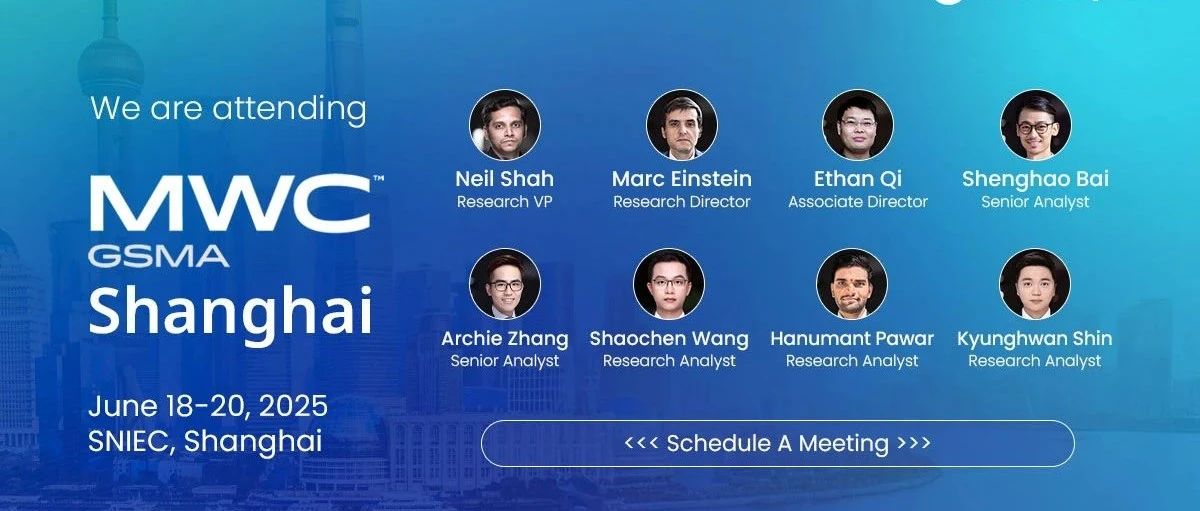
Core Insights - The 2025 Shanghai MWC will focus on key industry topics such as mobile terminals, AI, 6G, satellite communication, and AIoT [1][3] - Counterpoint analysts will engage in discussions about industry transformation trends and the global market positioning of Chinese manufacturers [3][4] Group 1 - The event will explore the transformative impact of AI on terminal technology and the vision and key technological research for 6G [3] - There will be discussions on the large-scale implementation of satellite communication and new scenarios for AIoT [3] - The conference aims to provide insights into how Counterpoint's research and services can support business needs [3][4] Group 2 - Industry professionals and partners interested in the mobile ecosystem are encouraged to schedule meetings with analysts at the event [3] - Continuous updates and deep insights into the global technology market will be available through Counterpoint Research [4]
六边形小米,或许仍有悬念
虎嗅APP· 2025-05-28 13:34
Core Viewpoint - Xiaomi's recent financial performance demonstrates significant growth across multiple business segments, indicating a strong market position and potential for future profitability, particularly in the smart electric vehicle sector [3][4]. Financial Performance - For Q1 2025, Xiaomi reported revenue of 1112.93 billion yuan, a year-on-year increase of 47.4%, and an adjusted net profit of 106.8 billion yuan, up 64.5%, both exceeding Bloomberg's expectations [3][4]. - The smartphone business saw a 40% increase in domestic market shipments, reclaiming a 18.8% market share, while the average selling price (ASP) of smartphones reached a historical high of 1211 yuan, reflecting a 5.8% year-on-year growth [4][8]. - The IoT and lifestyle products segment generated revenue of 323.4 billion yuan, a 58.7% increase, with IoT revenue now accounting for 29.1% of total revenue [11]. Business Segment Insights - The smart electric vehicle segment is nearing breakeven, with losses reduced from 18 billion yuan to 5 billion yuan, and revenue for the quarter reached 181 billion yuan, representing 55% of last year's total revenue [6][7]. - Xiaomi's home appliance sales surged, with air conditioning units and refrigerators both exceeding 110,000 and 88,000 units sold, respectively, and washing machines seeing over 74,000 units sold, with growth rates exceeding 100% [11]. Market Dynamics - The current growth is partly attributed to subsidy policies, which may pose challenges once these incentives are removed, potentially impacting demand in the consumer electronics sector [10][14]. - Xiaomi is proactively addressing future challenges by establishing a smart home appliance factory in Wuhan, aimed at reducing costs and maintaining inventory levels [15]. Future Considerations - The transition from IoT hardware to AI services is a critical challenge for Xiaomi, as consumer expectations evolve beyond simple smart devices to integrated AI solutions [16][18]. - Xiaomi's AI research has advanced, with significant developments in local model performance, but the implementation of these technologies into consumer products remains a key hurdle [17][18].