
产业链协同创新

Search documents
金信期货助力棉纺产业稳健经营与高质量发展交流会圆满举行
Cai Fu Zai Xian· 2025-09-03 10:25
Core Viewpoint - The conference aimed to create a platform for resource sharing, experience exchange, and collaborative innovation in the cotton spinning industry, emphasizing the integration of financial tools with the real economy to enhance risk management capabilities [1][11]. Group 1: Conference Overview - The conference was co-hosted by Jin Xin Futures Co., Ltd. and Shanghai Cotton Fengda Commercial Management Co., Ltd., supported by various industry associations and academic institutions [1]. - Nearly a hundred representatives from the cotton spinning industry, financial institutions, and academic organizations gathered to explore transformation paths and high-quality development [1]. Group 2: Industry Insights - The Deputy General Manager of Hangzhou Wanshili Silk Culture Co., Ltd. highlighted the significance of digital printing technology in revolutionizing the traditional dyeing industry, enabling flexible production and reducing inventory pressure [4]. - The integration of technology and industry is reshaping the competitiveness of the textile sector [4]. Group 3: Financial Tools and Risk Management - Jin Xin Futures' research head discussed the core role of futures tools in risk management, explaining price discovery and hedging functions using cotton yarn price fluctuation cases [5]. - The new regulations on cotton yarn futures are expected to enhance market liquidity and provide more precise risk management solutions for real enterprises [5]. Group 4: Green Transformation and ESG - A panel discussion emphasized the importance of blockchain technology in creating a full-process traceability system for cotton, promoting environmental monitoring and carbon footprint management [8]. - Green transformation is viewed not only as a social responsibility but also as a pathway to enhance brand value [8]. Group 5: Collaborative Innovation - The roundtable discussion focused on collaborative innovation and risk response in the textile industry, proposing cost-reduction and efficiency-increasing strategies through strategic partnerships and e-commerce [9]. - The participants stressed the need for international standards to overcome barriers in green trade and enhance industry resilience through blockchain traceability and ESG practices [10]. Group 6: Future Directions - Jin Xin Futures aims to continue serving the real economy by providing customized risk management solutions and forward-looking market analysis, facilitating the high-quality development of the cotton spinning industry [11].

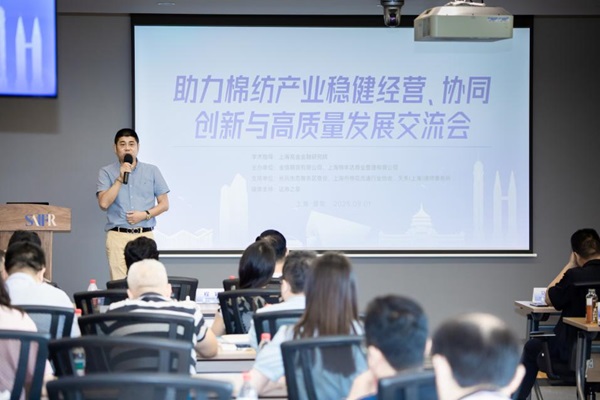
赋能产业升级,共绘发展蓝图——助力棉纺产业稳健经营、协同创新与高质量发展交流会圆满举行
Qi Huo Ri Bao Wang· 2025-09-03 09:24
Core Viewpoint - The conference aimed to create a platform for resource sharing, experience exchange, and collaborative innovation in the cotton spinning industry, emphasizing the integration of financial tools with the real economy to enhance risk management capabilities [1][14]. Group 1: Conference Overview - The conference was co-hosted by Jin Xin Futures Co., Ltd. and Shanghai Mianfengda Commercial Management Co., Ltd., supported by various associations and institutions, gathering nearly a hundred representatives from the cotton spinning industry and financial sectors [1]. - The event focused on exploring transformation paths and high-quality development for the cotton spinning industry amidst increasing global competition [1]. Group 2: Key Presentations - Hu Xiaobo, General Manager of Jin Xin Futures, highlighted the importance of building a platform for collaboration and resource sharing to help enterprises cope with market fluctuations [1][14]. - Ma Tingfang, Deputy General Manager of Hangzhou Wanshili Silk Culture Co., Ltd., discussed the significance of digital printing technology in revolutionizing the traditional dyeing industry, enabling flexible production and reducing inventory pressure [4][6]. - Yao Xinghang, head of Jin Xin Futures Research Institute, explained the core role of futures tools in risk management, emphasizing price discovery and hedging functions [7][9]. Group 3: Industry Innovations - A panel discussion featured industry leaders discussing collaborative innovation and risk management strategies, including the use of blockchain technology for environmental monitoring and carbon footprint management in cotton cultivation [8][10]. - The discussion emphasized the need for green transformation as a means to enhance brand value and fulfill social responsibilities [8][10]. Group 4: Future Directions - Jin Xin Futures aims to provide customized risk management solutions to help cotton spinning enterprises mitigate price volatility risks, while also offering forward-looking market analysis [14]. - The company is committed to deepening its service to the industry and collaborating with various stakeholders to outline a blueprint for high-quality development in the cotton spinning sector [14].

中国重汽以智造赋能产业链,驱动山东新能源汽车产业向新而行
Qi Lu Wan Bao· 2025-08-22 04:38
Core Viewpoint - China National Heavy Duty Truck Group (CNHTC) is positioning itself as a leader in the high-quality development of the automotive industry in Shandong Province, focusing on innovation-driven strategies and industry collaboration to build a robust ecosystem for the new energy vehicle sector [1][9]. Group 1: Intelligent Manufacturing - CNHTC has made a forward-looking investment in a "Smart Connected (New Energy) Heavy Truck Project" in Laiwu District, establishing a state-of-the-art intelligent factory that integrates automation, flexibility, and digitalization, featuring the first AGV flexible assembly line in the domestic heavy truck industry [3][5]. - The factory includes a fully automated cab welding production line and a high-end painting line that meets international standards, ensuring superior product quality [3]. Group 2: Product Matrix - CNHTC boasts a comprehensive product matrix covering all categories of commercial vehicles, including heavy, medium, light, micro, passenger, and special vehicles, supported by a robust supply chain [5]. - The company has launched various new energy products across its brands, including Huanghe, Shandeka, and HOWO, with technologies such as charging, battery swapping, plug-in hybrids, and fuel cells, catering to diverse market needs with battery capacities ranging from 60 to 600 kWh [5]. - The HOWO TX central drive tractor, developed by CNHTC, features optimized power systems for extended range and low energy consumption, with a maximum battery capacity of 600 kWh and a range of up to 450 km on a single charge [5][7]. Group 3: Innovation Ecosystem - As a "chain master" in Shandong's automotive industry, CNHTC promotes collaborative innovation across the entire supply chain by integrating core component resources and fostering partnerships with upstream and downstream enterprises [9]. - The company collaborates with universities, research institutions, and other businesses to create innovation platforms that accelerate technology transfer and talent aggregation, contributing to the establishment of a nationally influential new energy vehicle industry cluster in Shandong [9]. Group 4: Conclusion - CNHTC exemplifies how a leading enterprise can transform industrial advantages into developmental strengths through technological innovation and ecosystem building, marking a significant era in the high-quality development of the manufacturing sector in Shandong's new energy vehicle industry [10].

贴牌,冻品经销商的救命稻草?
3 6 Ke· 2025-08-22 00:30
Group 1 - The frozen food market is undergoing significant changes, with distributors facing unprecedented challenges due to strong brand pressures and market factors, prompting a reevaluation of their business strategies [1][3] - Historically, frozen food distributors relied on well-known brands for stable profits, but recent years have seen increased control from major brands, higher entry barriers, and intensified competition leading to price wars [3][4] - The evolving market landscape is reshaping the entire frozen food supply chain, with rising consumer demands for quality and variety, alongside the emergence of new sales channels like e-commerce and community group buying, which are squeezing traditional distributors [4][6] Group 2 - In response to these challenges, private label production has emerged as a new strategy for frozen food distributors, allowing them to create products tailored to market demands and reduce reliance on major brands [7][10] - Private label products can offer higher profit margins compared to branded products, with some distributors reporting that private label frozen dumplings can yield double the gross margin of branded ones [7][10] - However, challenges such as quality control, brand building, and increasing competition among similar private label products pose significant risks for distributors venturing into this space [8][10] Group 3 - The rise of private labels is not merely a survival tactic but also a means to foster market diversification and innovation, enhancing consumer choice and satisfaction [10][13] - The relationship between brands and distributors is evolving towards a co-creation model, where both parties leverage their strengths to better serve consumers [10][13] - Digital tools and collaborative innovation among distributors are emerging as key strategies to improve operational efficiency and product development, with some companies utilizing data analytics to better understand consumer preferences [11][13]

产业链协同创新带来新体验(链接)
Ren Min Ri Bao· 2025-08-13 21:50
Core Insights - The AI glasses industry in China is experiencing rapid development, showcasing vast market potential as the country promotes digital economy initiatives [1] - The application scenarios for AI glasses have expanded from initial visual assistance to sectors such as healthcare, smart manufacturing, smart education, and digital tourism [1] - The consumer market for AI glasses is diversifying and developing at multiple levels, with domestic tech companies gaining recognition for their cost-effective products [1] Industry Collaboration - Significant achievements in collaborative innovation within the industry have been noted, with hardware manufacturers and AI technology providers engaging in deep cooperation, resulting in new multi-terminal intelligent collaboration experiences [1] Challenges Faced - The industry faces challenges in user experience, including the need for improvements in product battery life and wearing comfort, as well as the necessity for enhanced privacy protection [1] - On the enterprise application side, there is a need for better cost control of customized solutions and talent development [1] - The establishment of a standard system and the realization of product differentiation are critical issues for the industry ecosystem [1] Future Outlook - The future of AI glasses is expected to transition from professional equipment to common consumer products, becoming a key driver of smart living trends and empowering industrial upgrades [1]
济南市机器人产业联盟揭牌,由济南工控集团牵头成立;上半年我国智能手机产量达5.63亿台丨智能制造日报
创业邦· 2025-08-03 03:09
Group 1 - The "Jinan Robot Industry Alliance" was officially established on August 1, led by Jinan Industrial Investment Holding Group, aiming to enhance technological innovation and collaboration among member companies, promote resource sharing, and strengthen the overall competitiveness of Jinan's robot industry [2] - Alphabet's venture capital firm CapitalG and Nvidia are in talks to invest in Vast Data, with the company's valuation potentially reaching $30 billion [2] - The SpaceX "Dragon" spacecraft successfully docked with the International Space Station, carrying four astronauts as part of the Crew-11 mission, marking the 11th crew rotation for the ISS [2] - In the first half of 2025, China's smartphone production reached 563 million units, a year-on-year increase of 0.5%, while total mobile phone production decreased by 4.5% to 707 million units [2]
济南市机器人产业联盟揭牌 由济南工控集团牵头成立
Zheng Quan Shi Bao Wang· 2025-08-02 02:59
Group 1 - The "Jinan Robot Industry Alliance" was officially established on August 1, aimed at enhancing technological innovation and collaboration among member companies [1] - The alliance is led by Jinan Industrial Investment Holding Group Co., Ltd., and is supported by the Jinan Robot Industry Development Office [1] - The initiative focuses on promoting collaborative innovation within the industry chain, resource sharing, and nurturing benchmark enterprises [1] Group 2 - The alliance aims to serve government industrial policies and enhance the overall competitiveness and influence of Jinan's robot industry [1] - It seeks to build an open innovation ecosystem among upstream and downstream enterprises in the industry chain [1] - The goals include strengthening, extending, and supplementing the industry chain to foster industrial integration [1]

SK海力士Q2营业利润飙升68%,加速HBM产能扩张应对AI算力需求激增
Zhi Tong Cai Jing· 2025-07-24 01:20
Core Insights - SK Hynix announced an acceleration of its advanced memory chip production expansion plan following record quarterly performance, driven by surging demand for artificial intelligence [1] - The company reported a 68% year-on-year increase in operating profit, reaching 9.21 trillion KRW (approximately 6.7 billion USD), with revenue growth of 35% hitting a historical high, exceeding market expectations [1] - SK Hynix aims to increase investments in cutting-edge areas like High Bandwidth Memory (HBM) to meet rising memory demands from clients' new products in the second half of the year [1] Group 1 - SK Hynix has become the global leader in the DRAM market by revenue in Q1 2023, currently competing with Samsung for market leadership [3] - Samsung's delay in HBM3E12 layer product certification has created favorable conditions for SK Hynix, allowing it to secure extended delivery cycles in the lucrative HBM market [3] - Despite a 10% decline in stock price from its 2025 peak and a downgrade from Goldman Sachs, the market generally views SK Hynix's technological advantages as competitive [3] Group 2 - SK Hynix is deepening collaborations with organizations like OpenAI to strengthen technological ties in AI infrastructure [4] - OpenAI's CEO announced plans to deploy one million GPUs by the end of the year, aligning with SK Hynix's strategic initiatives [4] - The strategic value of memory chips is increasing as AI computing power demands grow exponentially, with the outcome of the technology race likely hinging on collaborative innovation and market responsiveness [4]
跨越科技成果转化的“死亡之谷” 创新链如何让技术奔向生产线
Zhong Guo Qing Nian Bao· 2025-07-21 22:24
Group 1 - The core idea of the news is the emphasis on the importance of collaboration within the industrial chain to drive innovation and the successful transformation of scientific research into marketable products [1][2][3][4][5] - Dalian KOTIAN New Materials Co., Ltd. successfully industrialized a high-strength corrosion-resistant aluminum alloy plate using its proprietary "ceramic aluminum crystal seed engineering preparation technology," which originated from a doctoral thesis [1] - The third China International Supply Chain Promotion Expo showcased the innovation chain, highlighting the full process of technology transfer from basic research to market application, with participation from 14 institutions [2][4] Group 2 - The collaboration between upstream and downstream partners is crucial for the success of companies, as demonstrated by Dalian KOTIAN's products developed in partnership with downstream collaborators [1] - The mechanism established by the Ministry of Industry and Information Technology focuses on engineering and industrialization, forming collaborative application unions that have expanded to 113 directions and involved over 1,600 companies [2] - The Shanghai Technology Exchange has developed a technology pricing mechanism based on industry big data and historical transaction data, enhancing transparency and efficiency in technology transactions [3]
从“金点子”到“金钥匙” 科技成果转化全链条攻坚
Zhong Guo Zheng Quan Bao· 2025-07-20 20:17
Core Insights - The third China International Supply Chain Promotion Expo highlighted the importance of transforming scientific research into industrial applications, showcasing a 30-year journey from a doctoral thesis to material samples and products [1] - The event emphasized the need for collaborative support across the entire industrial chain to facilitate the transformation of technological innovations into practical applications [1] Group 1: Innovations in Materials - Dalian KOTAI New Materials Co., Ltd. developed a ceramic aluminum seed engineering preparation technology, which took over 4,000 experiments since 1994 to achieve industrial-scale production [2] - The new aluminum alloys and aluminum-based composite materials produced using this technology exhibit significantly enhanced properties, making them suitable for various industries including automotive, aerospace, and robotics [2] Group 2: Collaborative Innovation - BETTERI introduced a new S+i graphite long-lasting negative electrode material solution, which improves battery lifespan by 20% and enhances storage performance by over 25% [3] - The expo served as a platform for vertical communication between upstream and downstream partners, facilitating efficient collaboration and innovation [3] Group 3: Cross-Border Collaboration - The collaboration between Indonesia's Golden Agri-Resources, BASF, and China’s Doubaicheng resulted in the development of a "zero plastic" water-based barrier food packaging paper, which is eco-friendly and suitable for various food industries [4] Group 4: Comprehensive Support for Innovation - The Ministry of Industry and Information Technology and the State-owned Assets Supervision and Administration Commission are promoting a "one-stop" application plan to support the industrialization of innovative results across 113 key product categories by the end of 2024 [6] - The China Technology Exchange reported a 25-fold increase in business scale compared to ten years ago, indicating a significant acceleration in the transformation of technological innovations [6] Group 5: Ecosystem for Technology Transfer - TUS Holdings has established a "seven-step incubation chain" to nurture university innovations and facilitate their transformation into viable businesses through a combination of incubation and investment [7]
