
市场调整

Search documents
A股突发大洗盘!原因,找到了
中国基金报· 2025-09-23 07:40
Market Overview - The A-share market experienced a significant intraday drop but managed to recover towards the end of the trading session, with the Shanghai Composite Index down 0.18%, the Shenzhen Component down 0.29%, and the ChiNext Index up 0.21% at the close [4][5]. Market Dynamics - Despite the late recovery, the majority of individual stocks declined, with 1,108 stocks rising and 4,266 stocks falling, indicating a bearish sentiment overall [5][6]. - The total trading volume reached 25,184.71 billion, with a total of 157,261.1 million shares traded [6]. Sector Performance - Semiconductor stocks showed strength in the afternoon, with Longchuan Technology hitting the daily limit up of 20% and Demingli achieving a three-day consecutive rise [7]. - The shipping sector remained strong throughout the day, with Nanjing Port and Ningbo Maritime both hitting the daily limit up [9]. - Banking stocks collectively rebounded, with Nanjing Bank and Xiamen Bank rising over 3% [10]. Market Sentiment and Analysis - Analysts suggest that the market had risen too quickly and needed a correction, with the A-share market still in a minor adjustment phase [11]. - Concerns about the market's valuation and the completion of expectations have led to a decrease in market enthusiasm, as indicated by a rise in the number of stocks hitting the daily limit down [11]. - Pre-holiday risk aversion has emerged, with some investors opting to secure profits [12]. External Factors - The impending arrival of Typhoon "Hagupit" has contributed to a cautious market atmosphere, with many traders in the Pearl River Delta region leaving early to prepare for the storm [12].



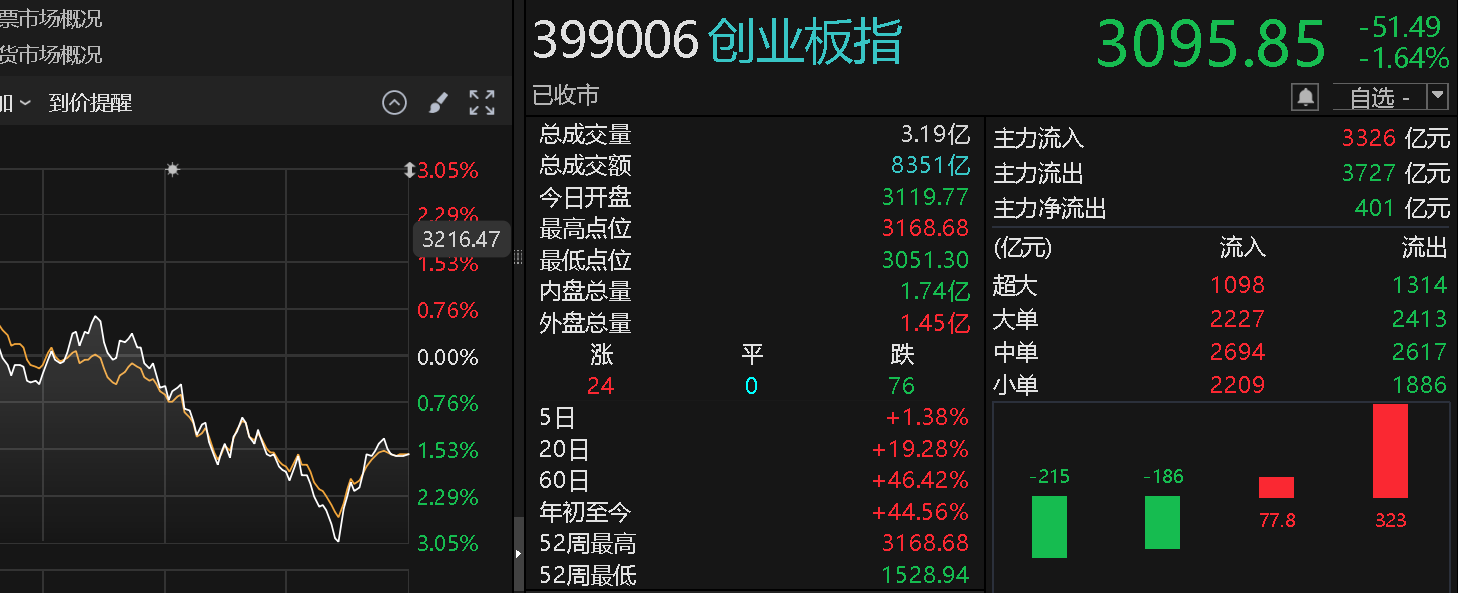
创指杀疯了?别慌,正常调整
Sou Hu Cai Jing· 2025-09-18 09:02
Core Viewpoint - The A-share market experienced a significant adjustment despite the favorable news of the Federal Reserve's interest rate cut, indicating a market correction rather than a fundamental downturn [1][4]. Market Performance - The ChiNext index showed extreme volatility, with a potential breakout above 4000 points being speculated [1]. - Early signals of market adjustment were noted, particularly with the "bull market leader" sectors being suppressed [3]. - The overall trend of the A-share market remains intact, with opportunities for short-term profit-taking or tactical trading strategies [4]. Sector Analysis - The securities sector, being the third-largest weight in the ChiNext index, underperformed significantly, contributing to the overall cooling of the market [7]. - The communication equipment sector, which is the second-largest weight in the ChiNext index, remained strong and closed in the green despite the market's overall decline [8]. - The battery sector, the largest weight in the ChiNext index, also showed signs of recovery as funds appeared to be looking for buying opportunities in strong sectors [9].
中交地产完成“保壳”第一步
21世纪经济报道· 2025-09-11 04:01
Core Viewpoint - The article discusses the significant asset restructuring of China Communications Real Estate (中交地产), highlighting its transition from real estate development to a light asset model, alongside changes in management and the implications for the company's future performance [1][7][8]. Group 1: Company Restructuring - China Communications Real Estate has completed a major asset restructuring, transferring all real estate-related assets and liabilities to China Communications Real Estate Group [1][7]. - The company has appointed a new management team led by Zeng Yiming, who has extensive experience in light asset operations, indicating a strategic shift in focus [1][8]. - The restructuring is seen as a necessary step to avoid delisting, as the company must achieve positive net assets by the end of the year [7][8]. Group 2: Financial Performance and Challenges - In recent years, China Communications Real Estate faced a debt crisis due to poor cash flow management, leading to a decline in sales and profitability [1][4]. - The company's sales figures peaked at 560 million yuan in 2021 but have since declined, with continuous losses expected in 2023 and 2024 [4][7]. - As of September 10, the stock price of ST Zhongdi was 4.93 yuan per share, with a market capitalization of 3.7 billion yuan [6]. Group 3: Industry Context - The article contrasts the restructuring of China Communications Real Estate with the performance of China State Construction Engineering Corporation, which reported real estate sales of 174.5 billion yuan in the first half of the year, maintaining its position as the industry leader [10]. - The real estate sector is undergoing significant adjustments, with many state-owned enterprises facing declining profit margins and the need for strategic realignment [11][12]. - Despite challenges, the strong backing of parent companies provides support for these enterprises, allowing them to explore opportunities in urban renewal and other sectors [12].

A股开盘速递 | 沪指跌0.16% 通信服务等板块涨幅居前
智通财经网· 2025-09-11 01:46
Market Overview - The three major A-share indices opened mixed, with the Shanghai Composite Index down 0.16% and the ChiNext Index up 0.46%. Sectors such as CPO, communication services, and computing power showed strong gains [1] Institutional Insights - According to Founder Securities, since September last year, the overall liquidity in the A-share market has been continuously improving, with trading volumes significantly increasing and financing scales reaching historical highs. Multiple positive factors indicate that the long-term trend of the Chinese capital market remains favorable: 1) The medium to long-term economic outlook is positive; 2) A-shares are undervalued, offering attractive returns; 3) The quality of listed companies is steadily improving; 4) Increasing dividends and buybacks enhance investor returns; 5) Patient capital continues to flow into the market, supporting healthy development [2] - Xing Shi Investment believes that the market is still in the first phase of a bull market, with a healthy upward trend in the medium term. On one hand, liquidity-driven momentum has not ended, with market transactions maintaining above 2 trillion, indicating strong trading activity. On the other hand, macroeconomic factors are improving, supported by ongoing policy efforts and the transition of old and new growth drivers, alongside reduced tariff concerns and potential interest rate cuts by the Federal Reserve, which may further open up domestic policy space [2] Market Analysis - Dongfang Securities notes that fluctuations and adjustments below the 3900-point mark of the Shanghai Composite Index do not signify the end of the current bull market but rather serve to build momentum for the next phase of growth, with potential for new highs within the year. Key sectors for investment include solid-state batteries and robotics, which are showing positive performance, while buying opportunities in technology stocks after recent pullbacks should be seized [3] - Everbright Securities observes that profit-taking has continued in the A-share market, with some high-priced stocks leading declines, affecting the overall market. However, the outlook remains optimistic as the Shanghai Composite Index stays above the 20-day moving average, suggesting that the index may continue to oscillate upward, with a high likelihood of ongoing rotation in market hotspots [3]
A股短期调整,中期或现机会
Sou Hu Cai Jing· 2025-09-10 14:33
Group 1 - The A-share market is experiencing significant volatility with extreme structural characteristics, where the CPO and technology sectors are declining while the index is rising [1] - The core contradiction of the market adjustment lies in the change in funding structure, highlighted by the record high margin financing balance since 2016, indicating potential overheating risks [1] - Institutional funds are withdrawing, as evidenced by over 10 billion yuan in redemptions from the Sci-Tech 50 ETF in the past two weeks [1] Group 2 - The adjustment in the growth sector is not over, with high-valued technology stocks needing to digest valuation bubbles [1] - Funds that flowed out of CPO have moved into dividend, CXO, and new energy sectors, but the adjustment phase is still ongoing, with funds searching for upward trends [1] - Short-term investors are advised to adopt a defensive strategy, such as investing in fund combinations, while mid-term attention should be given to potential mainline opportunities in CXO, chemicals, and new consumption sectors [1]

杨德龙:市场涨跌起伏就像四季轮换一样 保持平常心方能立于不败之地
Xin Lang Ji Jin· 2025-09-08 00:48
Group 1 - The market is currently experiencing a correction after a significant rally, particularly in popular stocks that have seen large gains [1] - The current market trend is characterized as a slow bull market rather than a fast bull market, indicating a more sustainable growth pattern [1] - The rapid increase in margin trading balances, which have surpassed 2.3 trillion yuan, signals both active investor engagement and potential short-term adjustment risks [1][2] Group 2 - Long-term market growth is supported by government policies aimed at boosting consumption through sustained market performance, which is essential for economic recovery [2] - There is a strong inflow of capital into the stock market from various sources, including funds moving from traditional industries and low-yield savings, indicating a shift in investment strategies [2] - The confidence of foreign investors in Chinese assets is increasing, particularly in high-tech sectors, which may lead to a revaluation of these assets [2] Group 3 - The overall market trend remains upward despite short-term fluctuations, with a recommendation for investors to maintain a positive mindset and focus on long-term growth [3][4] - The current market is in a phase of adjustment, and investors are advised to look for opportunities in undervalued stocks or funds during this period [4] - The combination of economic recovery, policy support, and capital inflow suggests that the long-term upward trend in the market is likely to continue [4]
大盘突然大跌,基金公司火线解读
Zhong Guo Ji Jin Bao· 2025-09-04 23:03
Market Overview - The three major indices all declined on September 4, with the Shenzhen Component Index down 2.83%, the Shanghai Composite Index down 1.25%, and the ChiNext Index down 4.25% [1] - Fund companies believe that the recent market adjustment is mainly influenced by profit-taking from previous gains, changes in market fund flows, and adjustments in policy expectations [1][2] Market Sentiment and Fund Flows - Market volatility is attributed to multiple factors, including profit-taking, marginal changes in investor sentiment, and differentiated fund flows [2] - Continuous inflow of funds and increased risk appetite have led to some stocks' valuations deviating from fundamentals, creating short-term correction pressure [2] - There is a rotation of funds between sectors, with some moving from high-volatility growth sectors to undervalued and defensive areas [2] Short-term Market Outlook - The current market adjustment is considered normal, and there is no need for panic, as valuations have not reached bubble levels [3] - The market is expected to remain in a state of fluctuation, with structural differentiation among hot sectors likely to continue [3] - As profit-taking behavior gradually releases, overall selling pressure in the market is expected to weaken, making indicators like trading volume and fund flows important for future trends [3] Economic and Policy Support - Despite short-term correction pressures, the backdrop of "asset scarcity" continues, with expectations for the Federal Reserve to lower interest rates becoming clearer [4] - The ongoing "anti-involution" policies are expected to improve corporate earnings, providing support for the market [4] Investment Strategies - In the current market environment, flexibility and foresight in strategies are essential, with a recommendation to adopt a "barbell strategy" [5] - On the offensive side, investors are encouraged to look for opportunities in sectors like AI, robotics, and innovative pharmaceuticals during corrections [5][6] - On the defensive side, focusing on dividend-paying and cash flow-stable industries is advised, along with tracking broad market indices like the A500 and CSI 300 [6] Sector Focus - Key areas of interest include AI-related industries, domestic brand competitiveness, and resource products [6] - The technology growth sector, particularly in TMT, advanced manufacturing, and biopharmaceuticals, is expected to remain a market focus [6]
中欧瑞博吴伟志:投资中最困难的事,踏空后该怎么办?
天天基金网· 2025-09-04 05:09
Group 1 - The core issue of "missing out" in a rising market is a significant psychological burden for investors, often more painful than losses in a declining market due to the feeling of having missed potential gains [2][4] - Professional investors may also experience "missing out" due to a lack of confidence in market strength and insufficient research preparation, leading to a failure to identify opportunities [4][5][6] Group 2 - The first reason for missing out is a lack of confidence in market strength, as investors often perceive initial market uptrends as mere rebounds rather than the start of a strong rally [5] - The second reason is the absence of thorough research and a lack of a "base" in specific stocks or sectors, which can prevent investors from capitalizing on market movements [6][7] Group 3 - Investors need to have a comprehensive understanding of market adjustments, recognizing that adjustments can take various forms beyond just significant declines in broad indices [9][10] - It is crucial for investors to focus on specific sectors or companies rather than solely on broad market indices, as individual stock performance may not align with index movements [10] Group 4 - In the current market, maintaining a high position is advisable, as there are no clear signs of a market turning point, and adjustments should be viewed as opportunities rather than threats [11] - Investors should actively seek opportunities in undervalued sectors or companies, rather than waiting for a market correction, as this could lead to missed opportunities [13][14]

中欧瑞博吴伟志:投资中最困难的事 踏空后该怎么办?
Zhong Guo Zheng Quan Bao· 2025-09-03 22:49
Group 1 - The core issue of "missing out" in a rising market is more painful for investors than experiencing losses in a declining market, reflecting a typical behavior of "loss aversion" [1][2] - Professional investors often face the dilemma of either buying into a rising market, fearing to chase high prices, or staying out, fearing further market gains [1][2] - The importance of maintaining a clear mindset and emotional stability during market fluctuations is emphasized as a key trait of mature investors [1][2] Group 2 - The primary reasons for professional investors missing out on market gains include a lack of confidence in market strength and insufficient research preparation on specific stocks or sectors [3][5] - The cyclical nature of the stock market leads to a common belief that any rise is merely a rebound, causing hesitation to invest until it is too late [3][5] - Successful investors often focus on in-depth fundamental analysis of individual stocks, allowing them to remain unaffected by broader market trends [4][5] Group 3 - Understanding market adjustments requires a broader perspective beyond just significant declines in major indices; adjustments can also occur through sector rotations and varying performance among stocks [6][7] - Investors should differentiate between their interest in specific stocks or sectors versus the overall index performance, as these may not always align [7][8] - Recognizing various forms of market adjustments can prevent investors from missing opportunities in specific sectors or stocks [8] Group 4 - Current market conditions are described as healthy, with a potential for adjustments, but no signs of a market turning point are evident [9] - Strategies during strong market conditions should involve maintaining high positions and making timely adjustments rather than waiting for corrections [10][11] - The concept of "missing out" is reframed as simply not participating in leading sectors, while still having opportunities in other areas of the market [10][11]
中欧瑞博吴伟志: 投资中最困难的事,踏空后该怎么办?
Zhong Guo Zheng Quan Bao· 2025-09-03 22:44
Group 1 - The core issue of "missing out" in a rising market is more painful for investors than experiencing losses in a declining market, reflecting a typical behavior of "loss aversion" [1][2] - Professional investors often face the dilemma of whether to buy into a rising market or risk missing further gains, leading to a psychological struggle [1][2] - The experience of missing out can be particularly acute for professional investors who see others profiting while they do not [2][3] Group 2 - Two main reasons for professional investors missing out include a lack of confidence in market strength and insufficient research preparation on specific stocks or sectors [3][5] - The cyclical nature of the stock market leads investors to perceive early gains as mere rebounds, causing hesitation to participate [3][4] - Successful investors often focus on in-depth fundamental analysis of individual stocks, allowing them to remain confident and avoid missing out [4][5] Group 3 - The research team operates at full capacity regardless of market conditions, emphasizing the importance of having a solid "base" of knowledge about specific sectors and companies [4][5] - A well-prepared team can mitigate the risk of missing out by maintaining confidence and readiness to act even in uncertain market conditions [5][6] Group 4 - Investors need to have a comprehensive understanding of market adjustments, which can take various forms beyond just significant declines in broad indices [6][7] - Recognizing that adjustments can occur through sector rotations and not solely through index declines is crucial for identifying investment opportunities [7][8] Group 5 - Current market conditions are described as healthy, with a potential for adjustments, but no signs of a market turning point are evident [9][10] - Investors are encouraged to maintain high positions and adjust portfolios as necessary, rather than waiting for a market correction [9][10] Group 6 - In a strong market, it is advised to actively invest in quality stocks rather than waiting for adjustments, as this can lead to missed opportunities [10][11] - The analogy of farming illustrates that missing the right planting season can lead to lost opportunities, emphasizing the importance of timely investment actions [10][11]