
新消费

Search documents
知名基金经理,“盯”上这只股
Zhong Guo Zheng Quan Bao· 2026-02-10 22:50
Core Viewpoint - The domestic consumption sector is experiencing a rebound as it approaches the Spring Festival holiday, supported by a recovery environment and low valuations [1] Group 1: Investment Activity - A-share leading pet company Zhongchong Co., Ltd. announced that as of January 23, well-known fund managers Xie Zhiyu and Qiao Qian have entered the top ten shareholders with their funds, holding a combined market value of over 800 million yuan [1][2] - The funds managed by Xie Zhiyu and Qiao Qian hold 6.43 million shares and 3.73 million shares of Zhongchong Co., Ltd., respectively, with estimated market values of 503 million yuan and 313 million yuan [2] - In the fourth quarter of 2025, some well-known active equity fund managers began to focus on the consumption sector, indicating a strategic shift towards undervalued consumer stocks [4] Group 2: Market Trends - As of February 10, 2025, the stock prices of Pop Mart and Laopu Gold have increased by over 40% and 20%, respectively, reflecting a warming trend in the consumption sector [3] - Traditional consumption stocks are seeing a resurgence, particularly in the liquor sector, as the market anticipates a recovery in consumer demand during the traditional peak season [4] - The market is observing a gradual improvement in price levels, with expectations of a moderate recovery in inflation, which could enhance the elasticity of the consumption sector [6] Group 3: Fund Manager Insights - Fund managers are increasingly optimistic about traditional consumer stocks, noting that strong brand equity and competitive advantages are providing a solid value foundation [6][7] - The proactive positioning of funds in low-valuation consumer stocks is seen as a strategy to enhance returns, especially in the context of improving market conditions [4][6] - New consumption sectors, such as trendy toys, beauty, personal care, and jewelry retail, are expected to present frequent opportunities for investment, with well-managed companies likely to emerge as winners [7]
社服零售行业周报:泡泡玛特年会出圈,春节出行人次预计高增
HUAXI Securities· 2026-02-10 10:30
Investment Rating - Industry rating: Recommended [3] Core Insights - The report highlights the strong performance of Pop Mart, with over 1 billion LABUBU sales and 4 billion total product sales in 2025, indicating robust growth potential in the emotional consumption sector [1] - The Spring Festival travel volume is expected to reach 10.68 billion trips in 2026, a significant increase of 11.7% compared to 9.56 billion trips in 2025, reflecting strong consumer demand for travel [2] - The report suggests focusing on high-growth sectors supported by policy and technology, including service consumption, new consumption trends, retail innovation, and AI applications [2][56] Summary by Sections Industry & Company Dynamics - Pop Mart's annual meeting showcased its achievements, including a global employee count exceeding 10,000 and a registered membership surpassing 100 million [1] - Anta Group's acquisition of Puma is a strategic move to enhance its global presence and compete with major brands like Nike and Adidas [15][16] - The opening of JD Seven Fresh stores in Beijing and Shanghai aims to capture the New Year market with a focus on fresh produce and high-quality consumer experiences [17] Macro & Industry Data - In November, retail sales grew by 1.3% year-on-year, with a notable increase in online retail sales, which accounted for 25.9% of total retail sales [31][41] - The gold consumption in Q3 2025 saw a decline of 18.56%, with jewelry sales dropping significantly, while demand for gold bars remained strong [48][49] Investment Recommendations - The report recommends focusing on sectors with high growth potential, including service consumption, new consumption trends, and retail innovation, with specific beneficiary companies listed [2][56]

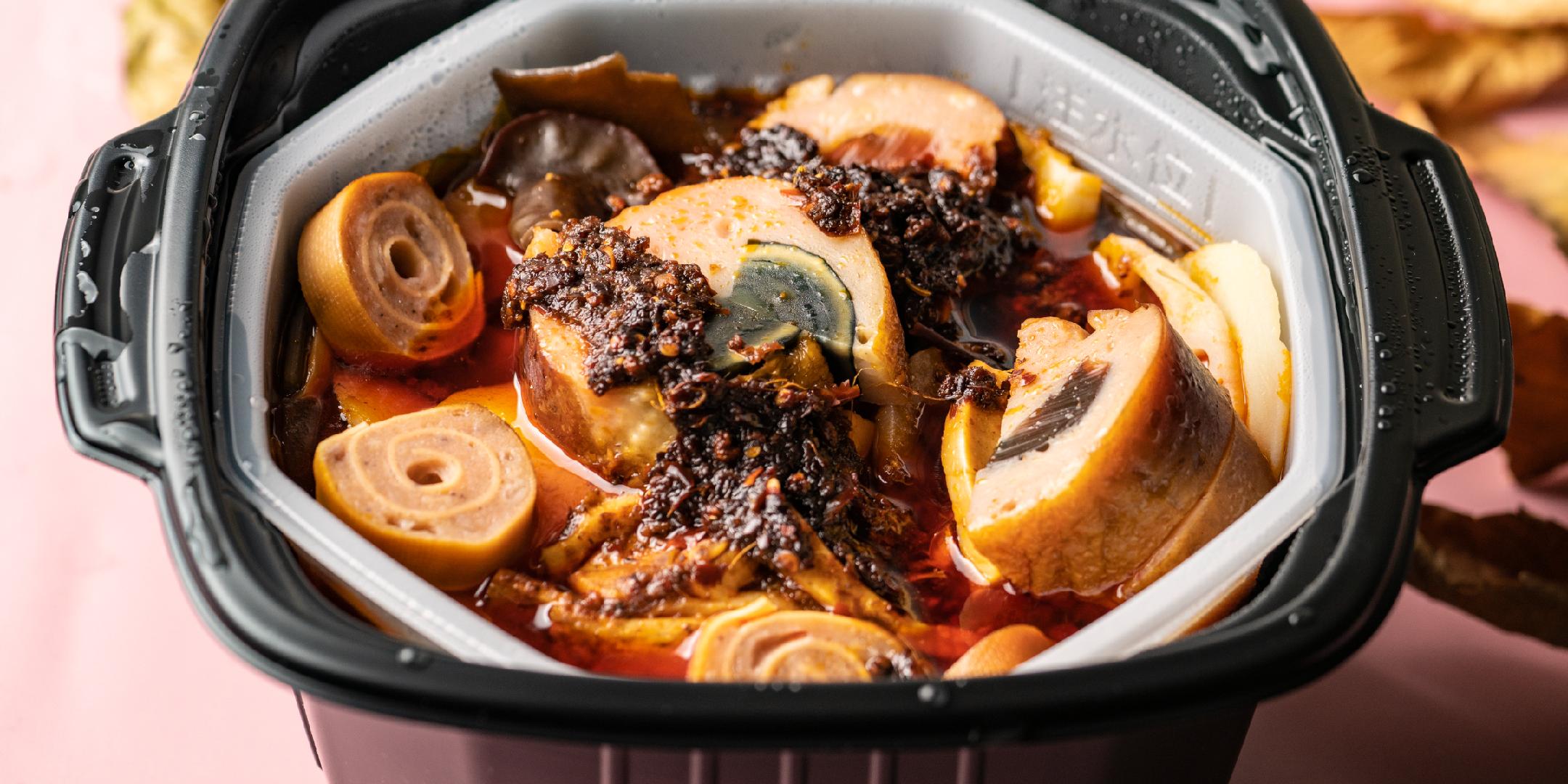
“自嗨锅”为何再也“嗨”不起来了?
Jing Ji Guan Cha Wang· 2026-02-10 07:24
Core Viewpoint - The rapid rise and subsequent decline of the hot pot brand "Zihai Guo" highlights the vulnerabilities in the new consumption wave, emphasizing the need for sustainable business models beyond capital-driven growth [2][6]. Group 1: Company Overview - "Zihai Guo" was once a sensation in the market, achieving sales of 5 million barrels in just 10 minutes and reaching a valuation of 7.5 billion yuan due to its innovative "self-heating hot pot" concept [2]. - The brand capitalized on the "lazy economy" and the single population demographic, launching its self-heating hot pot products in 2018, which quickly filled a market gap [2]. Group 2: Financial Performance - In 2022, "Zihai Guo" experienced a 17% decline in revenue, dropping to 820 million yuan, with online sales plummeting by 41% [3]. - The company faced severe financial distress, with debts exceeding 140 million yuan and a forced execution due to unpaid advertising fees [3]. Group 3: Product and Market Challenges - The self-heating food market became saturated with competitors, leading to a lack of product differentiation and innovation from "Zihai Guo" [3]. - Food safety issues have plagued the brand, eroding consumer trust, particularly following incidents involving product safety concerns [4]. Group 4: Marketing and Pricing Strategy - "Zihai Guo" relied heavily on marketing expenditures, with sales expenses exceeding 40% during 2020-2021, resulting in losses of over 460 million yuan [4]. - The pricing strategy has been criticized for being above industry averages while offering lower value, leading to consumer dissatisfaction and low repurchase rates [4]. Group 5: Competitive Landscape - The brand faces intense competition from established hot pot chains like Haidilao and emerging brands that offer lower prices and better quality [5]. - The overall market for self-heating hot pots has contracted, with a 32.67% year-on-year decline in sales by Q4 2024, and "Zihai Guo's" market share shrinking from 1.84% in 2022 to 1% in 2023 [5]. Group 6: Industry Implications - The decline of "Zihai Guo" serves as a cautionary tale for the fast-food industry, illustrating the risks of over-reliance on capital and marketing without a solid product foundation [6]. - The shift from a capital-driven growth model to a focus on product quality and user experience is essential for sustainable success in the new consumption landscape [6].

美日中消费演进启示录:下一站,风起服务消费
Shenwan Hongyuan Securities· 2026-02-10 06:11
Group 1: Core Insights - The report emphasizes that China's consumption market potential lies not only in income growth but also in the effective release of consumption scenarios and time, with current policies addressing constraints in holiday optimization and work time regulations [3] - The evolution of consumption patterns in the U.S., Japan, and China shows a clear transition from "survival" to "experience" consumption, with China's service consumption significantly lower than that of developed countries [3][10] - The report identifies three core variables driving consumption changes: economic development stage, demographic shifts, and technological innovation, highlighting the structural transformation of consumer preferences in China [3][12] Group 2: Historical Consumption Evolution - The U.S. consumption history from the 1970s to the present reflects a shift from practical consumption during crises to brand-driven consumption, rational consumption, and experience-oriented consumption, culminating in technology-enabled and social consumption [10][11] - Japan's consumption evolution post-World War II transitioned from durable goods to quality and luxury consumption, followed by a rational return and the emergence of the "silver economy" due to aging demographics [18][20] - China's consumption history since 1978 has progressed from policy-driven practical consumption to brand consumption, and now to a blend of rational and self-indulgent consumption, with a notable rise of domestic brands [23] Group 3: Current Market Analysis - The A-share consumption sector has seen significant price adjustments, with stock prices declining by 40%-70% since 2021, indicating a potential for long-term investment opportunities as market sentiment begins to recover [3][6] - The report suggests that the consumption sector is currently undervalued, with low profitability and low holdings, presenting a significant expectation gap compared to the technology sector [3][6] - Service consumption is highlighted as a key area for alpha returns, with structural highlights in sectors such as cultural tourism, sports, emotional value, and beauty, indicating a potential for independent alpha performance among core companies in these fields [3][6]
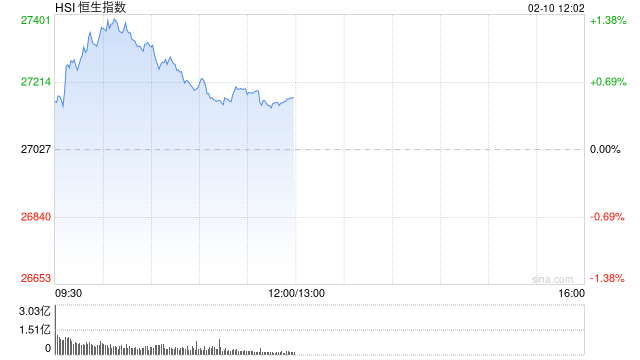
港股午评:恒指涨0.54% 科指涨0.84% 创新药概念股走强 AI应用股大涨 智谱涨超21%
Xin Lang Cai Jing· 2026-02-10 04:03
Market Overview - The Hong Kong stock market indices collectively rose, with the Hang Seng Index increasing by 0.54% to 27,172.87 points, the Hang Seng Tech Index up by 0.84%, and the State-Owned Enterprises Index rising by 0.78% [1][9] Technology Sector - Tech stocks showed mixed performance, with Xiaomi, JD.com, and NetEase rising over 2%, while Meituan fell over 3% and Tencent dropped over 1% [1][9] - AI application stocks surged, particularly Zhiyun, which increased by over 21% following the internal testing of ByteDance's Seedance 2.0 video model [2][10] Pharmaceutical Sector - Innovative drug concept stocks collectively rose, with CSPC Pharmaceutical gaining over 6%. The company has entered a platform-level collaboration with AstraZeneca worth up to $18.5 billion [4][12] - The innovative drug sector is experiencing rapid revenue growth, with over 70% of companies expected to achieve positive revenue growth by 2025 [4][12] Consumer Sector - The new consumption concept saw some stocks rise, with Pop Mart increasing by over 4%. The company announced plans to sell over 400 million products globally by 2025 [5][13] New Listings - Two new stocks were listed today, with Lexin Outdoor surging over 121% and Aixin Yuan Zhi rising nearly 1% [6][14]
美护大涨-关注高成长与边际改善
2026-02-10 03:24
Summary of Conference Call Records Industry Overview - The beauty and personal care sector is expected to see significant growth in 2026, driven by industry rotation and positive changes in certain companies. The market has experienced adjustments since the second half of 2025, particularly after the peak of new consumption trends, leading to declines of over 30% in some companies' stock prices. However, many companies are now at low valuation levels, and with the influence of style rotation, stock prices have rebounded significantly [2][3][4]. Key Companies and Performance - **Proya (珀莱雅)**: The main brand achieved a 24% growth in January 2026, with its OR brand doubling in growth. The company has undergone management changes and is launching new product lines, which are expected to contribute to stable growth [5][10][11]. - **Betaini (贝泰妮)**: The company has seen a recovery in e-commerce sales and profitability, with its main brand stabilizing in revenue and profit margins. The sub-brand Oksman is projected to grow over three times, indicating strong future potential [12]. - **Lurich (陆雨辰)**: Despite recent stock price adjustments due to industry style changes and regulatory uncertainties, the company remains optimistic about its growth potential, especially as it benefits from compliance with regulations [7]. - **Shangmei (尚美)**: The company has maintained good growth rates, with its sub-brands achieving significant increases in sales [6]. Market Trends and Consumer Behavior - The overall demand in the beauty sector is expected to bottom out and gradually recover in 2026. External shocks and subsidy reductions have already impacted business demand, and if housing prices stabilize and CPI rises in the second half of the year, consumer opportunities will increase [2][3]. - The growth of beauty products on platforms like Douyin (抖音) has been notable, with a 25% year-on-year increase in January 2026. This growth is attributed to organizational adjustments and operational improvements within companies [5][6]. Investment Opportunities - The focus for 2026 should be on companies that are at the bottom of their valuation with positive changes. Companies like Proya, Betaini, and Lurich are highlighted as having reflected the most pessimistic expectations in their stock prices, and any positive developments could lead to significant stock performance [4][5][6]. - The investment strategy should prioritize companies with strong fundamentals and those that have undergone structural or organizational adjustments, as these are likely to show marginal improvements and high growth potential [2][3][6]. Regulatory Environment - The regulatory landscape for NMN (Nicotinamide Mononucleotide) is evolving, with expectations that future policies will not be overly stringent. This is seen as beneficial for compliant large enterprises in the industry [8]. Conclusion - The beauty and personal care industry is poised for recovery and growth in 2026, with several companies showing promising signs of improvement. Investors are encouraged to focus on companies with strong fundamentals and positive changes, as these are likely to yield significant returns in the coming year [2][3][4].


不想排队等上市了?四川吉香居要转卖给海外“资本大鳄”…
Sou Hu Cai Jing· 2026-02-10 03:05
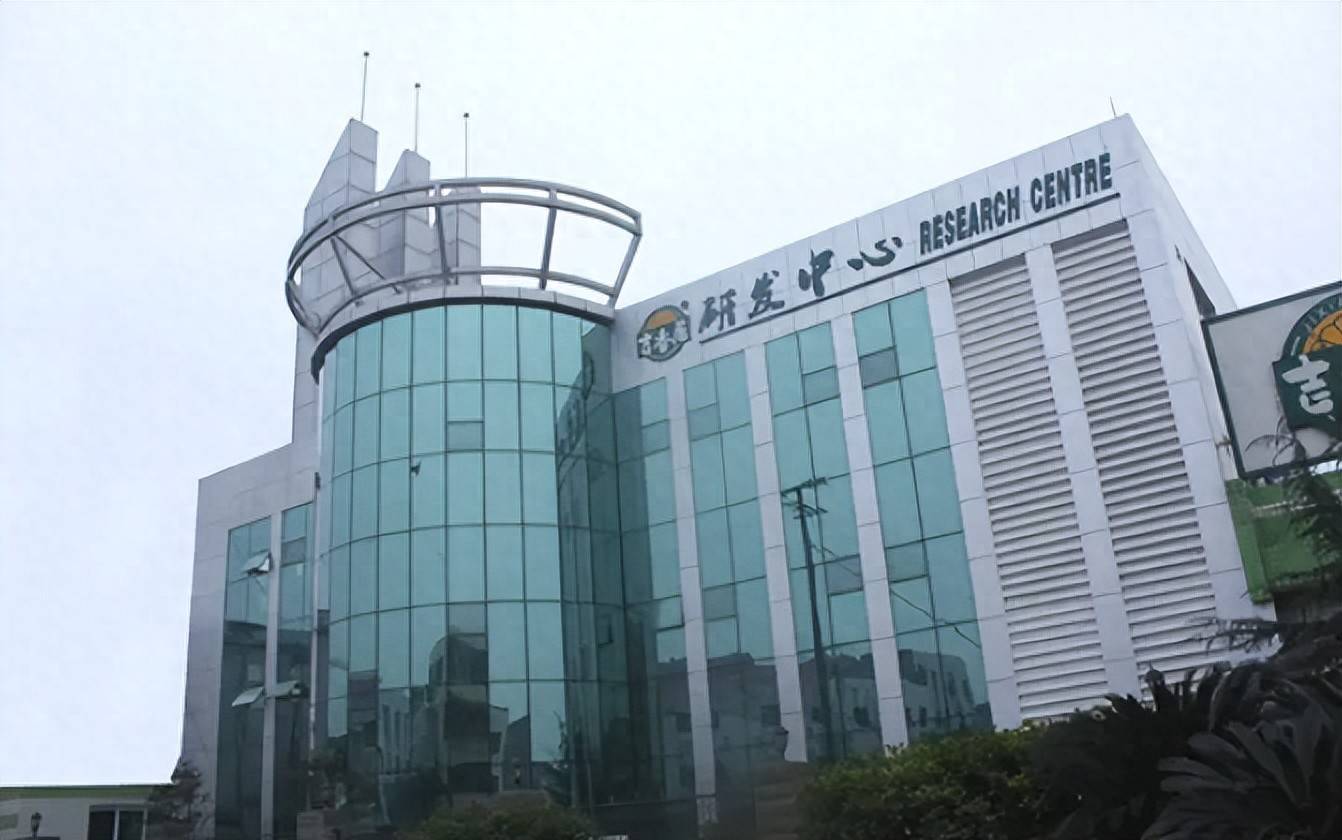
Core Viewpoint - The acquisition of 92% of Jixiangju Food Co., Ltd. by FountainVest Capital marks a significant shift in ownership, as the company, which has been striving for an IPO for over five years, opts for a complete change in control rather than going public [2][5][20] Company Overview - Jixiangju was established on December 28, 2000, in Meishan, Sichuan Province, focusing on the research, production, and sales of pickled vegetables and compound seasonings [3][4] - Prior to the acquisition, the founder Ding Wenjun held 31.24% of the shares and was the actual controller of the company [3][4] Acquisition Details - FountainVest Capital, through its indirectly controlled entity, signed a share purchase agreement to acquire a total of 92% of Jixiangju's shares, with the specific amount undisclosed [2][4] - This acquisition comes shortly after a previous major shareholder change in July 2023, when Sequoia Capital and Tencent acquired shares from South Korea's CJ Foods [5] Market Context - As of early 2026, nearly 700 companies are waiting to go public, highlighting the competitive and challenging nature of the IPO market [14] - Despite being a leading player in the pickled vegetable market, Jixiangju has faced difficulties in its IPO journey, submitting 19 rounds of guidance reports without success [10][13][20] Founder’s Journey - Ding Wenjun's entrepreneurial journey began at the age of 17, evolving from a vegetable vendor to the founder of a leading pickled vegetable brand, with aspirations to create a century-old brand achieving 10 billion in sales [6][7][10] - His approach included hiring professional managers early on, which contributed to the company's growth but also led to a dilution of his control over time [10][12] Challenges Faced - Jixiangju's IPO attempts have been hindered by frequent changes in shareholders and management, as well as unresolved financial and operational issues [13][20] - The competitive landscape has also shifted, with rivals like Fuling Mustard gaining market share, further complicating Jixiangju's position [13] Future Prospects - The acquisition by FountainVest Capital may provide Jixiangju with an opportunity for revitalization, as the new ownership could bring modern governance and strategic resources to the company [20] - The transition in control is seen as a potential turning point for Jixiangju, which has maintained its status as a top seller in the pickled vegetable market despite internal challenges [10][20]
美股异动 | 受美股大涨及春节消费驱动 乐信(LX.US)上涨8.54%
智通财经网· 2026-02-10 01:02
Group 1 - The core viewpoint of the article highlights the strong performance of Lexin (LX.US), a leading digital technology service provider in China's new consumption sector, which saw an 8.54% increase in stock price, closing at $3.05, driven by a bullish US stock market and the upcoming Spring Festival holiday [1] - On the same trading day, Lexin's trading volume reached $4.0542 million, indicating a continued increase in trading activity [1] - The broader US stock market also experienced gains, with the Dow Jones Industrial Average reaching a new all-time high, and the three major indices showing positive movements: Dow up 20.20 points (0.04%), Nasdaq up 207.46 points (0.90%), and S&P 500 up 32.51 points (0.47%) [1] Group 2 - The Nasdaq Golden Dragon China Index rose by 0.12%, with mixed performances among popular Chinese concept stocks; Lexin stood out positively among consumer-related stocks [1] - Lexin, established in August 2013 and based in Shenzhen, China, has been actively connecting millions of young Chinese consumers with new consumption brands through its platforms, promoting a brand philosophy of "easy consumption and flexible turnover" [1] - Lexin officially listed on the Nasdaq in December 2017, marking its entry into the US capital market [1]

布局新消费、促进有效投资 中部六省加快构建增长新引擎
Shang Hai Zheng Quan Bao· 2026-02-09 23:46
Group 1 - The core viewpoint of the articles highlights the economic growth and development strategies of six central provinces in China, with a focus on stabilizing growth and expanding domestic demand as key priorities for 2026 [1][2] - The GDP of the central region is projected to approach 30 trillion yuan by 2025, with Henan leading the growth at 5.6%, followed by Hubei, Anhui, and Jiangxi, all exceeding 5% [1] - The manufacturing sector shows strong performance, with Anhui and Henan's industrial added value increasing by 9.4% and 8.4% year-on-year, respectively [1] Group 2 - Central provinces are focusing on new consumption trends, emphasizing "emotional value" and "emotional economy" in their government work reports, indicating a shift towards innovative consumption models [2] - Hubei aims to cultivate new consumption growth points such as event economy and silver economy, while Jiangxi focuses on service, digital, green, and health consumption [2] - Henan plans to promote local business innovations and create new consumption scenarios, while Shanxi is developing night economy and new business models [2] Group 3 - Effective investment is crucial for stabilizing economic growth, with central provinces exploring investment potential in water conservancy and logistics to enhance their hub functions [4] - Henan emphasizes building logistics channels and industrial linkages, while Hubei is advancing waterway projects to support high-quality development [4] - Hunan has prioritized 389 key projects with a total investment of 2 trillion yuan, including major water conservancy initiatives [4] Group 4 - The central region is positioned as a significant base for modern equipment manufacturing and high-tech industries, with a focus on developing a modern industrial system [5] - Hubei is working on establishing a world-class integrated storage and computing industry base, while Hunan is advancing projects in lithium batteries and new energy systems [6] - Jiangxi aims to strengthen its capabilities in aircraft manufacturing and electric vehicles, while Shanxi is fostering new materials and high-end equipment manufacturing [6][7]
布局新消费 促进有效投资 中部六省加快构建增长新引擎
Shang Hai Zheng Quan Bao· 2026-02-09 18:33
Core Insights - The central provinces of China are focusing on "stabilizing growth and expanding domestic demand" as key priorities in their 2026 government work reports, with a projected GDP nearing 30 trillion yuan for 2025 [1][2] - The concept of "emotional value" and "emotional economy" has emerged as a significant trend in consumer behavior, prompting these provinces to innovate in consumption and investment [1][2] Economic Growth and Investment - Henan leads the central provinces with a GDP growth rate of 5.6%, while Hubei, Anhui, and Jiangxi also report growth rates exceeding 5% [1] - The provinces are enhancing their investment in sectors like water conservancy and logistics to strengthen their roles as key hubs in the domestic and international economy [3][5] New Consumption Trends - Provinces are actively cultivating new consumption growth points such as the "first release economy," "exhibition economy," and "silver economy" to meet evolving consumer demands [2] - Specific initiatives include promoting local business innovations and developing diverse consumption scenarios to stimulate economic activity [2] Industrial Development - The central region aims to establish a modern industrial system with a focus on new energy, new materials, and high-tech industries [5][6] - Hubei is working on a world-class integrated storage and computing industry base, while other provinces are advancing projects in electric vehicles, lithium batteries, and aerospace [5][6] Infrastructure and Project Development - Significant infrastructure projects are being prioritized, with Hunan announcing 389 key projects totaling 2 trillion yuan in investment [3] - The provinces are also focusing on enhancing their logistics and transportation networks to facilitate economic growth and connectivity [3][5]