
衰退

Search documents
纳指“六连涨”!英伟达、特斯拉双双涨超4%!中概股跑赢大盘,腾讯ADR涨超3%!金价大跳水
Mei Ri Jing Ji Xin Wen· 2025-05-14 22:23
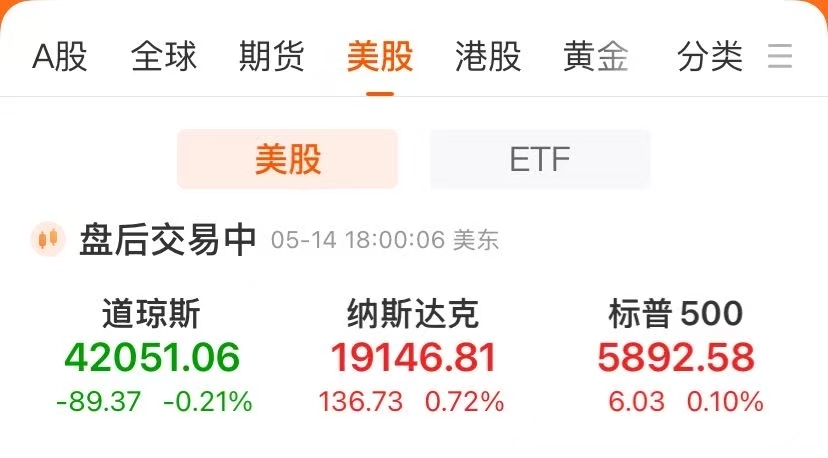
Market Performance - On May 14, US stock indices closed mixed, with the Nasdaq up 0.72%, S&P 500 up 0.1%, and Dow Jones down 0.21% [1][5] - Large tech stocks mostly rose, with Nvidia and Tesla both gaining over 4% [1][7] - The Nasdaq Golden Dragon China Index rose 1.17%, outperforming the broader market [11] Chinese Stocks - Popular Chinese stocks saw significant gains, with Tencent Music up over 15% and Li Auto up nearly 3% [1][11] - Alibaba, Baidu, and TAL Education also rose close to 2% [1][11] Commodity Market - COMEX gold futures fell 1.91% to $3185.7 per ounce, while silver futures dropped 2.23% to $32.37 per ounce [4] - International crude oil futures also declined, with WTI June futures down 0.82% to $63.15 per barrel [4] Federal Reserve Insights - Federal Reserve Vice Chairman Jefferson warned that new tariff policies could increase inflation uncertainty [4][16] - Chicago Fed President Goolsbee emphasized the importance of not reacting to daily market fluctuations, indicating a stable economic outlook [17] Company-Specific Developments - Tesla's Shanghai factory exported nearly 30,000 Model 3 and Model Y vehicles in April, marking a one-year high [11] - Nvidia and AMD are expected to benefit significantly from AI infrastructure projects in Saudi Arabia, with potential revenues estimated between $3 billion to $5 billion annually [11] - Tencent reported Q1 2025 revenue of 180.02 billion yuan, a 13% year-on-year increase, with significant growth in its advertising and gaming segments [14][15]




黄金突然直线跳水!金饰价格一夜跌了14元
21世纪经济报道· 2025-05-12 04:12
Core Viewpoint - The article discusses the recent significant decline in gold prices, highlighting both short-term risks and long-term investment potential in the gold market [1][4]. Price Movements - On May 12, gold prices experienced a substantial drop, with COMEX gold futures falling below $3,270 per ounce. Domestic gold jewelry prices also decreased, with brands like Chow Sang Sang and Chow Tai Fook marking their gold prices at 1,007 CNY and 1,008 CNY per gram, respectively, down 14 CNY from the previous day [1][2]. Market Analysis - Various gold-related ETFs have also seen declines, with the Huaxia Gold ETF dropping by 2.02% and the Gold Stock ETF falling by 1.54%. Key holdings such as Zhaojin Mining and Chow Tai Fook have also seen their stock prices decrease [3]. - Analysts from Guoxin Futures predict that gold prices may continue to fluctuate in the short term, with potential support around $3,250 per ounce. They suggest that geopolitical tensions or weak economic data could trigger a rebound [4][6]. Long-term Outlook - Despite short-term adjustments, the long-term investment value of gold remains widely recognized. Analysts from CITIC Futures maintain a bullish long-term outlook, citing a clear trend of slowing U.S. economic growth and ongoing trade tensions as factors that could support gold prices [6][8]. - Goldman Sachs forecasts that gold prices could rise to $3,700 per ounce by the end of 2025 and further to $4,000 per ounce by mid-2026, driven by structural demand from central banks and investors [8]. Conclusion - The article emphasizes the importance of monitoring economic indicators and geopolitical developments, as these factors will significantly influence gold price movements in both the short and long term [4][6][8].

热点思考 | 金融压力或是美联储“转鸽”的主要矛盾 ——关税“压力测试”系列之六
申万宏源宏观· 2025-05-11 00:45
Core Viewpoint - The article discusses the potential impact of tariffs on inflation and the Federal Reserve's interest rate decisions, highlighting a divergence in market expectations regarding rate cuts in 2025 due to financial pressures and the risk of stagflation [1][5]. Group 1: Financial Pressure as a Key Factor - In a stagflation environment, the Federal Reserve faces challenges in balancing its dual mandate, with financial pressure emerging as a primary concern [2][48]. - The economic effects of tariffs are contributing to stagflation, as indicated by manufacturing PMI and short-term inflation expectations, suggesting that stagflation risks are increasing [2][48]. - The Federal Reserve's recent stance indicates a preference for a reactive approach rather than a preemptive one, focusing on the economic impact of tariffs and uncertainty in the economic outlook [7][48]. Group 2: Impact of Financial Pressure on Decision-Making - Sustained financial pressure may lead the Federal Reserve to consider policy adjustments, as rising financial pressure often signals economic downturn expectations [3][24]. - Historical instances show that rising financial pressure has been a significant condition for the Federal Reserve to adopt a dovish stance, such as during the 2015-2016 period and the onset of the COVID-19 pandemic [3][28]. - The article emphasizes that financial conditions, including credit, valuation, and liquidity, are critical in assessing the overall financial pressure faced by the economy [24][25]. Group 3: Expectations for Rate Cuts in 2025 - The article anticipates that the Federal Reserve may initiate rate cuts in the third quarter of 2025, as the economic narrative shifts from stagflation to recession [4][35]. - The upcoming months will see market focus on the balance between inflation and economic slowdown, with expectations that if inflationary pressures ease while economic downturns persist, the Federal Reserve's primary concerns will shift accordingly [4][35]. - The probability of rate cuts may decrease if financial markets remain stable, but overall financial pressures are expected to trend upward, paving the way for potential rate cuts later in the year [4][35].
美联储理事巴尔喊话特朗普:关税可能推动通胀与失业率齐升
智通财经网· 2025-05-09 13:26
Core Viewpoint - The aggressive trade policies of the Trump administration may create long-term inflationary pressures and higher unemployment rates, complicating the Federal Reserve's monetary policy decisions [1][2][3] Group 1: Federal Reserve's Current Stance - The Federal Reserve's current benchmark interest rate is set between 4.25% and 4.50%, which is considered appropriate for the time being [1][2] - Federal Reserve officials, including Chairman Jerome Powell, have indicated that there is no urgency to adjust interest rates, allowing time to assess the impact of tariff policies [1][2] - The Federal Open Market Committee (FOMC) has maintained the interest rate unchanged for three consecutive meetings, reflecting market expectations [1][2] Group 2: Economic Impact of Tariffs - The scale and scope of recent tariff increases are unprecedented in modern history, and their ultimate impact on the economy remains unclear [2][3] - It is anticipated that the tariffs will lead to accelerated inflation and a slowdown in GDP growth for both the U.S. and significant global economies starting later this year [2][3] - Concerns over tariffs have already resulted in a sharp decline in consumer and business confidence, alongside a surge in import volumes [2][3] Group 3: Employment and Inflation Concerns - The potential for tariffs to disrupt global supply chains could create persistent upward pressure on U.S. inflation while also increasing unemployment rates [3][4] - The current labor market remains resilient, with April's non-farm payrolls adding 177,000 jobs, exceeding market expectations [2][4] - However, "soft data" indicators, such as consumer confidence surveys, show increasing pessimism about future economic conditions [4] Group 4: Future Considerations - The Federal Reserve is cautious about the dual challenge of managing inflation and unemployment simultaneously, which could complicate monetary policy decisions [3][4] - The impact of artificial intelligence on the labor market is also a topic of discussion, with potential for significant improvements in living standards but also challenges for workers [4] - Michael Barr, a Federal Reserve Governor, has emphasized the importance of avoiding distractions that could detract from the Fed's core responsibilities [4]
申万宏源证券晨会报告-20250509
Shenwan Hongyuan Securities· 2025-05-09 00:42
Group 1: Key Insights on Mixue Group - Mixue Group is a leading fresh beverage company in China, owning the fresh tea brand "Mixue Ice City" and the fresh coffee brand "Lucky Coffee" with a global store count of 46,479 by the end of 2024, making it the largest fresh beverage company worldwide [11][12] - The company focuses on the affordable price segment, with core products priced between 2 to 8 RMB, which is lower than some bottled beverages. The top three best-selling products account for over 40% of revenue [11][12] - Mixue Ice City has established the earliest and largest supply chain in the industry, with over 60% of beverage ingredients sourced from its own production, the highest in the industry, ensuring quality and cost control [12][13] - The company aims to build a strong brand connection with consumers through its high-quality and affordable value proposition, becoming a household name and launching the "Snow King" IP to enhance brand recognition [3][12] - Revenue and net profit are projected to grow at compound annual growth rates of 19% and 18% respectively from 2024 to 2027, driven by the opening of new franchise stores [12][13] Group 2: Insights on Konjac Industry - The report highlights the company's ambition to become a leader in the konjac industry, with three main product lines: konjac powder, konjac food, and konjac beauty products, focusing on high-end and refined product development [6][12] - The company has a well-established raw material supply chain and advanced processing capabilities, benefiting from the upgrading trend in the konjac industry, with China being the largest konjac producer globally [6][12] - The konjac food market has significant growth potential, with per capita consumption in China at 0.1 kg compared to 2 kg in Japan, driven by increasing demand from overweight populations, the elderly, and weight loss seekers [6][12] - The company serves major downstream brands and is well-positioned to capture demand during the market expansion phase, with a focus on cost control and product innovation [6][12]
美国经济:滞胀困境、金融脆弱性与美联储对策
2025-05-08 15:31
Summary of Key Points from the Conference Call Industry Overview - The discussion primarily revolves around the **U.S. economy**, focusing on the impacts of tariffs, inflation, and the Federal Reserve's policies. Core Insights and Arguments - **Tariff Impact**: The average tariff level in the U.S. has risen to approximately **24%**, reminiscent of the 1910s, significantly pressuring the economy. This increase in tariffs is expected to raise inflation by **1.5% to 2%**, with potential peaks at **2.5%** [1][2][8] - **Economic Transition**: The U.S. economy is anticipated to transition from **stagflation to recession** within the next year. Initially, inflation and economic growth may strengthen, but increasing downward pressure is expected to dominate later [1][5] - **Financial System Resilience**: The overall U.S. financial system is robust enough to absorb tariff shocks, but there are concerns regarding the **private equity market** and **insurance companies' cross-border positions**, which may pose risks due to low transparency and potential forced asset sales [1][4] - **Debt Market Risks**: The peak of corporate debt maturities in **2026** could reveal significant risks if credit spreads remain high, indicating potential financial stress [3][12] - **Market Dynamics**: The U.S. stock market is currently in a **W-shaped** recovery phase, but is expected to face downward pressure due to earnings challenges. Conversely, gold is in an **M-shaped** pattern, with its future performance hinging on the Federal Reserve's interest rate decisions [1][6][7] Additional Important Insights - **Labor Market Resilience**: Despite a resilient labor market, if the unemployment rate rises to around **5%**, it could signal a substantial recession. A rise to **4.5%** may only indicate recession fears rather than an actual recession [3][11] - **Global Fund Reallocation**: There is a gradual shift in global fund allocation from **overweighting dollar assets** to a more balanced approach, influenced by the recent volatility in U.S. debt, stocks, and currency [3][13][14] - **Manufacturing Sector Performance**: Following the implementation of tariffs on China, the U.S. manufacturing PMI dropped from approximately **60** to around **48**, reflecting the economic impact of trade policies [15] - **Future Monetary Policy**: The Federal Reserve's future interest rate cuts will likely depend more on market performance than on economic data, with potential cuts being considered in upcoming meetings [17] This summary encapsulates the critical points discussed in the conference call, highlighting the current economic landscape, potential risks, and future outlook for the U.S. economy.
21深度|彷徨的美联储:“双重使命”困境难解,“滞胀”过后难逃“衰退”?
Sou Hu Cai Jing· 2025-05-08 13:53
Group 1: Economic Impact of Tariffs - The U.S. economy is facing greater shocks due to the implementation of "reciprocal tariffs," leading to concerns about rising prices and consumer sentiment [2][3] - The labor market is showing signs of cooling, with companies adopting a more conservative approach amid policy uncertainty, while inflation expectations continue to rise [2][3] - The Michigan Consumer Sentiment Index fell to 52.2 in April, with one-year inflation expectations increasing from 5.0% in March to 6.5% [2] Group 2: Federal Reserve's Dilemma - The Federal Reserve is caught in a "dual mandate" dilemma, struggling to balance between supporting employment and controlling inflation due to the adverse effects of tariffs [8][9] - Fed Chair Powell emphasized the need for more data before making any preemptive rate cuts, indicating a cautious approach to monetary policy [1][8] - The Fed's current policy rate remains restrictive, and any potential rate cuts will depend on the impact of tariffs on economic growth and inflation expectations [9][10] Group 3: Future Economic Outlook - Analysts predict that the U.S. economy may transition from "stagflation" to "recession" in the coming quarters, with key economic indicators showing signs of weakness [11] - The uncertainty surrounding U.S. government policies and tariffs is eroding market confidence in the long-term economic outlook [6][11] - The potential for a recession is heightened if policy uncertainty continues to suppress economic growth in the second quarter [3][11]
申万宏源证券晨会报告-20250508
Shenwan Hongyuan Securities· 2025-05-08 01:13
Group 1: Key Insights on Mixue Group - Mixue Group is a leading ready-to-drink beverage company in China, with a global store count of 46,479 as of the end of 2024, making it the largest in the industry [10][11] - The company focuses on the affordable price segment, with core products priced between 2 to 8 RMB, appealing to cost-conscious consumers [10][12] - Mixue's main products, including fresh lemon water, fresh ice cream, and pearl milk tea, account for over 40% of its revenue, highlighting its strong market position [10][11] - The company has established the largest and earliest supply chain in the industry, with over 60% of beverage ingredients sourced from its own production, ensuring quality and cost control [11][12] - Mixue aims to build a strong emotional connection with consumers through its brand IP, "Xue Wang," which enhances marketing efficiency and brand recognition [11][12] - Revenue and net profit are projected to grow at compound annual growth rates of 19% and 18% respectively from 2024 to 2027, driven by new franchise openings [11][12] Group 2: Key Insights on Konjac Industry - The company aims to become a leader in the konjac industry, with three main product lines: konjac powder, konjac food, and konjac beauty products [4][12] - It has a robust supply chain and deep processing capabilities, allowing it to maintain price stability and benefit from industry upgrades [4][12] - The demand for konjac products is expected to grow due to increasing health awareness among consumers, particularly among overweight individuals and the elderly [4][12] - The domestic per capita consumption of konjac is significantly lower than in Japan, indicating substantial growth potential in the market [4][12] - The company is well-positioned to capture market opportunities as it serves major downstream brands, benefiting from the rising demand for konjac products [4][12]
被夹在通胀和衰退之间,鲍威尔如何直面特朗普威胁?发布会正在进行中,速来围观>>
news flash· 2025-05-07 18:31
同传直播 被夹在通胀和衰退之间,鲍威尔如何直面特朗普威胁?发布会正在进行中,速来围观>> 相关链接 ...
黄金价格剑指3500!“通胀+衰退”双重困境?金价多头势力能否持续扩张?日内交易者应该如何布局?TTPS团队交易学长正在分析中,立即观看!
news flash· 2025-05-07 11:46
黄金价格剑指3500!"通胀+衰退"双重困境?金价多头势力能否持续扩张?日内交易者应该如何布局? TTPS团队交易学长正在分析中,立即观看! 相关链接 黄金行情将讲解中 ...