
超级周期

Search documents
超级周期撞击,手机、电脑会持续涨价吗?
3 6 Ke· 2025-12-04 07:40
Core Insights - A "super cycle" of rising storage chip prices is impacting the global electronics supply chain, with major manufacturers like Samsung and SK Hynix announcing price increases of up to 30% for DRAM and NAND flash memory by Q4 2025 [1] - The price of DDR4 1Gx8 chips has surged by 158% since early September, while DDR5 2Gx8 chips have increased by 307%, driven primarily by AI demand [1] - Domestic brand Changxin Storage, the world's fourth-largest DRAM manufacturer, is focusing on high-end products like DDR5 to reduce reliance on foreign suppliers [3][10] Industry Impact - The price increase is rapidly affecting downstream markets, with reports of hard drive prices rising by 350 CNY in Shenzhen [3] - Companies are adjusting their procurement strategies, with B-end clients shifting from short-term to long-term stockpiling to lock in costs [5] - Xiaomi's Redmi K90 series saw price increases of 100-500 CNY due to rising storage costs, which are expected to compress profit margins in the mid-to-high-end smartphone market [5][6] Market Dynamics - Not all manufacturers are raising prices; Huawei's Mate 80 series was launched at a lower price point, indicating differing market strategies [6] - Global smartphone and laptop shipment forecasts have been downgraded by 2% and 2.4% respectively for 2026, suggesting a potential market shake-up [6] - The current supply-demand imbalance in the storage market could lead to sustained high prices, with a 5% supply reduction potentially doubling prices [7] Opportunities for Domestic Manufacturers - The AI-driven demand surge is creating opportunities for domestic storage manufacturers, with expectations of a 30.9% revenue increase in the DRAM industry by Q3 2025 [8] - Changxin Storage has launched DDR5 products with competitive specifications, indicating its capability to compete with international brands [10] - The shift in focus from major suppliers to niche markets presents opportunities for domestic firms like Changxin and Zhaoyi Innovation to capture market share [12][15]



集体大涨!芯片,重大利好传来!
天天基金网· 2025-11-29 02:26
Core Viewpoint - The article discusses the significant price increase of storage chips, particularly DRAM, driven by surging demand from AI infrastructure and a supply shortage, with expectations of further price hikes in the coming months and years [2][3][5]. Group 1: Market Dynamics - The global DRAM market is experiencing a supply-demand imbalance, leading to rapid price increases, with 512GB storage prices rising nearly 500 yuan compared to the previous month [2][3]. - Major tech companies like Dell and HP have issued warnings about potential storage chip shortages due to increased demand for AI infrastructure, predicting price hikes for their products [3][4]. - Counterpoint Research indicates that memory prices have already risen by 50% this year, with an additional expected increase of 50% by the second quarter of 2026 due to critical chip shortages [5][6]. Group 2: Company Responses - Lenovo's chairman, Yang Yuanqing, anticipates that the shortage and price increases of components, including storage, will persist throughout 2026, driven by the growing demand for AI-related infrastructure [4]. - Xiaomi's president, Lu Weibing, noted that the current rise in memory prices is a long-term trend influenced by AI demand, and the company has secured supply agreements for 2026 to mitigate cost pressures [4]. - Companies are adapting by potentially increasing product prices and seeking alternative suppliers to ensure adequate memory supply [3][4]. Group 3: Future Projections - Counterpoint predicts that major chip manufacturers will increase DRAM production by over 20% by 2026, but the current supply constraints primarily affect traditional products, impacting lower-cost consumer electronics [5][6]. - The shift in demand towards advanced memory types, such as LPDDR, poses significant challenges for the supply chain, as major players like NVIDIA are increasing their consumption, further straining resources [5][6]. - Analysts suggest that the current memory chip price surge may continue for several quarters, driven by strong demand across both advanced and traditional memory sectors [6].


深夜,集体大涨!芯片,重大利好传来!
Zheng Quan Shi Bao Wang· 2025-11-29 00:07
Core Insights - The global DRAM market is experiencing a supply-demand imbalance, leading to rapid price increases for storage chips, particularly driven by the surge in AI infrastructure demand [1][2][3] Group 1: Market Dynamics - The price of 512GB storage has increased by nearly 500 yuan compared to the previous month, indicating significant price inflation in the storage chip market [2] - Counterpoint Research reports that memory prices have risen by 50% this year, with an expected additional 50% increase by Q2 2026 due to critical chip shortages [4][5] - Major PC manufacturers like Dell and HP are issuing warnings about potential price hikes for their products due to rising storage chip costs and supply constraints [2][3] Group 2: Company Responses - Lenovo's chairman predicts that the shortage and price increases of components, including storage, will persist throughout 2026, prompting the company to secure optimal contracts with suppliers [3] - Xiaomi has proactively signed supply agreements for 2026 to mitigate the impact of rising storage costs and may consider price adjustments and product upgrades to alleviate cost pressures [3] - SK Hynix and Micron are adjusting their production strategies in response to the increased demand for advanced memory, with expectations of significant production growth in the coming years [5][6] Group 3: Future Outlook - The semiconductor industry is entering what analysts describe as a "super cycle," with manufacturers aggressively stockpiling memory chips amid soaring demand [6] - The shift in demand from traditional LPDDR4 to advanced memory types like HBM is causing market disruptions, with significant implications for supply chains [4][5] - Analysts predict that the price of DDR5 memory modules could double by the end of 2026 due to the ongoing supply constraints and heightened demand from major players like NVIDIA [5][6]


深夜,集体大涨!芯片,重大利好传来!
券商中国· 2025-11-28 23:35
Core Viewpoint - The storage chip market is experiencing significant price increases due to a supply-demand imbalance driven by surging AI infrastructure needs, with expectations of further price hikes in the coming months [1][2][5]. Group 1: Market Dynamics - The global DRAM market is facing a supply shortage, leading to rapid price increases for storage chips, with a reported rise of nearly 500 yuan for 512GB storage compared to the previous month [1][2]. - Counterpoint Research indicates that memory prices have already risen by 50% this year, with an additional expected increase of 50% by the second quarter of 2026 due to critical chip shortages [5][6]. - Major PC manufacturers like Dell and HP have issued warnings about rising costs and potential price increases for their products due to tight supply of DRAM and NAND flash memory [2][3]. Group 2: Company Responses - Lenovo's chairman, Yang Yuanqing, anticipates that the shortage and price increases for components, including storage, will persist throughout 2026, driven by the growing demand for AI infrastructure [3]. - Xiaomi's president, Lu Weibing, noted that the current rise in memory prices is a long-term trend influenced by AI demand, and the company has secured supply agreements for 2026 to mitigate cost pressures [3]. - Dell's COO Jeff Clarke mentioned that the company has never seen costs change at such a rapid pace and is considering raising prices for certain devices due to supply constraints [2][3]. Group 3: Future Projections - Counterpoint predicts that the production of DRAM by major chip manufacturers will increase by over 20% by 2026, but the current shortage primarily affects traditional products, impacting low-cost consumer electronics [5][6]. - The shift in demand towards advanced memory types, such as LPDDR, is expected to create significant supply chain challenges, particularly as companies like NVIDIA increase their usage of these memory types [5][6]. - Analysts suggest that the price increases for DRAM and NAND could continue for several quarters, driven by strong demand and insufficient supply [6].

这一产业开启“超级周期”,黄仁勋与杨元庆看到了什么?
财富FORTUNE· 2025-11-20 13:04
Core Insights - The storage chip market is experiencing significant price increases and supply shortages driven by the surge in AI computing demands, particularly for high bandwidth memory (HBM) [3][4][7] - Major manufacturers are reallocating production capacity towards HBM, leading to tight supplies and soaring prices for traditional DRAM and NAND flash memory [4][5] - Analysts predict a "super cycle" for the storage chip market, with global revenues expected to reach $200 billion by 2025 and nearly $300 billion by 2027 [7] Group 1: Market Dynamics - The current storage chip market is characterized by terms like "capacity transfer," "price doubling," and "supply tightness" [2] - AI model training and inference are creating unprecedented storage demands, reshaping market dynamics [3] - The concentration of HBM demand among a few companies (NVIDIA, Amazon, Google, and AMD) is significantly impacting the traditional storage market [3] Group 2: Manufacturer Strategies - Major suppliers like Samsung, SK Hynix, and Micron are prioritizing HBM production over traditional memory types, exacerbating supply shortages for DRAM and NAND flash [4] - NVIDIA's shift from DDR5 to LPDDR5X for server memory is expected to disrupt the supply chain and increase prices for server memory chips [5] Group 3: Economic Implications - The rise in storage chip prices is anticipated to increase the retail prices of laptops by 5%-15%, potentially dampening consumer demand [5] - Supply chain uncertainties are prompting manufacturers to stockpile inventory, further intensifying market tensions [6] Group 4: Future Outlook - The storage chip market is expected to benefit from the ongoing AI server construction wave, with significant opportunities for Chinese manufacturers if they can achieve breakthroughs in high-end products [7] - Geopolitical factors and changes in global trade dynamics are adding uncertainty to the stability of the supply chain [8] - The strategic importance of storage chips is increasing as they become critical components for computing performance in the AI era [9]


国泰海通:航空国际票价大涨 油运运价再创新高
Zhi Tong Cai Jing· 2025-11-18 07:29
Aviation Industry - The aviation sector is expected to enter a "super cycle" with high passenger load factors and low ticket prices, driven by demand growth and recovery in passenger structure [1] - Domestic airlines are active, and international ticket prices have surged, leading to significant reductions in losses expected in Q4 and a turnaround for the year [1] - The estimated passenger load factor for international routes in September-October exceeded 80%, with a year-on-year increase of over 3 percentage points, driving ticket prices significantly higher than market expectations [1] - The continuation of visa-free policies and the development of international transit hubs are expected to enhance long-term profitability for airlines [1] - Recommendations include China National Aviation, Juneyao Airlines, China Eastern Airlines, Southern Airlines, and Spring Airlines [1] Oil Shipping Industry - Recent increases in oil production from the Middle East and South America, along with U.S. sanctions on Russia, have positively impacted compliant VLCCs, leading to soaring freight rates [2] - The sentiment among shipowners is optimistic, with VLCC-TCE rates for Middle East to China routes reaching over $120,000, a new high [2] - The forecast for Q4 2025 indicates that oil shipping profits will reach a ten-year high, with expectations of continued demand growth outpacing supply [2] - Recommendations include COSCO Shipping Energy, China Merchants Energy Shipping, and China Merchants Jinling [2] Express Delivery Industry - The growth rate of express delivery volume during the Double Eleven shopping festival has slowed, with over 13.9 billion packages delivered, a 9% year-on-year increase, down from 21% in 2024 [3] - The average daily volume reached 634 million packages, reflecting a marginal effect of the Double Eleven promotion on consumer spending [3] - Instant retail has had a limited diversion effect on traditional e-commerce express delivery, primarily focusing on local perishable and daily goods without significantly impacting long-distance delivery [3]

从特朗普50%关税到力拓加价:在AI时代,铝正在被推向“超级周期”
智通财经网· 2025-11-18 00:28
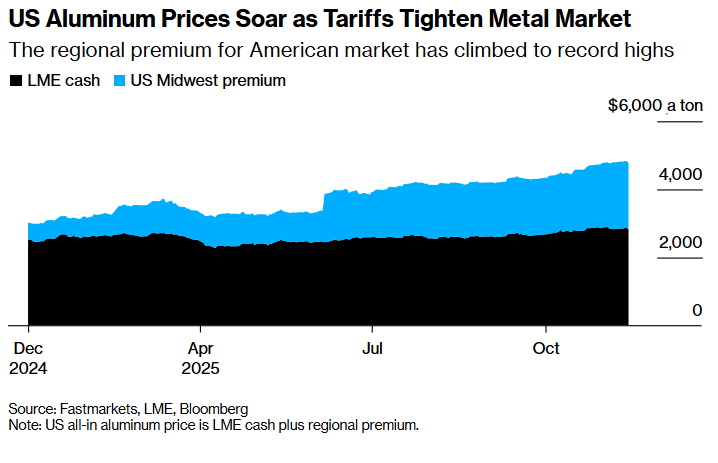
Core Viewpoint - Rio Tinto Group, the world's largest aluminum producer, is imposing additional fees on aluminum shipments to the U.S., which may further disrupt the North American aluminum market already affected by rising consumer costs due to Trump's import tariffs and increasing global demand driven by electric vehicles, solar energy, and AI data centers [1][2][4]. Group 1: Market Dynamics - The U.S. aluminum market is under significant pressure due to a 50% import tariff imposed by President Trump, which has made Canadian aluminum too expensive for U.S. metal processors and consumers, leading to a reliance on domestic inventory and exchange warehouse resources [2][4]. - The aluminum market is experiencing a "super cycle" driven by strong demand, particularly from the rapidly expanding AI data center sector, which is heavily reliant on aluminum for infrastructure and cooling systems [3][12]. Group 2: Pricing and Premiums - The new additional fee imposed by Rio Tinto adds to the existing Midwest premium, resulting in a total premium exceeding 70% on the LME aluminum price, which is already at approximately $2,830 per ton [4][11]. - The U.S. aluminum price has reached historical highs, with the Midwest premium being the highest globally, contrasting with a 5% decline in European regional premiums over the past year [11][12]. Group 3: Future Outlook - Analysts from major financial institutions, including Morgan Stanley and Citigroup, predict that the LME aluminum price could rise above $3,000 per ton, with extreme scenarios suggesting prices could reach $4,000 per ton due to ongoing demand pressures and supply constraints [12][16]. - The aluminum market is expected to remain tight, with U.S. domestic aluminum inventory only sufficient for 35 days of consumption, which typically triggers higher trading prices [15].


芯片股逆市走高 中芯国际营收创单季度新高 大摩称存储领域或出现供需失衡
Zhi Tong Cai Jing· 2025-11-17 02:29
Core Viewpoint - Semiconductor stocks are rising against the market trend, with notable increases in share prices for companies like Shanghai Fudan, Hua Hong Semiconductor, and SMIC, indicating positive investor sentiment in the sector [1] Company Performance - SMIC reported its Q3 2025 financial results, achieving total revenue of 17.162 billion yuan, a quarter-on-quarter increase of 6.9% and a year-on-year increase of 9.9%, marking a record high for quarterly revenue [1] - The company recorded a net profit attributable to shareholders of 1.517 billion yuan, reflecting a year-on-year growth of 43.1% and a quarter-on-quarter increase of 60.64% [1] - SMIC's CEO, Zhao Haijun, provided a positive outlook for Q4, expecting revenue to remain flat or grow by 2% quarter-on-quarter, with a gross margin guidance of 18% to 20% [1] Industry Trends - The global DRAM market is experiencing shortages, leading to rising prices for DRAM modules and a situation where products are hard to obtain [1] - Morgan Stanley's report suggests that the memory chip industry may enter a "super cycle" next year due to potential supply-demand imbalances in the storage sector [1] - The high market demand is causing a series of chain reactions in the storage chip industry, including supply shortages, price increases, and changes in ordering patterns [1]

港股异动 | 芯片股逆市走高 中芯国际营收创单季度新高 大摩称存储领域或出现供需失衡
智通财经网· 2025-11-17 01:57
Group 1 - Chip stocks are rising against the market trend, with Shanghai Fudan up 6.09% to HKD 41.48, Huahong Semiconductor up 3.69% to HKD 80.1, Jingmen Semiconductor up 2.17% to HKD 0.47, and SMIC up 1.43% to HKD 74.55 [1] - SMIC reported a record high revenue of CNY 17.162 billion for Q3 2025, with a quarter-on-quarter increase of 6.9% and a year-on-year increase of 9.9% [1] - SMIC's net profit attributable to shareholders reached CNY 1.517 billion, marking a year-on-year growth of 43.1% and a quarter-on-quarter increase of 60.64% [1] Group 2 - SMIC's CEO Zhao Haijun indicated that the fourth quarter is expected to be strong, with revenue guidance flat to a 2% increase, and production lines remaining fully loaded [1] - The global DRAM market is experiencing shortages, leading to rising prices for DRAM modules and a challenging supply situation [1] - Morgan Stanley's report suggests that the memory chip industry may enter a "super cycle" next year due to potential supply-demand imbalances in the storage sector [1]
存储和储能超级周期存在吗?
2025-11-16 15:36
Summary of Conference Call Notes Industry Overview - The storage and energy sector is experiencing a potential supercycle driven by AI demand, although consumer electronics growth is below expectations. Major global manufacturers are still expanding production, with 2026 projected as a peak year, testing whether AI demand can break the 30-year semiconductor cycle pattern [1][3][5]. Key Points and Arguments - **AI Demand and New Technologies**: The future of the storage industry hinges on sustained AI demand and support from new technologies like AIDC and HBM. The actual demand will become clearer after new products adapt to the supply chain by March 2026, potentially validating the current cycle [1][6]. - **Current Market Conditions**: Despite a shortage in 2025, the utilization rate for ordinary storage products is around 80%. The DDR5 introduction is not the main cause of shortages. The large customer market shows stable prices, while the channel market has seen significant price increases but reduced transaction volumes, indicating weak consumer market rigidity [1][7]. - **Challenges Ahead**: The main challenges for the storage industry include maintaining strong AI demand, the speed of new technology iterations, and the impact of major manufacturers' expansion plans on supply-demand balance. Effective management of these factors is crucial for healthy industry development [1][8]. - **Consumer Market Dynamics**: The consumer market shows strong but volatile demand. For instance, switching from a 1TB to a 2.5TB hard drive could halve demand. The current supercycle is causing rapid price increases due to mismatches between supply and demand [1][9]. - **China's Technological Advancements**: Chinese storage companies like Hefei Changxin and Yangtze Memory Technologies have made significant technological breakthroughs, bypassing patents and developing unique technology routes, thus entering the global supply chain [1][15]. Additional Important Insights - **AI Capital Expenditure Drivers**: The drivers of AI capital expenditure are complex, with a shift from viewing it as a military competition to a demand-driven phenomenon. The growth of cloud computing is critical, and if Kubernetes grows by 50%-60% in 2026 and maintains a 30%-40% growth rate, the supercycle will become more evident [1][18]. - **Inflation Impact**: Rising inflation affects the consumer electronics market significantly, with consumers willing to pay premiums for certain products, while demand for mobile devices may be suppressed due to limited AI attributes [1][17]. - **Future Outlook**: The supercycle for AI development is likely to be established, but it requires a significant explosion in downstream applications. Without this, the supercycle may not materialize, making downstream applications or indispensable platforms direct investment opportunities [1][26][28]. This summary encapsulates the key insights from the conference call, focusing on the storage industry's dynamics, challenges, and the implications of AI on future growth and investment strategies.