黄金避险属性

Search documents
11月24日金市晚评:地缘双刃剑与联储迷雾下 黄金震荡回升
Jin Tou Wang· 2025-11-25 02:20
Core Viewpoint - The future trajectory of the gold market will depend on several key factors, including the Federal Reserve's interest rate decision in December and upcoming economic data, particularly the November CPI report scheduled for release on December 18 [1][4]. Group 1: Market Overview - As of November 24, the dollar index slightly retreated, trading around 100.120, while gold prices were at $4066.81 per ounce, with a slight increase of 0.05% [1]. - Gold prices reached a high of $4076.69 and a low of $4039.72 during the trading session [1]. Group 2: Economic Indicators - Recent U.S. employment data showed a "strong but weak" trend, with non-farm payrolls increasing by 119,000 in September, significantly above the expected 50,000, but with downward revisions of 33,000 for July and August [3]. - The unemployment rate unexpectedly rose to 4.4%, the highest since October 2021, leading to significant fluctuations in market expectations for a rate cut by the Federal Reserve in December, with probabilities swinging between 40% and 74% [3]. Group 3: Geopolitical Factors - Progress in the Russia-Ukraine peace process and developments in the Middle East are influencing market sentiment. The U.S. proposed a "28-point peace plan" for Ukraine, which has led to a decrease in geopolitical risk [3][4]. - The escalation of tensions in the Middle East, particularly following discussions on a ceasefire involving Hamas and the death of a Hezbollah leader, has provided support for gold prices due to increased geopolitical risks [4]. Group 4: Technical Analysis - Technically, gold is at a critical juncture, with $4148 acting as a significant support/resistance level. A stable position above this level could lead to testing above $4200, while a drop below $4040 may trigger a decline towards $4000 or lower [7]. - The demand for physical gold in major Asian markets remains weak, and fluctuations in interest rates are hindering potential buyers, which may limit upward movement in gold prices [7].
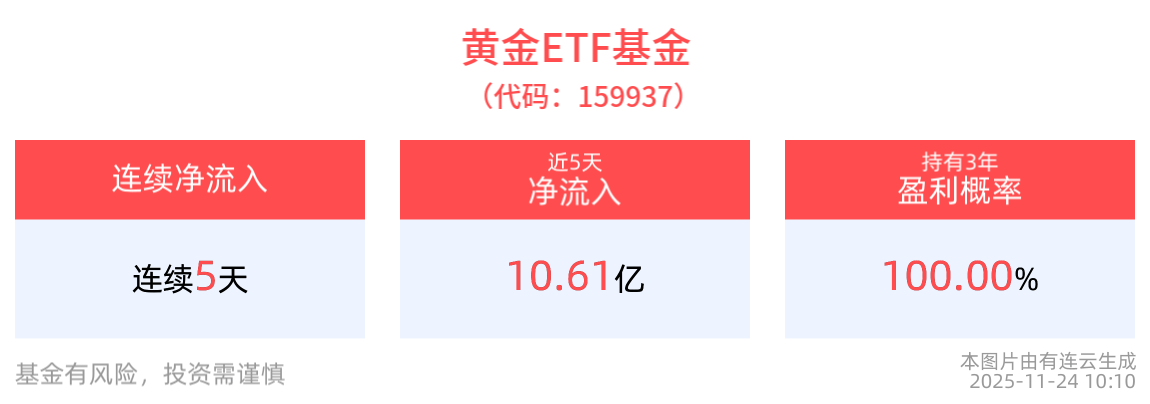
美元信用走弱,黄金货币属性加速凸显,黄金ETF基金(159937)连续5日“吸金”合计超10亿元
Sou Hu Cai Jing· 2025-11-24 02:37
Group 1 - The core viewpoint of the articles indicates that the gold market is experiencing fluctuations influenced by interest rate expectations, with short-term price movements likely to remain volatile due to uncertainty [2][3] - As of November 24, 2025, the gold ETF fund (159937) has seen a slight increase of 0.15%, with a cumulative rise of 0.48% over the past two weeks [2] - The gold ETF fund has experienced significant net inflows, totaling 10.61 billion yuan over the past five days, with a peak single-day inflow of 3.65 billion yuan [3] Group 2 - The recent U.S. non-farm payroll report showed an increase of 119,000 jobs, exceeding market expectations, which has contributed to a cautious stance from Federal Reserve officials regarding interest rate cuts [2] - The FedWatch tool indicates that the probability of a rate cut in December has risen to 70%-74%, marking a recent high [2] - Long-term trends suggest that ongoing U.S. debt issues and weakening dollar credibility will continue to support gold's appeal as a safe-haven asset, with expectations for rising gold prices [3]

强势美元成“黄金克星” 伦敦金短期反弹乏力
Jin Tou Wang· 2025-11-24 02:07
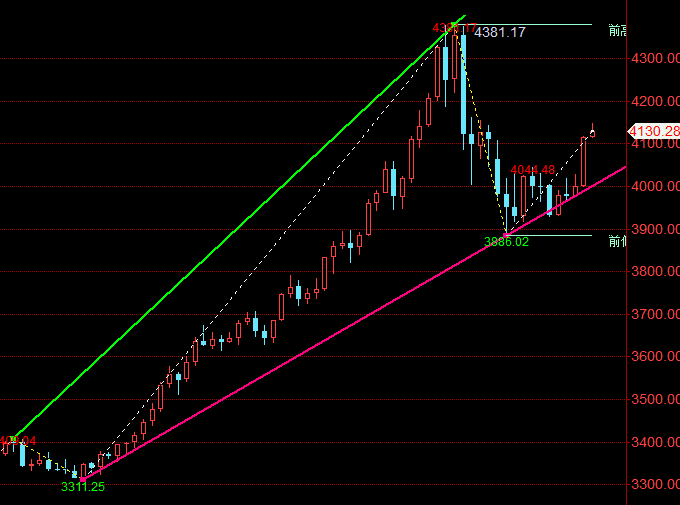
Core Viewpoint - The recent fluctuations in gold prices are primarily influenced by the strengthening US dollar and changing market expectations regarding Federal Reserve policies, leading to a decline in gold's appeal as a safe-haven asset [2]. Group 1: Market Conditions - As of November 24, gold is trading at $4,065.63 per ounce, down $9.33 or 0.23%, continuing a slight downward trend from the previous day [1]. - The US dollar index's upward movement is a key factor suppressing gold prices in the short term, with the USD/CNY exchange rate fluctuating between 7.10 and 7.11 [2]. - The probability of a rate cut by the Federal Reserve in December has decreased to 35.1%, indicating a cooling expectation for the Fed's easing policies, which diminishes gold's support as an inflation hedge [2]. Group 2: Gold's Safe-Haven Demand - In the context of a global sell-off of risk assets, gold's safe-haven characteristics have not been fully realized, as evidenced by significant declines in other assets like Bitcoin and crude oil [2]. - During the market adjustment triggered by the US stock market's drop on November 21, gold prices fell by 0.4%, reflecting a shift in safe-haven demand towards dollar-denominated assets [2]. Group 3: Technical Analysis - On a four-hour chart, gold prices have found support near the annual average line, indicating a potential stabilization as buying pressure emerges at critical levels [3]. - The MACD indicator shows a reduction in bearish momentum, suggesting a possible slowdown in the downward trend and a chance for price recovery in the short term [3]. - On an hourly chart, gold has faced resistance at the upper channel line of $4,087, with recent trading occurring in a narrow range between $4,030 and $4,070, indicating a stalemate between buyers and sellers [3].
今日金价:11月20日金价大反转,黄金市场或将迎来更大变盘?
Sou Hu Cai Jing· 2025-11-20 16:56
Core Viewpoint - The recent surge in gold prices is driven by heightened risk aversion among investors, influenced by stock market declines and geopolitical tensions, particularly the ongoing Russia-Ukraine conflict [5][9][16] Group 1: Market Trends - Gold prices have risen from $3998 to $4095 over two days, marking a total increase of 1.23% [3] - Major gold retailers in China have reported significant price increases, with prices reaching record highs [3] - The S&P 500 index has experienced a four-day decline, and the Dow Jones dropped nearly 500 points in one day, prompting investors to seek safer assets like gold [5] Group 2: Economic Indicators - The market's expectation for a Federal Reserve interest rate cut has significantly decreased from 94% to 50% in just a month, indicating uncertainty in monetary policy [5][9] - Conflicting statements from Federal Reserve officials have created confusion regarding the economic outlook and interest rate decisions [7][9] - Unemployment claims have risen to 1.957 million, suggesting a weakening labor market, despite the Fed's assertion that the economy is stable [7] Group 3: Future Outlook - The upcoming Federal Reserve meeting minutes and non-farm payroll report are critical for determining the future direction of gold prices [9][16] - If the Fed signals a potential early rate cut, gold prices could exceed $4100, while cautious language could lead to a pullback to around $4036-$4037 [9] - The non-farm payroll report, delayed by government shutdown, is seen as a crucial indicator for market sentiment and gold price movements [9] Group 4: Investment Strategies - Investors are advised to adopt a cautious approach, considering current gold prices are at a high level, and to establish a phased buying strategy to average costs [10][12] - For those in need of gold for consumption, early purchases are recommended to avoid future price increases [12] - It is essential to avoid "one-price" gold purchases due to hidden costs and to opt for gold sold by weight [13]

美债持仓,新变化
中国基金报· 2025-11-19 06:45
Core Viewpoint - Foreign investors' holdings of US Treasury bonds decreased to $9.249 trillion in September from $9.2662 trillion in August, indicating a net sell-off of US Treasuries by foreign investors during this period [4]. Group 1: Foreign Holdings of US Treasuries - Japan increased its holdings of US Treasuries to $1.189 trillion in September, with an increase of $8.9 billion, following an increase of $29 billion in August [4]. - The UK saw a rare decrease in its US Treasury holdings, dropping by $39.3 billion to $865 billion, maintaining its position as the second-largest holder [4]. - China's holdings of US Treasuries decreased slightly from $701 billion in August to $700.5 billion in September [5]. Group 2: Market Dynamics and Currency Impact - The decline in foreign holdings is influenced by the net buying and selling activities as well as price changes, with the Bloomberg US Treasury Index showing an upward trend during August and September [4]. - The weakening of the Japanese yen against the US dollar may have prompted Japanese investors to purchase more US Treasuries, reflecting a cautious attitude towards Japanese bonds [9]. - The widening interest rate differential between the US and Japan, following the Bank of Japan's decision to maintain its benchmark interest rate at 0.5%, has further accelerated the depreciation of the yen [9]. Group 3: Central Bank Actions and Gold Holdings - The People's Bank of China has been increasing its gold reserves, which reached 74.06 million ounces (approximately 2,303.523 tons) by the end of September, up by 40,000 ounces from August [11]. - Analysts suggest that the trend of diversifying foreign exchange reserves may lead to a continued gradual decrease in China's holdings of US Treasuries, as countries seek to diversify their assets amid rising gold prices [12]. - The long-term outlook indicates a weakening of the US dollar's credit, enhancing gold's monetary attributes, with central banks regularly purchasing gold as a sign of optimizing international reserves [13].

黄金今日行情走势要点分析(2025.11.13)
Sou Hu Cai Jing· 2025-11-13 00:41
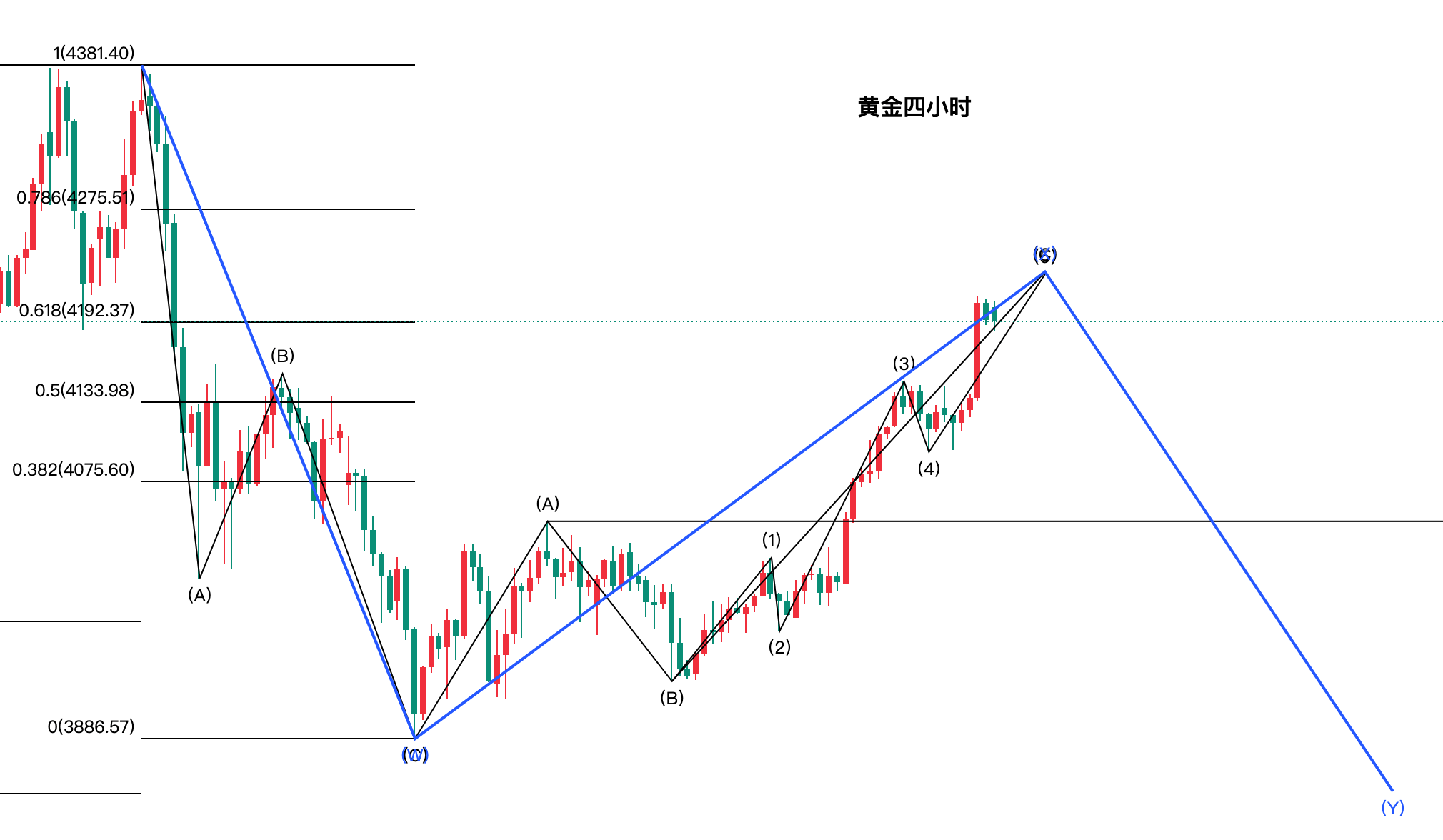
Core Viewpoint - The recent increase in gold prices is primarily driven by expectations surrounding the U.S. government funding bill and economic data indicating a slowdown in the U.S. economy, which enhances gold's appeal as a safe-haven asset [2][3]. Fundamental Analysis - Key drivers for gold's rise include the anticipated end of the U.S. government shutdown, with the House of Representatives moving towards a final vote on a funding bill, and President Trump indicating he will sign it. This has led to market expectations that upcoming economic data will confirm economic weakness in the U.S., further increasing gold's attractiveness [2]. - Economic indicators show weakness, with the ADP weekly employment report indicating a reduction of an average of 11,250 jobs per week in the private sector, reinforcing expectations for a Federal Reserve rate cut, with a 65% probability of a 25 basis point cut in December [2]. - The yield on the U.S. 10-year Treasury bond has fallen to 4.059%, reducing the opportunity cost of holding gold, coupled with economic uncertainty, leading to increased investment in precious metals [3]. - Future focus areas include the final voting results and signing progress of the U.S. government funding bill, the release of delayed economic data, particularly employment and inflation reports, and signals from Federal Reserve officials regarding interest rate cuts [3][4][5]. Technical Analysis - On the daily chart, the gold market has shown a strong upward trend, achieving four consecutive days of gains, indicating increasing bullish sentiment [6]. - Technical indicators reveal a strong short-term trend, with the 5-day and 10-day moving averages forming a golden cross, suggesting the stability and continuation of the upward trend. The 5-day moving average is currently acting as a strong support level [6]. - On the four-hour chart, the current market is in the C-wave of a corrective structure, with expectations of a five-wave push within this C-wave. Monitoring the momentum and completion of this wave structure is crucial for future positioning [8]. - Key resistance levels to watch include 4211/4212, with potential further resistance at 4238 and 4275/4276. Support levels to monitor are 4168, 4155-4140, and 4120 [9].
金价回升推高入场费!多家银行积存金门槛突破千元,“随金价浮动”新模式来了
Mei Ri Jing Ji Xin Wen· 2025-11-12 08:56
Core Viewpoint - The recent rise in international gold prices to $4100 per ounce has led to an increase in domestic gold prices, prompting banks to adjust the minimum investment thresholds for gold accumulation products [1][2]. Group 1: Price Trends - International gold prices have recently increased to $4100 per ounce, while domestic prices have risen from 900 yuan per gram at the end of October to over 940 yuan per gram [1]. - The increase in gold prices has resulted in banks raising the minimum investment amounts for gold accumulation products, with many banks surpassing the 1000 yuan threshold [2]. Group 2: Bank Adjustments - Citic Bank announced an increase in the minimum investment for gold accumulation from 1000 yuan to 1500 yuan, effective November 15 [1]. - Other banks, including Bank of China and Industrial and Commercial Bank of China, have also raised their minimum purchase amounts for gold accumulation products [1][2]. - Some banks have shifted their accumulation models from fixed amounts to variable amounts based on current gold prices [3]. Group 3: Market Dynamics - The gold accumulation business allows customers to either withdraw physical gold or sell it for cash, making it attractive to consumers [2]. - The pricing of gold accumulation products is influenced by the Shanghai Gold Exchange prices, leading to increased thresholds for consumers as gold prices rise [2]. - Traffic Bank has adjusted its gold accumulation plan to a model where the minimum investment is based on the fluctuating gold price, requiring the investment to be at least equal to the current gold price [3]. Group 4: Investment Insights - Analysts suggest that gold remains a reliable asset for hedging against risks and inflation, despite recent price volatility [3]. - The long-term upward trend in gold prices is supported by factors such as global uncertainty and declining real interest rates, although market sensitivity to external news can increase price fluctuations [4][5].
王召金:11.11黄金最新行情走势分析及操作建议
Sou Hu Cai Jing· 2025-11-11 08:09
Core Viewpoint - The recent surge in gold prices is driven by weak U.S. economic data and rising expectations for Federal Reserve interest rate cuts, highlighting gold's appeal as a non-yielding safe-haven asset [1] Group 1: Economic Indicators - Recent U.S. economic data, including manufacturing PMI and retail sales, fell short of expectations, undermining optimism for a "soft landing" in the U.S. economy [1] - The market is closely monitoring upcoming non-farm payroll and CPI data following the end of the U.S. government shutdown, as well as the tone of Federal Reserve officials' speeches regarding interest rate expectations for December [1] Group 2: Market Performance - Gold prices opened lower at 3999 but rebounded strongly, breaking through the 4050 resistance level and reaching a high of 4116 before closing at 4115, forming a bullish candlestick pattern [1] - The daily MACD indicator shows a golden cross with increasing volume, and the moving average system is in a bullish arrangement, indicating a solid short-term upward structure [1] Group 3: Technical Analysis - In the early Asian market, spot gold continued its strong upward trend, reaching a two-week high of 4140, with bullish momentum still present [3] - The hourly chart indicates that after breaking the 4050 resistance, gold entered an accelerated upward channel, with the Bollinger Bands expanding upwards and short-term moving averages showing a steep upward trend [3] - A trading strategy of "mainly short on rebounds, supplemented by long on corrections" is recommended, considering both trend continuation and short-term overbought conditions [3][4]
今日金价914克!不出意外的话,黄金或将迎来熟悉的行情
Sou Hu Cai Jing· 2025-11-08 16:51
Core Viewpoint - The new gold tax policy implemented on November 1 has significantly disrupted the gold market, leading to increased prices and a shift in trading dynamics, with a notable rise in demand for gold ETFs as physical gold becomes scarce [1][3][12]. Group 1: Market Reaction - On the first day of the new tax policy, trading volume in the Shui Bei market surged by 300%, with gold bar prices skyrocketing from 948 yuan/gram to 1134 yuan/gram, and the buy-sell price spread widening from 27 yuan to over 100 yuan [3]. - Some merchants introduced a "tax-free quota" at 930 yuan/gram, which sold out quickly, while major jewelry brands raised their prices significantly, with Chow Tai Fook's gold jewelry exceeding 1259 yuan/gram, marking a daily increase of 61 yuan [5]. - The tax burden has led to a clear division in the market, with essential buyers turning to rental markets and investors flocking to gold ETFs, which saw a growth of 32.4 billion yuan in the first quarter [5][12]. Group 2: Financial Channels and Investment Trends - As physical gold trading becomes more challenging, financial channels like gold ETFs are gaining traction, with an average net asset value growth of about 20% in the first quarter of 2025, and some ETFs achieving over 40% returns in the past year [7][8]. - The Tianhong Shanghai Gold ETF saw its assets increase more than tenfold in 2024, with a net asset growth of 1305% [7]. - The low management fee of 0.15% for the Huaxia Gold ETF has attracted significant institutional investment, with institutional holdings reaching 80% [7]. Group 3: Global Economic Context - The global demand for gold reached a record high of 1313 tons in the third quarter of 2025, with domestic demand for gold bars and coins increasing by 46% year-on-year in the first quarter [3]. - The World Gold Council noted that trade disputes, U.S. policy uncertainty, and recession fears have made gold a core asset for risk aversion, with historical data showing that gold prices typically rise following interest rate cuts [8]. - The divergence between domestic and international gold prices reflects deeper monetary dynamics, with the average price difference between Shanghai and London gold reaching 15 USD/ounce due to currency fluctuations and local supply-demand factors [10]. Group 4: Market Dynamics and Future Outlook - The new tax policy has highlighted fundamental contradictions in the gold market, where supply constraints affect physical gold while monetary policies drive its financial instrument status [12]. - Current gold prices are at historical highs, with significant daily fluctuations, prompting discussions on whether the market is experiencing a bubble or entering a new cycle [14]. - The increasing scarcity of physical gold and the rapid growth of digital gold ETFs suggest a potential shift in investment logic, indicating a historical return of gold as a "ultimate currency" [12][14].
金价冲突破1200元就崩盘!暴涨急跌后,普通人还能抓住投资机会吗
Sou Hu Cai Jing· 2025-11-05 19:05
Core Viewpoint - The recent volatility in the gold market, characterized by sharp rises and falls, is attributed to increased economic uncertainty, intensified US-China competition, geopolitical conflicts, and a new tax policy on gold trading set to take effect in November 2025 [1][3]. Market Dynamics - The immediate trigger for the gold market's fluctuations was the announcement of a new tax policy by the Ministry of Finance and the State Administration of Taxation on October 31, which will significantly alter the tax treatment of gold transactions [3][5]. - Following the announcement, major gold trading businesses in Shenzhen suspended pricing and settlement operations, indicating a swift market reaction to the new regulations [3][5]. - The new policy introduces a dual classification of market participants and differentiates tax treatment based on the use of gold, impacting the trading logic in the market [3][5]. Tax Policy Implications - The new tax rules will reduce the input tax deduction for certain market participants, particularly affecting those involved in investment-grade gold transactions [5][6]. - The policy aims to eliminate tax arbitrage opportunities that previously allowed for speculative trading, leading to a significant exit of gray market funds and a subsequent drop in gold consumption stocks [5][6]. Investment Sentiment - Despite the volatility, gold remains a focal point due to its unique status as a scarce safe-haven asset, although its price is influenced by market sentiment and capital flows [8][10]. - Historical trends indicate that gold performs well in inflationary environments, and current economic conditions in the US suggest a supportive backdrop for gold prices [17][28]. Long-term Outlook - The long-term support for gold as an asset class remains intact, driven by central bank purchases and a shift in global reserve structures away from the dollar [12][28]. - The new tax policy is expected to have a dual effect, causing short-term emotional disturbances while promoting a more rational market structure in the long run [28][29]. Investment Strategy - Investors are advised to clearly define their investment logic and risk tolerance when considering gold, emphasizing its role as a risk hedge rather than a high-return asset [20][29]. - A recommended allocation of gold in a diversified portfolio is between 5% to 10%, with a focus on avoiding speculative behavior and identifying appropriate entry points during market corrections [20][29]. - For retail investors, gold ETFs and accumulation gold products are suggested as they offer lower barriers to entry and better liquidity compared to physical gold [24][29].