
积极财政政策

Search documents
世界银行:释放消费潜力助力中国经济持续增长
news flash· 2025-06-13 06:01
Core Insights - The World Bank's latest economic report indicates that China's GDP is expected to grow by 5.4% year-on-year in Q1 2025, driven by policy support that enhances consumer spending and a recovery in housing sales in major cities [1] Group 1: Economic Growth Drivers - Strengthening consumer spending is identified as crucial for maintaining economic growth amid external and domestic challenges [1] - Increased public investment and targeted support for residents are expected to bolster economic growth through more proactive fiscal policies [1] Group 2: Investment Trends - Infrastructure and manufacturing investments are responding significantly to policy support, with rapid growth in infrastructure investment observed in the first four months of 2025 due to accelerated bond issuance and fund allocation by the government [1] - Manufacturing investment is also maintaining robust growth, aided by policies related to large-scale equipment upgrades and targeted support for key industries [1]
罗志恒:“十五五”时期中国财政政策展望
和讯· 2025-06-05 10:16
以下文章来源于粤开志恒宏观 ,作者罗志恒 粤开志恒宏观 . 在这里,一起解读中国与世界。立足中国,全球视野;宏大叙事,微观关怀。 作者:罗志恒 晁云霞 自2008年以来,本轮积极财政政策实行了长达17年之久,积极财政政策的内涵和特点也逐渐发生了 变化,及时总结积极财政政策的效果、分析当前财政政策存在的不足,并指出未来财政政策可能的转 型方向具有重要意义。我国积极的财政政策有力地促进了稳增长、惠民生和防风险,发挥了财政作为 国家治理的基础和重要支柱的作用。但积极财政政策仍存在一些不足,亟待转型优化以释放更大的政 策效力。 01 积极财政政策的实施效果 (一)有力地应对了外生冲击、促进了经济稳定 本轮积极财政政策实施以来,成功应对了2008年全球金融危机、2020年新冠疫情等外生冲击,确保 我国经济总体平稳运行。 2008—2010年,以扩大政府投资、实施结构性减税为主的积极财政政策 在供需两端发力,使我国经济保持在9.9%的平均增速,而同期的世界经济平均增速仅为1.7%。 2020年以来,我国在全球经济变局、国内经济新旧动能转换、疫情冲击等多重考验下,以大规模减 税降费和支出结构优化为主的积极财政政策持续发力, ...


罗志恒:“十五五”时期中国财政政策展望
和讯· 2025-06-05 10:16
Group 1 - The core viewpoint of the article emphasizes the need for a transformation and optimization of China's active fiscal policy after 17 years of implementation, highlighting its effectiveness in promoting economic stability, quality growth, and social welfare, while also addressing existing shortcomings and future directions for fiscal policy [2][3][4][5][6]. Group 2 - Active fiscal policy has effectively responded to external shocks, maintaining economic stability with an average growth rate of 9.9% from 2008 to 2010, compared to the global average of 1.7%, and a growth rate of 4.7% from 2020 to 2023, significantly higher than the global average of 2.3% [3][4]. - The policy has shifted focus towards technology innovation and green development, enhancing the potential for long-term high-quality economic growth [4]. - Social welfare has improved, with rural minimum living standards increasing by 73.3% and urban low-income standards by 45.4% from 2017 to 2023, while the share of public budget for social welfare rose from 35.1% in 2013 to 40.7% in 2023 [5]. Group 3 - Current fiscal policy faces challenges, including an overemphasis on short-term fiscal balance, which may hinder long-term economic stability and increase hidden government debt risks [8][9]. - The effectiveness of large-scale tax reductions is diminishing, with the macro tax burden decreasing to 16.3% of GDP in 2024, down 5.1 percentage points from 2013, which may threaten fiscal sustainability [12]. - The structure of fiscal spending needs optimization, as there is a tendency to focus more on supply-side and enterprise support rather than on demand and household needs [13][24]. Group 4 - Future fiscal policy should transition from a balanced approach to a functional one, allowing for a potential breach of the 3% deficit limit to better support economic stability and growth [16][17]. - Systematic responses to long-term challenges such as aging population and digital economy risks are necessary, including enhancing social security systems and adapting tax policies to new economic realities [18][20]. - The focus should shift from income policies to expenditure policies, emphasizing direct government spending to stimulate demand and support households [22][25]. Group 5 - The article suggests that the term "active fiscal policy" should be reconsidered to "expansionary fiscal policy" to better convey the intended signals to the market and stabilize expectations [26][27].

经济大省四川调整预算,增加举债扩大支出稳经济
Di Yi Cai Jing· 2025-06-03 06:25
Core Viewpoint - The increase in local government debt limits, particularly in Sichuan, is expected to accelerate bond issuance, channeling more funds into major project construction, thereby supporting stable economic growth [1][2]. Group 1: Debt Limit and Budget Adjustments - Sichuan's new local government debt limit for 2025 is set at 269.9 billion yuan, which is an increase of 16.1 billion yuan or approximately 6.3% compared to last year's limit of 253.8 billion yuan [1][2]. - The new debt limit accounts for about 5.2% of the national total new local government debt limit of 5.2 trillion yuan, aligning closely with Sichuan's local fiscal revenue share [1][2]. - The budget adjustment report indicates that Sichuan plans to borrow an additional 118.2 billion yuan this year, following the approval of the new debt limit [2]. Group 2: Financing and Debt Management - The issuance of refinancing bonds is crucial for local governments to manage repayment pressures, with Sichuan's refinancing bond issuance limit set at 115.51 billion yuan, strictly for repaying maturing bonds [3]. - By the end of 2024, Sichuan's total local government debt is projected to rise to 2.77371 trillion yuan, remaining within the debt limit of 2.96017 trillion yuan, indicating manageable debt risk [5]. Group 3: Fiscal Policy and Expenditure - The budget adjustment includes an increase in general public budget expenditure by 74.48 billion yuan, raising the total to 1.41707 trillion yuan, reflecting a commitment to expand fiscal spending [5]. - Government fund expenditures are also set to increase by 113.31 billion yuan, totaling 622.94 billion yuan, showcasing the implementation of proactive fiscal policies [5]. Group 4: Project Funding and Management - The distribution of the new debt limit will favor regions with significant projects and strong economic management, focusing on key areas such as modern infrastructure and public welfare [7]. - Sichuan is implementing a "self-audit and self-issue" policy for special bonds, allowing for quicker project financing and emphasizing the importance of project quality and readiness [8]. Group 5: Debt Risk Mitigation - To mitigate hidden debt risks, Sichuan is part of a national initiative to issue 6 trillion yuan in refinancing bonds, with a specific allocation of 344.4 billion yuan for the province [9]. - The province is enhancing debt management strategies, including strict oversight of financing plans and efforts to replace non-standard debts to prevent defaults [9].
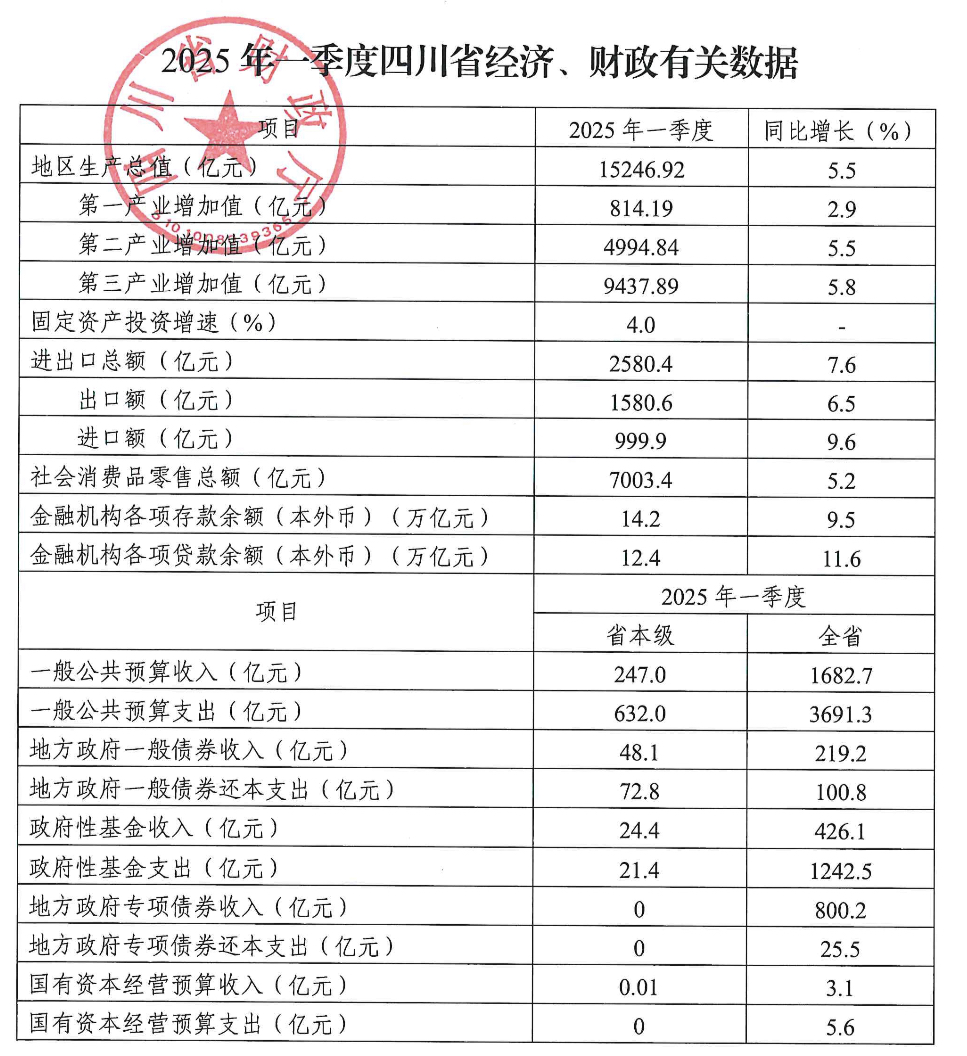
前4个月广义财政收支差2.7万亿,哪些支出在发力|财税益侃
Di Yi Cai Jing· 2025-05-29 12:09
Core Viewpoint - The fiscal policy in China has been actively implemented in the first four months of 2023, with a significant increase in fiscal expenditure compared to revenue, supporting economic resilience in April [2][3]. Fiscal Revenue and Expenditure - In the first four months of 2023, the total national broad fiscal revenue reached 93,202 billion yuan, a year-on-year decrease of approximately 1.3%, while broad fiscal expenditure was 119,717 billion yuan, showing a year-on-year increase of about 7.2% [2][5]. - The fiscal revenue shortfall compared to expenditure was approximately 26,515 billion yuan, which represents a year-on-year increase of about 54% [2][5]. - The general public budget expenditure was 93,581 billion yuan, with a year-on-year growth of 4.6%, slightly above the annual budget growth rate of 4.4% [3][4]. Government Debt and Financing - The government has accelerated bond issuance to support fiscal expenditure, with net financing of government bonds reaching 48,500 billion yuan in the first four months, an increase of 35,800 billion yuan year-on-year [6][9]. - Local government bond issuance totaled approximately 35,354 billion yuan, marking a year-on-year increase of about 84%, the highest in recent years [6][9]. Economic Support Measures - The fiscal expenditure has been directed towards social security, employment, and education, with social security and employment spending around 17,000 billion yuan, up 8.5% year-on-year, and education spending approximately 15,000 billion yuan, up 7.4% year-on-year [4][5]. - Infrastructure investment has shown stable growth at 5.8%, supported by the acceleration of local government special bond issuance [4][5]. Future Outlook - The central government has indicated a need for more proactive macroeconomic policies, including the acceleration of local government special bonds and long-term special bonds [9][12]. - Experts predict that the fiscal policy will continue to be a crucial support for economic resilience in the second quarter, with potential for new debt policies to be introduced later in the year [12][13].
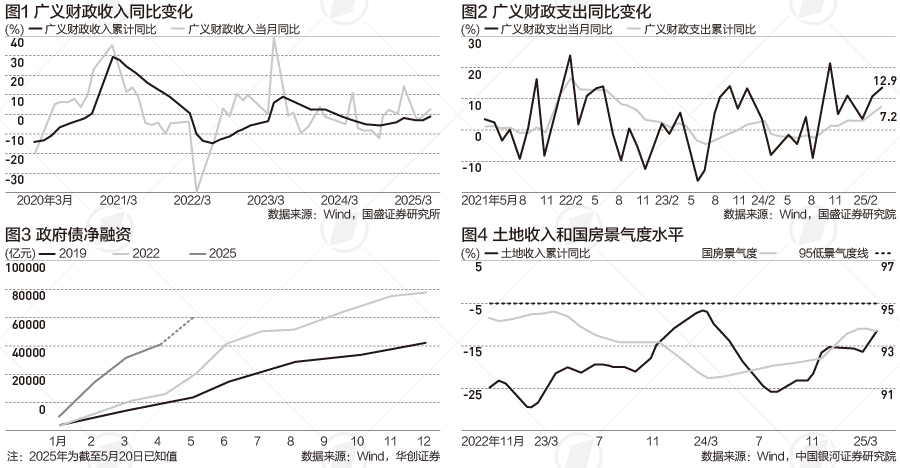
【粤开宏观】“十五五”时期中国财政政策展望:财政政策转型的必要性与可能路径
Yuekai Securities· 2025-05-27 14:43
Group 1: Implementation Effects of Active Fiscal Policy - Active fiscal policy has effectively responded to external shocks, maintaining an average economic growth rate of 9.9% from 2008 to 2010, compared to the global average of 1.7% during the same period[7] - From 2020 to 2023, China's average economic growth rate was 4.7%, significantly higher than the global average of 2.3%[7] - Social welfare spending has increased, with rural minimum living standards rising by 73.3% and urban low-income support increasing by 45.4% from 2017 to 2023[9] Group 2: Challenges of Active Fiscal Policy - The emphasis on current fiscal balance may impact long-term fiscal risks, with a consistent deficit rate below 3% reflecting a balanced fiscal approach[11] - The effectiveness of large-scale tax cuts is diminishing, with the macro tax burden needing stabilization as general public budget revenue as a percentage of GDP fell to 16.3% in 2024, down 5.1 percentage points since 2013[17] - The fiscal expenditure structure requires optimization, with a tendency to focus more on supply-side measures rather than demand-side support, leading to potential demand deficiencies[19] Group 3: Directions for Fiscal Policy Transformation - Transition from a balanced fiscal approach to a functional fiscal policy, potentially breaking the 3% deficit constraint to better support economic stability[21] - Fiscal policy objectives should balance short-term economic stability with long-term systemic challenges, addressing issues like population aging and digital economy risks[23] - Shift focus from income policies to expenditure policies, enhancing the efficiency and effectiveness of fiscal measures[28]
粤开宏观:“十五五”时期中国财政政策展望:财政政策转型的必要性与可能路径
Yuekai Securities· 2025-05-27 09:39
Implementation Effects of Active Fiscal Policy - Active fiscal policy has effectively responded to external shocks, maintaining an average economic growth rate of 9.9% from 2008 to 2010, compared to the global average of 1.7%[5] - From 2020 to 2023, China's average economic growth rate was 4.7%, significantly higher than the global average of 2.3% during the same period[5] - Social welfare spending has increased, with rural minimum living standards rising by 73.3% and urban low-income standards increasing by 45.4% from 2017 to 2023[7] Challenges of Active Fiscal Policy - The emphasis on current fiscal balance may impact long-term economic risks, with the deficit rate rarely exceeding 3%[9] - The effectiveness of large-scale tax cuts is diminishing, with the general public budget revenue as a percentage of GDP dropping to 16.3% in 2024, down 5.1 percentage points from 2013[13] - The fiscal expenditure structure needs optimization, with a tendency to focus more on supply-side measures rather than demand-side support[14] Directions for Fiscal Policy Transformation - Shift from a balanced fiscal approach to a functional fiscal policy, potentially breaking the 3% deficit constraint to stimulate economic growth[16] - Enhance the focus on long-term challenges such as population aging and digital economy risks, ensuring fiscal policy addresses both short-term stability and long-term sustainability[18] - Transition from income policies to expenditure policies, emphasizing efficiency and effectiveness in fiscal measures[22]
专家详解关税战下的财政数据,短期财政增量政策出台可能性小
Di Yi Cai Jing· 2025-05-22 02:22
Economic Performance - In April, China's tax revenue growth turned positive for the first time this year, increasing by approximately 1.9% year-on-year, which helped narrow the decline in general public budget revenue to -0.4% for the first four months of the year [1][3] - Despite a 21% decline in exports to the US, exports to ASEAN countries increased by 20.8%, indicating a shift in trade dynamics [2] Fiscal Policy - The general public budget expenditure for January to April reached 93,581 billion yuan, a year-on-year increase of 4.6%, while government fund budget expenditure rose by 17.7% [6] - The government is expected to accelerate the implementation of existing fiscal policies, including the issuance of government bonds, to support economic stability [9][12] Real Estate Market - The land transfer income showed a significant recovery in April, with a year-on-year decline of only 11.4%, indicating a potential rebound in the real estate market [6][7] - The current real estate market is undergoing structural changes, with core cities experiencing a faster recovery, which may support future demand [7] Trade Relations - The US-China trade negotiations are set to take place within 90 days, which may lead to a significant reduction in tariffs, potentially stabilizing economic growth in the short term [8][9] - The ongoing tariff situation remains a concern, with tariffs on Chinese goods still exceeding 40%, necessitating careful monitoring of trade policies [10] Future Outlook - The economic growth for the second quarter is projected to be close to 5%, with the potential for fiscal stimulus measures to be adjusted based on trade negotiations [9][12] - The government is focusing on maintaining social stability and expanding domestic demand through targeted fiscal measures [10][12]
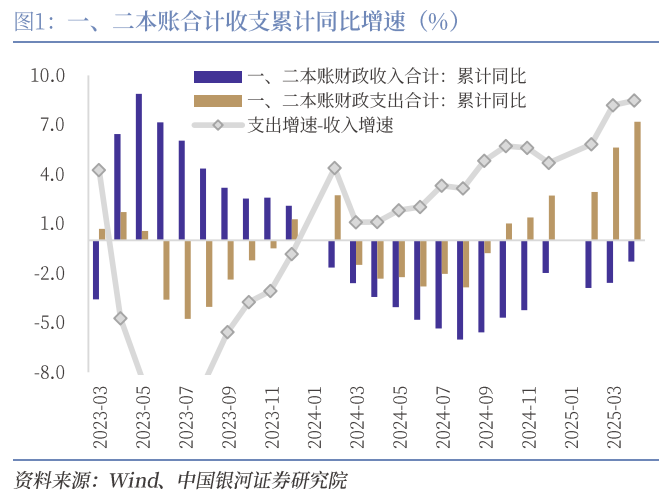
财政政策加大力度稳经济
Jing Ji Ri Bao· 2025-05-20 22:49
Group 1: Fiscal Policy Implementation - The Central Political Bureau meeting emphasizes the need for more proactive fiscal policies, including increased spending intensity and accelerated government bond issuance to support economic development and social stability [1][2] - The fiscal deficit for this year is set at 5.66 trillion yuan, an increase of 1.6 trillion yuan from last year, marking the highest deficit level in recent years [2] - The total public budget expenditure is projected to reach 29.7 trillion yuan, reflecting a 4.4% increase compared to last year, indicating further fiscal expansion [2] Group 2: Support for Domestic Demand - The issuance of special bonds and long-term treasury bonds is a key strategy to support domestic demand and economic growth, with a total of 4.4 trillion yuan in new local government special bonds planned for this year [4][6] - The first issuance of long-term special treasury bonds amounted to 1.3 trillion yuan, aimed at supporting major projects and enhancing consumer spending [4][6] - The government aims to boost consumer spending through initiatives like the "old-for-new" consumption program, which has seen significant sales growth in related sectors [5][6] Group 3: Policy Coordination and Effectiveness - The government is implementing a combination of policies, including tax reductions and fiscal incentives, to enhance the effectiveness of fiscal measures and support high-quality development in technology and manufacturing [8] - The central government has allocated 10.34 trillion yuan for transfer payments to local governments, a year-on-year increase of 8.4%, to enhance local fiscal capacity [8][9] - There is a focus on improving the efficiency of fund usage through better project management and collaboration among various departments [7][10]
财政收入降幅缩窄,4月税收年内首增
Di Yi Cai Jing· 2025-05-20 09:38
积极财政政策正不断加力 "真金白银"的财政收入一直备受市场关注,直接关系政府履职和民生保障。今年以来财政收入降幅呈现 缩窄势头。 财政部数据显示,1—4月,全国一般公共预算收入80616亿元,同比下降0.4%。这一降幅较一季度 (-1.1%)有所缩窄。1—4月,全国政府性基金预算收入12586亿元,同比下降6.7%。这一降幅较一季度 (-11%)缩窄了4个多百分点。 全国一般公共预算收入是以税收收入为主体的财政收入,资金安排用于保障和改善民生、推动经济社会 发展等,因此备受关注。 根据财政部数据,今年前4个月约8万亿元全国一般公共预算收入中,全国税收收入约6.6万亿元,同比 下降2.1%,较一季度降幅(-3.5%)有所缩窄。其中4月份税收收入增速实现年内首次转正,同比增长约 1.9%。 税收被称为经济的"晴雨表",经济决定税收。今年一季度中国国内生产总值按不变价格计算同比增长 5.4%。4月份国家统计局披露主要经济数据显示,经济顶住压力稳定增长,延续向新向好发展态势,这 也为税收收入转好提供基础。 另一方面,受经济下行压力影响,部分企业利润下滑,楼市总体依旧低迷,叠加物价低迷、基数因素 等,使得今年以来税收收 ...