
智能化

Search documents
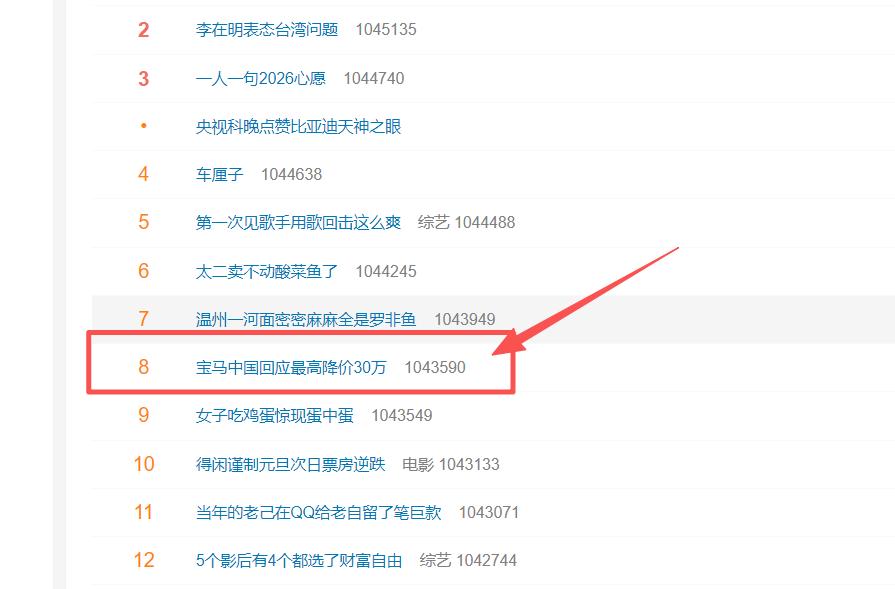
宝马开年挥刀,2026豪华车卷生卷死
3 6 Ke· 2026-01-08 01:08
Core Viewpoint - The luxury car market is experiencing significant changes due to price adjustments by major brands like BMW, which are interpreted as a response to increased competition from domestic manufacturers and shifting consumer preferences towards technology and value rather than traditional luxury symbols [2][3][4]. Group 1: Price Adjustments and Market Response - BMW announced price reductions on 31 key models in China, with 24 models seeing reductions of over 10% and 5 models over 20%, including the iX1 eDrive25L with a 24% drop and the i7 M70L with a maximum reduction of 301,000 yuan [2]. - The adjustments have led to an increase in the number of BMW models priced below 300,000 yuan, indicating a shift towards more competitive pricing in the luxury segment [2]. - BMW claims these price changes are part of a value upgrade strategy rather than a price war, although market interpretations suggest otherwise, especially following reports of Porsche closing several showrooms in China [3]. Group 2: Market Dynamics and Competitive Landscape - The luxury car market, particularly the BBA (BMW, Benz, Audi) trio, is facing declining profits, with net profits dropping significantly: Mercedes-Benz by 55.8%, Audi by 37.5%, and BMW by 29% in the first half of 2025 [3]. - The traditional dominance of BBA is being challenged by domestic brands like BYD and Xiaomi, which are gaining traction among younger consumers who prioritize technology and personalized experiences over brand prestige [5][7]. - The penetration rate of domestic electric vehicles in the 300,000 to 500,000 yuan price range has surged from under 10% in 2020 to over 40% by 2025, directly impacting BBA's sales [7]. Group 3: Strategic Challenges for BBA - BBA's transition to electric vehicles is perceived as slow, with Mercedes-Benz and Audi adjusting their electrification goals and timelines, while BMW has also revised its electric vehicle sales expectations downward by over 20% [9][11]. - The traditional luxury brands are struggling with high production costs and lengthy product development cycles, which hinder their ability to compete effectively with agile domestic brands [11]. - BBA's marketing strategies, rooted in traditional luxury branding, are becoming less effective in an era where consumers seek innovation and technological engagement [12]. Group 4: Future Outlook and Consumer Impact - The ongoing price competition may lead to increased efficiency and technological advancements in the luxury car sector, ultimately benefiting consumers [13][14]. - Analysts predict that more luxury brands may be forced to adjust their strategies or exit the Chinese market in the coming years due to intensified competition [13].


竞争力重塑 传统产业转型集中发力
Jing Ji Ri Bao· 2026-01-08 01:01
Group 1: Core Insights - Traditional industries are the backbone of China's manufacturing sector, accounting for approximately 80% of key indicators such as value added and employment [1] - The transformation of traditional industries towards high-end, intelligent, and green development is essential for building a modern industrial system [1] Group 2: Cost Reduction and Efficiency Improvement - In Zhengzhou, the use of intelligent manufacturing systems has led to a 10% to 15% increase in production efficiency and a 5% to 10% reduction in delivery cycles, with overall costs decreasing by 3% to 5% [2] - Traditional industries are shifting from relying on scale and experience to a data-driven approach that integrates hardware and software ecosystems [2] Group 3: Smart Factory Development - Over 35,000 basic-level and more than 7,000 advanced-level smart factories have been established since the start of the 14th Five-Year Plan, significantly enhancing production efficiency and reducing costs [3] - Continuous investment in new technology and the application of AI and smart technologies are crucial for traditional industries to enhance their high-end and intelligent capabilities [3] Group 4: Green Development Opportunities - The "dual carbon" goals are driving traditional industries to transition from resource dependency to technology value addition, creating new growth opportunities through smart and green technologies [4] - By 2024, the utilization of recycled resources such as waste steel and waste copper is expected to exceed 400 million tons, highlighting the push for industrial decarbonization and green growth [4] Group 5: Energy Transition and Circular Economy - Traditional energy companies are encouraged to explore clean energy development, while steel companies can utilize recycled materials to reduce costs and emissions [5] - The development of carbon trading markets presents opportunities for traditional industries to profit from energy-saving and emission-reduction efforts [5] Group 6: Consumer Market Dynamics - The expanding consumer market is providing new opportunities for traditional industries, emphasizing the need for precise alignment of production with consumer preferences [7] - The demand for higher quality and diverse products is driving traditional industries to innovate and enhance product offerings [8] Group 7: Value Enhancement Challenges - The ultimate goal for traditional industries is to address the challenge of value enhancement through technological innovation and brand building [9] - Improving product quality and brand premium capabilities are essential for driving value enhancement in traditional enterprises [9]
南网储能探索智能化、绿色化、融合化发展新范式
Zhong Guo Fa Zhan Wang· 2026-01-07 21:32
Core Viewpoint - The Nanning Pumped Storage Power Station in Guangxi is set to be fully operational by the end of 2025, marking a significant step in the construction of a new power system in Guangxi as part of the national "14th Five-Year Plan" [1] Group 1: Project Overview - The Nanning Pumped Storage Power Station has an installed capacity of 1.2 million kilowatts, featuring four 300,000-kilowatt pumped storage units, making it the first independent pumped storage project in China to be approved, constructed, and put into operation within a single five-year plan [1] - Once operational, the power station is expected to consume up to 2.5 billion kilowatt-hours of clean energy annually, resulting in a reduction of carbon dioxide emissions by 2.2 million tons [1] Group 2: Technological Innovations - The project has introduced advanced construction technologies, including the use of a tunnel boring machine (TBM) named "Nanning No. 1," which is the first application of the world's most advanced tunneling equipment in the pumped storage sector in South China [2] - The construction of the self-draining tunnel was completed in 460 days, achieving a precision breakthrough with a total length of 5,099 meters [2] Group 3: Construction Efficiency - A new water storage method combining "large flow pumping" and "small flow stabilization" was adopted for the first time in the country, allowing for rapid water transfer to the upper reservoir, achieving efficiency over 20 times that of natural rainfall [3] - The total volume of earth and stone excavation for the project reached 19 million cubic meters, with the installation of a dedicated battery swap station for electric heavy trucks, promoting green construction practices [3]

广汽集团2025年销量连续3个季度环比增长 番禺行动逐步落地
Zheng Quan Shi Bao Wang· 2026-01-07 12:49
Group 1: Sales Performance - In December 2025, GAC Group's vehicle sales exceeded 187,400 units, representing a month-on-month increase of 4.3% [1] - For the entire year of 2025, total vehicle sales reached 1.7215 million units, with terminal sales at 1.8135 million units [1] - The fourth quarter of 2025 saw sales surpassing 537,800 units, a 25.56% increase compared to the third quarter, marking three consecutive quarters of positive month-on-month growth [1] Group 2: Product Development and Innovation - GAC Group has accelerated the speed of innovation and new product launches, with Aion's December sales reaching 42,000 units, a 10% month-on-month increase [1] - The company has implemented an integrated product development (IPD) and strategy-to-execution (DSTE) reform, reducing new car development cycles to 18-21 months and cutting R&D costs by over 10% [2] - The ADiGO GSD intelligent driving assistance system now covers 99.9% of road scenarios, and the new ADiGO intelligent cockpit has tripled interaction response speed and increased service richness by 50% [2] Group 3: International Expansion - In 2025, GAC introduced five new models to overseas markets and expanded into 16 new markets, including Brazil, Poland, and Australia [3] - The company's overseas sales of its own brands reached nearly 130,000 units, a year-on-year increase of 47% [3] - By the end of 2025, GAC's business operations spanned 86 countries and regions, with over 630 outlets established [3] Group 4: Technological Advancements - GAC has accelerated its layout in advanced technology applications, including solid-state batteries, with a pilot production line established in November 2025 [3] - The company has developed a complete automotive chip matrix and launched 12 high-safety automotive-grade chips in collaboration with domestic chip companies [2] - GAC's intelligent safety protection system has served nearly 2 million users, preventing potential accidents 5.51 million times [2]

【重磅深度】乘用车电动化复盘:拥抱变化
东吴汽车黄细里团队· 2026-01-07 12:21
Investment Highlights - The automotive market began to show an upward trend in 2020 despite the pandemic, primarily due to a year-on-year increase in industry sales and a significant turning point in the penetration rate of new energy vehicles (NEVs), which led to a notable increase in the market share of domestic brands [2][26] - The core turning point for NEV penetration was driven by the localization of Tesla, with the Model 3 quickly becoming a best-seller, and improvements in the economic viability of the supply chain leading to a diverse supply [2][36] Historical Index Trends - In May 2021, the electric vehicle logic remained strong with a penetration rate of about 10%, and demand did not weaken despite a chip shortage that began in early 2021. The market anticipated a gradual easing of supply issues by July-August [3][45] - By May 2022, the penetration rate had increased to approximately 25%, with the resumption of production in lockdown areas and the implementation of tax reduction policies, which contributed to an upward trend in the index [3][48] - In February 2024, a shift in supply-demand dynamics occurred, leading to a price war initiated by Tesla's significant price cuts. The market began to rebound, with BYD's price reduction strategy proving effective [4][51] Profitability and Valuation Changes - The profitability of the automotive sector under the NEV trend has not significantly improved compared to the traditional fuel vehicle era, as selling NEVs has not altered the industry's business model, which remains rooted in manufacturing logic [5][56] - The valuation center for the automotive sector has shifted upward, with the price-to-sales (PS) ratio moving from a maximum of 2x during the fuel vehicle era to a current center of 1x, driven by increased market share and high-end breakthroughs of domestic brands [5][57] Competitive Factors in the NEV Era - The competition among automotive companies is characterized by a focus on hard power in the early stages, with soft power becoming more relevant later. The core competitive factors have evolved through different phases, including supply chain integration, electric vehicle technology, and marketing capabilities [6][60] - The first phase (2021-2022) emphasized supply chain advantages, while the second phase (2023) shifted towards electric vehicle technology and product definition capabilities, leading to a price war [6][60] - By 2025, the growth rate of NEV penetration is expected to slow down, with the main competitive logic focusing on imitating and surpassing leading NEV companies [7][60] Stock Performance Review - A review of stock performance from 2020 to 2025 indicates that early in the NEV development phase, the market had high expectations for leading companies from the previous cycle, while later periods required identifying emerging players based on changing competitive factors [8][20] - Notable stock performances include Seres as a tenfold stock, Jianghuai with an eightfold increase, and BYD with a fivefold increase, highlighting the importance of recognizing industry trends and selecting the best-performing stocks [8][20]



智行者完成4亿元新一轮融资,加速构建特种无人驾驶产业生态
机器人圈· 2026-01-07 09:45
Core Insights - The article highlights that Zhixingzhe has completed a new round of financing amounting to 400 million RMB, backed by the Huangshi State-owned Capital Investment Group, indicating strong market recognition of its special unmanned driving technology and commercial capabilities [1] - The financing will significantly drive the company's strategic development in core technology research, expansion of high-end product matrix, and the integration of "unmanned driving + intelligent manufacturing" ecosystem [1] Company Overview - Established in 2015, Zhixingzhe focuses on the research and application of special unmanned driving technology, with a core team originating from Tsinghua University's automotive department [1] - The company has accumulated over 1,200 patents, with more than 60% being invention patents, and has participated in the formulation of several national and industry standards [1] Commercialization Progress - Zhixingzhe has successfully applied its unmanned driving technology in various fields such as public safety, life services, and intelligent travel, achieving over 130 million kilometers of commercial operation mileage [3] - Its solutions have been scaled and operated stably in specific scenarios like emergency rescue, cleaning, and urban travel, effectively enhancing operational efficiency and safety [3] Industry Trends - The article notes that the upgrade to unmanned technology is deeply integrating with digitalization and intelligence, driving transformative changes in production and service models across various industries [5] - Zhixingzhe's dual-driven model of "technology platform + scenario-based products" and its proven commercial capabilities are continuously deepening its strategic loop of "technology empowerment, ecosystem co-construction, and value realization" [5] - The completion of this financing will inject critical momentum for accelerating core technology iteration, expanding high-end product matrix, and deepening industrial ecosystem cooperation, further solidifying its leading position in the special unmanned driving sector [5]

广州发布2025年企业紧缺急需职业补贴目录 精准锁定84个紧缺急需职业
Guang Zhou Ri Bao· 2026-01-07 08:07
Core Insights - Guangzhou's Human Resources and Social Security Bureau has released the "Guangzhou Enterprise Urgently Needed Occupation Subsidy Directory (2025)" to support the city's "Manufacturing City" strategy and the construction of the "12218" modern industrial system [1] Group 1: Key Occupations Identified - The directory identifies 84 urgently needed occupations focusing on intelligent, digital, and green development, reflecting a clear path for industrial transformation in Guangzhou [2] - The demand for skilled workers in intelligent manufacturing is the highest, with 47 out of the 84 occupations related to production and manufacturing, indicating a significant need for technical workers capable of operating and maintaining advanced equipment [2] - Emerging digital and green occupations are also highlighted, including roles such as artificial intelligence trainers and automotive parts remanufacturing workers, showcasing the rise of new economic drivers [2] Group 2: Skills Development Focus - The 2025 version of the directory adds 29 new occupations, including 16 in production manufacturing and 13 in modern services, while removing 12 occupations with saturated market demand, optimizing training resource allocation [3] - The total number of skilled workers in Guangzhou has reached 4.22 million, with a target of exceeding 4.6 million by 2027, aiming for 40% to be high-skilled [3] - The directory serves as a "guiding signal" for skill training, encouraging collaboration between educational institutions and enterprises to address talent shortages [3] Group 3: Policy Incentives - The directory links to tangible policy incentives, allowing for a 30% increase in training subsidies for workers obtaining high-level vocational skill certificates in listed occupations [3] - Companies engaging in new apprenticeship training can also benefit from corresponding support policies, enhancing the overall training ecosystem [3] Group 4: Future Directions - The Human Resources and Social Security Bureau plans to create a dynamic monitoring ecosystem for industrial skill talent, aiming to develop a demand-driven talent cultivation and evaluation system to support high-quality development in Guangzhou [4]
2026年车圈这三大趋势“藏不住”
Huan Qiu Wang· 2026-01-07 07:28
Core Insights - The automotive industry in China is transitioning from "scale expansion" to "quality enhancement," indicating a shift in focus towards technological transparency and user trust as key competitive factors [1][3][4] Group 1: Technological Transparency - Companies are moving away from abstract innovation slogans to concrete technological commitments and public demonstrations, with firms like FAW aiming to become technology companies and SAIC focusing on electrification and intelligence [1] - The concept of "technological transparency" is becoming a competitive threshold, where companies must publicly verify their core component performance and manufacturing standards to build market trust [1] Group 2: Smart Technology as a Necessity - Smart technology is no longer an optional enhancement but a survival requirement for automotive companies, as evidenced by leaders like Li Shufu and Yin Tongyue emphasizing the importance of emotional and intelligent vehicles [2] - The automotive value proposition is shifting from mere transportation to mobile intelligent terminals, with AI-driven smart cabins and high-level autonomous driving becoming essential for competitive advantage [2] Group 3: Trust in a Saturated Market - The Chinese automotive market has transitioned to a saturation phase, with a 52.7% penetration rate for new energy vehicles by 2025, shifting the focus from acquiring new customers to retaining existing ones [3] - Building user trust is now a core asset for companies, requiring substantial investments in product quality, service experience, and commitment fulfillment to navigate market cycles effectively [3] Group 4: Consumer and Industry Benefits - The industry's transformation will yield tangible consumer benefits through technological transparency, smart upgrades, and service optimization [4] - This competition around technology, intelligence, and trust will enhance the resilience and security of the supply chain, contributing to the establishment of a modern automotive industry with international competitiveness [4]
吉利汽车(00175.HK)2025年12月销量点评:超额完成全年目标 极氪9X月交付过万
Ge Long Hui· 2026-01-07 06:19
Core Viewpoint - Geely Automobile reported a total sales volume of 237,000 units in December 2025, representing a year-on-year increase of 12.7% but a month-on-month decrease of 23.7% [1] Group 1: December Sales Performance - December total deliveries continued to grow year-on-year, with Zeekr 9X deliveries exceeding 10,000 units, surpassing the annual target [1] - December sales breakdown by model: Geely brand/Link & Co/Zeekr sold 173,000/34,000/30,000 units, with year-on-year changes of +10.2%/+29.4%/+11.3% and month-on-month changes of -29.9%/-3.7%/+4.9% [1] - Geely brand's Galaxy model sold 101,000 units in December, up 45.0% year-on-year but down 24.1% month-on-month [1] - Exports in December reached 40,000 units, a year-on-year increase of 49.0% but a month-on-month decrease of 4.2% [1] - December new energy vehicle sales totaled 154,000 units, up 38.7% year-on-year but down 17.9% month-on-month, accounting for 65.1% of total sales, an increase of 12.2 percentage points year-on-year and 4.6 percentage points month-on-month [1] Group 2: 2025 Annual Performance - Total sales for 2025 reached 3.025 million units, a year-on-year increase of 39.0% [1] - Annual cumulative sales for Galaxy/Link & Co/Zeekr in 2025 were 1.236 million/350,000/224,000 units, with year-on-year changes of +149.9%/+25.4%/-1.8% [1] - Q4 2025 cumulative total sales for Galaxy/Link & Co/Zeekr were 854,000/361,000/109,000/81,000 units, with year-on-year changes of +24.2%/+73.3%/+30.1%/-5.6% [1] Group 3: Future Outlook - Geely aims for a total sales target of 3.45 million units in 2026, representing a year-on-year increase of 14%, with sales targets for Geely brand/Link & Co/Zeekr set at 2.75 million/400,000/300,000 units [2] - The new GEA architecture supports a new product cycle, with positive developments across Zeekr, Link & Co, and Galaxy [2] - The transition to new energy vehicles is progressing smoothly, with scale effects expected to enhance profitability [2] - The company maintains a solid foundation in fuel vehicles and continues to explore new overseas markets through innovative joint ventures [2] - The smart driving strategy is being accelerated to enhance driving capabilities, with significant profit elasticity anticipated under the new vehicle cycle [2] - The projected net profit for 2025 is 17 billion yuan, corresponding to a PE ratio of 10.6X, maintaining a "buy" rating [2]

AI应用正当时-看好2026年AI应用进展
2026-01-07 03:05
摘要 AI 产品设计和工具运用潜力巨大,早期项目估值在三年内增长 10 倍, 智谱和 Minimax 上市在即,IPO 市值预计超 500 亿港币,反映市场对 AI 公司的高度认可。 国内 AI 公司通过赞助大型晚会等方式提高品牌知名度,预计春节前后将 有更多模型发布。2026 年,各大公司将围绕降低 AI 使用门槛展开激烈 竞争,争夺新的流量入口。 未来 AI 应用发展关键在于对 AI 应用及模型定价的影响,以及 2026 年 各大公司在入口及应用上的竞争。商业化边际变化,如营收、ARR 和 EPS 边际,是核心判断指标。 C 端有效变现是大厂战略布局重点,阿里巴巴等将在流量入口争夺战中 发挥重要作用,布局涵盖电商广告、医疗金融等场景。垂直应用场景逐 步进入商业兑现期,探索数字化与规则化结合构建系统。 AI 技术正改变多模态创作、客服、电商贸易和招聘等垂直行业。可根据 容错率和任务复杂度划分应用场景,从容错率高、任务复杂度低的场景 扩展到税务和金融等复杂领域。 AI 应用正当时:看好 2026 年 AI 应用进展 20260106 Q&A 当前 AI 应用市场有哪些显著变化和投资机会? 目前 AI 应用市场 ...