黄金避险属性

Search documents
金价4000美元“拉锯战”开启,黄金市场多空博弈加剧!
Sou Hu Cai Jing· 2025-11-03 06:31
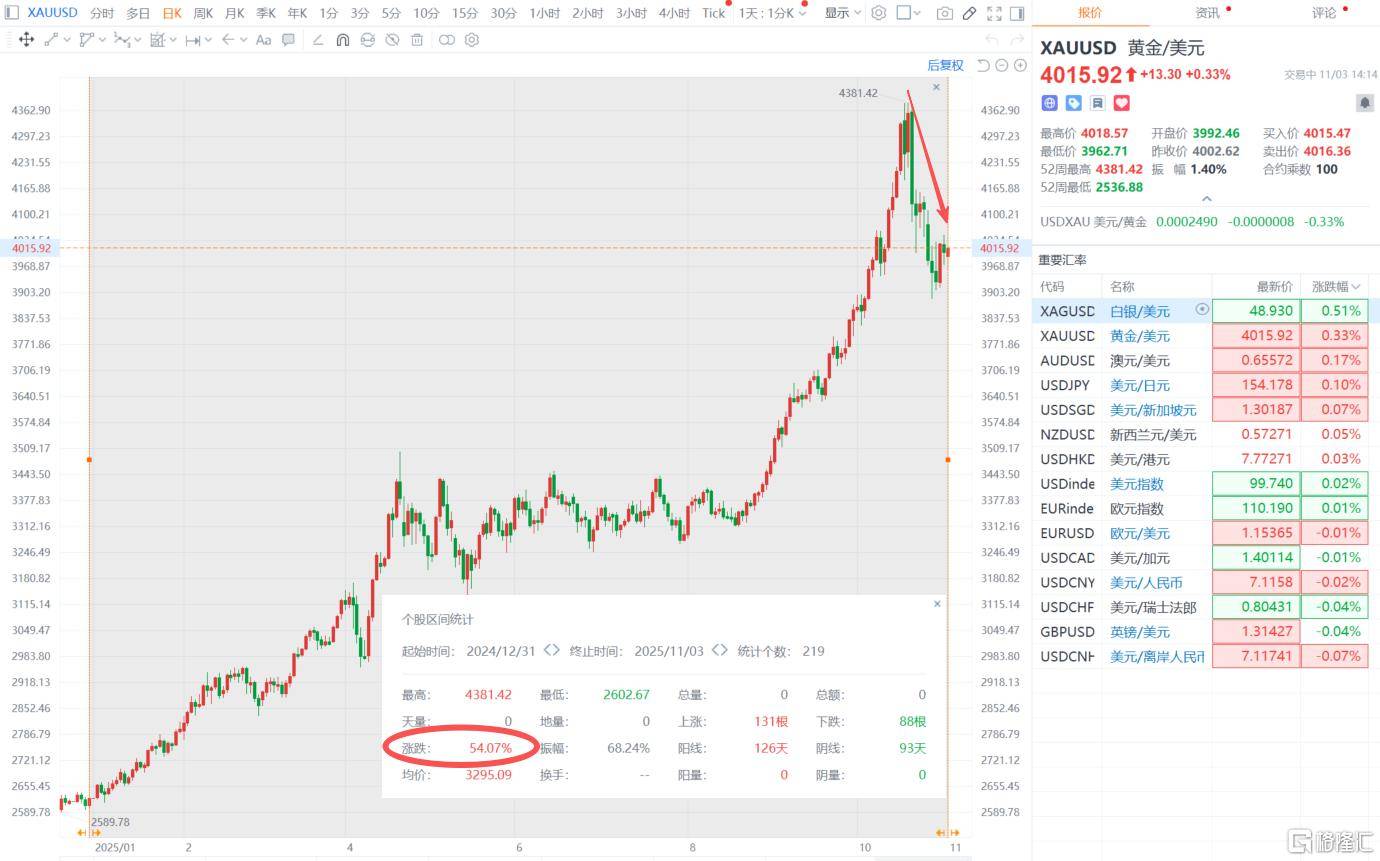
Core Viewpoint - The financial markets are experiencing significant fluctuations, particularly in the A-share market and precious metals, with the Shanghai Composite Index hovering around the 4000-point mark and gold prices fluctuating around $4000 per ounce [1]. Gold Market Dynamics - In the first week of November, gold continued its trend of volatility and correction [2]. - On Monday, spot gold briefly fell below $4000 per ounce but later rebounded, while COMEX gold futures also saw significant fluctuations [3]. - Despite recent volatility, gold prices have increased by over 50% year-to-date [4]. Market Reactions - Precious metal stocks in Hong Kong and A-shares experienced collective declines, with companies like Zijin Mining and Hunan Gold seeing drops of over 3% and 4%, respectively [5]. - The recent announcement of tax policy changes regarding gold has impacted market sentiment negatively [6][9]. Tax Policy Changes - The Ministry of Finance and the State Administration of Taxation issued new tax policies that clarify the boundaries for value-added tax (VAT) on "investment gold" versus "non-investment gold" [7][8]. - Starting November 1, retailers selling gold purchased from the Shanghai Gold Exchange will no longer enjoy VAT deductions, which may increase procurement costs for retailers [8][13]. Global Demand Trends - The World Gold Council reported a 28% increase in global central bank gold purchases in Q3 compared to the previous quarter, reversing a downward trend seen earlier in the year [10]. - Total global gold demand reached $146 billion in Q3, marking the highest quarterly demand on record, driven primarily by investment demand [11]. - Chinese investors purchased 74 tons of gold bars and coins in Q3, a 19% increase year-on-year, contributing to a total retail gold investment demand of 313 tons for the year, the highest since 2013 [12]. Market Outlook - Concerns arise that the cancellation of tax incentives may suppress demand in the global precious metals market, with potential short-term selling pressure from speculative funds [13]. - Analysts suggest that the new tax policy may increase procurement costs for small retailers, potentially benefiting larger companies with better channel management [13][14]. - The market is currently reassessing gold's value amid various macroeconomic factors, including U.S. interest rate changes and geopolitical tensions [15][16]. - Despite recent outflows from gold ETFs, the inherent safe-haven appeal of gold remains attractive to investors due to ongoing global uncertainties [18]. Future Price Predictions - Metals Focus predicts that gold prices may challenge the $5000 per ounce mark by 2026, with an average price of approximately $4560 per ounce for that year, reflecting a 33% year-on-year increase [19].

金价要重现15年历史了?大家注意,下周,金价可能重现15年历史
Sou Hu Cai Jing· 2025-11-01 04:59
Core Viewpoint - The current fluctuations in gold prices are reminiscent of the 2015 market dynamics, with significant volatility and a potential for further declines due to market sentiment and Federal Reserve policies [3][5][6]. Market Trends - Gold prices recently experienced a drop from $3950 to $3880 following a statement from the Federal Reserve, which reduced market expectations for future rate cuts [3]. - The price movements show a pattern similar to 2015, with daily fluctuations of over $50 becoming common [5][14]. Investor Behavior - There is an increase in gold selling, with reports indicating a 30% rise in individuals selling gold, reflecting a fear of repeating past losses [6][13]. - Younger investors are increasingly purchasing gold, with their share of investment rising to 35%, contrasting with the past trend of declining interest during price drops [11][16]. Institutional Perspectives - Major financial institutions are divided on gold price forecasts, with some predicting further declines while others anticipate a rebound due to strong demand from central banks [6][13]. - The current central bank gold purchases have significantly increased compared to 2015, providing a buffer for gold prices [8][13]. Technical Analysis - Current support levels for gold are clearer than in 2015, with a defined range between $3850 and $3880 [8]. - Historical data suggests that after significant price drops, there is a high probability of subsequent rebounds, indicating potential trading opportunities [16][18]. Economic Context - The inflation environment is notably different from 2015, with current core PCE inflation above 3%, which may enhance gold's appeal as an inflation hedge [18]. - The gold-to-oil ratio has reached an extreme level, indicating a significant premium for gold compared to oil, which was not the case in 2015 [16].
地缘央行双擎沪金内强外弱
Jin Tou Wang· 2025-10-31 03:05
Core Viewpoint - The recent interest rate cut by the Federal Reserve and the ongoing geopolitical tensions have created a complex environment for gold prices, with domestic markets showing stronger performance compared to international counterparts due to local demand and currency stability [3][4]. Group 1: Market Dynamics - The Federal Reserve cut interest rates by 25 basis points and announced a halt to balance sheet reduction, which theoretically benefits non-yielding assets like gold [3]. - The mixed signals from Fed Chair Powell regarding future rate cuts have led to fluctuating market expectations, creating both upward and downward pressures on gold prices [3]. - The U.S. dollar index slightly decreased by 0.01% to 99.5328, providing some support for gold prices, although the dollar remains in a range-bound pattern [3]. Group 2: Domestic vs. International Markets - Domestic gold prices have shown significant gains, with Shanghai gold futures rising to 919.86 CNY per gram, a 1.05% increase, driven by stable RMB exchange rates and local demand [1][3]. - In contrast, international gold markets are experiencing a more subdued performance due to the lack of a clear downward trend in the dollar and ongoing uncertainty in economic indicators [3]. Group 3: Investment Trends - Global gold investment demand surged by 47% year-on-year in Q3, as reported by the World Gold Council, providing strong support for gold prices amid rising geopolitical risks [3]. - Despite a five-day outflow of funds from global gold ETFs, domestic investors are taking advantage of market volatility to enter positions [3]. Group 4: Technical Analysis - Key resistance levels for Shanghai gold futures are identified between 951 CNY and 1000 CNY per gram, while support levels are between 894 CNY and 950 CNY [4]. - The core trading range for Shanghai gold is expected to be between 910 CNY and 925 CNY, with a critical support level at 915 CNY [4].
美联储内部分歧加大叠加换届悬念,黄金避险属性凸显,黄金ETF华夏(518850)涨1.31%
Sou Hu Cai Jing· 2025-10-31 02:05
Core Viewpoint - The recent increase in gold prices has positively impacted gold-related ETFs, with significant movements observed in various funds following the Federal Reserve's decision to cut interest rates by 25 basis points and end balance sheet reduction, creating a favorable environment for precious metals [1] Group 1: Market Performance - As of 9:41 AM, the 华夏 Gold ETF (518850) rose by 1.31%, while the Gold Stock ETF (159562) increased by 1.17%. In contrast, the Nonferrous Metals ETF (516650) saw a decline of 0.34% [1] - The liquidity easing expectations have contributed to a rebound in precious metals, despite potential technical pullback pressures after surpassing the $3,700 mark [1] Group 2: Analyst Insights - Wang Yanqing, Chief Analyst of Precious Metals at CITIC Futures, noted that the current environment indicates a third round of a bull market for gold, with central bank gold purchases reshaping the long-term price center [1] - The report from the Gold Research Institute of Jinyafo suggests that while there may be short-term technical pressures, the overall trend remains bullish for gold [1] Group 3: Cost Efficiency - The management and custody fees for 华夏 Gold ETF (518850) and Gold Stock ETF (159562) are combined at 0.2%, which is among the lowest in similar products, enabling investors to participate in the gold market at a lower cost [1]
金价跌破900元/克,昆明市场刚需族和投资者纷纷进场
Sou Hu Cai Jing· 2025-10-30 12:44
Core Viewpoint - The recent decline in gold prices has sparked a surge in demand in the Kunming gold market, with both consumers and investors actively participating in purchases as prices drop significantly from previous highs [1][3]. Group 1: Market Activity - The current spot price of gold is 894.48 yuan per gram, down 16.31 yuan from the previous trading day and over 100 yuan from a peak of around 1000 yuan per gram ten days ago [1]. - The wedding season in the second half of the year, combined with the recent price drop, has led consumers to seize the opportunity to save money on gold purchases, particularly for wedding-related items [3][5]. - Sales of popular wedding gold items, such as solid bangles and personalized three-gold sets, have increased significantly, with some consumers saving nearly 4000 yuan compared to previous high prices [3][5]. Group 2: Investor Behavior - Investors are showing varied responses to the price drop, with some small investors choosing to cut losses by selling their gold, while larger investors are taking the opportunity to buy at lower prices [7]. - The base price for investment gold bars is around 929 yuan per gram, which is significantly lower than the price of jewelry gold, indicating a price disparity that investors can exploit [7]. - The market remains uncertain, but some investors believe that the long-term value of gold will hold, viewing the current price drop as a normal market fluctuation and a good opportunity for cost-effective accumulation [7]. Group 3: Sales Trends - In the Shenzhen Shui Bei gold market, sales have increased by 20% compared to when gold prices were around 1000 yuan per gram, with popular items quickly selling out [8]. - Despite the increase in sales, the volume of gold being sold back to dealers has decreased by about 30%, as many customers are holding onto their gold in anticipation of future price increases [8].

今日金价:10月25日,大家注意了,下周,金价或将重现2013年历史
Sou Hu Cai Jing· 2025-10-25 17:18
Core Viewpoint - Recent discussions suggest that gold prices may experience a significant drop similar to the historical events of 2013, but the current macroeconomic environment differs fundamentally from that time, indicating that the core support factors for gold prices remain strong [4][6]. Group 1: Historical Context - In April 2013, international gold prices fell nearly 15% in just two trading days, dropping from $1597/oz to $1360/oz, with a subsequent decline to $1197/oz, resulting in a nearly 30% drop over six months [3]. - The primary reasons for the 2013 decline included a policy shift from the Federal Reserve signaling a reduction in bond purchases, a technical sell-off due to profit-taking after 12 years of rising prices, and a decrease in demand as the global economy began to recover [3]. Group 2: Current Market Analysis - As of October 2025, international gold prices are fluctuating around $4100/oz, with domestic gold jewelry prices ranging from 1164 to 1236 CNY/g [1]. - The macroeconomic environment in 2025 is fundamentally different from 2013, with the Federal Reserve entering a rate-cutting cycle, which lowers the opportunity cost of holding gold and supports price increases [4]. - Central bank gold purchases are strong, with a net buy of 255 tons in Q3 2025, marking a historical high for the same period, contrasting with a 34% year-on-year decrease in 2013 [4]. - Geopolitical risks and a global debt crisis, with U.S. national debt exceeding $35 trillion, enhance gold's appeal as a safe-haven asset, unlike the post-crisis risk appetite observed in 2013 [4]. Group 3: Short-term Considerations - Despite high gold prices, there are short-term pressures for a correction, with technical indicators suggesting an "overbought" condition after surpassing $4300/oz [5]. - The upcoming Federal Reserve meeting in early November could be pivotal; any hawkish signals may trigger a price correction [6]. - Market sentiment is cautious, with some institutions warning of potential short-term pullbacks, emphasizing the need for investors to remain rational and not overreact to historical comparisons [6]. Group 4: Long-term Outlook - The long-term fundamentals for gold remain strong, supported by its safe-haven and currency substitution attributes, indicating potential for future price increases [6]. - Investors are advised to adopt a strategy of buying on dips and diversifying investments to mitigate risks associated with single asset exposure [6].

黄金历史级暴跌!美元货币储备量下降,普通投资者该如何应对?
Sou Hu Cai Jing· 2025-10-25 11:01
Core Insights - The recent fluctuations in the gold market are driven by short-term market sentiments rather than intrinsic value changes in gold itself [1][3] - Geopolitical tensions, particularly the easing of the Russia-Ukraine conflict, have led to a decrease in gold's appeal as a safe-haven asset, prompting investors to shift towards riskier assets [3][5] - The upcoming APEC meeting has also contributed to market volatility, as pre-meeting tensions can influence investor behavior [5][7] Market Dynamics - The gold price surge was primarily fueled by heightened geopolitical risks, which have now subsided, leading to a market correction [3][5] - Historical data shows that gold prices typically rise during periods of intense conflict but quickly revert once tensions ease, indicating that the recent price drop is a normalization of previously heightened fears [5][7] Long-term Factors - The long-term outlook for gold remains positive due to escalating global debt levels, which currently stand at $324 trillion against a global economic output of $100 trillion, creating a lack of confidence in credit-based assets [9][11] - The diminishing trust in the US dollar, exacerbated by past financial crises and geopolitical actions, has made gold a more attractive asset for many countries seeking alternatives [11][13][15] Investment Strategy - Investors are advised to focus on long-term trends rather than short-term price fluctuations, as gold serves as a stabilizing asset in times of economic uncertainty [17][21] - Allocating a portion of investment portfolios to gold can provide a safeguard against economic downturns and currency devaluation, acting as a financial safety net [21]
教授每年强制自己定投100克黄金,黄金定投背后的理智与疯狂
Sou Hu Cai Jing· 2025-10-22 06:32
Core Insights - The article highlights the significant rise in gold prices and the increasing interest in gold investment among different demographics, particularly intellectuals and young consumers in China [1][3][8]. Group 1: Gold Price Surge - Gold prices have recently surpassed $4,200 per ounce, leading to a corresponding increase in domestic gold jewelry prices, with notable daily increases in prices from major retailers [3][5]. - The price of gold jewelry has seen substantial increases, with examples including a rise from 1,215 RMB per gram to 1,235 RMB per gram for Chow Tai Fook jewelry [3][5]. Group 2: Investment Trends - The trend of gold investment is particularly strong among two groups: intellectuals like Professor Yu, who view gold as a long-term investment, and young consumers who see it as a combination of personal enjoyment and savings [3][4]. - A report indicates that the gold jewelry ownership rate among young consumers has increased from 37% to 62% [3]. Group 3: Banking Actions - In response to rising gold prices, major banks in China have raised the minimum purchase amounts for gold investment products, marking a shift to a "thousand yuan era" for gold investment [5][6]. - The adjustments made by banks, such as China Bank and Industrial and Commercial Bank, are seen as risk management measures in light of the soaring gold prices [6]. Group 4: Factors Driving Gold Prices - Multiple factors are contributing to the surge in gold prices, including economic uncertainty, geopolitical tensions, and expectations of a renewed interest rate cut cycle by the Federal Reserve [8][9]. - The demand for gold as a defensive asset has significantly increased, with central banks contributing to price support through substantial gold purchases [9][10]. Group 5: Investment Strategies - Professor Yu's strategy of regular gold investment has proven effective, with historical data showing that gold can serve as a hedge against inflation and market volatility [12][14]. - The article emphasizes the importance of a disciplined investment approach, as demonstrated by Professor Yu, who views gold investment as a form of forced savings rather than speculation [15][16].




大跌近4%,黄金股ETF(159562)有望受益金企三季报业绩高增
Sou Hu Cai Jing· 2025-10-20 06:01
Core Viewpoint - The three major indices rose collectively, with a strong return of the technology sector, while gold-related products experienced significant declines due to a sharp pullback in gold prices [1] Group 1: Market Performance - As of 13:40, the gold stock ETF (159562) fell by 3.92%, with most holdings declining, while silver and non-ferrous metals also faced steep losses, including a drop of over 9% for Western Gold [1] - The gold ETF Huaxia (518850) decreased by 2.55%, and the non-ferrous metals ETF (516650) fell by 1.69% [1] Group 2: Fund Flows and ETF Performance - The gold stock ETF (159562) saw continuous net inflows over the past eight days, totaling 671 million yuan, with the latest share count reaching 1.398 billion and a total scale of 3.158 billion yuan, both hitting record highs since inception [1] Group 3: Market Analysis and Outlook - Guolian Futures analysts suggest that factors such as policy uncertainty, fiscal sustainability in major economies, expectations of loose monetary policy, regional conflicts, and concerns over the independence of the Federal Reserve will continue to support a strong gold market [1] - Short-term influences like the potential U.S. government shutdown and escalating trade tensions between China and the U.S. are expected to drive gold prices higher, with macro disturbances likely persisting until the end of the month [1] - The probability of a Federal Reserve rate cut in October is seen as supportive for gold [1] Group 4: Mining Sector Expectations - With rising precious metal prices, mining companies' profit expectations are anticipated to be significantly revised upward, with substantial growth expected in the performance of gold stocks in the A-share market for the third quarter [1] - Institutions like Goldman Sachs and Huatai Securities believe that the safe-haven attributes of gold will continue to support both gold prices and the performance of gold stocks in the medium to long term [1]


经济学家宋清辉:黄金与股票或不再此消彼长
Sou Hu Cai Jing· 2025-10-19 22:46
Core Viewpoint - Successful investment is not about chasing short-term fluctuations of a single asset, but about achieving long-term returns through diversified allocation. The rise of the Chinese stock market does not imply a decrease in gold investment demand; rather, gold's role in Chinese investors' asset portfolios may become more significant than ever due to the upgrading of wealth management concepts and increasing global economic cycle volatility [1][7]. Group 1: Gold Market Dynamics - During the National Day holiday, the international gold market attracted global investors, with gold prices briefly surpassing $4000 per ounce, reaching a historical high due to geopolitical uncertainties, expectations of a shift in Federal Reserve monetary policy, and continuous accumulation of gold by global central banks [4]. - The strong rise in gold prices reflects long-term macroeconomic changes rather than short-term speculative trading. The global economy has entered a "new normal" characterized by low growth, high inflation, and frequent geopolitical risks since 2024 [5]. - Central banks worldwide have been increasing their gold reserves, with emerging market countries accounting for nearly 70% of net gold purchases in 2024, indicating a shift towards diversifying reserve assets amid declining trust in the dollar system [5]. Group 2: Investment Logic and Asset Allocation - Gold, as a non-debt asset, does not rely on any sovereign credit, making it a preferred asset for hedging systemic risks during economic cycles' turning points and heightened financial market volatility [6]. - The traditional view of an inverse relationship between gold and stock markets is weakening, as global investors are increasingly adopting diversified asset allocation strategies that include stocks, bonds, and gold to balance returns and risks [6]. - The changing structure of Chinese investors, with a growing emphasis on wealth management, has led to a more stable demand for gold. There is a noticeable trend towards diversifying asset allocation, with gold becoming an essential component of stable asset allocation rather than merely a safe haven [7].