
以旧换新

Search documents
以旧换新,激活快递物流新动能
Ren Min Ri Bao· 2025-08-04 01:18
Core Viewpoint - The express delivery industry is experiencing new opportunities for growth through the "old for new" consumption policy, which enhances service models and strengthens supply chain capabilities, as evidenced by the early achievement of delivering the 100 billionth express package in 2025, 35 days ahead of schedule compared to last year [1] Group 1: Service Model Evolution - The transition from one-way delivery to a dual fulfillment model, where new products are delivered and old ones are collected, reflects an upgrade in service capabilities [2][3] - The integration of delivery and installation services has become essential, requiring delivery personnel to possess multiple skills, including delivery, disassembly, and installation [3] - The introduction of a verification process during delivery ensures that subsidies for old-for-new exchanges are accurately distributed, enhancing customer experience and reducing return rates [4][5] Group 2: Business Growth and Demand - The expansion of the "old for new" policy has led to increased demand for home appliances and consumer electronics, driving a significant rise in delivery volumes [7] - In 2022, a major express delivery company reported over 20% year-on-year growth in cargo volume, with the "national subsidy" service covering a wide range of products and generating over 10 million new orders [7] - The proportion of large appliance orders related to "old for new" exchanges has exceeded 30%, with a year-on-year increase of 150% in the first half of the year [7] Group 3: Technological and Operational Innovations - The express delivery industry is shifting from low-value traditional services to high-value offerings, driven by the need for enhanced technical capabilities and service quality [8] - Companies are leveraging technology and efficient collaboration across the supply chain to support the growth of "old for new" services, with recommendations for optimizing integrated warehousing and distribution models [9][10] - The establishment of centralized processing warehouses for recycling and disposal is being implemented to streamline operations and improve the efficiency of the reverse logistics process [12][13] Group 4: Future Directions and Policy Support - The ongoing implementation of policies to stimulate domestic demand will require express delivery companies to further optimize their service networks and technological applications [14] - Future initiatives include enhancing urban networks and promoting the use of recyclable packaging in reverse logistics, aiming for high-quality industry development [14]
多维发力提质扩量 大连消费领域交出亮眼“期中卷”
Sou Hu Cai Jing· 2025-08-04 01:15
原标题: 多维发力提质扩量 我市消费领域交出亮眼"期中卷" 本年度,我市将114类产品纳入补贴范围,其中家电类在国家规定的12类家电产品基础上我市自主扩品 34类,补贴产品品类极大丰富,超过全国绝大部分省市。在丰富补贴品类的基础上,我市加强消费品以 旧换新补贴活动全流程的风险防控,营造规范市场环境,保障补贴活动合规有序开展。在风险可控的前 提下,将个体工商户纳入补贴活动。支持品牌企业经销商销售公司落户大连,开设"线上商城+小程 序"开展以旧换新补贴活动。目前,全市共有595家经营主体,2765个门店商户参与消费品以旧换新补贴 活动,为消费者提供广泛便捷的补贴权益申领模式。"从家电赛道来看,以旧换新政策的创新与流程优 化,有效激发了消费活力。"大商电器集团公司副总经理王晓男介绍,政策红利释放消费潜力,技术迭 代与产品创新满足了消费诉求,在国补政策的加持下,2025年上半年大商电器实现销售同比增长18%, 其中空调补贴拉动销售贡献突出,上半年增幅达到35%。"当政策紧贴民生、民意,也就搭起了消费速 通的桥梁。"王晓男表示。 场景创新多维融合 市场潜能持续释放 随着今年中超赛季的开启,全国首家滨海国际名品运动小镇— ...
以旧换新,激活快递物流新动能(经济聚焦)
Ren Min Ri Bao· 2025-08-03 22:10
Core Viewpoint - The express delivery industry is experiencing new opportunities for growth due to the "two new" policy, which enhances the service of old-for-new consumer goods while optimizing service networks and technology applications [1][5]. Group 1: Service Model Evolution - The express delivery service is evolving from one-way delivery to a dual fulfillment model, integrating delivery and installation services [2]. - New logistics models for large items and advanced technologies for small item delivery are being implemented to meet the demands of the old-for-new policy [2][3]. - The introduction of a verification step in the delivery process is crucial for ensuring the authenticity of subsidies and enhancing customer experience [4]. Group 2: Business Growth and Transformation - The express delivery business is witnessing continuous growth driven by the expansion of the old-for-new policy, particularly in home appliances and consumer electronics [5][6]. - The proportion of large appliance old-for-new orders has increased significantly, with a year-on-year growth of 150% in the first half of the year [6]. - Companies are shifting from low-value traditional delivery services to high-value services that require advanced technology and skilled personnel [6][7]. Group 3: Supply Chain and Reverse Logistics - Efficient collaboration between upstream and downstream partners is essential for the successful implementation of the old-for-new service [7][9]. - New reverse logistics models are being developed to streamline the process of returning old items while delivering new ones, significantly improving customer experience [9][10]. - The establishment of central processing warehouses is being prioritized to enhance the efficiency of recycling and processing old appliances [10]. Group 4: Future Directions - The express delivery industry is encouraged to further optimize service networks and technology applications to support the ongoing expansion of the old-for-new policy [10]. - The promotion of recyclable packaging and the establishment of industry standards for reverse logistics are seen as key steps towards achieving high-quality development in the sector [10].
丰台以旧换新促家电消费15.3亿元!零售额同比增长42%
Sou Hu Cai Jing· 2025-08-03 13:57
便民服务不止于"省钱",更在于"省心"。活动贴心提供免费停车券,化解"停车难";"服务到家"承诺让大件商品从选购到配送安装一站式搞定,免去搬运 烦恼。此外,消费者手持《绿色丰彩·智趣打卡地图》,还能解锁5大智能打卡点,亲身体验锁鲜科技的AI超氧零度冰箱、贴合人体需求的3D恒温随心洗 马桶、适配不同睡眠偏好的双调节床垫等智能产品。这些体验不仅让消费者直观感受科技赋能生活的便利与舒适,也为家装升级提供了灵感。 丰台以旧换新 促家电消费15.3亿消费! 零售额同比增长42% ·幸福零距离· 前言 家电特卖低至1折、百余爆款产品3折起、500元专属补贴、以旧换新折扣……8月2日,丰台区红星美凯龙西四环店B1层人头攒动,"绿色丰彩・乐享生 活"消费品以旧换新内购会火热进行,家电、家居、日用、美食、汽车等丰富品类一站式呈现,吸引众多居民前来"淘宝" "平时换台洗衣机总觉得贵,这次价格不高,还享受以旧换新折扣,能省不少钱。"在附近社区工作的王先生一边仔细比对产品,一边算着账。商场内,家 电特卖区吸引了大批顾客驻足询价,从小厨电到大家居,从日用品到改善型消费,应有尽有。 "以前买大家电总得多跑几家比价,这次在家门口就能看到这 ...


周观点:“反内卷”投流税、育儿补贴政策相关投资机会-20250803
Huafu Securities· 2025-08-03 05:55
Investment Rating - The report maintains an "Outperform" rating for the industry [8] Core Insights - The introduction of the "flow tax" is expected to improve the competitive landscape and profitability of sectors such as clean appliances, pet food, and kitchen small appliances [12][14] - The newly announced childcare subsidy policy will provide 3,600 yuan per year for each newborn until the age of three, which is anticipated to lower family birth costs and stimulate demand in the maternal and infant sectors [15][18] - The report highlights that the domestic demand is expected to recover due to policy support, with specific recommendations for major appliance companies benefiting from trade-in programs [19] Summary by Sections Investment Opportunities - The "flow tax" regulation limits tax deductions for advertising expenses to 15% of annual revenue, which may lead to a more sustainable competitive environment in e-commerce [12][14] - The childcare subsidy program is projected to create a market of approximately 100 billion yuan annually, benefiting maternal and infant products [15][18] Weekly Market Insights - The home appliance sector experienced a decline of 2.3% this week, with specific segments like white goods and kitchen appliances seeing drops of 2.6% and 3.2% respectively [24] - The textile and apparel sector also faced a decline of 2.14%, with cotton prices showing a decrease of 1.86% [26] Investment Recommendations - Major appliance companies such as Midea Group, Haier Smart Home, and Gree Electric are recommended due to expected benefits from trade-in policies [19] - The pet industry is highlighted as a resilient sector, with companies like Guibao Pet and Zhongchong Co. suggested for investment [19] - Small appliances and branded apparel are expected to see a recovery in demand, with recommendations for leading brands like Supor and Anta Sports [19] Global Expansion Themes - The report emphasizes the long-term theme of overseas expansion, recommending leading clean appliance brands like Roborock and Ecovacs for their global market potential [20] - The report also notes that Chinese manufacturers maintain a competitive edge in global markets, particularly in major appliances and tools [20]
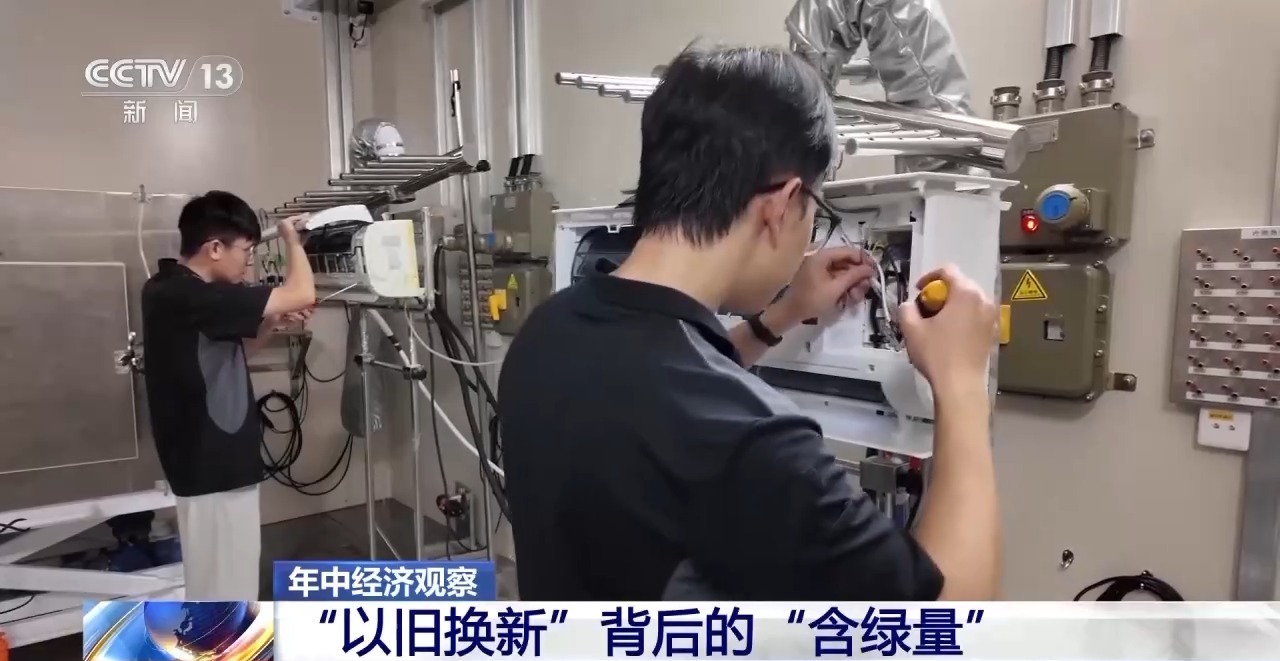
年中经济观察|感受“以旧换新”背后的“含绿量”
Yang Shi Xin Wen Ke Hu Duan· 2025-08-02 07:54
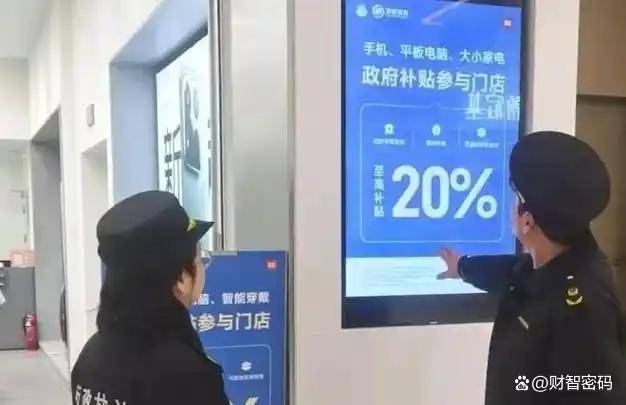
Group 1 - The core viewpoint of the article highlights the acceleration of China's green transformation in the economy, with a focus on the "old-for-new" policy that promotes low-carbon initiatives and encourages the adoption of energy-efficient appliances [1][12][19] - The "old-for-new" policy has led to significant energy savings for consumers, with new air conditioning units demonstrating a drastic reduction in energy consumption compared to older models, saving consumers approximately $943 million annually [7][9][19] - The shift towards energy-efficient products is evident as manufacturers are increasingly focusing on producing first-level energy efficiency appliances, with a reported 70% of television products shipped being of this category [16][18] Group 2 - The article discusses the impact of government subsidies on the adoption of energy-efficient appliances, with first-level energy efficiency products receiving a 20% subsidy and second-level products a 15% subsidy, driving both consumer and manufacturer engagement [14][19] - Equipment upgrades in traditional industries such as steel and cement are being supported by a special long-term national bond fund of 200 billion yuan, facilitating energy-saving transformations and enhancing green productivity [19][25] - The implementation of smart mining projects and energy-efficient upgrades in mining operations has resulted in significant reductions in energy consumption and increased production efficiency, showcasing the benefits of technological advancements in traditional sectors [25][27]
“国补”再注资690亿!10月第四批以旧换新资金即将下达,引爆下半年消费热潮
Sou Hu Cai Jing· 2025-08-02 07:00
Core Viewpoint - The "consumption upgrade battle" is entering its final sprint phase, with the full allocation of 300 billion yuan in special government bonds aimed at stimulating consumption, providing strong momentum for the market in the second half of the year [1][14]. Group 1: Economic Stimulus Plan - The unprecedented economic stimulus plan began in early 2025, with funds allocated in four batches, totaling 300 billion yuan, specifically targeting consumption enhancement [3]. - The first two batches of 162 billion yuan were completed in January and April, while the third batch of 69 billion yuan was fully allocated by the end of July [3]. - This phased funding approach helps avoid market volatility and resource waste, ensuring precise economic support [3]. Group 2: Consumption Data and Trends - As of July 16, the policy has significantly boosted sales in various sectors, with household appliance sales showing notable growth [5]. - Specific growth rates include a 24.1% increase in communication equipment, 25.4% in cultural and office supplies, and 22.9% in furniture, contributing to a 5% year-on-year increase in total retail sales of consumer goods [5]. - Approximately 30 yuan of every 100 yuan spent on household appliances is attributed to policy stimulation [5]. Group 3: Regional Implementation and Consumer Engagement - The implementation of the policy varies by region, with local authorities encouraged to optimize subsidy distribution and ensure equitable use of funds [5]. - Consumers are advised to stay informed about local announcements to take full advantage of policy benefits [5]. Group 4: Market Outlook and Consumer Behavior - The upcoming traditional promotional periods, such as "Golden September and Silver October," are expected to align with policy benefits, further driving consumption growth [5][12]. - There is a significant potential for demand in the home appliance sector, particularly for replacement purchases, as current sales volumes remain low compared to existing appliance stock [10]. - Companies in the home appliance sector are accelerating innovation and enhancing product features to meet rising consumer demand [8].
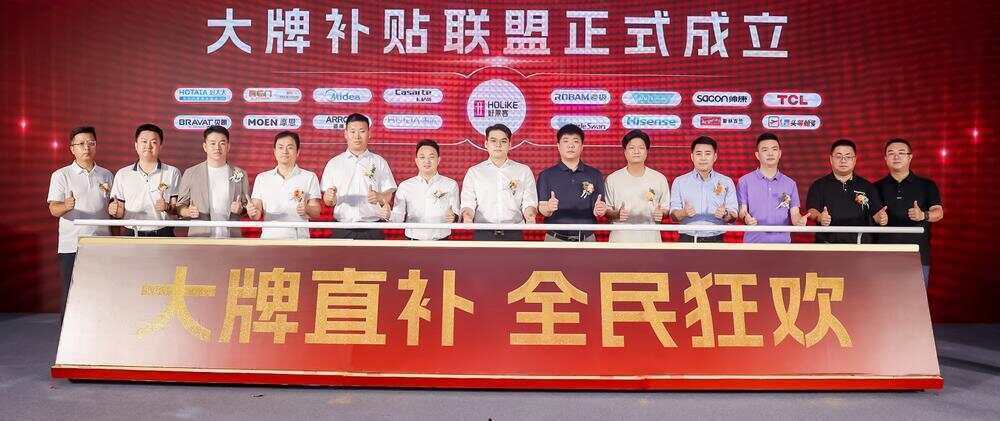
家居行业16家头部品牌在广州成立“大牌补贴联盟”
Sou Hu Cai Jing· 2025-08-02 05:26
Group 1 - The National Development and Reform Commission has announced the completion of the third batch of 69 billion yuan in special bonds to support the "old for new" consumption policy, with plans to distribute another 69 billion yuan in October, aiming to fulfill the annual target of 300 billion yuan [1] - A "Big Brand Subsidy Alliance" has been formed by local custom home furnishing company Haoleke and 16 leading brands, aiming to provide additional quality subsidies to consumers, creating a new consumption promotion model driven by government guidance and enterprise leadership [1][3] - The establishment of the alliance signifies a shift in the home furnishing industry from individual competition to collaborative development, potentially leading to a demonstration effect that encourages more companies to participate in promoting high-quality industry development [3] Group 2 - The home furnishing market is undergoing structural changes, with consumers increasingly demanding quality, while issues such as price transparency and insufficient funding remain prevalent [3] - Data from Douyin indicates that quality, practicality, and brand are the three core factors influencing consumer decisions in the home furnishing sector [3] - The government plans to introduce supporting policies focusing on environmental standards, consumer protection, and rights maintenance to promote the standardized development of the industry [3]
31省份消费版图
2 1 Shi Ji Jing Ji Bao Dao· 2025-08-02 04:30
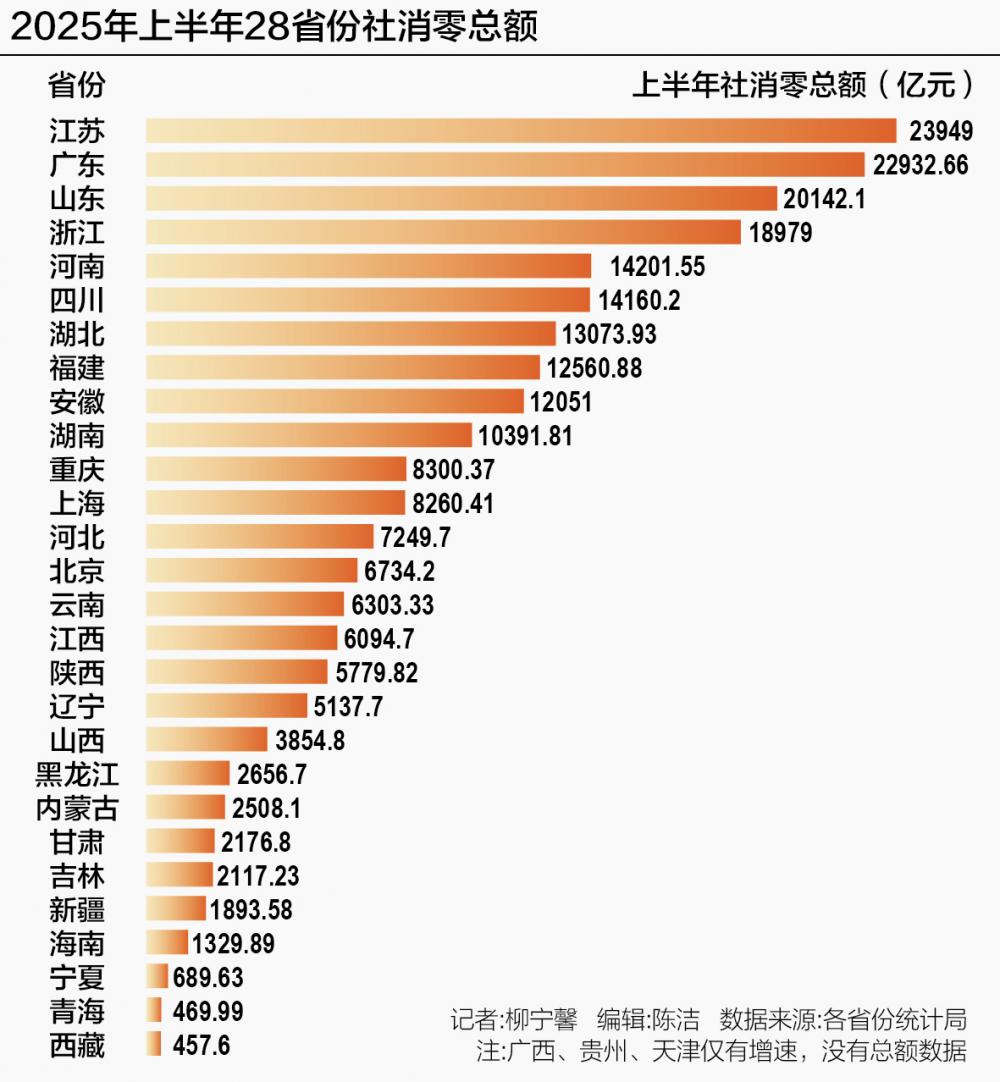
Core Insights - Domestic demand contributed 68.8% to China's GDP growth in the first half of the year, highlighting its role as the main driver of growth [1] - The consumption reports from 31 provinces indicate the initial effectiveness of strategies aimed at expanding domestic demand [1] Consumption Growth - The top ten provinces by total retail sales of consumer goods (社消零) in the first half of the year are Jiangsu, Guangdong, Shandong, Zhejiang, Henan, Sichuan, Hubei, Fujian, Anhui, and Hunan, with Jiangsu, Guangdong, and Shandong exceeding 2 trillion yuan [1][5] - 19 provinces outperformed the national retail sales growth rate of 5%, with 11 provinces achieving growth rates of at least 6%, led by Hainan at 11.2% [1][5] - Hainan's total retail sales reached 1329.89 billion yuan, growing 11.2% year-on-year, with significant growth in automobile sales, particularly in new energy vehicles [5][6] Regional Performance - Jiangsu, Guangdong, and Shandong are the top three provinces in retail sales, with Jiangsu leading at 23949 billion yuan, followed by Guangdong at 22932.66 billion yuan and Shandong at 20142.1 billion yuan [5][6] - The rankings of the top ten consumption provinces have shifted, with Fujian surpassing Anhui to become the eighth largest [6] Consumption Drivers - The main drivers of consumption growth include trade-in policies and the rise of online shopping, with structural factors such as effective domestic demand policies and rapid growth in e-commerce playing significant roles [9][10] - In Fujian, the implementation of trade-in policies and online consumption led to a total retail sales figure of 12560.88 billion yuan, with a growth rate of 6% [10] Future Outlook - The second half of the year is expected to focus on emerging consumption and service consumption, with many provinces planning to enhance trade-in policies and promote service consumption activities [2][11] - The government plans to increase fiscal support for trade-in subsidies to 300 billion yuan, potentially driving an additional 2 trillion yuan in consumption [11] Service Consumption Trends - New consumption hotspots are emerging, particularly in technology and high-quality exhibitions, which are expected to drive service consumption [12][13] - Various provinces are implementing specific actions to enhance service consumption, including cultural tourism and sports events [13][14]
南昌市打出财政“组合拳”激活消费新动能
Sou Hu Cai Jing· 2025-08-01 16:11
Group 1 - The city is implementing a more proactive fiscal policy to stimulate consumption and promote high-quality development, focusing on expanding domestic demand [1] - By 2025, the city plans to expand its consumption upgrade initiatives to include mobile and 3C digital products, in addition to existing categories like automobiles and home appliances [1] - In the first half of the year, the city secured 8.81 billion yuan in special long-term bonds and provincial matching funds, with 7.25 billion yuan already disbursed in subsidies, leading to significant increases in sales across various sectors [1] Group 2 - A budget of 46.6 million yuan has been allocated for the "Car Purchase Hongcheng" and "Shopping Hongcheng" initiatives, resulting in a notable increase in foot traffic in key commercial areas [2] - An additional 13 million yuan has been set aside to support local dining events, enhancing the visibility of local restaurant brands [2] - The city is fostering the "Four First Economy" by attracting 50 new stores and developing 30 "quarter-hour convenient living circles," with a focus on integrating urban and rural commerce [2]