
创新药

Search documents
西部证券晨会纪要-20251230
Western Securities· 2025-12-30 03:51
Group 1: Company Overview - The report focuses on 康宁杰瑞生物-B (9966.HK), which specializes in the development, production, and commercialization of innovative biopharmaceuticals in the oncology field, leveraging various core technology platforms [4][6] - The company has developed a differentiated pipeline that includes single-domain antibodies, bispecific antibodies, and antibody-drug conjugates (ADCs), showcasing international competitiveness [4][5] Group 2: Product Pipeline and Commercialization - The commercialization of 安尼妥单抗 injection is imminent, targeting 2L+HER2+GC treatment and providing better clinical options for 1L/newly diagnosed HER2+ breast cancer patients [4][5] - The first listing application for 安尼妥单抗 for HER2+ gastric cancer has been accepted by NMPA, with expectations for approval within 2026, marking the beginning of a commercialization phase [4][5] - Multiple ongoing clinical trials for various indications, including 1L HER2+ breast cancer and HER2+ gastric cancer, indicate significant potential for blockbuster products [4][5] Group 3: Financial Projections - Revenue forecasts for 康宁杰瑞 are projected at 432 million, 484 million, and 596 million yuan for 2025, 2026, and 2027 respectively, reflecting year-on-year growth rates of -32.5%, 12.1%, and 23.0% [6] - The current price-to-sales (PS) ratios are estimated at 20.6x, 18.4x, and 14.9x for the respective years, indicating substantial upside potential due to effective drug commercialization and clinical data disclosures [6] Group 4: Industry Overview - The report highlights a positive macroeconomic environment for the non-ferrous metals industry, with significant price increases in metal commodities driven by supply constraints and favorable economic indicators [7][10] - The U.S. GDP for Q3 exceeded expectations, with a year-on-year growth rate of 4.3%, supporting consumer spending despite inflation and employment concerns [7][8] - The industrial added value for large-scale industries in China is expected to grow by 5.9% in 2025, indicating a robust manufacturing sector [9]
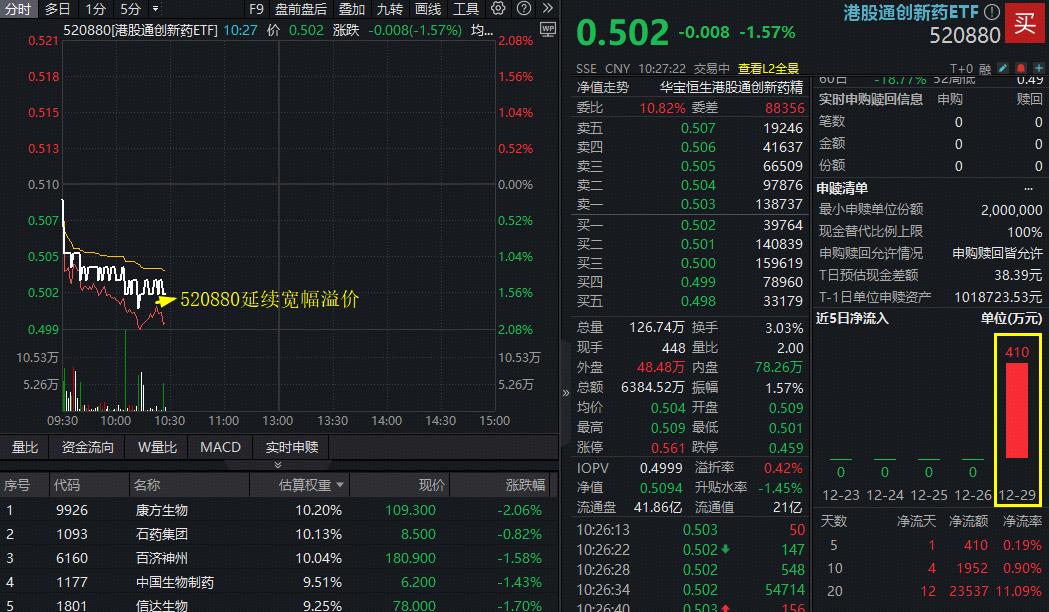
ETF盘中资讯|乐观BD预期退潮?港股通创新药ETF(520880)创5个半月新低!场内延续宽幅溢价,机构:基本面无虞
Jin Rong Jie· 2025-12-30 02:53
权重龙头股呈普跌态势,康方生物、科伦博泰生物-B跌超2%,百济神州、中国生物制药、信达生物、三生制药等集体跌逾1%。 1、纯粹,全面。不含CXO,纯正创新药!全面覆盖创新药研发类公司。 2、龙头占比大。前十大创新药龙头权重超72%,表征创新药硬核力量。 3、风险更可控。对流动性较差的成份股强制降权,有力管控尾部风险。 | | | 港股通创新药ETF (520880) 标的指数 | | | --- | --- | --- | --- | | | | 前十成份股权重高达72.57%,龙头优势显著 | | | 代码 | 简称 | 权重(%) | 总市值(亿港元) | | 6160.HK | 百济神州 | 11.51 | 3,070 | | 1801.HK | 信达生物 | 10.19 | 1,613 | | 1177.HK | 中国生物制药 | 9.47 | 1,323 | | 9926.HK | 康方生物 | 8.99 | 1,132 | | 1093.HK | 石药集团 | 8.39 | 911 | | 1530.HK | 三生制药 | 8.32 | 760 | | 3692.HK | 翰森制药 | 6.63 ...

12月29日港股通创新药ETF南方(159297)份额增加500.00万份
Xin Lang Cai Jing· 2025-12-30 01:10
Group 1 - The Hong Kong Stock Connect Innovative Drug ETF (Southern, 159297) experienced a decline of 1.96% with a trading volume of 47.07 million yuan on December 29 [1] - The fund's shares increased by 5 million, bringing the total shares to 1.815 billion, with an increase of 186 million shares over the past 20 trading days [1] - The latest net asset value of the fund is calculated to be 1.455 billion yuan [1] Group 2 - The performance benchmark for the Hong Kong Stock Connect Innovative Drug ETF is the National Index for Hong Kong Stock Connect Innovative Drugs, adjusted for valuation exchange rates [1] - The fund is managed by Southern Fund Management Co., Ltd., with fund managers Zhang Qisi and Ye Zhenan [1] - Since its establishment on September 12, 2025, the fund has reported a return of -19.85%, with a one-month return of -10.93% [1]
【医药】口服司美格鲁肽减肥适应症获批,相关密集催化有望推动产业发展——行业跨市场周报(叶思奥 /吴佳青/黄素青/黎一江/曹聪聪)
光大证券研究· 2025-12-29 23:04
Core Viewpoint - The oral weight loss drug sector is entering a critical commercialization phase, with significant regulatory approvals and partnerships indicating strong market potential and demand for innovative treatments [4][5][6]. Group 1: Recent Developments in Oral Weight Loss Drugs - On December 23, 2025, the FDA approved Novo Nordisk's oral semaglutide for chronic weight management, marking a significant milestone for oral GLP-1 peptides [4]. - Eli Lilly's management anticipates that the oral small molecule weight loss drug orforglipron will likely receive approval by March 2026, potentially becoming the second approved oral weight loss medication [4]. - Recent data releases include Structure's report on aleniglipron, which showed a 11.3% weight loss in the 120mg dose group and 15.3% in the 240mg dose group after 36 weeks [4]. Group 2: Industry Partnerships and Strategic Moves - On December 9, 2025, Pfizer announced an exclusive collaboration with YaoPharma for the oral small molecule GLP-1R agonist YP05002, involving a $150 million upfront payment and up to $1.935 billion in milestones, indicating strong interest from multinational pharmaceutical companies in oral weight loss products [5]. - Shijiazhuang Pharmaceutical Innovation announced the establishment of a joint venture focused on innovative metabolic drug development, highlighting the recognition of the significant value in GLP-1 related metabolic disease medications [6]. Group 3: Market Trends and Valuation Recovery - The pharmaceutical and biotechnology sector has seen a recovery in valuation, with the PE ratio stabilizing and increasing since Q1 2025, driven by macroeconomic conditions and supportive policies for innovative drugs [7]. - The global trend of returning to a rate-cutting environment, alongside increasing healthcare spending due to aging populations, is expected to expand the global demand for pharmaceuticals, particularly benefiting China's pharmaceutical industry [8]. Group 4: Investment Themes in Innovation - The investment focus is categorized into three phases: "0→1" for breakthrough technologies in innovative drugs, "1→10" for clinical validation of high-quality domestic innovative drugs, and "10→100" for leveraging China's efficiency in the pharmaceutical supply chain [9]. - The acceleration of business development (BD) for innovative drugs and the rise of high-end medical devices and consumables are seen as promising investment opportunities [9].




创新药起飞,健康更有保障…… 盘点2025年改写国人健康答案的十大关键词
Mei Ri Jing Ji Xin Wen· 2025-12-29 12:33
Group 1 - The core viewpoint of the article highlights the significant growth and transformation in China's pharmaceutical industry, particularly in the biopharmaceutical sector, with a notable increase in the number of innovative drugs approved for market entry [1][4]. - In 2025, the number of innovative drugs approved in China reached 69, a substantial increase from 48 in the previous year, indicating a surge in innovative research and development [1][4]. - The total amount of external licensing transactions in China's pharmaceutical sector reached $92.03 billion in the first three quarters of 2025, and with additional agreements, it surpassed $100 billion, averaging $270 million per day in international capital investment [4][27]. Group 2 - The government work report in March 2025 emphasized the importance of innovative drugs by introducing the concept of an "innovative drug directory," which supports the development of innovative pharmaceuticals [5][6]. - The rapid approval of two new Alzheimer's drugs in China, namely Donanemab and Lecanemab, reflects the industry's ability to address significant health challenges, with the former being approved just five months after its U.S. approval [8][9]. - The collaboration between 3SBio and Pfizer, amounting to $6.05 billion, marked a significant milestone for Chinese innovative drugs entering international markets [10][11]. Group 3 - The introduction of a 30-day review and approval system for clinical trial applications by the National Medical Products Administration in September 2025 significantly accelerated the drug development process [18][19]. - The clinical data presented by Baillie-Tianheng at the 2025 European Society for Medical Oncology (ESMO) conference showcased impressive efficacy and safety, enhancing China's reputation in the global pharmaceutical arena [20][21]. - The inclusion of the HPV vaccine in the national immunization program signifies a major advancement in public health, particularly for women's health [22][23]. Group 4 - The release of the first version of the commercial health insurance innovative drug directory by the National Healthcare Security Administration aims to enhance the accessibility of innovative drugs through a dual-channel approach of insurance and commercial health coverage [24][25]. - By October 2025, the total amount of external licensing for Chinese innovative drugs exceeded $100 billion, marking a significant shift in the global biopharmaceutical landscape [27][28]. - The article emphasizes the need for Chinese pharmaceutical companies to expand internationally, as the country transitions from being a major raw material supplier to a significant contributor to global innovation [32][33].


君实生物跌1.89%,成交额2.09亿元,后市是否有机会?
Xin Lang Cai Jing· 2025-12-29 11:44
Core Viewpoint - Junshi Biosciences is positioned as a comprehensive innovative pharmaceutical company with capabilities spanning drug discovery, clinical research, large-scale production, and commercialization, aiming for a global footprint while being rooted in China [2] Group 1: Company Overview - Junshi Biosciences was established on December 27, 2012, and went public on July 15, 2020, focusing on the research and commercialization of monoclonal antibody drugs and other therapeutic proteins [7] - The company's main revenue sources include drug sales (90.67%), technology licensing and royalties (8.74%), and technical services (0.59%) [7] - As of September 30, 2023, Junshi Biosciences reported a revenue of 1.806 billion yuan, a year-on-year increase of 42.06%, while the net profit attributable to shareholders was -596 million yuan, reflecting a year-on-year growth of 35.72% [8] Group 2: Product Pipeline and Innovations - The company has developed a robust product pipeline, including its core product, Toripalimab, which is the first domestically approved PD-1 monoclonal antibody in China, with 11 approved indications and one supplemental NDA under review [2] - Toripalimab is also the first innovative biopharmaceutical developed and produced in China to receive FDA approval, with approvals in multiple regions including the U.S., EU, and Australia [2] - Junshi Biosciences is advancing its self-developed Tifcemalimab, the world's first anti-BTLA monoclonal antibody entering clinical development, with two Phase III registration trials ongoing [2] Group 3: Collaborations and Future Developments - On October 27, 2023, Junshi Biosciences announced collaborations with several institutions, including Peking University and the Chinese Academy of Sciences, to develop a monkeypox recombinant protein vaccine [3] - The company’s subsidiary, JunTuo Biologics, is involved in the preclinical development of vaccines for monkeypox and Zika virus, indicating a focus on expanding its vaccine pipeline [3]

海翔药业参投公司创新药NWRD06注射液完成Ⅱ期临床首例受试者入组
Zhi Tong Cai Jing· 2025-12-29 08:21
Core Viewpoint - The announcement highlights the initiation of the Phase II clinical trial for NWRD06, a novel nucleic acid drug developed by Nuo Wei Biotechnology, which targets liver cancer recurrence post-surgery and represents a significant advancement in cancer treatment [1][2]. Group 1: Clinical Development - The Phase II clinical trial for NWRD06 has officially started at the Chinese Academy of Medical Sciences Cancer Hospital, with the first subject enrolled and treated [1]. - NWRD06 is the world's first therapeutic nucleic acid drug targeting the specific liver cancer marker GPC3, entering Phase II clinical trials [1]. Group 2: Mechanism and Potential - NWRD06 operates by activating specific T-cell immunity to eliminate tumor cells, showcasing an innovative mechanism that could potentially expand its application to early-stage cancer treatment [1]. - The drug may also have the potential to be combined with existing treatments for advanced liver cancer, such as interventional therapies and immune checkpoint inhibitors like PD-1 inhibitors [1]. Group 3: Clinical Value - The Phase I clinical study of NWRD06 has been completed, demonstrating its core value in precisely identifying tumor cells and addressing micro-lesions that are inaccessible to surgical treatment, while sparing normal tissues [2]. - The successful initiation of the Phase II trial marks a significant step towards clinical application, potentially offering a safe and non-invasive option for preventing recurrence in liver cancer patients, thereby improving survival rates [2].

海翔药业(002099.SZ)参投公司创新药NWRD06注射液完成Ⅱ期临床首例受试者入组
智通财经网· 2025-12-29 08:19
Core Viewpoint - The company Haishang Pharmaceutical (002099.SZ) has announced the initiation of the Phase II clinical trial for its innovative nucleic acid drug NWRD06, aimed at preventing postoperative recurrence of liver cancer, marking a significant advancement in cancer treatment [1][2]. Group 1 - Haishang Pharmaceutical's subsidiary, Beijing Guoxin Zhongshu Investment Management Co., has informed the company about the participation in the clinical trial of NWRD06, which has successfully enrolled its first subject [1]. - NWRD06 is the world's first therapeutic nucleic acid drug targeting the specific liver cancer marker GPC3, currently in Phase II clinical trials, showcasing an innovative mechanism that activates specific T-cell immunity to eliminate tumor cells [1]. - The potential applications of NWRD06 may extend beyond postoperative recurrence to early-stage cancer treatment and possibly even cirrhosis, indicating a biologically rational expansion of its indications [1]. Group 2 - The Phase I clinical study of NWRD06 has been completed at the Chinese Academy of Medical Sciences Cancer Hospital, emphasizing its core value in precisely identifying tumor cells and addressing micro-lesions that are inaccessible to surgical treatment [2]. - The successful launch of the Phase II clinical trial and the enrollment of the first subject represent a significant step towards clinical application, potentially offering a safe and non-invasive option for postoperative liver cancer patients to prevent recurrence and improve survival rates [2].
跨国药企迎战略重构
2 1 Shi Ji Jing Ji Bao Dao· 2025-12-29 08:11
Core Insights - The pharmaceutical industry is experiencing significant performance divergence among major multinational companies in 2025, with some companies thriving while others face substantial challenges [1][2][3][4]. Financial Performance - Novo Nordisk reported Q3 2025 revenues of 74.976 billion Danish Krone (approximately $11.276 billion), a year-on-year increase of 11%, with total revenues for the first three quarters reaching 229.92 billion Danish Krone (approximately $34.58 billion), up 15% [1]. - Key products such as Ozempic, Rybelsus, and Wegovy contributed significantly to Novo Nordisk's revenue, with Wegovy showing a remarkable growth of 54% [1]. - Merck's pharmaceutical revenue for the first three quarters of 2025 was $43.299 billion, with a 68% decline in revenue from China, dropping to $1.452 billion [2]. - Eli Lilly achieved a remarkable turnaround with Q3 revenues of $17.6 billion, a 54% increase year-on-year, driven by the success of its GLP-1 drug [3]. - Pfizer was the only company in the top 10 to experience a decline in both revenue and profit, with Q3 revenues of $16.654 billion, down 6% year-on-year [4]. Strategic Adjustments - Major pharmaceutical companies are actively seeking solutions to address strategic challenges, including layoffs and business divestitures, with 190 layoffs reported in the first three quarters of 2025 [2][9]. - Companies like Merck and Novo Nordisk are implementing significant cost-cutting measures, with Merck aiming to save $3 billion by 2027 and Novo Nordisk planning to cut approximately 9,000 jobs [2][9]. - The trend of divesting mature assets is becoming common, with companies opting to sell off non-core or underperforming business units to focus on innovation [7][9]. Market Dynamics - The Chinese market is no longer a guaranteed success for multinational pharmaceutical companies, with significant performance disparities emerging [5][12]. - The ongoing "patent cliff" is a critical concern, with many companies facing over 20% of their revenue at risk due to expiring patents [5]. - The competitive landscape is shifting, with local investment firms increasingly acquiring mature products from multinational companies, allowing for more localized management and decision-making [8][9]. Future Outlook - The future of multinational pharmaceutical companies will depend on their ability to innovate rapidly, adapt to local market policies, and manage patent expirations effectively [12][14]. - Companies that can successfully transition to innovation-driven models and integrate into China's biopharmaceutical ecosystem are likely to thrive [12][14]. - The restructuring of global pharmaceutical companies is creating both challenges and opportunities for local firms, as they may benefit from the divestiture of mature products and increased collaboration on early-stage innovations [14].


跨国药企迎战略重构|记“医”2025
2 1 Shi Ji Jing Ji Bao Dao· 2025-12-29 08:06
Core Insights - The pharmaceutical industry is experiencing significant performance divergence among major multinational companies in 2025, with some achieving remarkable growth while others face substantial declines [1][4][6]. Financial Performance - Novo Nordisk reported Q3 2025 revenues of 74.976 billion Danish Krone (approximately $11.276 billion), a year-on-year increase of 11%, with total revenues for the first three quarters reaching 229.92 billion Danish Krone (approximately $34.58 billion), up 15% [1]. - Merck's pharmaceutical business revenue for the first three quarters of 2025 was $43.299 billion, with a 68% year-on-year decline in revenue from China, dropping to $1.452 billion [2]. - Eli Lilly achieved a Q3 2025 revenue of $17.6 billion, a 54% increase from $11.439 billion in the same period last year, with total revenues for the first three quarters reaching $45.887 billion, up 46% [3]. - Pfizer's Q3 2025 total revenue was $16.654 billion, a 6% decrease from $17.702 billion year-on-year, with a 55% drop in revenue from its COVID-19 oral drug Paxlovid [4]. Strategic Adjustments - Major pharmaceutical companies are actively seeking solutions to address strategic challenges, including layoffs and business divestitures, with 190 layoffs reported in the biopharmaceutical sector in the first three quarters of 2025 [2][9]. - Companies like Merck and Novo Nordisk are implementing significant cost-cutting measures, with Merck aiming to save $3 billion by 2027 and Novo Nordisk targeting an annual cost saving of 8 billion Danish Krone [9]. - The trend of divesting mature assets is becoming common, with investment firms stepping in as buyers, indicating a shift in the operational landscape of the pharmaceutical industry in China [7][8]. Market Dynamics - The Chinese market is no longer a guaranteed profit zone for multinational pharmaceutical companies, with significant performance disparities emerging among leading firms [5][12]. - The ongoing "patent cliff" is a critical concern, with many companies facing over 20% revenue exposure to patent expirations in the next three years, impacting their financial stability [4][5]. - The competition in the pharmaceutical sector is intensifying, necessitating companies to adapt quickly to local market policies and innovate their product pipelines to maintain growth [6][12]. Future Outlook - The future of multinational pharmaceutical companies will heavily rely on their innovation capabilities, local market strategies, and management of patent expirations [12][15]. - Companies that successfully transition to innovation-driven models and establish strong positions in emerging therapeutic areas are likely to thrive, while those unable to adapt may face ongoing growth pressures [12][15]. - The restructuring of global pharmaceutical strategies is expected to accelerate, focusing on both downsizing and investing in innovative fields, such as gene and cell therapies [9][10].