
A股市场

Search documents
沪指盘中触及3680.47点,创2021年12月14日以来新高
Bei Jing Shang Bao· 2025-08-13 02:07
Core Viewpoint - The A-share market experienced a collective rise in the three major stock indices, with the Shanghai Composite Index reaching a new high since December 14, 2021, indicating positive market momentum [1] Group 1 - The three major stock indices opened higher on August 13, with significant upward movement observed shortly after the market opened [1] - The Shanghai Composite Index hit a peak of 3680.47 points, surpassing the previous high of 3674.4 points recorded on October 8, 2024 [1] - As of the report, the Shanghai Composite Index, Shenzhen Component Index, and ChiNext Index recorded gains of 0.34%, 0.66%, and 1.15% respectively, closing at 3678.31 points, 11426.57 points, and 2437.12 points [1]
创3年多以来新高!沪指突破3674.40点
Guan Cha Zhe Wang· 2025-08-13 02:03
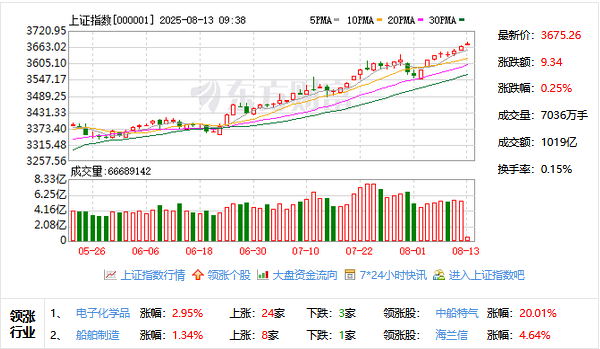
8月13日,A股三大指数集体高开,截至上午9点38分,沪指报3675.26点,涨0.25%,突破2024年10月8 日的高点,为2021年12月17日以来的新高。 此外,深成指报11393.11点,涨0.37%;创指报2427.48点,涨0.75%,沪深京三市上涨个股近3000只。 ...

通信半导体领涨,A股震荡上行
Zhongyuan Securities· 2025-08-12 11:08
Market Overview - On August 12, the A-share market opened high and experienced slight fluctuations, with the Shanghai Composite Index facing resistance around 3667 points[2] - The Shanghai Composite Index closed at 3665.92 points, up 0.50%, while the Shenzhen Component Index rose 0.53% to 11351.63 points[7] - Total trading volume for both markets reached 1,905.6 billion yuan, above the median of the past three years[3] Sector Performance - Semiconductor, communication equipment, consumer electronics, and electronic components sectors performed well, while small metals, aerospace, biopharmaceuticals, and cement materials lagged[3] - Over 50% of stocks in the two markets declined, with multi-financial, electronic chemicals, gas, and shipping sectors leading in gains[7] Valuation and Investment Strategy - The average P/E ratios for the Shanghai Composite and ChiNext indices are 14.96 times and 42.36 times, respectively, indicating a suitable environment for medium to long-term investments[3] - The market is expected to focus on technology growth and cyclical manufacturing as primary investment themes moving forward[3] Economic Context - China's economy continues to show moderate recovery, driven by consumption and investment[3] - The balance of margin financing has surpassed 2 trillion yuan, indicating potential for increased financing activity in a low-interest-rate environment[3] Risk Factors - Potential risks include unexpected overseas economic downturns, domestic policy changes, and macroeconomic disturbances[4]
加速配置人民币资产 外资看好A股长期机遇
Xin Hua Wang· 2025-08-12 06:31
Core Viewpoint - The A-share market has shown signs of valuation advantages, leading many foreign institutions to adopt a more positive outlook on future investments in Chinese assets [2][4]. Market Performance - As of February 21, the Shanghai Composite Index closed at 3490.61 points, down 0.001%, while the Shenzhen Component Index rose 0.09% to 13471.16 points, and the ChiNext Index fell 0.79% to 2804.60 points [1]. - Since the beginning of 2022, the three major indices have been in a downward trend, with declines of 4.10%, 9.33%, and 15.59% respectively [2]. Foreign Investment Sentiment - Foreign institutions are increasingly optimistic about the A-share market, citing its valuation advantages and potential for recovery in the economy from the second quarter of 2022 [2]. - Analysts from Goldman Sachs noted that factors such as capital market reforms and the expansion of investment channels are enhancing the investability of A-shares for overseas investors [2]. Valuation and Investment Opportunities - The dynamic price-to-earnings ratio of the CSI 300 Index was reported at 12.59 times, indicating a relatively low valuation compared to the S&P 500 Index's approximately 25 times [4]. - As of February 21, northbound capital continued to show a net buying trend, with a cumulative net purchase of 48.24 billion yuan, marking 16 consecutive months of net inflows [4]. Economic Fundamentals - The manufacturing PMI for January was reported at 50.1%, indicating stability in the economy, with several indices showing month-on-month recovery [5]. - The National Development and Reform Commission emphasized the resilience and potential of China's economic growth, supporting the case for foreign investment [5]. Policy Support - Recent policies aimed at stabilizing industrial growth are expected to enhance investment in the manufacturing sector and consumer spending [6]. - Analysts believe that the ongoing implementation of supportive policies will positively impact market expectations and growth prospects [6]. Risk Aversion and Market Dynamics - The A-share market is perceived as a safe haven amid global monetary tightening, attracting global funds due to its low valuations and unique monetary expansion capabilities [6].
6月份A股投资者数量环比增10.6%
Xin Hua Wang· 2025-08-12 06:25
Group 1 - The A-share market has shown positive signals since June, with a month-on-month increase in the number of new investors and accelerated inflow of northbound funds [1][2] - In June, the number of new investors reached 1.3303 million, a month-on-month increase of 10.6%, marking a recovery after two consecutive months of decline [1] - As of the end of June, the total number of A-share investors was 20.62391 million, with a cumulative increase of 8.8305 million new investors in the first half of the year [1] Group 2 - Northbound capital inflow has accelerated, with a net purchase of 75.36 billion yuan year-to-date, and 72.96 billion yuan in June alone [2] - The influx of foreign capital is attributed to concerns over the U.S. economy and high inflation, making the A-share market an attractive option due to its low valuation and economic recovery [2] - The balance of margin trading has also increased significantly, surpassing 1.6 trillion yuan, indicating a rise in market activity and investor confidence [2][3] Group 3 - The improvement in the two-margin business reflects a notable increase in market confidence, suggesting that A-shares may maintain a strong performance [3] - The rise in margin trading indicates that investors are willing to increase leverage in response to positive market sentiment and potential profit opportunities [3] - The overall market environment is conducive to a more significant upward trend, although caution is advised for retail investors regarding leverage usage [3]
开盘:三大指数小幅高开 电子化学品板块涨幅居前
Xin Lang Cai Jing· 2025-08-12 02:11
Group 1 - The core viewpoint indicates that the A-share market is experiencing a collective rise, with the ChiNext index leading the gains, and the Shanghai Composite Index successfully breaking through a previous resistance level of 3650.50 points, suggesting a relatively strong short-term market condition [2] - The market is characterized by abundant liquidity and high trading sentiment, indicating a healthy overall operational state, with short-term fluctuations potentially building momentum for future trends [2] - Structural differentiation is observed in the market, with previously popular sectors at relatively high levels, suggesting that the pace of sector rotation may accelerate, making it crucial to seize structural opportunities [2] Group 2 - The A-share market is showing a "volume and price rise" trend, continuing its upward trajectory, with short-term potential for further gains, although attention should be paid to the rotation rhythm among thematic sectors [2] - Mid-term factors such as anti-involution policies and demand-side policies are expected to significantly influence market heights, with a recommendation to maintain a high equity market position as long as the broad market index does not show significant breakdowns [2]
3600点之后:聊聊当下权益投资的锚点、策略与心态
Sou Hu Cai Jing· 2025-08-12 01:36
Group 1 - The market has remained above the 3600-point mark for 10 trading days since July 29, indicating a strong upward momentum [1][2] - The A-share market has shown resilience and cyclical behavior, moving from the explosive growth in 2022 to steady gains in recent months [3] - The mixed equity fund index has gained over 16% this year, marking the first time since 2021 that it has surpassed this threshold, although it remains below the historical high of 20% [5] Group 2 - The current position of the Shanghai Composite Index at 3600 points carries significant psychological and technical implications, being close to last year's high of 3674 points and the ten-year peak of 3731 points [6] - The overall valuation of A-shares is at a historically moderate to high level, with the index's PE ratio at 15.69 times and PB ratio at 1.42 times, which is lower than major US indices [9][11] Group 3 - The recent increase in market capitalization and the return of the financing balance to 2 trillion yuan indicates a growing market interest, reminiscent of the last bull market a decade ago [14] - The current leverage level in the market is still below half of the peak seen in 2015, suggesting that there is room for further capital inflow without overheating [16] Group 4 - Investors are showing varied responses at this market juncture, with some considering profit-taking while others are waiting for breakeven [17][18] - Investment strategies should focus on matching industry exposure with personal risk tolerance and aligning investment styles with market trends [20][21] Group 5 - The market is expected to experience fluctuations, and a long-term investment perspective is essential as the capital market's importance grows [27][29] - Investors should focus on understanding market dynamics and their own limitations, emphasizing the value of time in investment [30]
财经夜行线0811丨A股集体上扬 沪指再创新高 投资者聚焦本周美俄首脑会晤
Di Yi Cai Jing· 2025-08-12 01:10
Market Overview - The A-share market saw all three major indices open lower but recover, with the Shanghai Composite Index briefly surpassing the 3650 mark, closing up 0.34% at 3647.55 points, marking a new high for the year and achieving six consecutive days of gains [1] - Senior analyst Wang Lu from Shenwan Hongyuan Securities suggests that the market is likely to continue its rebound, advising investors to follow the main trends to identify opportunities [1] Automotive Industry - According to data released by the China Association of Automobile Manufacturers (CAAM), domestic automobile production and sales in July reached 2.591 million and 2.593 million units, respectively, representing month-on-month declines of 7.3% and 10.7%, but year-on-year increases of 13.3% and 14.7% [1] - CAAM attributes the month-on-month decline in production and sales to the traditional off-season in the automotive market, but anticipates stable performance in the domestic automotive market in the second half of the year, supported by the ongoing implementation of vehicle replacement policies [1] Global Market Insights - A meeting between U.S. President Trump and Russian President Putin is scheduled for August 15 in Alaska, focusing on the Ukraine issue, which may provide new possibilities for resolving the ongoing conflict that has persisted for three years [1] - The upcoming summit raises questions about the discussions that will take place and whether there is a potential for an end to the Russia-Ukraine conflict [1]
【机构策略】预计A股市场中枢有望稳步抬升
Zheng Quan Shi Bao Wang· 2025-08-12 01:01
东莞证券认为,周一,A股市场集体上涨,创业板指领涨。从技术分析角度看,上证指数成功突破了之 前的压力位3650.50点,5日均线和10日均线形成金叉,且指数位于多条均线上方,显示出短期市场处于 相对强势的状态;深证成指已经进入了上升通道,短期内可能会继续冲击之前的高点。当前A股市场内 流动性相对充裕,交投情绪仍处于高位,整体运行状态较为健康,短期震荡或为后续行情积蓄动能。考 虑到当前市场呈现一定程度的结构分化,前期热门板块已处于相对高位,板块轮动节奏或进一步加快, 把握结构性机会将成为关键。从中长期维度审视,市场仍处于趋势性行情的中段阶段。伴随国内积极因 素的持续累积与发酵,股市驱动逻辑不断夯实,预计A股市场中枢有望稳步抬升。 财信证券认为,周一,A股市场呈现"量价齐升"的普涨行情,大盘继续处于震荡上行趋势中,短期仍有 反复冲高的动能,但需关注题材板块之间的轮动节奏。中期来看,反内卷政策及需求端政策将是影响市 场高度的重要因素,继续维持指数震荡偏强运行、投资容错率将提升、积极参与A股市场的判断,在市 场宽基指数并未明显破位时,可保持较高权益市场仓位,顺势而为。 中原证券认为,周一上证指数、深证成指、创业板指早 ...
A股超4100只股票上涨 上证指数创今年以来新高
Zhong Guo Zheng Quan Bao· 2025-08-11 23:31
Market Overview - On August 11, the A-share market experienced a significant increase, with a trading volume exceeding 1.8 trillion yuan, and the Shanghai Composite Index reached a new high for the year, briefly surpassing 3650 points [1] - The A-share market saw over 4100 stocks rise, with more than 80 stocks hitting the daily limit up [1] Liquidity and Financing - The recent strength in the A-share market is driven by liquidity, with both financing balance and margin trading balance continuing to grow. As of August 8, the margin trading balance was reported at 2009.516 billion yuan, with the financing balance at 1995.359 billion yuan [1] - On August 11, the net inflow of main funds into the CSI 300 was 11.181 billion yuan [1] Index Performance - On August 11, the Shanghai Composite Index opened high and closed at 3647.55 points, marking a new closing high for the year. The index reached a peak of 3656.85 points during the day [1] - The Shenzhen Component Index, ChiNext Index, Sci-Tech 50 Index, and North Securities 50 Index rose by 1.46%, 1.96%, 0.59%, and 1.18% respectively [1] Sector Performance - In the Shenwan first-level industry classification, the power equipment, communication, and computer sectors led the gains, increasing by 2.04%, 1.95%, and 1.94% respectively. The electronics sector also rose by 1.76%, indicating a strong performance across technology stocks [2]